Short Video Making Ideas: 10 Proven Formats for 2026
Other
A webinar, podcast episode, or interview can sit untouched on your channel while your team struggles to find something worthwhile for the next short post. The problem usually isn't a lack of ideas. It's that the strongest moments are buried inside material you've already recorded.
The best short video making ideas turn one clear moment into one clear job. A surprising statement can hook new viewers. A practical answer can teach. A customer story can build trust. A teaser can move someone from a feed to a full episode. You can also discover Forexyoutube for more video research and inspiration.
Short-form viewing is now a mainstream global habit. Ampere Analysis reported that 63% of the global online population uses algorithmic short-form video features daily, compared with 73% for general social-media apps. Daily short-form usage also exceeded broadcast television, long-form streaming, and gaming in the same analysis (Advanced Television).
The ten formats below are ordered from hook-first clips to conversion-focused assets. Each has different editing decisions, platform adaptations, and success metrics, so you can build a complete repurposing plan instead of publishing random excerpts.
1. The Cold-Open Hook Clip
Move the strongest line to the front. A cold-open clip takes the most surprising, emotional, or quotable moment from a long recording and places it in the first 1 to 3 seconds, then supplies enough context for the statement to make sense.
A podcast guest might begin with a provocative claim before explaining it. In an interview, the host's sharpest reaction can become the teaser, followed by the guest's answer. This works because the viewer encounters the payoff before deciding whether the conversation deserves attention.
Klap's AI hook detection can help surface high-tension moments buried deep in a transcript. Still, don't accept the first suggested segment automatically. A technically interesting line may depend on several minutes of setup, while a shorter sentence from the same recording may stand alone much better.
Use this editing sequence:
- Open with a complete statement: The first line should make sense without the original episode.
- Add a text duplicate: Restate the hook in bold on-screen text for viewers watching without sound.
- Remove dead air: Cut the pause, “um,” throat clearing, and explanatory lead-in before the key line.
- Create alternatives: Test two or three candidate openings from the same recording and keep the one with the strongest retention.
Practical rule: If the hook needs the viewer to know who the speaker is before it becomes interesting, it isn't ready for the first frame.
For more opening patterns, review these hook examples for short-form videos.

2. The Contrarian Hot-Take Clip
Find the sentence that challenges a popular belief, industry habit, or piece of common advice. A strong hot take creates tension immediately, but it also needs enough explanation to feel like a considered opinion rather than manufactured outrage.
A business podcast might feature a guest arguing against a widely repeated productivity rule. A marketing webinar might include a presenter explaining why a familiar SEO or advertising practice is outdated. These clips travel beyond the original audience because viewers don't need to know the full episode to understand the disagreement.
Context matters more here than in most formats. Without it, a clipped opinion can sound misleading or more extreme than the speaker intended. Put the setup in the caption and, when necessary, add a short text card before the statement.
Try this structure:
- Frame the belief: “Teams think X.”
- Deliver the challenge: Give the speaker's alternative view without a long introduction.
- Support the claim: Keep the explanation, example, or qualification that makes the opinion credible.
- Invite a response: End with a question such as “What would you add?”
Reply to thoughtful comments with additional clips from the same recording. That gives the original take a second life and lets you develop the debate without forcing one video to carry every argument. Track which subjects generate meaningful discussion, not just quick reactions, and build a topic log for future episodes.
A hot take that attracts comments but creates confusion may damage trust. A sharp opinion supported by a clear reason can position the speaker as someone worth following.
3. The One-Lesson How-To Breakdown
Cut a tutorial, product demonstration, or coaching session into single-purpose lessons. Don't compress an entire training into one frantic summary. Extract one useful skill per clip, name the outcome, and let the viewer finish with something they can apply immediately.
A coach can turn a workshop into a numbered sequence of tactical lessons. A software company can transform a webinar walkthrough into feature-specific videos. Each clip should answer one practical question, such as how to write a stronger opening line or where to find a particular setting.
Write the title around the result, not the method. “Get more replies with this one line” gives the viewer a reason to watch, while “Email tip” leaves the value unclear.
Use Klap's caption styling to emphasize the key term as it's spoken. For screen recordings, crop tightly around the active interface and enlarge small labels. A full desktop view often becomes unreadable on a phone, even when the original recording looked clear.

Publish the sequence in order and pin the first lesson to your profile. A viewer who discovers Part 4 should still have a simple path back to the beginning.
The format suits both discovery and retention. YouTube reported that Shorts reached 30 billion daily views and 1.5 billion monthly logged-in viewers by July 2022, while the number of daily first-time creators more than doubled between September 2020 and September 2021 after Shorts creation tools launched (YouTube). That audience scale makes concise, independently understandable lessons more useful than vague highlights.
Here's an example of the kind of tutorial pacing that works well:
<iframe width="100%" style="aspect-ratio: 16 / 9;" src="https://www.youtube.com/embed/y7Ci_H9bYEk" frameborder="0" allow="autoplay; encrypted-media" allowfullscreen></iframe>4. The Myth-Busting Q&A Clip
Pull a direct answer to a question your audience already asks. Q&A clips work especially well when the question contains a misconception, because the viewer immediately understands the problem and wants to verify the answer.
Start with the question on screen and, where possible, in the first spoken words. “Do you need a podcast mic?” is stronger than opening with a guest greeting. A title that resembles a real search query also gives the clip a clearer discovery angle.
Expert interviews, customer-support webinars, and live question sessions are full of this material. Keep a question bank from comments, direct messages, sales calls, and webinar Q&A sections. When a question appears repeatedly, look for the cleanest answer in your existing recordings before commissioning new footage.
“Answer the question first. Explain the exception second.”
Avoid cutting away the qualification that prevents the answer from becoming misleading. If the speaker says, “Usually, but not when...,” keep the second half. A short video that earns attention by giving an incomplete answer may create comments, but it won't necessarily create trust.
Use the description to point viewers toward the full episode, supporting resource, or product page. Measure whether the clip attracts relevant profile visits and follow-up questions, not only whether it receives broad feed distribution.
5. The Multi-Part Series with a Cliffhanger
Turn one compelling story or lesson into connected episodes. This format works when the source has a natural sequence, such as how a founder won a first customer, encountered a failure, and changed direction, or how a product moved through development stages.
Plan the arc before you cut. A strong series has a clear beginning, rising tension, and a useful resolution. Each part needs its own mini-payoff, even if the larger story remains unfinished. Ending on a random edit point feels manipulative and makes viewers less likely to return.
Use a recognizable system:
- Choose a series title: Keep the wording and visual treatment consistent.
- Number every part: Make the sequence obvious in the feed.
- Pin the beginning: New viewers need a simple entry point.
- Reference the next episode: Use the caption and spoken close to direct attention.
- Keep the schedule predictable: For example, publish every Tuesday and Thursday.
A cliffhanger should withhold the next development, not the basic meaning of the current clip. If Part 1 ends before the viewer understands the problem, the series feels like an incomplete excerpt. Give them a satisfying piece of the story, then leave a genuine reason to continue.
This format also gives you a useful editorial test. If you can't divide the source into distinct episodes without repeating the same setup, it probably works better as one complete short.
6. The Podcast Soundbite with Animated Captions
Give an audio-first moment a visual structure. A vertical podcast clip can combine a speaker frame, a waveform or other restrained visual accent, and captions that move in time with the words.
Captions are essential for silent viewing, but inaccurate captions are worse than plain captions. Review every generated line, especially names, technical terms, product names, and negations. One missing “not” can reverse the speaker's meaning.
Keep the design readable rather than decorative. Place text inside the central safe area so platform controls don't cover it. Use two lines at a time and roughly six to eight words on screen as a starting production specification. Highlight one brand color consistently instead of changing colors for every word.
A reliable caption workflow looks like this:
- Transcribe automatically: Use the generated captions as a draft.
- Correct meaning: Fix names, punctuation, and terms by listening to the audio.
- Match timing: Captions should appear with the spoken phrase, not several words afterward.
- Control emphasis: Highlight only the words that carry the main idea.
- Review on a phone: Desktop previews hide cropping and interface problems.
Mis-synced captions often cause early exits because viewers can't follow the rhythm of the conversation. A waveform can support the audio identity, but it shouldn't compete with the speaker's face or the central sentence.
For podcast-specific editing approaches, see this guide to podcast clips for TikTok.
7. The Top-3 Takeaways Listicle from Webinars
Extract three strong insights from a webinar, workshop, or presentation. You can combine them into one list video, or publish each takeaway as its own clip when the explanations need more room.
Listicles work because they set a clear expectation. “Three onboarding mistakes” tells viewers what they'll receive and how much remains. Make the promise specific, though. “Three fixes for a confusing signup flow” gives the editor and the audience a sharper target than “Three onboarding tips.”
Replace dense presentation slides with a speaker close-up, a large text statement, or a simple visual demonstration. Webinar slides often contain too much copy for a phone screen. Keep only the phrase that helps the viewer understand the point.
A strong structure is:
- Promise: State the three outcomes before the first takeaway.
- Separate: Give each point a clear visual or spoken transition.
- Explain: Include the reason behind each recommendation, not just the label.
- Close: Add a final card directing viewers to the complete webinar or a relevant resource.
Webinars often contain several useful angles, so don't assume the first three points are the strongest. Search the transcript for objections, memorable examples, and moments where the presenter changes from theory to application. Those sections usually make better clips than polished introductory slides.
For ways to extend the value of a webinar, explore these webinar marketing tips.
8. The Full-Episode Teaser Clip
Build a short bridge to a longer asset. A teaser should feature the strongest question, conflict, or surprising exchange from the episode, then end with a direct reason to watch the complete version.
Keep the edit focused. A teaser that includes five unrelated highlights may show variety, but it doesn't create anticipation. Choose one question the full episode answers and let every cut support that promise.
A podcast teaser can run before the full episode is published. A course creator can preview one useful moment from a longer lesson. A brand can show the problem and the beginning of the solution while reserving the full demonstration for the main asset.
Production details matter:
- Lead with the episode question: Don't open with a logo animation.
- Use a clear destination: Say “Full episode on YouTube” or “Link in bio” on screen.
- Coordinate timing: Publish the teaser shortly before the full episode so interest has somewhere to go.
- Track the handoff: Use UTM parameters or available platform link analytics to identify downstream clicks.
The distinction between a teaser and a standalone clip is intent. A standalone clip should satisfy the viewer even if they never watch anything else. A teaser can leave some information unresolved, but it must make the next step obvious and worthwhile.
9. The Customer Story and Testimonial Snippet
Cut the customer's problem, solution, and result into a compact narrative. Testimonials work best when the customer sounds like a person describing a real experience, not a spokesperson reading approved marketing copy.
Lead with the result when the result is verified and approved. A line such as “We cut production time in half” gives the viewer immediate context, then the rest of the clip can explain what changed. Don't manufacture a result or display a metric without permission and documentation.
Customer credibility comes from visible specificity. Add the speaker's name, role, and company when they've approved that presentation. Keep the customer's own phrasing in the captions, including natural pauses where they help the clip feel authentic.
Use an approval process that keeps publishing efficient:
- Get written permission: Confirm the platforms and intended use.
- Maintain an approved library: Store final clips, source footage, captions, and usage notes.
- Protect context: Don't remove a qualification that changes the customer's meaning.
- Match the audience: Use a customer story that resembles the prospect you want to reach.
A polished testimonial can still underperform if it sounds like an advertisement. The editor's job is to preserve the customer's voice while removing repetition, dead air, and unrelated setup. Put the actual experience ahead of brand graphics.
10. The Reaction or Commentary Overlay
Add your own analysis to an existing clip. A split-screen format can place the source footage on one side and your commentary on the other, but the value comes from the explanation, not from a silent reaction face.
A marketer might break down why a competitor's advertisement works. An educator might pair an industry clip with historical or technical context. In both cases, the audience should leave with an interpretation they couldn't get from the original footage alone.
Keep the source segment short and label it clearly. Use platform reaction or duet tools where available, and check the platform's current rules before publishing. Commentary should be substantial, specific, and relevant to the source material.
Your face isn't the analysis. Explain what viewers should notice, why it matters, and what they can apply.
Build the edit around three questions:
- What happened: Give enough source material for viewers to understand the moment.
- What does it mean: Identify the tactic, mistake, assumption, or pattern.
- What should viewers do: End with a practical conclusion or question.
A reaction can attract attention through novelty, but commentary earns the follow. Pin the strongest example so new visitors immediately understand what your account contributes.
Comparison of 10 Short-Video Ideas
| Item | Implementation complexity (🔄) | Resource requirements (⚡) | Expected outcomes (📊) | Ideal use cases (💡) | Key advantages (⭐) |
|---|---|---|---|---|---|
| The Cold-Open Hook Clip | Moderate 🔄, re-ordering + tight cut | Low–Moderate ⚡, AI hook detection, captions | High retention 📊, strong 3s hold & avg view | Interviews, podcasts, vlogs, webinars 💡 | Front-loads attention; scalable with AI ⭐ |
| The Contrarian Hot-Take Clip | Low 🔄, single opinion extraction | Low ⚡, short shot + caption | High engagement 📊, comment-driven distribution | Thought leadership, trending topics, debates 💡 | Sparks debate and shares; positions creator ⭐ |
| The One-Lesson How-To Breakdown | Moderate 🔄, segmenting steps & framing results | Moderate ⚡, screen capture, reframing, overlays | High saves/completions 📊, evergreen reference value | Educators, coaches, SaaS tutorials 💡 | Actionable, repeatable micro-lessons; long-tail value ⭐ |
| The Myth-Busting Q&A Clip | Low–Moderate 🔄, tighten answer while keeping meaning | Low ⚡, question card + concise edit | Good search discovery 📊, strong watch time per view | FAQs, expert interviews, science/health Q&A 💡 | Searchable, trust-building answers ⭐ |
| The Multi-Part Series with a Cliffhanger | High 🔄, plan arc and serialized edits | Moderate–High ⚡, consistent thumbnails, cadence | Increased bingeing & follower growth 📊 | Narratives, founder stories, case studies 💡 | Encourages repeat views and profile navigation ⭐ |
| The Podcast Soundbite with Animated Captions | Moderate 🔄, caption timing + reframing | Moderate ⚡, caption animation tools, design | Better silent-view retention 📊, accessibility lift | Audio-first podcasts and interviews 💡 | Accessible, polished captions improve retention ⭐ |
| The Top-3 Takeaways Listicle from Webinars | Moderate 🔄, condense and number insights | Low–Moderate ⚡, text overlays, slide resizing | Clear value; lead-gen potential 📊 | Webinars, workshops, B2B content 💡 | Scannable, repurpose-friendly with CTA potential ⭐ |
| The Full-Episode Teaser Clip | Low–Moderate 🔄, montage + clear CTA | Low ⚡, highlight cuts, on-screen CTA | Drives long-form clicks 📊, increases watch time | Episode launches, course promotion, events 💡 | Direct traffic to full content; easy to produce ⭐ |
| The Customer Story and Testimonial Snippet | Low–Moderate 🔄, trim to problem→solution→result | Moderate ⚡, permissions, polished edit, on-screen metrics | High trust & conversions 📊, strong CTR/CR | B2B case studies, e‑commerce, service proofs 💡 | Credible social proof that converts ⭐ |
| The Reaction or Commentary Overlay | High 🔄, split-screen + added analysis | Moderate–High ⚡, creator on-camera, editing time | Strong comments & follower conversion 📊 | Reviews, analysis, educational breakdowns 💡 | Adds original value and personality-driven engagement ⭐ |
Turn One Source Video into a Week of Shorts
Choose one long video you already own. A webinar, podcast episode, interview, product demonstration, or course lesson is enough. Don't begin by searching for a completely new topic. Start with material that already contains a complete argument, answer, story, or demonstration.
Pick three formats that match the source. A conversation with a strong opinion may support a Cold-Open Hook Clip, a Contrarian Hot-Take Clip, and a Full-Episode Teaser Clip. A tutorial may produce a One-Lesson How-To Breakdown, a Myth-Busting Q&A Clip, and a Top-3 Takeaways Listicle. A customer interview may support a hook, testimonial, and commentary response.
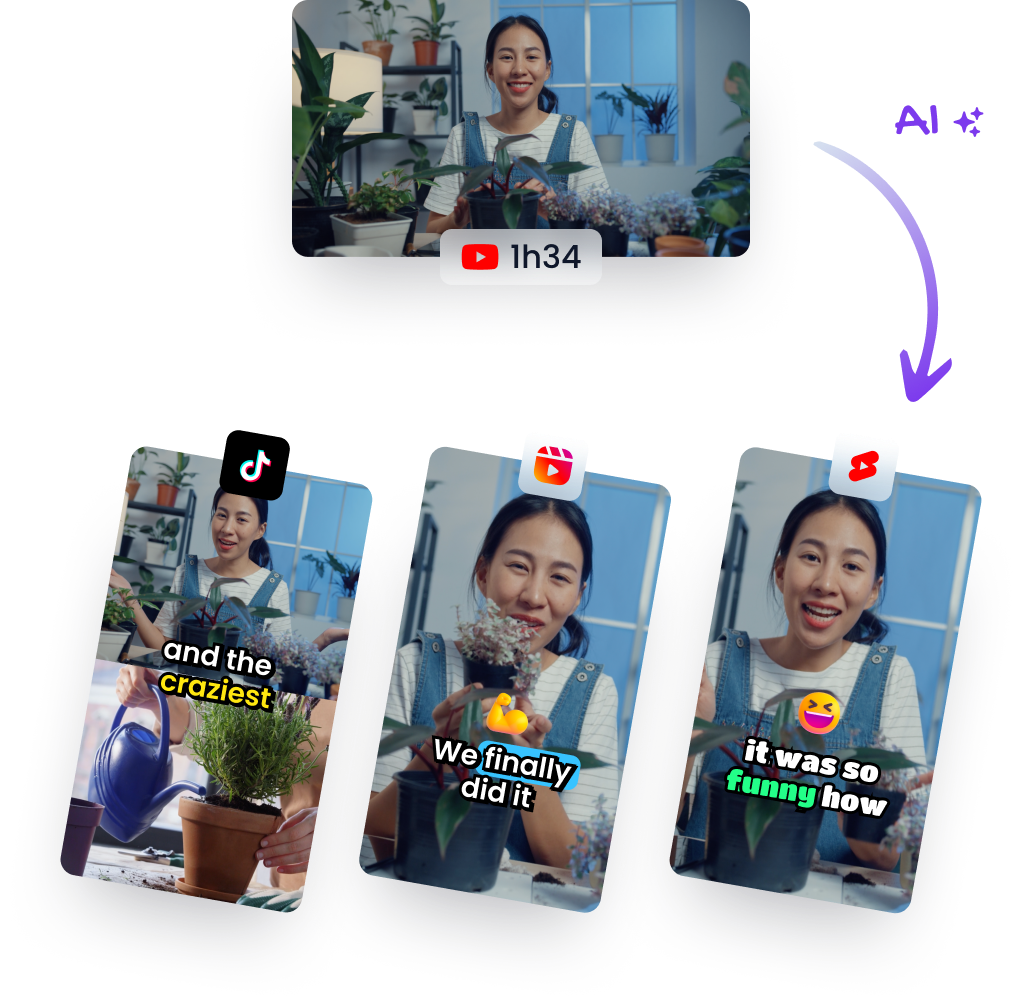
Klap can import a video file or YouTube link, analyze the recording for engaging segments, reframe clips for vertical viewing, and generate captions. Review the candidates rather than publishing them unchanged. Adjust the start and end points, remove setup filler, correct captions, choose the strongest framing, and make sure each clip has one clear job.
Use different production choices for different platforms. Metricool's cross-platform analysis reported average views of 15,334 for Facebook videos, 14,422 for Instagram, 11,447 for TikTok, and 9,921 for YouTube. It also reported average engagement rates of 8.24% on Instagram, 6.10% on TikTok, 2.99% on YouTube, and 2.13% on Facebook (Net Influencer). Those figures aren't a promise for your account. They're a reminder that one generic export shouldn't define every platform version.
Publish the three formats across a week, then compare the 3-second hold rate, average view duration, and saves for each one. Add shares, comments, profile visits, and qualified clicks when the format has a discovery or conversion role. Keep the templates that outperform your own baseline and revise the ones that lose viewers early.
Short-form investment is growing, but volume alone isn't a strategy. A Metricool analysis of 5.7 million short-form videos from 582,456 accounts found that publishing increased 71% year over year, while the number of accounts publishing short videos rose 51%. The same analysis reported declines in average likes, engagement, and reach for YouTube Shorts, alongside a fall in Instagram Reels views (MarketingTechNews). The practical lesson is simple: select clips by purpose, not by how many fragments you can export.
A 2025 video-marketing survey found that 73% of respondents considered videos in the 30-second-to-2-minute range the most effective, while 63% said they'd most like to watch a short video to learn about a product or service (BrandVM). Use that as a testing range, not a rigid rule. Create shorter and longer cuts from the same strong segment, then let retention and saves show you which version fits your audience.
Repeat the workflow with the next source video. Over time, your library will reveal which hooks attract the right viewers, which lessons earn saves, which stories create trust, and which teasers move people toward longer content.
Klap helps turn long videos such as podcasts, webinars, interviews, and YouTube uploads into captioned, vertically reframed short clips for TikTok, Instagram Reels, and YouTube Shorts. Choose one source recording, review the suggested moments, edit the captions and timing, then visit Klap to start building a more consistent short-video workflow.