8 Hook Examples for Short-Form Video in 2026
Other
A Facebook brand video averaged only 4.57 seconds of watch time in a 2019 analysis of 19,622 pages, a sharp reminder that a short-form video often has only a brief window to earn another second of attention. The Socialbakers analysis also found that the opening structure and format affected early completion, which helps explain why TikTok, Instagram Reels, and YouTube Shorts compete so aggressively around the first frame, first line, and first sound.
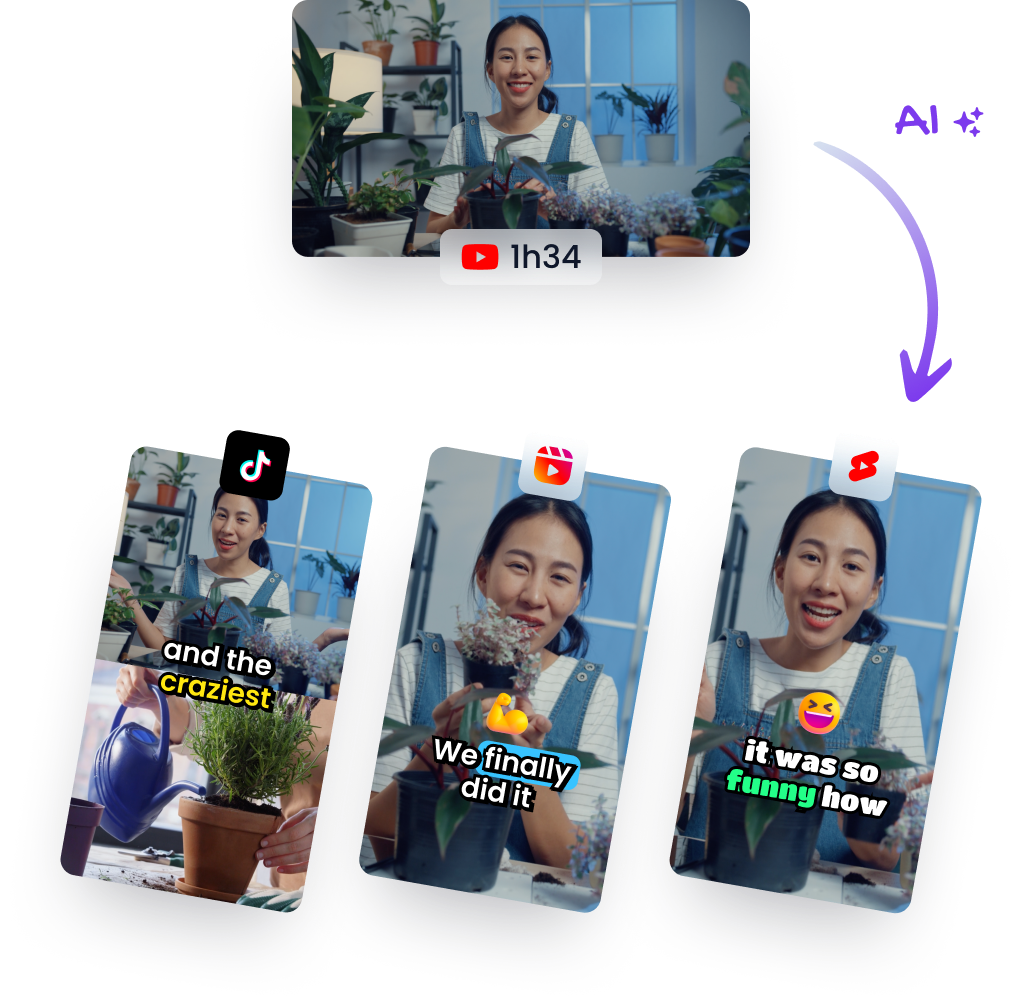
A strong hook must do two jobs quickly. It must create a reason to keep watching, then deliver on the expectation it creates. The eight hook examples below examine what viewers see or hear, why each pattern creates curiosity, and how the format fits education, business, fitness, podcasts, and creator content. They also connect each format to niche fit, retention psychology, ethical trade-offs, and a practical Klap workflow for finding promising moments in long-form recordings, adding captions, reframing footage, and preparing social-ready variations. If you're also exploring adjacent creative workflows, you can find AI music video software for visual and audio experimentation.
1. The Pattern Interrupt Hook
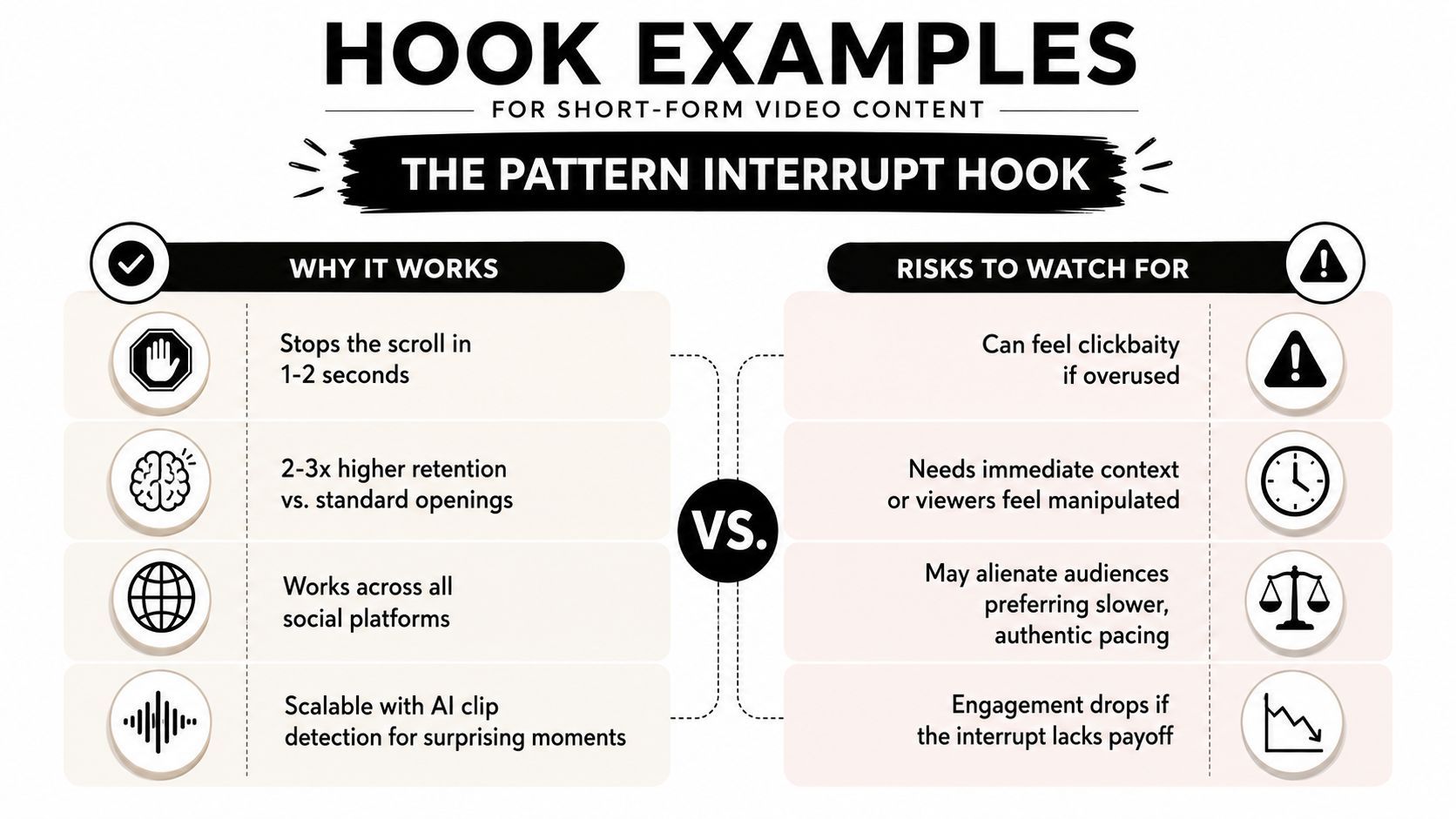
The pattern interrupt begins with something that doesn't match the viewer's expectation. A speaker opens with a blunt claim, a camera cuts to an unusual visual, or a sound arrives before the audience understands its source. The interruption matters because viewers must resolve the mismatch before they can comfortably scroll away.
A podcast guest might begin, “Your best business idea may be the one you rejected,” then explain the decision behind that claim. A business creator could open with a failed checkout screen instead of a polished product reveal. A fitness coach might show an incorrect movement for a moment, then explain why the common version causes problems. The format suits educational and expert content because contradiction gives the viewer a clear reason to seek context.
What to extract and edit
When repurposing a long interview or webinar, look for moments where the speaker's tone changes, introduces an unexpected idea, or challenges an assumption. Klap can help identify engaging segments, after which you can adjust the opening so the surprising line arrives before greetings, introductions, or background explanation. Guidance on what makes a video go viral is useful here because the opening needs to function as a complete attention signal, not merely as the beginning of the original recording.
Use large on-screen text to reinforce the interruption, especially when the visual itself isn't enough to explain the contrast. Then supply context immediately. A pattern interrupt should create curiosity, not manufacture confusion or imply a claim the clip won't support.
Practical rule: Break the pattern first, explain the break immediately after, and remove any opening that promises a payoff the clip can't deliver.
2. The Question Hook
A question hook turns passive viewing into a small act of participation. “Why do smart teams keep missing their deadlines?” asks the viewer to compare the question with personal experience before the answer arrives. The unanswered question creates a gap, and the audience keeps watching to close it.
Specificity determines whether the question feels relevant or disposable. “Are you productive?” is broad enough to ignore. “Why do you finish your busiest workday with the most important task untouched?” identifies a recognizable problem for a particular audience. That makes the format effective for productivity creators, health educators, B2B marketers, and podcast clips where a host's question naturally sets up a guest's answer.
Build a complete question arc
Klap users can search long-form recordings for naturally phrased questions, then isolate the question and the strongest answer in one short clip. A useful edit often begins with the question, cuts hesitation or repetition, and preserves enough of the response to give the viewer a satisfying explanation. The guide to increasing social media engagement can support this broader approach, but the practical test is simple: does the clip feel complete without requiring the viewer to find the full episode?
Repeat the question in captions for sound-off viewing, but don't cover the speaker's face or the visual evidence needed to understand the answer. You can use a rhetorical question for fast-moving creator content, or a genuine question for interviews where the answer carries authority.
A question that remains unanswered for too long becomes bait. Put the clearest answer early enough that the viewer feels progress, then use the remaining time for evidence, an example, or an application.
3. The Data and Statistic Hook
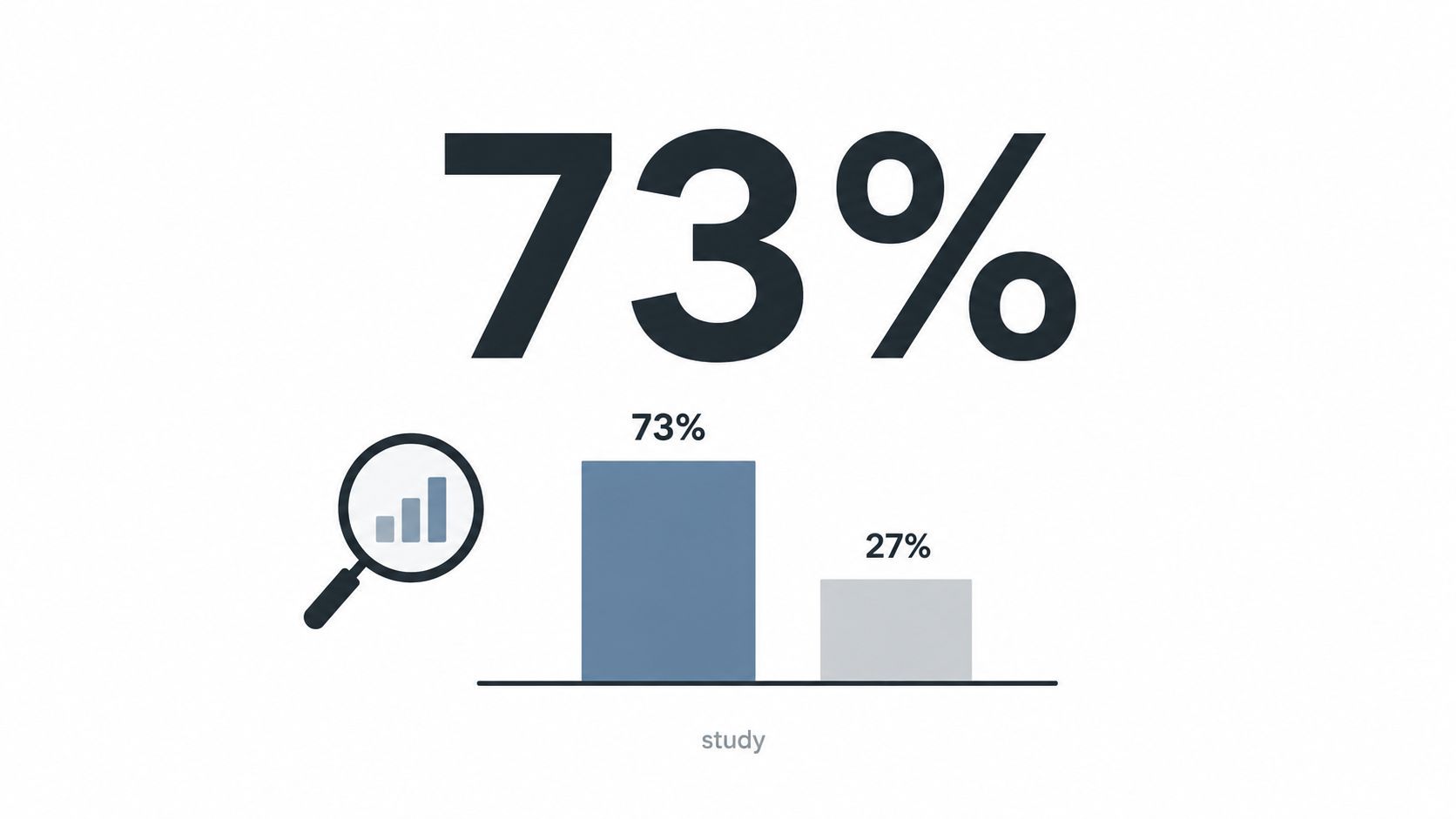
A number can make an abstract problem tangible. "Wasting time on manual reporting" sounds familiar, while a verified benchmark, clearly attributed, gives the viewer something precise to evaluate. The number is only the entrance, however. The clip must explain what it means and why the audience should care.
This format works particularly well for B2B, education, finance, health communication, and thought leadership. A consultant can lead with a benchmark from a named organization, a researcher can introduce a finding before explaining its limitation, and a podcast guest can turn a complex report into one practical implication. Klap's transcript-based workflow is useful for locating passages where speakers mention studies, benchmarks, or research bodies.
Make the number trustworthy
Search the transcript for phrases such as “according to,” “the report found,” or “the benchmark is,” then verify the source before publishing. Put the central figure in large text, but include the study, organization, or research body in the clip or caption. A statistic without attribution may look authoritative while giving viewers no way to judge its relevance.
The supplied evidence illustrates why attribution and context matter. A 2025 analysis of 46,605 TikTok hooks found that emotional hooks appeared in about 3.2% of posts, while producing proportionally higher comments and shares. The empirical analysis also reported that curiosity-gap and urgency openings outperformed direct-address and instructional openings across most content categories, while optimal hook length varied by niche. Those findings don't justify copying one formula everywhere. They support adapting the statistic, wording, and explanation to the audience.
4. The Story Hook
A story hook opens on a human moment rather than a conclusion. “I sat in my car after losing my biggest client, and I didn't know whether to call my team” gives the viewer a person, a setting, and a problem. The audience wants to know what happened next, which makes the format especially effective for podcasts, interviews, personal brands, mental health content, and founder narratives.
The strongest stories use concrete details. A fitness coach might describe struggling with stairs, a founder might recall a first customer who offered feedback instead of a purchase, and a creator might describe the decision to publish after months of hesitation. These details help viewers understand the emotional stakes without requiring an exaggerated claim.
Find the emotional turn
In long-form footage, look for slower delivery, a quieter voice, a pause before a difficult admission, or a shift from general advice to a specific memory. Klap can help surface these moments for review, but the editor still needs to protect the story's meaning. Remove setup that doesn't affect the conflict, keep the sensory detail that gives the scene life, and end on a lesson, decision, or unresolved tension that connects to the channel's subject.
Captions can emphasize a phrase such as “I almost quit,” while restrained music and deliberate pacing support the emotional beat. Don't use vulnerability as decoration. If the story concerns grief, debt, illness, or mental health, avoid cutting the speaker's words into a sensational promise that the original conversation doesn't support.
“A personal story earns attention by making the problem specific, not by making the emotion louder.”
The niche fit comes from the lesson after the story. A business audience needs a business insight, a fitness audience needs a training implication, and a creator audience needs a decision or process they can apply.

5. The Before and After Transformation Hook
Transformation hooks show the destination before explaining the route. A messy workspace becomes organized, a confusing workflow becomes clear, or a beginner demonstrates a skill they previously couldn't perform. The contrast gives viewers an immediate outcome and creates a practical question: what changed?
Fitness, education, productivity, business, and product demonstrations all benefit from this structure. A creator could show a cluttered calendar beside a workable weekly system. A language tutor could contrast a hesitant introduction with a confident exchange. A software educator could show a manual process next to an automated result. The visual evidence makes the promise easier to understand than a general claim about improvement.
Sequence the contrast honestly
Klap can help locate the “before” section where a speaker describes the problem and the “after” section where they explain the result. Since those moments may appear far apart in a podcast or webinar, review the generated clip carefully and preserve the causal connection. The audience should understand what method, timeline, or constraint produced the change.
Use a split screen, a clean cut, or a visual sequence, then add a short overlay that names the contrast. Don't add a precise metric unless the original speaker provides it and you can verify the context. A transformation can remain compelling when it shows capability, clarity, or a changed process rather than a numerical outcome.
The short-form Reels experiment comparing creative hooks with traditional openings reported that the creative-hook group outperformed its control group across measured engagement metrics, including reposts, shares, comments, likes, and completion rate. That result supports testing a more distinctive opening, but it doesn't guarantee that every before-and-after edit will perform equally well.
A visual example can clarify how contrast works when the opening shows both the problem and the result before the explanation.
The ethical risk is overclaiming. Don't imply that a result came from one tactic if the speaker identifies several factors, and don't present a staged “before” state as an ordinary starting point. The hook should reveal the outcome, while the rest of the clip explains the method.
6. The Contrarian and Myth-Busting Hook
Contrarian hooks challenge a belief the audience already recognizes. “More meetings won't fix a communication problem” is stronger than “Here are some meeting tips” because it creates a direct dispute. Viewers can test the claim against their own experience, then watch for the explanation or evidence.
This format suits experts, educators, consultants, and thought leaders who need differentiation. A nutrition educator might challenge a popular diet rule, a career coach might question conventional résumé advice, and a productivity creator might explain why an elaborate morning routine creates more friction than focus. The claim should be narrow enough to defend and relevant enough to matter.
Lead with the claim, then earn it
Search a long-form transcript for phrases such as “the common advice is wrong,” “people assume,” or “the issue is.” Klap can help isolate the segment, reframe it for vertical viewing, and add captions that place the conventional belief beside the speaker's alternative. Keep the evidence close to the claim. If the speaker cites research, name the research body accurately. If the argument comes from experience, label it as experience rather than presenting it as universal proof.
The major risk is confusing disagreement with insight. Shock tactics may generate a pause, but unsupported claims weaken trust when viewers investigate them. A credible contrarian hook identifies the belief, narrows the context, and provides a reason to reconsider it.
A strong edit might follow this sequence:
- Conventional belief: State the familiar advice in a few words.
- Contrarian claim: Introduce the specific alternative without exaggeration.
- Support: Preserve the example, evidence, or reasoning from the original recording.
- Application: Tell viewers what they should change or test.
The format is especially valuable when the long-form speaker explains a framework in detail. Extract the sharpest claim, not the entire debate, then retain enough substance for the audience to understand why the claim deserves attention.
7. The Urgency and FOMO Hook
Urgency gives the viewer a reason to act now rather than later. A product launch may have a real closing date, a workshop may stop accepting registrations, or an industry change may require preparation before a stated deadline. The hook works when the time constraint is concrete and relevant to the viewer's decision.
This format fits launches, limited enrollment, seasonal offers, event promotion, and time-sensitive education. It doesn't fit evergreen advice that uses artificial countdown language merely to force a click. Audiences learn to distrust repeated scarcity, especially when the same “last chance” message returns without a meaningful change.
Separate real urgency from pressure
When reviewing a long-form sales call, webinar, or announcement, use Klap's clip generation to locate genuine references to deadlines, availability, or upcoming changes. Place the time condition in the opening text, then explain what viewers should do and where they can confirm the details. A practical guide to getting more views on Shorts can inform the distribution side, but ethical accuracy remains the foundation.
Soft urgency can explain that registration closes after a stated date. Hard urgency can identify a real short window. Both require proof. Don't invent a countdown, inflate scarcity, or imply that a price will change when no such change has been announced.
Trust check: If the deadline disappeared, would the viewer still receive an accurate description of the offer or event?
Use countdown graphics only when they reflect the actual deadline, and rotate urgency with questions, stories, and educational hooks so the audience doesn't experience constant pressure. The strongest version gives viewers enough information to decide, rather than using anxiety as the entire creative strategy.
8. The How-To and Value Delivery Hook
A how-to hook tells viewers exactly what they'll learn. “Use this three-part process to plan next week's content” communicates utility before the method begins. The viewer can quickly decide whether the outcome matches a current problem, which makes the format a natural fit for tutorials, professional development, software education, fitness instruction, and creator workflows.
The promise must be specific. “Improve your workflow” is vague. “Turn one recorded interview into three captioned vertical clips” gives the audience a concrete result and creates a structure for the video. A how-to hook can also frame a mistake list, a process breakdown, or a short demonstration, provided the clip delivers the promised value.
Match the edit to the promise
Klap can identify moments where a speaker teaches a process, explains a framework, or lists steps. After generation, edit the clip so each promised step has a visible label and a clear transition. If the opening promises three points, the viewer should encounter three distinct sections, not a loose discussion that never reaches the stated number.
Captions are especially important for instructional material. A Verizon Media and Publicis Media study of 5,616 U.S. adults found that 80% were more likely to watch a video to the end when captions were available, according to a summary of that research from QuickReel's caption retention analysis. That makes captions more than a decorative layer, although accurate timing and readable phrasing still determine whether they help.
Deliver the core insight inside the short clip. A teaser that withholds every useful detail may generate a click, but it doesn't build authority or repeat viewing. For more creative list-based writing workflows, this guide to listicle ads for Shopify offers a useful adjacent reference for organizing benefits into a scannable sequence.
8 Hook Types: Quick Comparison
Hook🔄 Implementation complexity⚡ Resources & production effort⭐📊 Expected outcomes / metrics💡 Ideal use cases⭐ Key advantages
The Pattern Interrupt Hook
Medium, precise timing & quick context needed
Low–Medium, use AI clip detection; short edits
⭐⭐⭐, 2–3x watch time; 70% completion vs 24% baseline
Short-form viral clips; repurposed long-form surprising moments
Grabs attention immediately; scalable with AI; cross-platform
The Question Hook
Low, open loop then clear answer required
Low, find natural Q&A moments; text overlays help
⭐⭐⭐, 40–50% more engagement; 3–5x comments
Educational, B2B, discussion-driven clips; podcasts
Drives comments/shares; increases cognitive engagement
The Data / Statistic Hook
Low, needs accurate stat + quick attribution
Low–Medium, verify sources; bold text/graphics
⭐⭐⭐, higher trust (78%); 3.2x shares; 52% higher saves
Thought leadership, LinkedIn, B2B, research-driven content
Establishes credibility quickly; highly shareable and verifiable
The Story Hook (Personal Narrative)
Medium–High, authentic setup and emotional arc
Medium, editing, music, pacing for emotional beats
⭐⭐⭐⭐, up to 65x recall; 4–7x shares; highest follower conversion
Personal brands, coaches, podcasts, community building
Deep emotional resonance; builds loyalty and parasocial bonds
The Before‑After Transformation Hook
Medium, needs clear visual/metric contrast
Medium, split-screen footage, metric overlays
⭐⭐⭐, 80% higher CTR; 5.2x saves; 3x conversion rate
Fitness, product demos, coaching, skill transformation
Shows outcome instantly; highly motivational and conversion‑focused
The Contrarian / Myth‑Busting Hook
Medium, requires strong evidence and framing
Low–Medium, research and clear supporting clips
⭐⭐⭐, 2x engagement; 3.4x comment rate; sparks debate
Thought leadership, expert positioning, niche B2B content
Positions creator as authority; generates discussion and loyalty
The Urgency / FOMO Hook
Low, direct time-bound messaging
Low, countdowns, overlays; ethical use advised
⭐⭐⭐, 79% completion; 4.1x CTA CTR; highest immediate conversions
Product launches, limited offers, time-sensitive promos
Drives immediate action and conversions; effective in funnels
The How‑To / Value Delivery Hook
Medium, must promise and deliver concrete steps
Medium, clear structure, on-screen steps, examples
⭐⭐⭐⭐, 82–87% completion; 2.8x saves; high utility engagement
Tutorials, professional development, educational series
High completion and bookmarkability; builds authority through utility
Turn Strong Openings Into a Repeatable System
The eight formats serve different jobs. Pattern interrupts and contrarian claims are built to stop the scroll by disrupting expectations. Questions and personal stories invite conversation because viewers can answer, relate, or add their own experience. Statistics and how-to promises support authority and saves when the source or method is clear. Transformations make aspiration visible, while urgency is designed for immediate action when the deadline is genuine.
Platform context should influence the edit. Short-form video has an average engagement rate of 5.5%, compared with 1.7% for long-form video and 0.8% for static image posts, according to ClipSpeed's short-form video statistics. The same source reports that vertical 9:16 content outperforms letterboxed horizontal video by 60% in average view count on short-form platforms. These figures don't tell you which hook to choose, but they support a mobile-first production workflow with readable text, immediate framing, and a visual composition designed for vertical viewing.
Start with one audience problem, not eight formulas. Choose a long-form recording where the speaker addresses that problem, then create three opening variations. One might lead with a question, one with the strongest claim, and one with the outcome. Keep the body of the clip as consistent as possible so the opening remains the main variable.
A practical testing loop
- Define the goal: Use completion for a teaching clip, comments for a debate or story, saves for a framework, and clicks for an offer.
- Clarify the promise: Put the most understandable text on screen without hiding the speaker or essential evidence.
- Deliver the payoff: Answer the question, explain the contradiction, show the method, or substantiate the statistic within the clip.
- Review audience signals: Compare retention curves and the action that matches your objective, rather than treating views as the only outcome.
- Repeat with restraint: Keep the strongest format for the niche, then test a different framing when performance plateaus.
The first three seconds deserve special attention. Industry guidance estimates that roughly 65% of viewers who continue past the first three seconds watch at least ten more seconds, while about 45% remain for thirty seconds or more, as summarized by Covalent's analysis of the eight-second attention span. The implication is practical: the opening isn't the whole retention strategy, but it determines whether the rest of the clip gets a chance to work.
Review old podcasts, webinars, interviews, tutorials, and YouTube uploads for sharp claims, emotional turns, questions, transformations, and teachable sequences. Klap can analyze a long-form video, identify candidate segments, reframe them for vertical formats, add captions, and let you adjust the cut before exporting multiple versions. That workflow is more useful than chasing a universal formula because it turns existing recordings into a library of testable openings.
Short-form distribution also varies by audience. Industry coverage of a 2025 study reported that 56% of respondents identified YouTube Shorts as their primary short-form destination, while TikTok and Facebook each reached 50% in that study; separate reporting on Gen Z preferences listed TikTok at 64%, Instagram Reels or Stories at 55%, and YouTube Shorts at 54%. The coverage of short-form platform usage makes the strategic point without making platform choice automatic. Test the same core idea with platform-appropriate captions, pacing, and calls to action.
For another perspective on turning raw ideas into concise, memorable lines, you can explore Drumloop AI's rap writing guide. The principle transfers well: a compact opening needs rhythm, specificity, and a payoff that feels earned.
Klap helps you turn long-form videos into captioned, reframed short clips, so you can test pattern interrupts, questions, stories, transformations, and how-to openings without rebuilding every edit from scratch. Review your next podcast, webinar, or YouTube recording with these eight formats in mind, then visit Klap to generate and refine social-ready variations.