Short Form Video Marketing: The Complete 2026 Guide
Other
49% of marketers now say short-form video is their highest-ROI content format, ahead of long-form video at 29% and live-streaming at 25% according to HubSpot's 2026 State of Marketing data. That shift matters because it isn't just a creative preference, it's a budget signal. Brands are choosing the format that gets attention, holds it, and keeps producing usable assets long after the original recording is done.
Short-form video marketing has become the most practical way to turn one good idea into many publishable clips. The best teams don't chase one-off virality. They build a repeatable system that takes long-form footage, extracts the strongest moments, and ships those moments in the places where people already watch, search, and share.
If you're evaluating partners for production, a useful starting point is this guide to video marketing companies, especially if you need outside support for editing, strategy, or distribution. For teams that want a broader content framework beyond clips, this related resource on content marketing videos helps connect short-form with the rest of the funnel.
Your Guide to Short-Form Video Marketing
Short-form video marketing has moved into the center of content planning because it solves a practical problem for brands, not because it looks current. Independent market reporting summarized by Marketing Tech News says short-form video publishing grew 71% year over year, while the number of accounts using the format rose 51%. TikTok drove the sharpest growth in that reporting with a 156% increase in video posts, while Instagram still led in total volume with 34.43% growth HubSpot's marketing statistics.
That growth matters because it changes how teams should build video programs. Instead of treating short clips as a side experiment, brand managers need a repeatable workflow that turns each recording session into a stream of assets. One interview, one webinar, one podcast, or one product demo can produce multiple clips if the source material is planned with repurposing in mind.
Why this format won the budget conversation
Short-form works because it compresses the value exchange. A viewer gets the point quickly, and a brand can produce, test, and repurpose faster than it can with more polished long-form assets. That efficiency matters for brand managers who need volume without letting quality collapse.
The shift is operational. Teams are no longer trying to make every video stand alone as a finished piece. They are building a content engine that starts with one strong long-form asset, then breaks it into angles that fit different audiences, platforms, and stages of interest. That approach keeps production costs under control and gives distribution teams more material to work with.
If you need outside help with production or editing, a useful starting point is this guide to video marketing companies. For teams that want to connect clips to a wider content system, this resource on content marketing videos shows how short-form can fit into the rest of the funnel.
Practical rule: if a video cannot become several distinct clips, it usually is not strong enough to anchor a short-form system.
That is the strategic advantage. The formats that keep working are the ones that match audience behavior, creator bandwidth, and distribution logic at the same time. Teams that get that balance right stop asking whether short-form video is worth it. They start asking how many usable clips each recording session can produce.
Why Short-Form Video Dominates Attention

Short-form video works because it matches how people consume content. In practice, viewers move in quick bursts, and the format gives them a clear payoff before attention slips. A 2026 industry compilation says 95% of consumers watch short-form video regularly, 71% do so daily, and 90%+ of Gen Z and Millennials watch it weekly across major platforms such as TikTok, Reels, Shorts, and Facebook Reels short-form video statistics. The format is no longer tied to one platform or one age group. It has become a default content pattern.
The commercial case matters too. The same compilation says global short-form video ad spending reached $111 billion in 2025 and is projected to rise to $145.8 billion by 2028 short-form video statistics. That scale shows how media teams are treating short clips as a core budget line, not a side experiment. For a brand manager, that usually means the question is no longer whether short-form belongs in the plan. The question is how to produce enough of it without creating a one-off content scramble.
Attention is earned in the opening seconds
Short-form video performance is front-loaded. Kapwing's cited Facebook research says 65% of viewers who make it through the first 3 seconds continue for at least 10 seconds, and 45% continue for 30 seconds or more Kapwing short-form video statistics. The first frame, the first line, and the first visual proof carry most of the load. If those elements do not work, the rest of the clip rarely gets a fair chance.
That also explains why structure matters more than raw length. A study on short-form video ads found that performance is shaped by content features such as the opening hook, pacing, and message clarity rather than shortness alone ScienceDirect abstract. In day-to-day production, that means a 35-second clip with a weak opening will usually lose to a longer clip with a sharp question, visible proof, and one clean takeaway. Short-form rewards discipline, not just brevity.
Short-form is faster judgment, not just faster media.
Why brands keep building around it
Short-form video has stayed attractive because it fits a repeatable production model. A team can build one long-form source asset, then cut it into multiple clips for different audiences, different platforms, and different stages of interest. That workflow keeps the content engine moving without forcing every post to start from zero. It also gives editors, strategists, and distribution teams more room to test angles instead of betting everything on a single upload.
That is where a system matters more than a viral hit. Brands that want consistent output need a method for turning one recording session into a set of usable assets, not just a highlight reel. If that is the direction you are building toward, this guide on how to grow on TikTok is a useful companion because it shows how platform behavior and content structure work together.
The practical takeaway is simple. Short-form video matches fast consumption, mobile viewing, and the way teams now reuse content across channels. The strongest programs are not random bursts of creativity. They are repeatable systems built around attention, editing efficiency, and repurposing workflows that make each asset work harder.
Choosing Your Platform Playground
Platform choice should follow audience intent, not habit. TikTok, Instagram Reels, and YouTube Shorts all support vertical short-form video, but they reward different kinds of content and different levels of discovery. If you post the same clip everywhere without adjusting the angle, you're relying on luck.
PlatformPrimary AudienceContent CultureBest For
TikTok
Broad consumer audience, especially discovery-minded users
Fast, native, trend-aware, conversational
Top-of-funnel reach, brand personality, quick tests
Instagram Reels
Existing followers, lifestyle and product audiences
Polished but still native, visually led
Product discovery, brand presence, social proof
YouTube Shorts
Viewers already in a video-first ecosystem
Search-adjacent, utility-driven, creator-friendly
Education, repurposed long-form clips, discovery
YouTube Shorts is especially useful when your content already has depth. YouTube as a platform is built for both search and viewing behavior, which makes it a natural home for educational snippets, expert takes, and repurposed long-form content. That's why creators and brand teams that already publish on YouTube often get more mileage from Shorts than from starting from scratch elsewhere.
Match the platform to the content job
TikTok works best when the goal is attention and rapid iteration. Its culture favors native-feeling clips, quick hooks, and content that looks like it belongs in the feed rather than like a polished ad.
Instagram Reels suits brands that already have a visual identity and an existing audience relationship. It's where product moments, testimonials, and social proof can travel well, especially when the creative feels clean without becoming overproduced.
YouTube Shorts works well for brands that have something to explain. It's the easiest place to turn a webinar, interview, podcast, or tutorial into a shorter discovery asset. For a tactical breakdown of platform growth patterns and creative fit, this guide on how to grow on TikTok is useful context if TikTok is part of your mix.
Choose based on production reality
The wrong platform choice usually comes from overestimating what your team can sustain. A brand with a small team and lots of subject-matter expertise often does better on YouTube Shorts first, because it can recycle existing footage. A brand with a strong social voice may lean into TikTok because it can generate ideas quickly and test hooks aggressively.
Good channel strategy starts with the footage you already have. The best platform is the one that lets your team publish consistently without rebuilding the same story three times.
That's the selection framework. Pick the place where your content style fits the culture, your audience already spends time, and your production workflow can keep up.
Strategic Playbooks for Winning Content

The strongest short-form programs aren't random. They rely on repeatable content models that can be reused across topics, products, and campaigns. If your team is improvising every clip, production gets expensive and message quality gets inconsistent. If you use a few reliable playbooks, the work gets simpler and the output gets better.
The Educator
This format breaks a complex topic into one clear answer. It works well for SaaS, finance, health, B2B services, and any brand that needs to build trust through clarity.
Start with a buyer question, not a brand slogan. A clip about “how pricing works,” “what the difference is,” or “whether it's worth it” tends to outperform vague awareness content because it answers real intent. ImpactPlus recommends saying the keyword or topic in the first 1 to 2 seconds, answering first, then explaining, and using searchable captions or titles ImpactPlus short-form videos for business.
The Storyteller
This playbook uses behind-the-scenes moments, process clips, founder commentary, customer reactions, or team decisions. It works because people trust context more than polished claims.
The key is to show movement. A product being assembled, a live reaction during an event, or a team making a trade-off feels credible because it gives the viewer something concrete to interpret. Keep the narrative tight and let the visual evidence do part of the selling.
The Problem-Solver
This one is built for search intent packaging. A buyer asks a specific question, and the clip answers it immediately.
Use this model for pricing questions, comparison clips, “how long does it take,” “which one is better,” and “what happens if” formats. The point is to make the video discoverable for the same language buyers use in search and social comments.
If a customer support team hears the same question twice a week, it probably deserves a short-form video.
The Converter
This playbook is less about going viral and more about moving the viewer to the next step. It can be a demo snippet, a testimonial, or a concise offer explanation.
The mistake brands make here is over-explaining before proving anything. Lead with the benefit or outcome, then add just enough context to make the next step feel obvious. That's especially effective when the clip sits next to a landing page, email, or remarketing sequence.
These playbooks give a team structure without forcing every clip to feel identical. That balance is what keeps a short-form program from becoming repetitive while still making it scalable.
The Modern Repurposing Workflow From Long Form to Viral Shorts

The most efficient short-form programs start with material that already exists. A webinar already contains sharp answers. A podcast already contains strong opinions. A YouTube video already contains tension, proof, and payoff. The task is to extract those moments without rebuilding the story from scratch.
That approach matters because short-form volume now lives on a scale that rewards repeatable systems, not one-off edits. A separate industry roundup reports that YouTube Shorts generates over 200 billion daily views, up from 70 billion in March 2024 Short-form content statistics. The point is simple, repurposed vertical video is no longer a side tactic. It is a practical way to keep one strong idea circulating across a huge distribution surface.
Start with the source asset, not the clip
The workflow starts before editing. Record long-form content with clip extraction in mind, which means clean audio, clear topic shifts, and enough space between ideas for clean cut points. If you already know a conversation may become ten shorts, the recording itself should be structured to support that.
Transcription turns that source asset into something searchable. A well-prepared transcript makes it faster to spot high-value segments, compare candidate hooks, and reduce the time spent scrubbing through footage. A practical guide on video transcription software shows how text-based review can speed up clip selection and make the process easier to repeat across formats.
Build the workflow in a sequence
A repurposing pipeline works best when the team follows the same order every time.
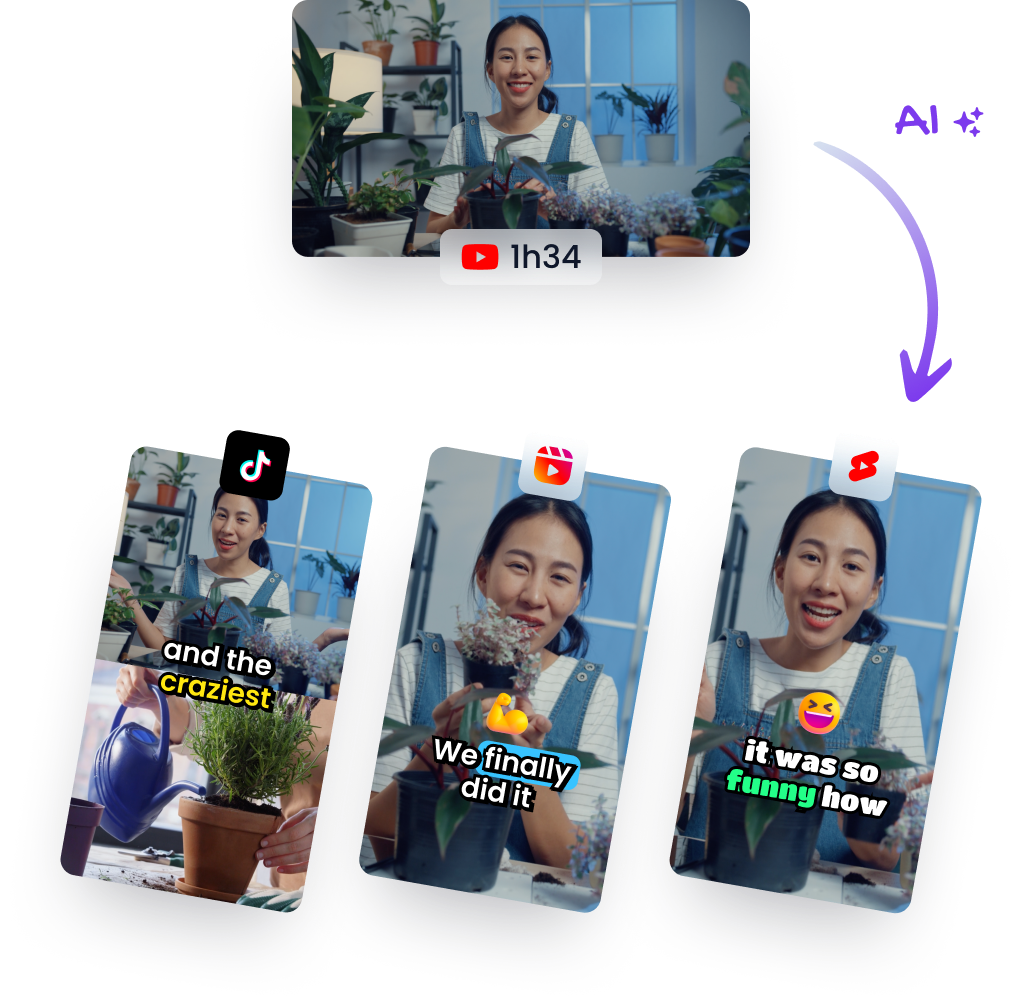
- Ingest the source: Upload a webinar, podcast, interview, or YouTube video.
- Find the strongest moments: Look for clear opinions, direct answers, surprising lines, and proof points.
- Trim for one idea: Each clip should carry one message, not three.
- Reframe for vertical: The framing has to fit mobile viewing, not just crop the sides.
- Caption for comprehension: Many clips are watched without sound, so subtitles are part of the product.
- Review for fit: Check whether the opening makes sense without context.
- Publish and reuse: Save the winning angles and turn them into new variants.
That sequence keeps the work practical. It also gives strategists, editors, and social managers a shared process instead of a pile of one-off decisions.
Use tools to remove the bottleneck
A repurposing tool is useful when the process starts slowing down at the same steps every week. Klap, for example, is built to turn long-form video into social-ready shorts by finding strong segments, reframing them for vertical formats, and adding captions automatically. For teams that need an AI tool for faceless video creators, that kind of workflow can make the difference between publishing irregularly and maintaining a steady output.
The value is not automation for its own sake. It is the removal of repetitive labor so editors can spend more time on judgment, pacing, and brand fit. Tools can speed up production, but human taste still decides which moments deserve distribution.
Repurpose with intent, not volume for volume's sake
A strong repurposing system does more than create extra files. It turns one source recording into multiple angles that serve different jobs. One clip can answer a buyer question, another can work as a top-of-funnel hook, and a third can function as proof for a warm audience.
That is the primary payoff. The original recording keeps working, the cost of each additional post drops, and the content library compounds instead of decaying. The system stays useful because each new short comes from a deliberate workflow, not a scramble to find something postable.
Measuring What Matters KPIs for Short Form Video

Views are the least useful metric when you're trying to improve a short-form system. They tell you something was shown, not whether it worked. A better measurement stack focuses on what happened in the opening seconds, how long people stayed, and whether the clip moved a viewer closer to action.
JetFuel defines thumbstop rate as 3-second views divided by impressions, and says anything above 25% is strong on TikTok. It also notes that 50%+ completion is solid for videos under 30 seconds, while about 25% can still be acceptable on 60-second videos because retention naturally declines as length increases JetFuel measurement guide.
Read the first drop-off before you celebrate reach
The opening hook is the first thing to inspect. If people stop at the first frame or the first sentence, the clip is usually failing at the promise level. The audience didn't get a reason to keep going.
That's why thumbstop rate matters so much. It tells you whether the first visual beat and the first line are strong enough to interrupt scrolling. If a clip gets broad distribution but weak thumbstop performance, the problem is usually the opener, not the subject.
Use completion and hold rate to judge the content itself
Completion rate shows whether the video kept its promise after the hook. Hold rate, or the shape of the retention curve, tells you where interest fell off. If the graph drops hard after the first few seconds, the opening may be good but the body lacks pacing or clarity.
Those patterns are more useful than total views because they give you an editing diagnosis. Tighten the first line, cut the dead air, or move the value earlier. Small changes to structure often matter more than changing the topic.
Measure the business outcome too
A short-form program still has to support revenue, pipeline, or brand growth. That means tracking actions tied to the clip's role in the funnel, not just social engagement. If a clip is meant to educate, watch retention. If it's meant to convert, track downstream action.
Best practice: use views for distribution context, but use retention and action for decision-making.
The sharpest teams review a clip in three layers. First, did the hook stop the scroll. Second, did the body hold attention. Third, did the viewer do something useful after watching. That's the measurement stack that turns short-form from a posting habit into a real content engine.
Klap helps teams turn long-form recordings into short clips without rebuilding the same edit from scratch every time. If you want a faster way to create a repeatable short-form video marketing workflow, visit Klap and see how it can help you turn existing video into a steady stream of vertical content.