Ecommerce Video Marketing Playbook for 2026
Other
Digital video generated $62.1 billion in U.S. advertising revenue in 2024, growing faster than the overall internet advertising market. For ecommerce teams, the opportunity isn't to make every clip go viral. It's to match each video to a buyer's question, turn existing footage into useful platform-native assets, and measure the purchases video helps influence, including those that happen later or somewhere else. The IAB's 2024 digital advertising report puts the channel's scale in perspective.
Why Video Now Powers Ecommerce Growth

U.S. internet advertising revenue reached $258.6 billion in 2024, up 15% year over year. Digital video generated $62.1 billion, grew 19.2%, and accounted for approximately 24% of total internet advertising revenue, according to the IAB's 2024 report. Video outpaced the overall market, giving ecommerce brands reason to treat it as a regular part of their marketing operations rather than an occasional experiment.
A Wyzowl industry survey found that 91% of businesses use video as a marketing tool, and 93% of video marketers consider it important to their strategy. Adoption alone does not guarantee sales. It does mean shoppers are likely to encounter video at multiple points in the buying journey.
Different clips serve different buyer needs. A social video can introduce a product and earn a shopper's attention. A demonstration shows how it works; a review can address trust concerns. On a product page, video can answer a practical question while a shopper weighs a purchase.
Producing enough relevant creative without exhausting a small marketing team or confusing attention with revenue remains the core challenge. Making every asset from scratch consumes time that could go toward testing a stronger opening, clarifying a demonstration, or aligning a video with its landing page. Repurposing helps teams keep a steady flow of useful creative, provided each version fits its placement and audience.
Practical rule: Treat video as an operating channel. Give each asset a buyer question, a distribution plan, and a measurable job.
A useful program depends on how well footage is matched to buyer stage, adapted for each channel, and assessed for its contribution to business outcomes. Some videos assist a purchase without earning the last click. Tracking those contributions gives teams a clearer view of what to improve than view counts alone.
Setting Goals and Mapping Video to the Funnel
Assign each video a buyer-stage goal before recording. A shopper discovering your product needs a reason to investigate; someone on the product page may need proof that it solves their problem. Judging both clips by immediate purchases can push a team to abandon useful discovery content while overlooking weak conversion creative.
Length follows the buyer question. Wyzowl's survey found that 71% of respondents considered videos between 30 seconds and two minutes the most effective length, and 93% of marketers said video improved customers' understanding of their offering. Use those findings as planning context: give the explanation enough room to make sense, then cut anything that delays the answer.
Choose one primary outcome
Set a primary KPI before production begins. For awareness, qualified product-page visits can be more useful than raw views. For consideration, choose an action that reflects growing purchase intent, such as add-to-cart. Conversion assets need purchase outcomes, while retention videos need measures tied to product use or returning customers.
Keep the assignment specific:
- Buyer question: What does the shopper need to understand or believe?
- Funnel job: Is the clip for awareness, consideration, conversion, or retention?
- Primary KPI: Which single outcome will determine whether it worked?
- Destination: Where should the viewer go next?
- Creative proof: What demonstration, testimonial, or comparison supports the message?
If the destination cannot answer the question raised by the video, fix that mismatch before filming.
Match format to the job
| Format | Funnel Job | Primary KPI |
|---|---|---|
| Short social introduction | Awareness | Qualified product-page visits |
| Product demonstration | Consideration | Add-to-cart rate |
| Customer testimonial | Consideration | Assisted purchases |
| Direct-response ad | Conversion | Purchases |
| Product-use tutorial | Retention | Repeat visits to product guidance |
These assignments are starting points. A testimonial might help a shopper return later and buy through another channel, so last-click sales alone can understate its contribution. Assisted purchases deserve attention, but they do not establish that the video caused the sale. Keep that distinction visible when deciding what to fund.
Repurposed footage needs its own assignment for each placement. A product-page demonstration cut into a social introduction may need a different opening, destination, and KPI. Reusing footage saves production time; carrying over the original goal without checking buyer stage makes the test harder to interpret.
Use secondary metrics to diagnose the primary result. Strong viewing with weak product-page visits may warrant checking the call to action or audience fit. High views alone should never justify scaling an asset whose intended outcome remains weak.
Choosing the Right Video Content Types
Video formats aren't interchangeable. A glossy product demo, a creator review, a livestream, and a short paid ad can all help a store, but they solve different problems. Choose based on the product's complexity, the customer's question, and the resources available to produce and distribute the work.
Nearly 46% of shoppers say short-form video influences purchase decisions, but audience preferences vary. Shoppers aged 35 and older show stronger engagement with long-form demonstrations and tutorials on Facebook and YouTube, while younger audiences favor bite-sized video on Instagram and TikTok, according to Bazaarvoice's research. Short isn't automatically better if it removes the proof or detail a buyer needs.

Compare formats by buyer question
Product demonstrations show how an item works, how it fits, or what setup involves. They're useful when shoppers need concrete proof before deciding. Keep the focus on use, rather than opening with brand history or a list of features.
UGC and creator content can make the product feel tangible in a real setting and help answer trust or fit concerns. Use a creator or customer perspective when that viewpoint adds credibility, not just because an informal style is fashionable. For a deeper look at planning and using customer-created assets, see this user-generated content strategy guide.
Paid ads need a clear opening, a specific audience, and a logical next step. The creative should fit the placement and destination. A discovery ad can introduce a problem; a retargeting ad can answer a product objection.
Livestreams can support interactive demonstrations and audience questions, especially when the product benefits from showing several use cases. They take more coordination than repurposed clips, so plan for how the recording will continue to serve the brand afterward.
Short-form clips work well for discovery, objection handling, and concise proof. For examples of formats and hooks to explore, this collection of ecommerce short form campaign ideas can help teams think beyond generic product montages.
A lean team should prioritize formats based on what buyers need. For a simple product, creator clips and short demonstrations may be enough to start. For a complex or higher-consideration item, pair short discovery clips with a fuller tutorial or comparison. That sequence lets the short asset earn attention without asking it to carry the entire explanation.
Production and Repurposing Workflow
A sustainable production system starts with useful source footage, not an endless calendar of original shoots. Look through product demonstrations, customer interviews, creator reviews, tutorials, podcasts, and recorded webinars. The strongest source material usually includes clear product use, a direct answer to a common objection, or a credible explanation of who the product suits.

Turn source footage into purposeful clips
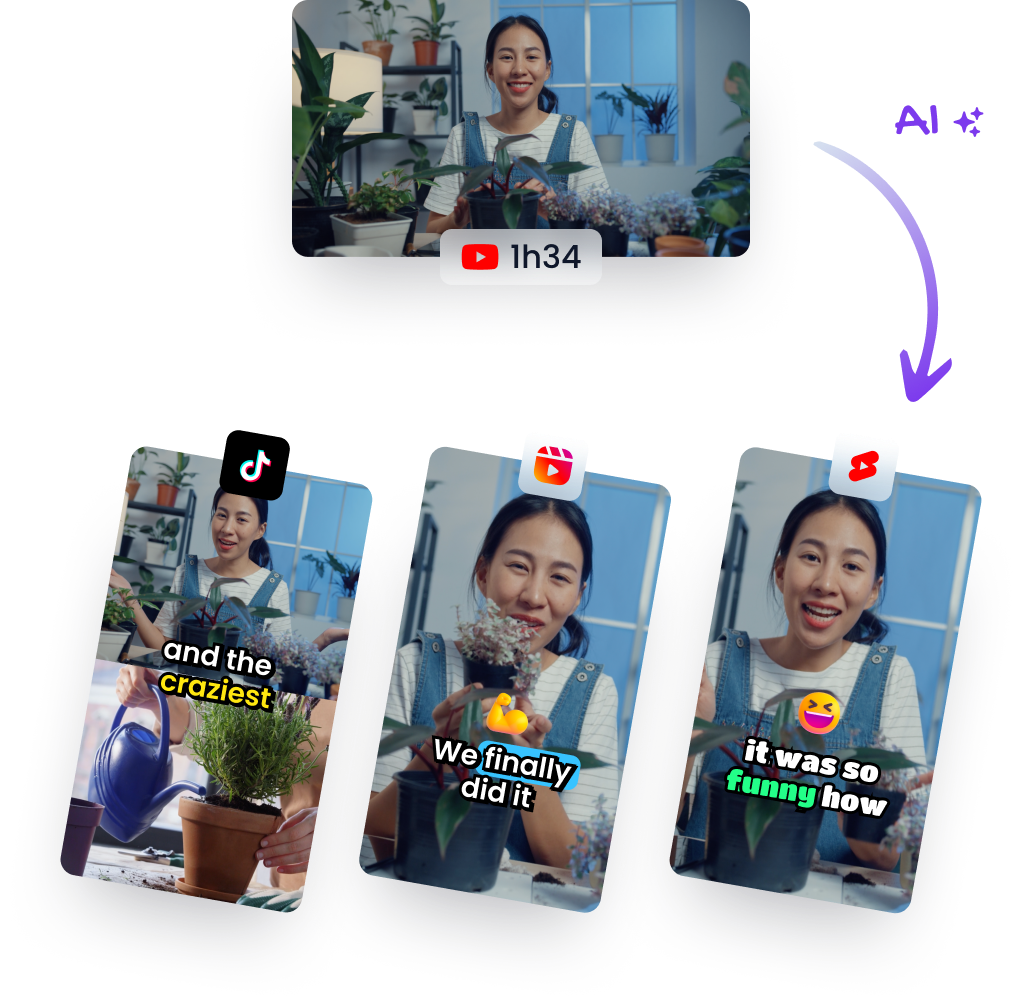
Start by reviewing the recording for distinct moments, then give each selected clip a single job: show a feature, answer an objection, demonstrate a use case, or compare options. Don't treat every highlight as a finished ad. A clip needs a clear opening, enough context to make its point, and a next step that suits its role.
AI-assisted tools can speed up the mechanical work of finding moments, reframing footage for vertical formats, and adding captions. Klap is one option: it takes a long-form video or YouTube link, identifies potential segments, reframes and captions clips, and lets users review and adjust the result before exporting. Human review still matters. Check that the crop keeps the product visible, captions are accurate, and the selected moment makes sense without the rest of the recording.
Then tailor each approved version to its destination. Use readable burned-in captions where they help people follow along without audio, leave safe margins for platform controls, and keep the product visible in the frame. For practical guidance on adapting production to social platforms, consult this guide to profitable social video.
This walkthrough shows the kind of source-to-social workflow teams can build around existing footage.
<iframe width="100%" style="aspect-ratio: 16 / 9;" src="https://www.youtube.com/embed/-mVIijFtnQc" frameborder="0" allow="autoplay; encrypted-media" allowfullscreen></iframe>Before publishing, review the opening, claims, captions, crop, and destination link. Name files so editors and media buyers can identify the product, buyer question, platform, and creative variant without opening each asset. That keeps testing organized when several versions share the same source.
A useful production checklist is simple: identify the source, select a buyer-relevant moment, edit for the destination, check mobile framing and captions, then label and export. Repurposing is valuable when it preserves context and proof. Cutting a long video into arbitrary highlights may increase output, but it won't necessarily give shoppers better reasons to act.
Distribution Channels and Paid Ad Tactics
Distribution should follow the buyer's path, not a belief that every short video must close a sale inside the social app. A discovery clip can introduce a product, a marketplace listing can capture comparison shopping, and the brand's own product page can provide deeper details or complete the purchase.
Consumer data reflects that split. After seeing a product on social media, 15% of surveyed consumers purchase directly on social platforms, 31% go to marketplaces, and 36% purchase on a brand's website, according to Clutch's shoppable-content research. A low last-click conversion rate may therefore miss the role a clip played in starting or supporting the buying journey.

Give each channel a clear role
Use organic TikTok, Instagram Reels, and YouTube Shorts to test ideas and introduce products in platform-appropriate formats. Don't post identical exports by default. Check captions, framing, product visibility, and the call to action in each placement.
Paid distribution can extend clips beyond existing followers. Prospecting creative should make the product and its relevance clear to new audiences. Retargeting creative can address the hesitation that keeps interested shoppers from moving forward, such as fit, setup, or a comparison with another option. Creator partnerships can add a distinct point of view, but only when the creator's content and audience fit the product.
Consistent UTMs and event tracking help connect a clip to the next step, including product-page visits, add-to-cart, checkout, or purchase. Add product tagging where it's available, and keep the landing page aligned with the promise in the video. A clip about how a product fits shouldn't land visitors on a broad page that leaves the fit question unanswered. Teams building a TikTok product-discovery plan can use this guide on how to promote products on TikTok.
Test creative components independently. Compare openings, proof types, caption treatments, and landing pages rather than changing everything at once. A strong view count can identify an attention-grabbing clip, but commercial value depends on whether that attention leads to relevant visits or helps shoppers return and buy.
Social discovery and checkout aren't always the same event. Measure the path a shopper takes, not only the platform where the first view happened.
Measuring What Actually Drives Sales
Video reporting goes wrong when teams stop at plays and watch time. Those numbers can help diagnose whether a clip earns attention, but they don't establish that it changed buying behavior. A useful measurement plan follows the customer from exposure through product-page engagement and purchase, while accounting for the fact that video may assist rather than close a sale.
Industry sources cite a product-page benchmark of 4.8% average conversion with embedded video versus 2.9% without, an approximately 65% relative lift. Treat that comparison as a directional planning reference, not proof that adding video caused the difference; brands and pages in the comparison may vary in ways that affect conversion. The reported benchmark and its caveats are a reason to test your own pages, not assume the result.
Run a controlled page test
Start with a product page where video can answer a real buying question. Preserve price, offer, copy, traffic sources, and merchandising between the control and video versions. Randomize visitors between them, then compare product-page conversion and add-to-cart rate alongside revenue per visitor, video engagement, and returns.
Keep the video concise and place it near the relevant product information. Show the product in use, explain a meaningful feature or setup detail, and caption the content so the message still works when a viewer has muted audio. Keep the buy button easy to find.
Watch for implementation problems that can obscure results:
- Autoplay with sound: Avoid surprising shoppers or making the page difficult to use.
- Slow-loading players: Check page performance before and after adding the embed.
- Buried purchase controls: Don't make shoppers work through a video to reach the buy button.
- Views without outcome tracking: Connect engagement to downstream actions rather than treating plays as sales.
Read results in context
Separate video-engaged and non-engaged visitors for diagnosis, but don't assume the difference between those groups proves that video caused a purchase. Viewers may already be more motivated. The randomized control and video variant provide a stronger basis for comparing page outcomes.
Use a test duration that covers complete weekly cycles, then assess confidence before broad rollout. If the video attracts attention but doesn't improve downstream behavior, revisit the buyer question, placement, landing-page fit, and technical performance before producing more variations. A useful video marketing ROI guide can help teams connect activity to commercial outcomes.
30-Day Execution Plan and Troubleshooting
Build a repeatable loop from buyer question to tested creative. Keep production narrow enough to learn which messages help shoppers progress before expanding the clip library.
Week one: Choose a priority product, identify the buyer stage and question, set a primary KPI, and audit existing footage.
Week two: Select formats that answer that question. Source demonstrations or reviews, then identify reusable clips. Repurpose around the message, keeping enough context for the proof to make sense.
Week three: Edit and review assets. Prepare captions, platform-specific crops, naming conventions, landing pages, UTMs, and event tracking.
Week four: Publish, launch a product-page test where relevant, and review attention alongside downstream actions. Judge each clip against its buyer-stage role.
Troubleshoot the break in the journey:
- Polished clips with weak sales: Check whether the opening and proof address a purchase objection.
- Retargeting audiences that don't grow: Review the source audience and campaign setup.
- Dashboards full of views and no revenue context: Connect reporting to product-page and purchase events.
Relevant visits, clearer product understanding, and assisted purchases can indicate progress. Avoid requiring every clip to earn a last-click sale. When engagement is healthy but qualified actions remain weak, revise the hook, format, or landing page before producing more variations. Prioritize evidence over viral potential.
Klap turns existing long-form product demonstrations, webinars, and creator content into short social-ready clips with reframing and captions. Review and edit those outputs to support a consistent workflow using footage you already have.