How to Promote Products on TikTok: Your 2026 Playbook
Other
TikTok performance is decided fast. Viewers judge the video, the creator, and the product in seconds, so product promotion on the TikTok platform works best when the offer, hook, and payoff show up early.
Many marketing teams fall into the trap of treating TikTok like a smaller version of Instagram. The result is familiar. Slow intros, polished edits that feel like ads, and one-off production cycles that eat time without producing enough creative to test.
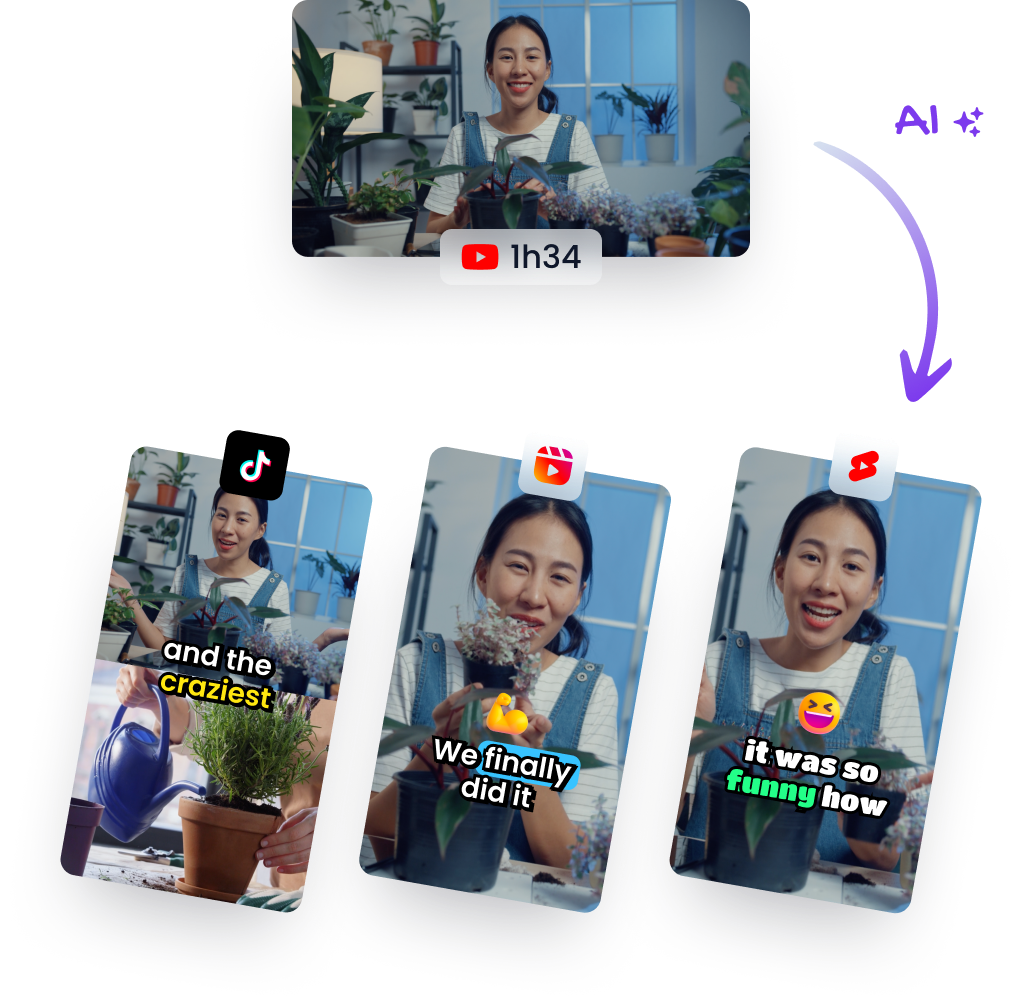
A better approach is to build volume from assets you already have. Podcasts, webinars, founder interviews, product demos, sales calls, and YouTube videos can all become short-form product clips with different hooks, cuts, and calls to action. That workflow matters because TikTok usually rewards range and repetition more than a single carefully edited post.
I have seen the strongest campaigns come from teams that stop creating every video from scratch. They use a repurposing system to pull multiple sellable moments from long-form content, publish faster, and learn which angle drives clicks or sales. Tools like Klap make that process practical by turning existing footage into a steady pipeline of TikTok-ready clips instead of another editing backlog.
Setting Your Foundation for TikTok Success
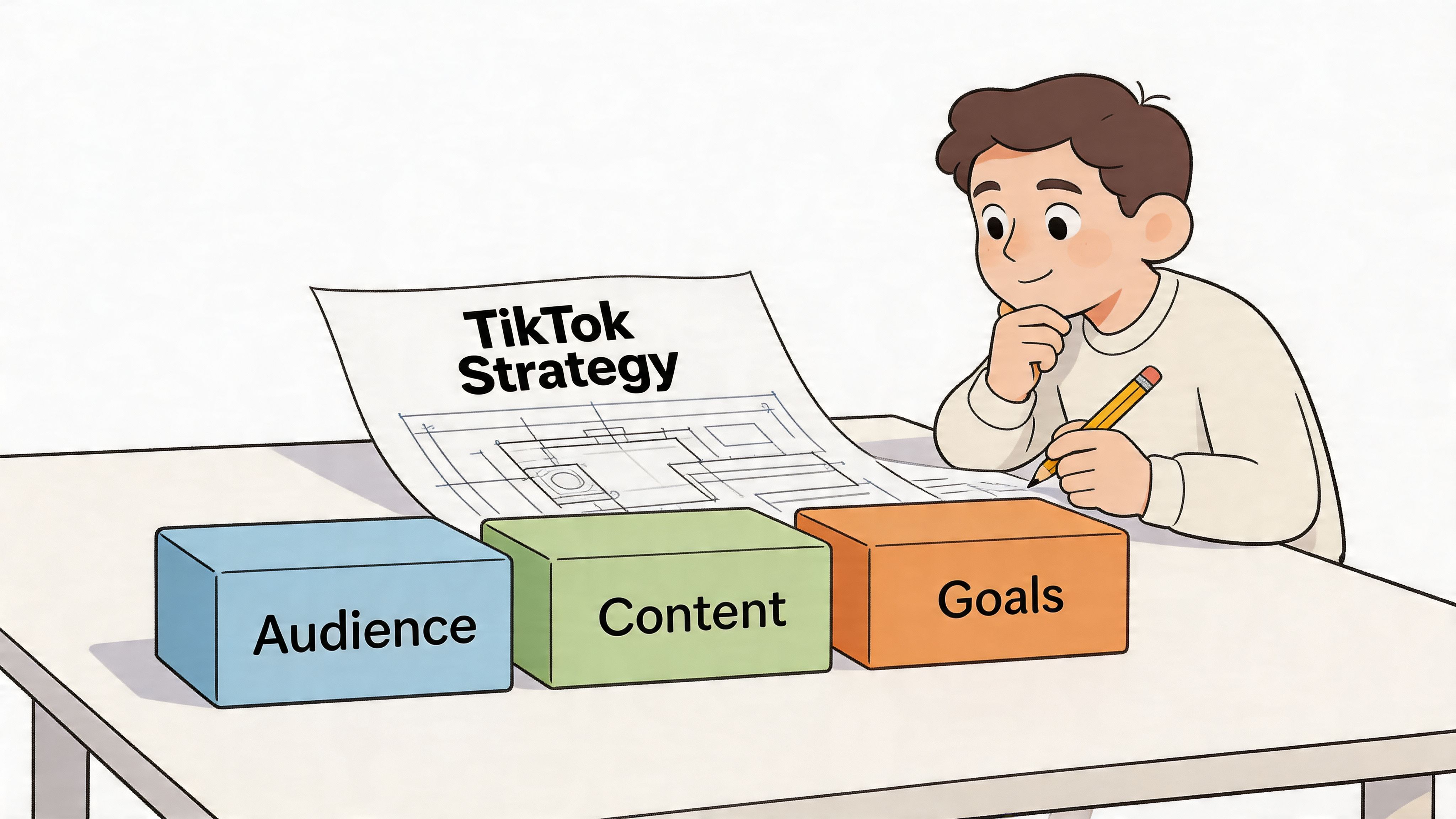
TikTok promotion fails early when the goal is fuzzy. "We want more exposure" isn't a strategy. It creates weak briefs, random videos, and bad postmortems.
Set one primary objective for each campaign. On TikTok, that usually falls into one of three buckets:
- Awareness: You want more people to know the product exists.
- Consideration: You want viewers to learn, compare, or click through.
- Sales: You want product page visits, TikTok Shop activity, or purchases.
If you mix all three into every video, the content gets muddy. A strong awareness clip can be funny, surprising, or highly relatable. A strong conversion clip usually needs clarity, proof, and a direct next step.
Define the buyer before you define the content
Determining audience fit often involves guesswork. This is expensive on TikTok because the platform moves fast and punishes bland creative.
Build a practical viewer profile around behavior, not demographics alone. Look at:
- What they already watch: product reviews, tutorials, routines, reactions, side-by-sides
- Who they trust: creators, niche experts, shop affiliates, founders, employees
- What problem they're trying to solve: save time, look better, fix pain, reduce cost, avoid hassle
- What tone they respond to: dry humor, blunt advice, demo-first, story-led
A skincare brand and a software tool can both sell on TikTok, but the framing changes. Skincare often needs visible use and outcome. Software usually needs a pain point, workflow simplification, and a quick proof moment.
Practical rule: If you can't explain why someone would stop scrolling for this product, you aren't ready to film.
Track the metrics that match the objective
Watch time matters. Engagement matters. Clicks matter. But they don't all matter equally on every video.
Use this simple operating view:
ObjectiveWatch firstSecondary signalsWhat success looks like
Awareness
Hook retention
Shares, profile visits
New viewers keep watching
Consideration
Average watch time
Comments, saves, clicks
Viewers want more detail
Sales
Click-through behavior
Product page visits, purchase actions
Viewers take the next step
This is also where native creative matters more than polished brand ads. For advanced product promotion, campaigns like Spark Ads and branded hashtag plays can work well, and 41% of viewers report higher loyalty after ads while branded challenges can boost awareness by 25-50% (Printful). But the same source notes that Gen Z rejects non-native content, and authentic tutorials outperform sales pitches by 4:1 in shares.
That's why your foundation should include a creative rulebook. Decide early what "native" means for your brand. Usually it means creator-style framing, real use cases, direct speech, and minimal corporate polish.
If you want a practical view of how automation and publishing fit into the TikTok platform, it's worth studying workflows that connect ideation, clip production, and distribution instead of treating each post like a one-off asset.
Build a testing plan, not a content calendar
A content calendar is useful. A testing calendar is better.
Each week, test variations across:
- Hook angle: problem, curiosity, result, opinion
- Presenter: founder, creator, customer, employee
- Offer framing: save money, save time, get a better outcome
- Format: talking camera, demo, testimonial, montage
A weak campaign usually doesn't need more effort. It needs cleaner variables. When teams post randomly, they can't tell whether the issue is the opening line, the presenter, or the product angle.
The TikTok Content Playbook That Actually Works
TikTok is a fast-decision feed. Creatives that win usually communicate the product, the use case, and the payoff almost immediately. TikTok’s own guidance on creative performance consistently points to the same rule. Put the message on screen early, because users decide fast whether a video deserves another few seconds.
That changes how product promotion should be built. The job is not to hide the sale. The job is to package the sale inside a format people already watch on TikTok.
Hooks that earn the next three seconds
Strong hooks create tension fast. They point to a mistake, a result, or a clear problem the viewer recognizes.
These formats are reliable:
- Problem-first: “If your product pages get traffic but no one buys, fix this.”
- Unexpected result: “This looked like a gimmick until we tested it.”
- Direct challenge: “Most brands show this product the wrong way.”
- Specific audience callout: “If you sell on TikTok Shop, watch your demo footage.”
Keep the opening focused on one idea.
A hook does not need to explain the whole offer. It needs to earn attention long enough for the viewer to care about the next line. In practice, that means skipping logos, long scene-setting, and polished intro shots that look expensive but say nothing.
Four content formats that consistently sell
Product demos
Demos reduce uncertainty better than almost any other format. Viewers can see the product, understand how it works, and judge the result for themselves.
The strongest demos answer practical buying questions without sounding scripted. What does it do? Who is it for? What problem does it solve faster, better, or more easily than the alternative?
For physical products, use close-ups, in-use footage, and clear before-and-after context when the transformation is real. For digital products, show the actual interface, the setup, and the output. Screen recordings usually outperform abstract brand visuals because they remove doubt.
Tutorial clips
Tutorials work because the viewer gets value before the pitch. That makes them one of the most efficient formats for product education and conversion.
Use a simple sequence:
- State the problem.
- Show the process.
- Introduce the product as the tool that makes the process easier or faster.
- End on the outcome.
This format gives teams more room to reuse existing material. A webinar walkthrough, product training, or customer onboarding call can often be clipped into short educational TikToks with very little rewriting. That matters if the goal is weekly output, not a one-off post.
Founder or creator talk-to-camera
Talk-to-camera still works because accountability reads well on TikTok. A founder, operator, or creator explaining a real use case usually lands better than a polished brand voice reading claims.
Keep it tight. One point. One proof. One CTA.
Tool choice affects how quickly your team can test variations from the same recording. If you want options, this guide to TikTok editing apps for faster clip production is a useful starting point.
The fastest way to improve a TikTok video is often cutting the first two seconds.
UGC and social proof clips
UGC works when it looks like real usage, not a brand trying to imitate real usage.
Ask creators and customers for footage that includes:
- The setup: what they needed or wanted
- The product in use: not just the packaging
- The reaction: practical, not exaggerated
- The takeaway: who should buy it and why
The trade-off is control. Raw creator footage feels more native, but it can miss key selling points. Tight briefs fix that. Ask for one problem statement, one demonstration, and one clear opinion after use.
What usually underperforms
We often see underperforming TikTok promotions follow a similar pattern.
Weak approachWhy it underperformsBetter alternative
Brand intro first
The viewer has no reason to care yet
Start with a problem, result, or strong claim
Overproduced ad style
It reads like an interruption inside a content feed
Use creator-style framing and direct speech
Too many features
The message gets diluted
Focus on one job the product does well
No narrative
There is no tension or payoff to hold attention
Build a short story with setup, proof, and outcome
The best TikTok product videos usually feel like a recommendation, a lesson, or a useful observation. That is the standard to aim for, especially if you plan to turn long-form assets into a repeatable stream of clips instead of rebuilding creative from scratch every time.
Scale Your Video Production with AI Workflows
Teams typically don't struggle with ideas. They struggle with throughput.
They know they should post more. They know TikTok rewards volume and testing. But recording fresh footage every day is slow, editing is slower, and approvals make everything worse. That's where a repurposing workflow changes the math.
If you have long-form content, you already have hooks, objections, product explanations, stories, and proof moments sitting in your archive. A founder webinar can become ten short clips. A customer interview can become a week of testimonials. A podcast can generate multiple opinion-led videos.
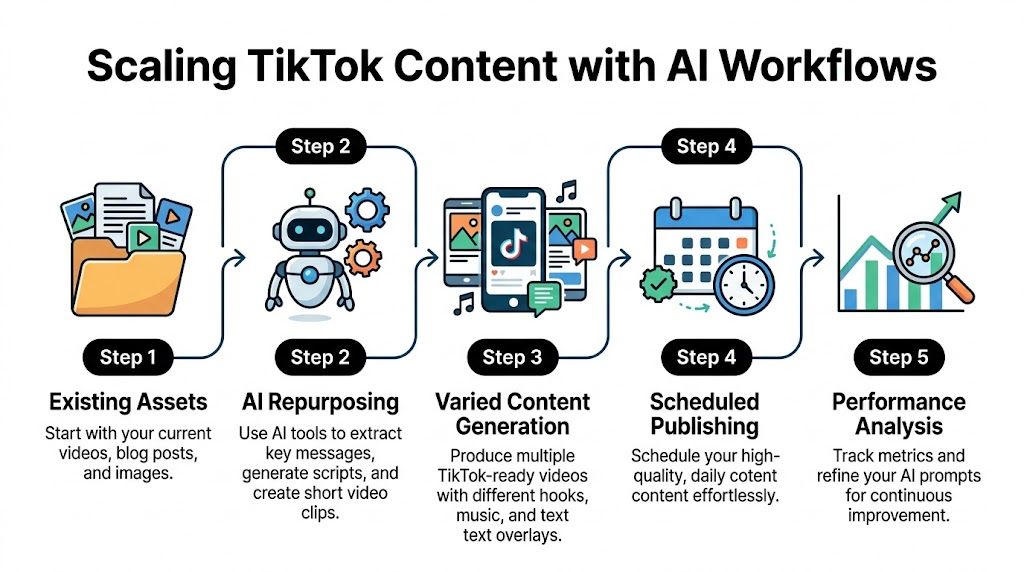
A practical repurposing system
Use a repeatable pipeline instead of an ad hoc editing queue.
- Start with strong source material
Pull from videos where someone is already speaking clearly about the product, a problem, a transformation, or a hot take. - Identify clip-worthy moments
Look for sections that open with tension. Good examples include a sharp opinion, a customer objection, a mistake to avoid, or a fast demo. - Convert for vertical viewing
Reframe to 9:16, tighten pacing, and keep the speaker or action centered. Most long-form footage wasn't shot for mobile, so composition matters. - Add readable captions
A lot of TikTok viewing happens with sound off or with partial attention. Captions make average footage more usable. - Export multiple angle variants
One core clip can produce several versions with different first lines, captions, or on-screen text.
Where AI actually helps
AI is useful when it removes repetitive editing labor. It isn't a replacement for judgment.
The best use cases are:
- Hook extraction: finding the parts of a long video most likely to hold attention
- Auto-captioning: speeding up subtitle creation and cleanup
- Reframing: keeping faces or product action centered in vertical format
- Variant generation: producing multiple testable cuts from one source file
Klap fits this workflow as one option for turning long-form video into short vertical clips. It can take a YouTube video or upload, identify engaging segments, add captions, and reframe for social formats. If you want to test that type of pipeline directly, the https://klap.app/tools/ai-tiktok-video-generator page shows the production path clearly.
Build around batches, not daily scrambling
The teams that stay consistent usually batch content. They don't wake up and ask what to post today. They process assets in rounds.
A simple weekly batch might look like this:
InputOutput
One webinar
Educational clips, objection-handling clips, CTA clips
One customer interview
UGC-style testimonial clips, quote-led hooks
One founder recording
Opinion clips, behind-the-scenes clips
One product demo
Feature clips, comparison clips, how-it-works clips
Workflow note: The point of AI isn't to make content generic. The point is to make testing sustainable.
The best results come from combining automation with human review. Let the tool surface options. Then choose the clips that feel native, clear, and credible.
Fueling Organic Growth and Going Viral
TikTok content can keep generating reach for days after publishing, but only if the first audience gives the platform strong signals to work with. Organic distribution tends to expand when a clip gets early watch time, comments, rewatches, shares, and profile visits. The practical job is simple. Publish more clips that earn those signals, more often.
That is why workflow matters as much as creativity. Teams that repurpose webinars, podcasts, demos, and customer calls into a steady stream of short clips have more chances to hit on a strong angle than teams betting everything on one hero post. Tools like Klap help reduce the editing load, but the primary advantage is volume with quality control.
What the algorithm seems to reward in practice
TikTok usually pushes a video further when it clears four tests fast:
- The hook makes sense in the first second or two
- The viewer can follow it without extra context
- The format feels native to the feed
- The post gives people a reason to react
A common mistake is overfocusing on hashtags and underfocusing on the clip itself. Hashtags can help TikTok categorize content, but they do very little for a weak opening or a muddy message. Clear packaging wins more often than clever tagging.
Use trends with restraint
Trends can help distribution, but only when they support the product story. A trending sound with no relevance to the offer may raise views while lowering click quality and buying intent.
Use a simple filter:
- Direct fit: the trend supports a demo, reveal, comparison, or reaction
- Adaptable fit: the format works, but the script needs to be rewritten for your product
- No fit: skip it and keep your posting slots for stronger ideas
This saves time. It also keeps the content engine focused on clips that can drive both reach and revenue, instead of chasing empty spikes.
Comments create momentum
Comment activity matters because it gives TikTok another reason to keep testing the post with fresh viewers. It also gives your team free creative prompts for follow-up videos.
Low-effort prompts rarely help. “Thoughts?” usually gets weak replies. Better prompts ask for a choice, an opinion, or a personal experience.
Try prompts like:
- Choice prompts: “Which version would you pick?”
- Contrarian prompts: “What would you never buy in this category?”
- Playful prompts: “Wrong answers only”
- Experience prompts: “What usually goes wrong when you try this?”
Replying with follow-up videos is one of the fastest ways to extend the life of a post that is already getting traction. In practice, one useful comment thread can become three more clips, a product objection video, and a stronger sales angle for the next batch.
Cadence beats sporadic brilliance
Avoid the pattern of posting one polished video and then disappearing for a week. TikTok rewards repeated testing because each post teaches you something different about hooks, positioning, and audience fit.
A steady rhythm also makes repurposing pay off. One long-form asset can become several TikToks with different openings, captions, and CTAs. That is far more efficient than starting from scratch for every post. If you sell through TikTok Shop, Affiliate Marketing TikTok Shop: The Ultimate Guide is a useful reference for pairing organic content with affiliate-driven distribution.
The brands that grow organically on TikTok usually do a few things well, over and over. They publish consistently. They test multiple angles from the same source material. They use trends selectively. They treat comments as creative input, not admin work. That is how viral moments become a repeatable system instead of a lucky break.
Paid Amplification with TikTok Ads and Influencers
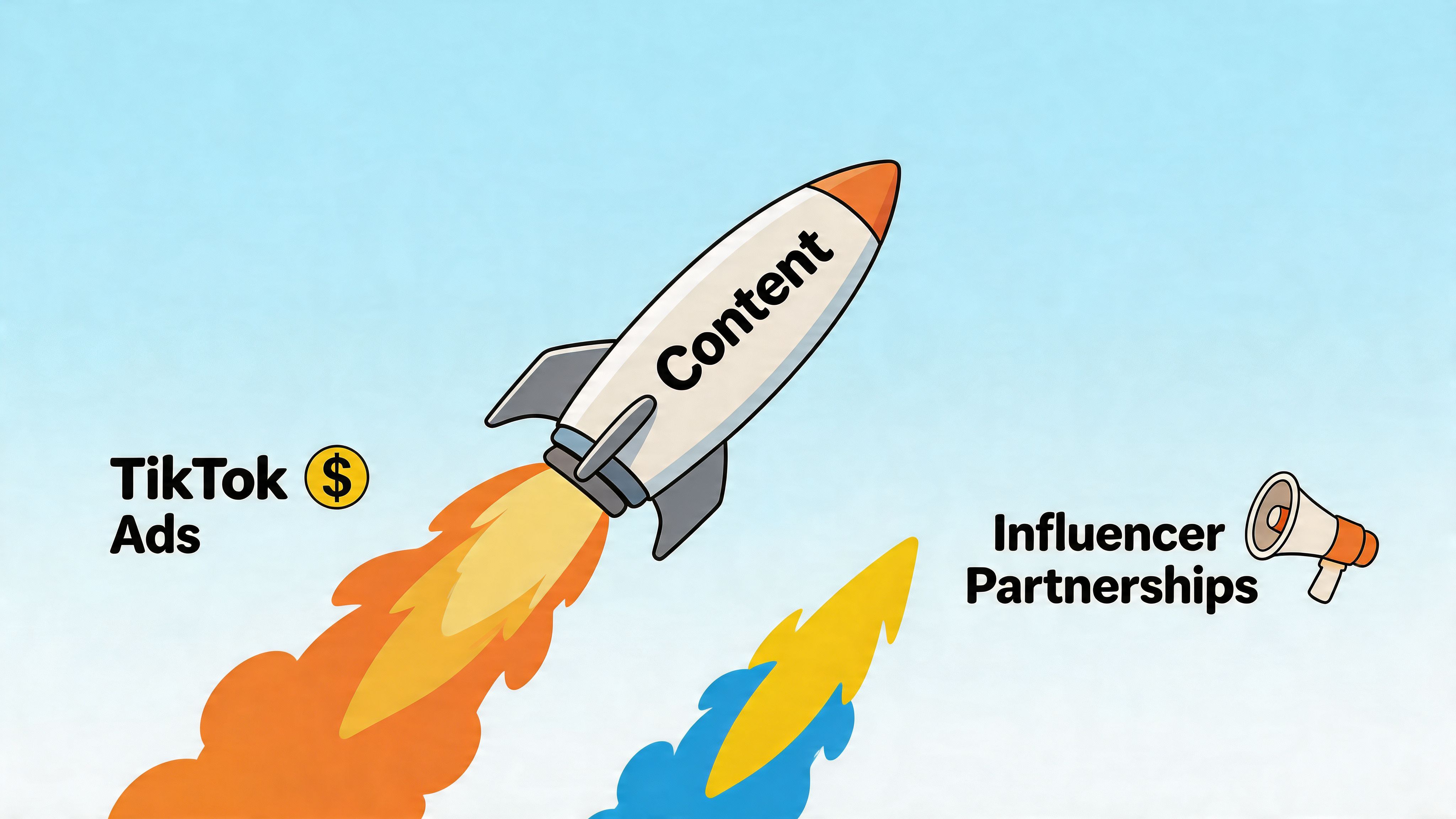
Once you've found creative that performs organically, paid distribution can scale it. But there are two very different levers here: ad buying and creator partnerships.
Most brands shouldn't ask which one is universally better. They should ask which one fits the product, timeline, and proof level.
TikTok ads when you need control
Ads give you speed, targeting, and testing discipline. They're useful when you already know the message and want to scale reach or conversions with more control.
Common options include In-Feed placements and Spark Ads. Spark Ads are especially useful because they amplify content that already looks native instead of forcing everything into a traditional ad shell.
Ads are usually the better choice when:
Use caseWhy ads fit
Product launch
You can force early reach and learn quickly
Retargeting intent
You control who sees the next message
Scaling a proven clip
You can push what already works
Tight reporting needs
Campaign structure is easier to analyze
The trade-off is creative fatigue. If the ad looks too polished or too sales-heavy, viewers scroll. Paid reach doesn't fix weak creative.
Influencers when you need trust
Influencer content solves a different problem. It transfers credibility faster than most brand-owned content can.
On TikTok, nearly 50% of TikTok Shop purchases originate from influencer posts, brand advertising recall rises 27% when campaigns include influencers, and nano-influencers under 100k followers deliver engagement rates from 7.5% to 10.3% (PartnerCentric).
That last part matters. Many brands chase the biggest name they can afford. In practice, smaller niche creators often produce better product-market fit, better comment quality, and more believable recommendations.
Ads versus influencers in real use
- Choose ads if your offer is clear, your landing flow is strong, and you already have winning organic creative.
- Choose influencers if the product needs demonstration, trust transfer, or category education.
- Use both when a creator video performs organically, then gets boosted through paid media.
A lot of teams get the most value from creator-led assets that later become ad creative. That gives you authenticity first and scale second.
If you're structuring a creator commerce program, this guide on Affiliate Marketing TikTok Shop: The Ultimate Guide is worth reviewing because affiliate mechanics change how you source creators, handle incentives, and evaluate output.
Here's a useful walkthrough to pair with your planning:
How to vet creators without wasting budget
Follower count is a weak filter on its own. Look deeper:
- Check product fit: Have they talked about adjacent products naturally?
- Review comment quality: Do people ask real questions or just leave emojis?
- Look at delivery style: Can they explain, demo, or compare clearly?
- Assess editing pace: Does their content hold attention without feeling forced?
Give creators a clear brief, but don't over-script them. The more a creator sounds like your brand manager wrote the lines, the worse the video usually performs.
Turning Viewers into Customers on TikTok
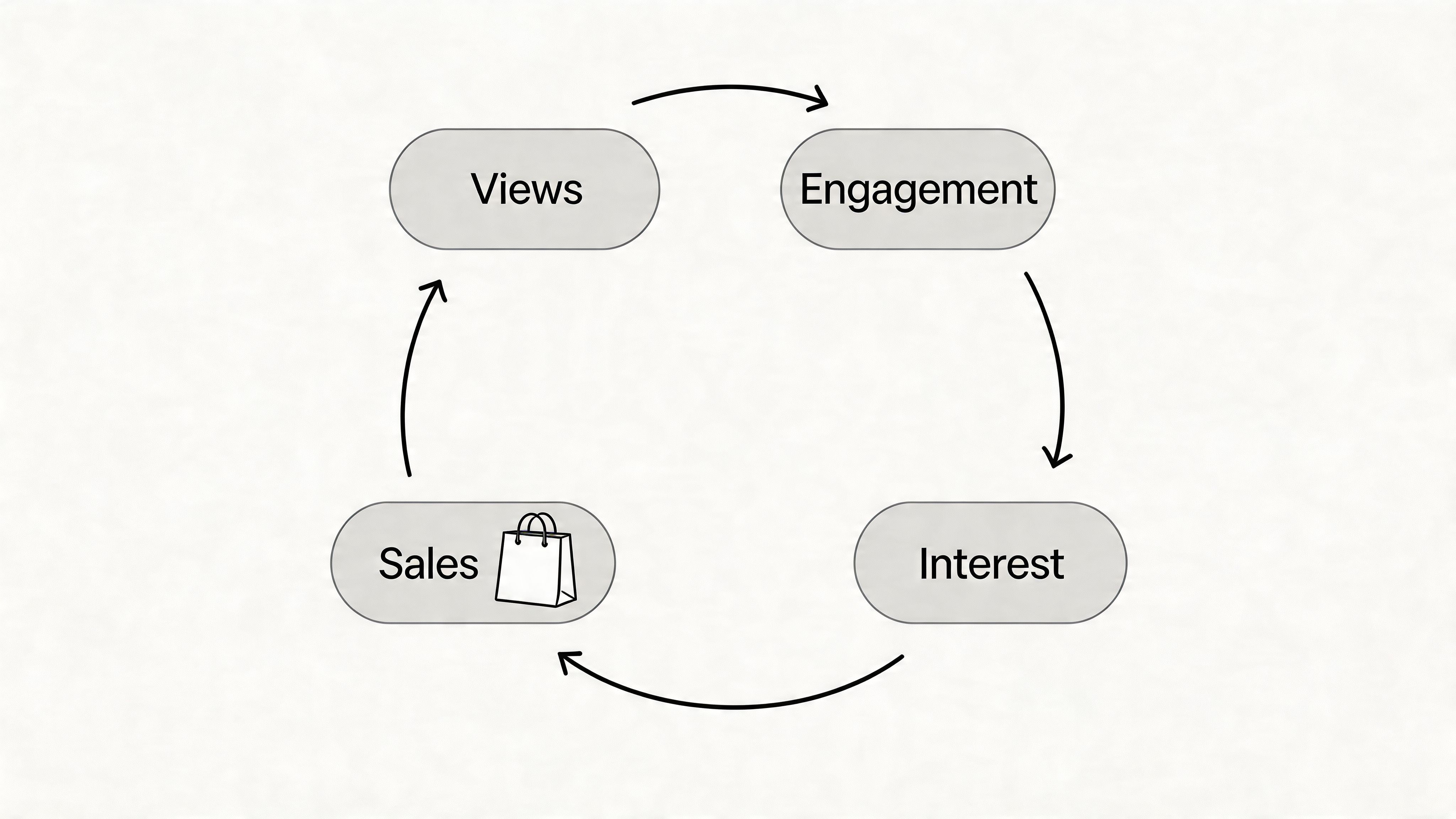
TikTok can generate huge buying intent, but conversion still breaks when the path from video to checkout takes too many steps. The common disconnect between high attention and low sales is usually a friction problem.
Fix that first.
A viewer who likes the video should know where to click, what they are buying, and why this version fits them. If any of that is unclear, the sale slips.
Fix the conversion path first
Start with your profile, because that is where a strong clip often sends interested traffic. Your bio should answer three questions in seconds:
- What do you sell
- Why does it matter
- What should someone do next
Keep the profile picture, display name, bio, pinned posts, and shop or link destination aligned. If the video promises one thing and the profile signals another, drop-off climbs fast. I have seen brands spend weeks improving hooks while the actual issue was a vague bio and a landing page that did not match the product shown in the clip.
Use TikTok Shop and direct CTAs properly
If TikTok Shop fits your setup, use it. Fewer clicks usually means more completed purchases, especially for lower-consideration products and impulse buys.
The CTA has to match the moment in the video. Broad prompts waste intent. Specific prompts convert better because they answer the viewer's next question.
- Tap to shop if you want the exact version shown
- Open the product page to see how it works
- Check the pinned link for the full setup
- Watch part two before you buy if you're comparing options
“Link in bio” still has a place, but not as the default on every post. It adds a step. Use it when the buyer needs more context, product comparison, or a bundle page that does more selling than the TikTok Shop listing can.
Captions should support the sale
Captions close small gaps that the video leaves open. Use them to answer one objection, clarify who the product is for, or explain a detail that helps someone decide faster.
Readable subtitles matter too. They help with retention, comprehension, and product clarity, especially when you are repurposing podcasts, webinars, or founder videos into shorter clips. If you are building volume from existing footage, a TikTok subtitle generator speeds up production and keeps on-screen text consistent across dozens of assets.
That matters more than it sounds. A scalable workflow only works if the clips are still easy to follow and easy to buy from.
The conversion videos that keep working tend to follow a simple sequence. Show the product clearly. Explain why it matters. Remove doubt about the next step.
Frequently Asked Questions About TikTok Product Promotion
How promotional does a TikTok product video need to be?
Your videos should be less promotional than you might think.
TikTok works best when the product is part of a useful, entertaining, or curiosity-driven moment. A direct sales pitch usually lowers watch time. A clear demo, a strong use case, or a fast before-and-after gives the product a reason to belong in the feed.
In practice, that means showing the product doing something specific. Solve one problem. Answer one question. Give the viewer a reason to keep watching before you ask them to buy.
How do you avoid TikTok Shop compliance problems?
Avoid common compliance mistakes that many brands make. TikTok Shop checks whether the video matches the product listing, and small mismatches can hurt both approval and performance.
TikTok Shop seller guidance notes that policy violations increased in Q1 2025, and it also recommends UGC-style videos that clearly show the actual product from multiple angles and in real use because those formats perform better than generic ad creative. Review the guidance before publishing if your team is posting shoppable content from a high-volume workflow: TikTok Shop seller guidance.
Use a short review process before anything goes live:
- Match the product exactly: color, model, size, shape, and visible features should match the listing.
- Show real use: especially for beauty, tools, kitchen products, and anything with a performance claim.
- Keep claims consistent: the video, title, and product page should say the same thing.
- Check repurposed clips manually: AI can speed up editing, but a human should still confirm product accuracy and claims.
Teams that repurpose webinars, podcasts, or creator footage into dozens of clips each week need this step even more. Speed helps distribution. Accuracy protects the account and the sale.
Should small brands start with ads or organic content?
Start with organic if you do not already have a disciplined paid testing setup.
Organic content shows which hooks, problems, and product angles get attention without paying for every lesson. Then paid spend can amplify clips that already proved they can hold watch time. That lowers creative waste and gives you better inputs for Spark Ads or creator partnerships.
This matters even more if you are building content from long-form assets. One webinar or product walkthrough can produce multiple TikTok tests with Klap, which gives you a faster way to find winning messages before you put budget behind them.
How much should you rely on influencers?
Use influencers to add trust and distribution. Do not use them to figure out your positioning for you.
A creator can make a strong offer travel faster, but they will not fix a weak product page, a confusing benefit, or a bad hook. The best workflow is usually simple: validate angles on your own channel first, then brief creators on the messages and product moments that already work.
That keeps creator spend focused on scale, not guesswork.
If you're sitting on podcasts, webinars, interviews, or YouTube videos, turn them into a real TikTok publishing system instead of letting that footage collect dust. Klap helps teams convert long-form video into short vertical clips with captions, reframing, and editable outputs, which makes it much easier to keep testing content without rebuilding your workflow every week.