Your Winning User Generated Content Strategy for 2026
Other

A solid user generated content strategy is your game plan for encouraging, gathering, and using content your audience creates—like reviews, photos, and videos—to champion your brand. It's a powerful shift from pushing polished ads to showcasing genuine social proof. Honestly, it builds trust and drives sales far more effectively than traditional marketing ever could.
Why UGC Is Your Brand's Most Authentic Asset
Let's be real: consumers are drowning in ads. They’ve become experts at tuning out slick, corporate messages and are actively looking for authentic experiences instead. They trust real people, not brand logos. This is why a smart user generated content strategy isn't just a "nice-to-have"—it's a core engine for modern growth. It’s about turning your audience into your most valuable creative partners.
The magic of UGC lies in its raw authenticity. When a customer shares a photo of your product in their daily life or posts a video testimonial, it provides a powerful endorsement that a high-budget ad campaign simply can't buy. The numbers don't lie: a staggering 92% of consumers trust content from their peers far more than traditional advertising.
This isn't just about warm, fuzzy feelings; it's about real business results. The global market for UGC platforms exploded to $7.1 billion in 2025 and is on track to hit $8.48 billion by 2026. Savvy marketers know this growth reflects a simple truth: brands that integrate UGC see an average 29% lift in web conversions.
UGC vs. Traditional Brand Content At a Glance
The difference between UGC and old-school ads is night and day. Branded content is a monologue where you talk at your audience. UGC is a conversation where they talk with you and for you. To truly grasp the difference, it’s worth exploring the full scope of user generated content benefits that build lasting brand trust.
This table breaks down how customers perceive the two.
MetricUser Generated Content (UGC)Traditional Brand Content
Trust
High. Seen as an authentic peer recommendation.
Low. Viewed as a biased sales pitch.
Authenticity
Genuine, relatable, and unpolished.
Polished, scripted, and often unrelatable.
Engagement
Generates more likes, comments, and shares.
Lower organic engagement; often relies on paid spend.
Cost
Low to none. Sourced directly from your community.
High production costs for photoshoots and video.
Conversion
Significantly higher, driven by social proof.
Lower, as consumers are skeptical of direct ads.
Ultimately, UGC turns your marketing from a company-led initiative into a community-driven movement. It’s more believable, more engaging, and far more cost-effective.
The most powerful shift is realizing that your customers are not just consumers; they are creators, advocates, and your best-performing marketing channel. Your brand story is being told with or without you—a UGC strategy ensures you're part of the conversation.
Repurposing Existing Assets as UGC-Style Content
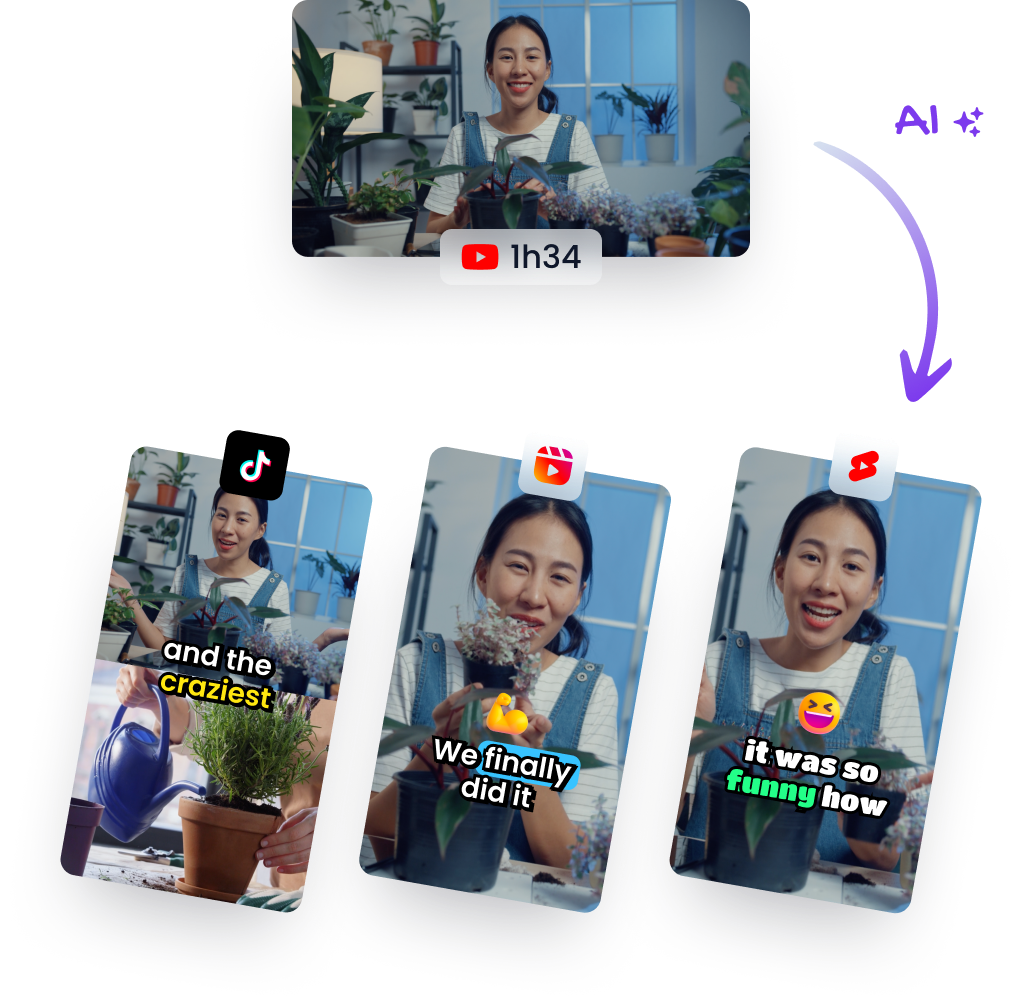
Here's a powerful tactic that many brands overlook: creating UGC-style content from your own existing assets. Have a podcast? A webinar? A recorded customer interview? These long-form videos are goldmines for authentic, bite-sized clips that mimic the raw feel of user-generated posts.
This approach gives you a steady stream of content that feels native to platforms like TikTok and Instagram Reels, capturing the unpolished style that makes UGC so compelling.

By repurposing your long-form content, you can rapidly scale your output with short clips that have that genuine, off-the-cuff vibe. It's a fantastic starting point for any brand wanting to dip its toes into the UGC world without launching a full-blown campaign. We cover more on this in our guides on content creation. It perfectly bridges the gap between purely branded content and fully user-led initiatives.
How to Build Your UGC Sourcing Engine
A great user-generated content strategy doesn't run on luck. If you're just waiting for customers to tag you in posts, you're leaving money on the table. You need a repeatable system—an engine—that consistently brings in authentic content you can actually use.
It all starts with knowing what you’re trying to achieve. Before you ask for a single photo or video, get crystal clear on your main goal. Are you trying to boost brand awareness? Increase conversions on a specific product page? Or are you focused on building a die-hard community?
Each of these goals requires a different approach. A brand chasing awareness might launch a viral hashtag contest. But a brand focused on conversions will want video testimonials to feature directly on their product pages. Nailing down your objective first ensures you don’t end up with a folder full of content that doesn't move the needle.
Designing Compelling Sourcing Campaigns
Once you know your "why," you can focus on the "how." The trick is to make participating so easy and exciting that your audience can't resist. You're not just asking for content; you're creating an experience.
Here are a few actionable tactics to get the ball rolling:
- Branded Hashtag Contests: A classic for a reason. Offer a prize worth talking about in exchange for posts tagged with a unique hashtag. Doritos' #CrashtheSuperBowl campaign is the stuff of legends, offering a $1 million prize and turning its fans into Super Bowl ad creators. On a smaller scale, even a $100 gift card can generate hundreds of entries.
- Targeted Product Seeding: Instead of a massive giveaway, strategically send products to a handful of customers or micro-influencers who perfectly match your brand aesthetic. Then, ask for their genuine feedback in an unboxing video or a "day in the life" post.
- Community-Focused Challenges: Tap into a shared passion. The lifestyle brand Apartment Therapy nailed this with its #SmallCoolChallenge, getting users to show off their small living spaces. The focus is on the community's creativity, not just the brand.
The secret to amazing UGC isn't a huge budget. It's creativity and truly understanding what makes your audience tick. Make them the hero of the story, and they'll create content far more powerful than any ad you could ever buy.
As you build out your UGC engine, pulling strategies from a solid social media for brands playbook can give you a serious leg up, helping you integrate these campaigns right where your audience lives.
Crafting Incentives That Motivate Action
Sure, some loyal fans will create content just for the love of your brand. But if you want to really crank up participation, incentives are a must. The good news? It doesn't always have to be about cash. Research from a Nielson study shows that 67% of consumers are motivated by exclusive access and recognition.
Think about using a mix of rewards to keep things interesting:
Incentive TypeExampleBest For
Public Recognition
A feature on your homepage or a shout-out on your Instagram.
Building community and rewarding your biggest advocates.
Exclusive Access
Early access to a new product or a private Q&A with the founder.
Fostering deep loyalty with your most engaged fans.
Discounts & Freebies
A 25% off coupon or a free product for their next post.
Driving repeat business and generating tangible ROI.
Major Prizes
Cash, vacations, or high-value product bundles.
Creating massive buzz and attracting a high volume of content.
The best incentives feel authentic to your brand and line up with what your audience actually wants. If you're a travel company, a free trip is a no-brainer. But for a SaaS brand, a lifetime subscription might be way more exciting than a gift card.
Securing Legal Rights and Permissions
This is it. The most critical—and most frequently ignored—step in any user generated content strategy. Let me be clear: a user tagging your brand or using your hashtag is not legal permission to repurpose their content, especially in paid ads.
Skipping this step can land you in serious legal trouble and completely trash your brand's reputation. You must always ask for permission. For content you find on social media, a simple DM usually does the trick.
Keep your permission request short and to the point:
- Lead with a compliment: Start by telling them how much you love their post. Be genuine.
- State your intent: Be super clear about how you want to use it (e.g., "on our Instagram feed," "in a paid social ad," or "on our website").
- Ask for a clear "yes": Tell them exactly how to give you permission. For example, "If you're happy for us to do that, please reply with #Yes[YourBrand]."
For bigger campaigns, it's smart to have a link to your official terms and conditions ready to go. Many UGC platforms can automate this whole rights management process, which is a lifesaver as you start to scale. Getting this right from day one protects both you and your awesome creators.
Repurposing Content Into High-Impact UGC
Sourcing great content is a huge win, but it’s just the beginning. Raw photos and videos are full of potential, but they need to be polished and formatted to actually grab attention and get results. This is where you turn authentic submissions into high-performing social assets.
But here’s an even more powerful, often-overlooked strategy: mining your own long-form content. Think webinars, podcasts, and interviews. These are goldmines for clips that have the same raw, genuine feel as user-created posts. This tactic lets you scale your content production massively, turning a single one-hour video into a month's worth of social proof.
The Power of Repurposing Your Own Content
Think about the content you already have sitting on a hard drive. That customer Q&A from last month's webinar? The killer testimonial from a podcast guest? Those moments are pure gold. They're unscripted, authentic, and deliver value in a way that feels completely genuine—exactly like the best UGC.
The problem has always been the sheer amount of time and effort it takes to find and edit these clips. This is where AI-powered tools come in. A platform like Klap is built for this exact purpose, letting you upload a long video and have the most engaging segments automatically identified. It's like having a video editor on your team who knows exactly what will pop on social media.
This visual shows the typical process for a strong UGC engine, which is what provides the raw material for this whole repurposing workflow.
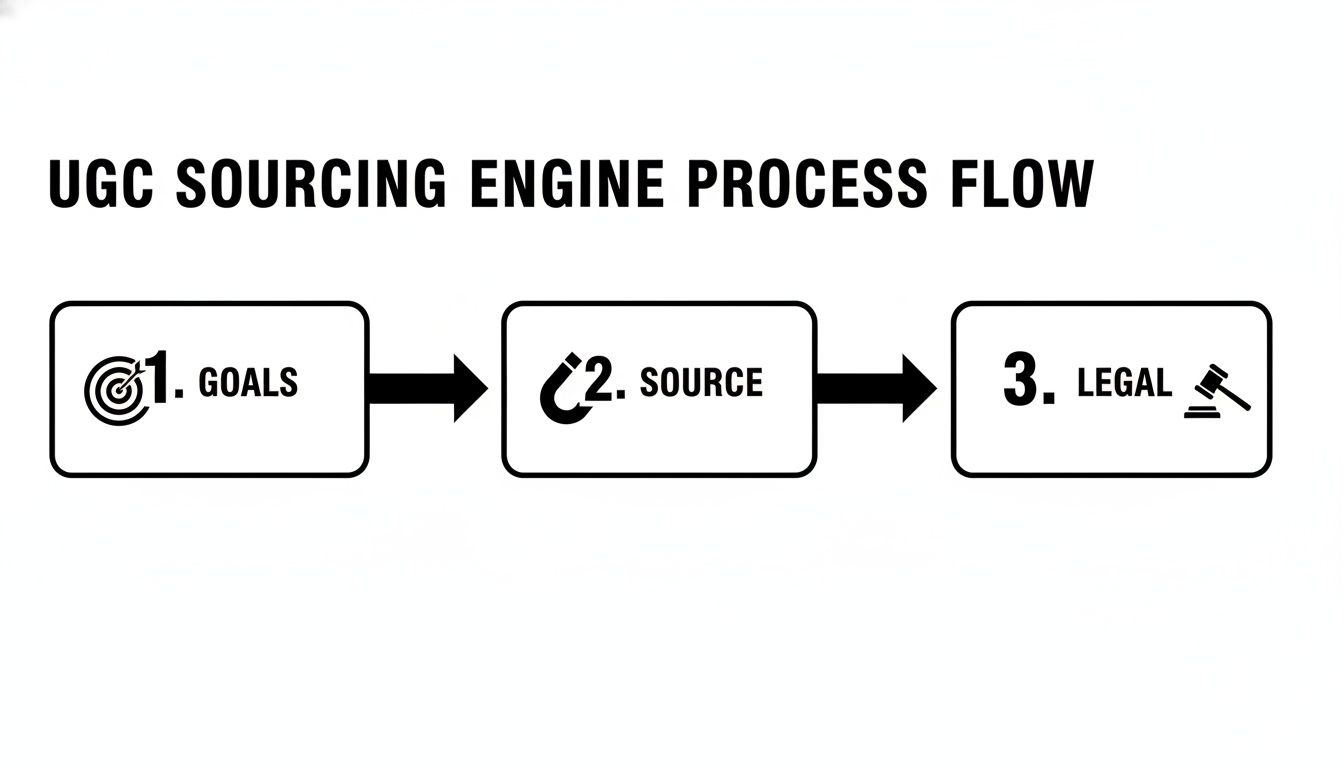
As you can see, a successful strategy starts with clear goals before moving on to sourcing and legal clearance. That groundwork sets you up for this critical repurposing phase.
A Modern Workflow for Creating Short-Form Video
Turning raw footage into clips ready for social media requires a smart workflow. It doesn’t matter if you're starting with a customer’s unboxing video or a segment from your own podcast—the goal is to make it look and feel native to platforms like TikTok, Instagram Reels, and YouTube Shorts.
Here’s an actionable workflow for creating engaging short-form videos:
- Find the Hook: The first 3 seconds determine if someone keeps watching. Whether you're using an AI tool or reviewing manually, find moments with a strong emotional pull, a surprising statement, or a pressing question that hooks the viewer instantly.
- Reframe for Vertical: Most UGC and long-form content is shot horizontally. To win on mobile, you have to reframe it for a 9:16 aspect ratio. Smart tools can automatically keep the speaker or main action in the frame, saving you hours of tedious editing.
- Add Dynamic Captions: With up to 85% of social videos watched with the sound off, captions are non-negotiable. Dynamic, word-by-word captions (popularized by creators like Alex Hormozi) have been proven to seriously boost watch time and retention.
- Edit for Pace: Cut out every bit of dead air and any long pauses. Your clips need to be fast-paced and punchy, ideally between 15 and 45 seconds. The goal is to deliver value fast and get people to re-watch or share.
If you’re just getting your feet wet, you can get a head start and learn how to create YouTube Shorts from existing video to maximize your reach.
Scaling Your Output with AI-Powered Tools
Manually editing every single clip just isn't scalable for most teams. This is where a dedicated repurposing platform becomes a total game-changer for your content strategy.
By using AI to handle the heavy lifting of clip discovery, reframing, and captioning, you free up your team to focus on the bigger picture. You shift from spending hours on one video to generating dozens of ready-to-post clips in minutes.
This approach brings a few key advantages to your content workflow:
- Consistency: It guarantees a steady stream of content for your social channels, keeping your brand top-of-mind.
- Efficiency: It drastically cuts down the time and money spent on video production and editing.
- Authenticity at Scale: It helps you create content that has that "real person" feel that resonates so strongly with audiences today, but without the manual grind.
By building this repurposing mindset into your strategy, you turn every piece of content—whether it comes from a user or your own library—into a reusable asset. Your content strategy transforms from a constant sprint for new ideas into an efficient system that gets maximum value from everything you create.
How to Scale and Automate Your UGC Workflow
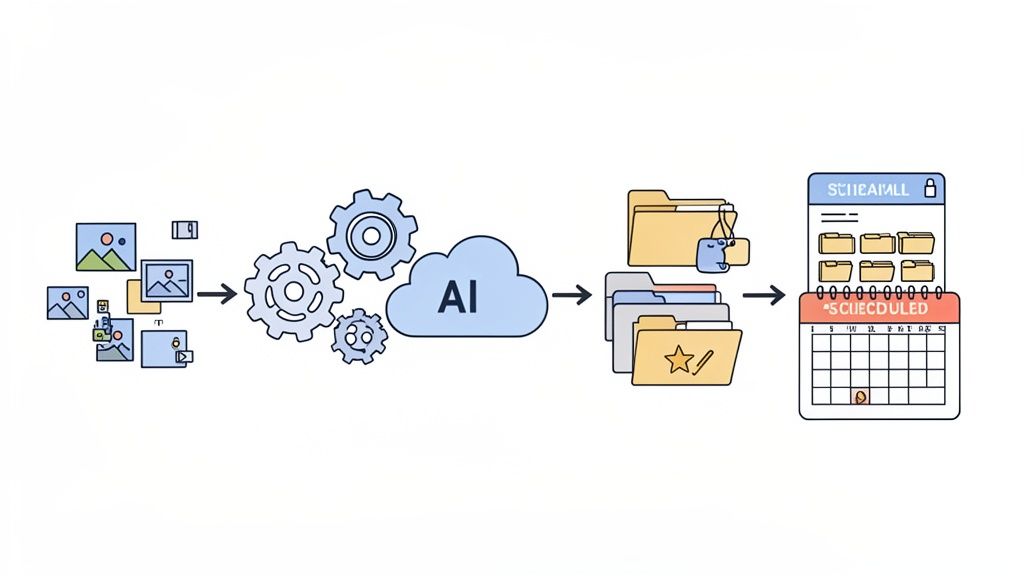
Getting great user-generated content is one thing. Actually using it effectively is another. If sourcing content is half the battle, the other half is building a workflow that prevents a disorganized mess of video files and screenshots. Without a system, you simply can't scale.
The goal here isn't just to stay organized—it's to automate the tedious work so you can focus on strategy and community building. A manual process might work when you’re handling a few posts a week, but it breaks down completely once you start getting hundreds.
Building Your Content Moderation Guardrails
Before any piece of UGC sees the light of day, it has to pass your brand’s standards. Moderation is your first line of defense against anything off-brand, low-quality, or inappropriate. I've found a blended approach using both human review and AI works best.
- Manual Review: For smaller volumes, nothing beats a human eye. People are far better at catching nuance, humor, and subtle context that an algorithm might miss. This is absolutely critical when you're hand-picking top-tier content for a big campaign.
- Automated Moderation: As your UGC volume grows, AI-powered tools become a necessity. They can automatically filter out spam, profanity, or specific keywords you want to avoid, flagging only the borderline content for a human to review. This saves an incredible amount of time.
Think of it as a quality control queue. Nothing gets published without a stamp of approval, which is key to protecting your brand's reputation.
Creating an Organized and Searchable Content Library
A messy desktop folder filled with random video files isn't a content strategy—it's a digital headache waiting to happen. You need a central content library where every asset is tagged and easy to find. This is how you turn a digital junk drawer into a powerful, searchable database.
The real value of a UGC library isn't just storing content—it's the ability to find the perfect asset for the perfect moment in seconds. Need a video testimonial from a customer in New York for a targeted ad? Smart tagging makes that possible.
Start by creating a consistent tagging system. Here are a few actionable tags to start with:
- Product: Which product is featured? (e.g.,
product-running-shoe) - Content Type: Is it a video, an image, or a text review? (e.g.,
type-video-unboxing) - Campaign: Was this created for a specific initiative? (e.g.,
campaign-summer2026) - Usage Rights: What permissions do you have? (e.g.,
rights-paid-social) - Performance: Did the original post do well organically? (e.g.,
performance-high-engagement)
This level of organization is the absolute backbone of a scalable user generated content strategy.
Assembling Your Modern UGC Tech Stack
Let's be real: no single tool does it all. A truly modern UGC workflow is built by connecting a few specialized platforms that work together to automate the entire process, from sourcing content all the way to scheduling it.
Your tech stack should cover the entire content lifecycle.
- Sourcing & Rights Management: First, you need a way to find the content. Dedicated UGC platforms can automatically pull in posts that use your hashtag or mention your brand, and they make getting legal permissions much smoother. This is non-negotiable if you want to stay compliant at scale.
- AI-Powered Editing & Repurposing: Once you have the rights, you need to make the content shine. This is where an AI editor like Klap comes in. It’s built to take raw video submissions—or even your own long-form videos—and quickly generate dozens of short, captioned clips perfectly formatted for TikTok, Reels, and Shorts. For programmatic access, you can even integrate these features with an API for automated video editing.
- Content Scheduling & Distribution: Finally, a good social media scheduling tool lets you plan out your UGC calendar weeks or even months in advance. This ensures you have a consistent stream of authentic content going out on all your channels without any last-minute scrambling.
By connecting these types of tools, you build an automated pipeline. A piece of UGC can be sourced, cleared, edited into a viral-ready clip, and scheduled to post with very little manual effort. This is how you graduate from just collecting content to strategically deploying it for maximum impact.
Measuring UGC Performance and Optimizing for Growth
So you're getting great UGC, but how do you prove it’s actually working? Likes and shares are nice, but they won't convince your boss to increase your budget. To show the real value of your user generated content strategy, you need to tie your efforts directly to business results.
This is all about moving past vanity metrics and focusing on the numbers that actually impact your bottom line. A great UGC program isn't just about collecting cool content—it's about using that content to fuel measurable growth.
Focus on the KPIs That Actually Drive Growth
To prove the ROI of your UGC, you have to track the right data. Your goal is to show how authentic content from your community influences customer behavior and helps you hit your business targets.
Here are the key metrics you should be tracking:
- Conversion Rate: This is the most important one. Track how many people who interact with UGC (on a product page, in an ad, etc.) end up buying. Ads featuring UGC see a 4x higher click-through rate on average, which directly impacts sales.
- Engagement Per Post: Don’t just look at total likes. Compare the average comments, shares, and saves on your UGC posts to your regular branded content. This tells you what your audience genuinely connects with.
- Submission Volume & Quality: Are you getting more UGC this month than last month? A steady increase is a great sign of a healthy, growing community. Also, keep an eye on the quality—is the content getting better over time?
- Cost Per Asset: Calculate what you’re spending to acquire each piece of usable UGC. If you're sourcing it organically from your community, this cost is often close to zero. That’s a powerful story to tell about your marketing efficiency.
When you can show that adding customer photos to a product page boosted the conversion rate by 9%, you’ve got a clear, data-driven win. That’s the kind of insight that gets everyone on your team excited about UGC.
Run A/B Tests to Figure Out What Works
The quickest way to improve your strategy is to test it. A/B testing different types of UGC is a cheap and effective way to see what resonates with your audience. Stop guessing and let the data do the talking.
This creates a feedback loop where you’re constantly learning and getting better. Just set up a simple test comparing two different approaches and see which one performs best for a specific goal, like getting more clicks or sales.
Here’s a simple framework for your tests:
Test IdeaMetric to TrackWhat You'll Learn
Video Testimonial vs. Unboxing Photo in an ad.
Click-Through Rate (CTR) & Cost Per Click (CPC).
Which format grabs more attention and drives cheaper traffic?
UGC Gallery vs. Single Image on a product page.
Add-to-Cart Rate & Conversion Rate.
Does more social proof actually lead to more sales?
Customer Quote vs. Employee Quote on a careers page.
Application Clicks.
What kind of proof is more convincing for job applicants?
Reposted Reel vs. Original Branded Reel.
Engagement Rate & Reach.
Does authentic content from users outperform your own?
When you run tests like these, you're replacing guesswork with real data. This allows you to go all-in on the formats and channels that deliver the best results, making your user generated content strategy more powerful over time.
Build a Simple Reporting Dashboard
You don’t need a fancy, expensive tool to start tracking your UGC performance. A simple spreadsheet or a free dashboard in a tool like Google Data Studio works perfectly.
Your dashboard should be the single place where you can see all your most important KPIs at a glance.
- Pull Your Data Together: Bring in the numbers from your social media analytics, e-commerce platform (like Shopify), and any UGC tools you’re using.
- Look for Trends: Use basic charts to show how things like submissions, conversions, and engagement are changing month-to-month.
- Showcase Your Wins: Create a section to highlight your best results—like that one UGC ad with a massive ROI or the product page that saw a huge conversion lift after you added customer photos.
This dashboard becomes your proof. It’s what you’ll bring to meetings to show the value of your work, defend your budget, and make the case for investing even more in your community’s content.
Common Questions About User Generated Content Strategy
Even the best-laid plans run into tricky questions on the ground. When it comes to building a user generated content strategy, a few common hurdles pop up for almost everyone, whether you're just starting out or trying to scale.
Let's walk through the big ones I see marketers face all the time.
How Can I Get UGC if My Brand Is New?
This is the classic chicken-or-egg problem. No customers means no content. But you have to be the one to spark the flame. Don't just cross your fingers and hope for the best.
A simple, direct exchange is often the best approach to get the ball rolling. Offer your first few customers a free product, a significant discount, or some exclusive swag in return for an honest review or a social post. You can also run a small-scale social media contest with a prize that your specific audience would actually want.
Another great angle is to connect with micro-influencers (creators with under 10,000 followers). These creators have tight-knit, engaged communities and are often excited to work with new brands. The goal is to make it incredibly easy for your earliest fans to participate and feel like they're part of your brand's journey from the start.
What Is the Most Critical Legal Part of Using UGC?
Getting explicit, written permission. Period. This is the one thing you absolutely cannot skip.
Just because someone tags your brand or uses your hashtag does not give you the legal right to use their photo or video in your marketing—especially not in paid ads.
Assuming you can use someone’s content just because they mentioned you is the fastest way to wreck your brand's reputation and find yourself in a legal mess. Always, always ask first.
The gold standard is to have users agree to clear terms and conditions through a dedicated campaign submission form. If you find content organically on social media, slide into their DMs and ask for permission directly. Be specific about how you want to use it (e.g., "on our Instagram," "in a Facebook ad," "on our product pages"). As you grow, many UGC platforms can help automate this rights management process, which is a lifesaver.
Can I Repurpose My Own Videos as Part of a UGC Strategy?
Absolutely. While it’s not technically from a user, repurposing your own long-form content is a brilliant way to mimic the authentic, unpolished style that makes UGC so effective. Think about it: your webinars, podcasts, and customer interviews are packed with real, unscripted moments.
This is where tools like Klap come in handy. Instead of manually scrubbing through hours of footage, you can use AI to pull out the best parts—compelling stories, audience Q&A, or strong hooks that feel genuine.
By reformatting these clips with dynamic captions for platforms like TikTok and Instagram Reels, you get content that feels native to the feed and has that same off-the-cuff vibe. It’s a smart way to fill your content calendar with posts that have the look and feel of real UGC, using assets you already own.
How Much Should I Budget for a UGC Strategy?
This is one of the best parts about a user generated content strategy—it's incredibly budget-friendly. You can genuinely get started with $0. Focus on building a strong community and offer non-monetary rewards like a shout-out on your social channels or other public recognition.
Even a small budget can make a big impact. You could earmark some funds for product seeding with a handful of micro-influencers or buy a prize for a hashtag contest. This kind of targeted spending can produce a ton of quality content without breaking the bank.
If you’ve got a larger budget, you can put money behind paid ads to promote your UGC campaign, license premium content from top-tier creators, or invest in management and repurposing platforms. Given the high ROI of UGC—research shows ads featuring UGC get a 73% higher time-on-site—it's one of the most effective strategies you can run, no matter the budget.
Ready to turn your existing videos into a stream of viral-ready clips that capture the authentic UGC feel? Klap uses AI to find the best moments in your long-form content and transforms them into engaging shorts in minutes. Try it for yourself.