Transcribe Video to Text in 2026: Expert Methods
Other
You've probably got the same problem most video creators have. Hours of podcasts, interviews, webinars, sales calls, lessons, or YouTube uploads are sitting in a folder somewhere, and the only way to get value from them is to rewatch everything.
That's the bottleneck.
When you transcribe video to text, the video stops being a locked file and starts becoming workable material. You can scan it, search it, cut it, quote it, turn it into captions, pull out hooks, and rebuild it into short clips without scrubbing through a timeline for half a day.
Most guides stop at “upload your file and download the transcript.” That's useful, but it misses the ultimate payoff. The transcript isn't the final output. It's the raw material for repurposing, SEO, faster editing, and social growth.
Why Your Video Content Needs a Transcript
A long video without a transcript is hard to reuse. You remember there was a strong moment somewhere in the middle, but finding it means watching the footage again, dragging through the timeline, and guessing where the good line started.
That friction adds up fast.
A transcript fixes the biggest problem in long-form content. It makes spoken ideas searchable. Once the text exists, you can find the exact sentence where the speaker made a strong claim, told a story, answered an objection, or delivered a clean one-liner that can stand alone as a short clip.

Transcripts turn archives into assets
If you've built a library of video, you're already sitting on more content than you think. A single transcript can support:
- Short-form clips for TikTok, Reels, and Shorts
- Quote posts pulled from strong lines in interviews or podcasts
- Blog drafts built from the core ideas in a webinar or tutorial
- Caption workflows that improve readability on social platforms
- Internal documentation for teams that need searchable knowledge
That's why this space is growing so quickly. The global speech-to-text API market was valued at USD 3.8135 billion in 2024 and is projected to reach USD 8.5694 billion by 2030, according to Grand View Research's speech-to-text API market report. The reason that matters to creators is simple: automated transcription has become part of the standard workflow for repurposing long-form video efficiently.
Searchability matters more than people think
A transcript also helps with discovery. Search engines can't interpret a video the way they can interpret text on a page. If you publish the spoken ideas as usable text, your content becomes easier to organize, summarize, and repurpose into pages that can rank.
For social content, the same logic applies. Text makes video easier to skim, clip, and caption. If you're already building a caption workflow, it helps to understand how captions improve video performance before you decide how much cleanup your transcript really needs.
Practical rule: Don't think of transcription as documentation. Think of it as indexing. You're creating a map of your own content library.
A lot of creators still treat transcription like a side task for accessibility or admin work. In practice, it's one of the fastest ways to reduce editing time and increase how many publishable assets you can pull from one recording session.
Choosing Your Transcription Method
There isn't one “right” way to transcribe video to text. The method depends on what you're making, how quickly you need it, and how clean the audio is.
If you're clipping a podcast for social, speed usually matters more than perfect punctuation. If you're working with legal, medical, or compliance-heavy content, accuracy matters more than raw turnaround. Approaches to transcription generally fall into one of three categories: manual, AI, or hybrid.
What the market says about demand
This isn't a niche workflow anymore. North America holds approximately 45% of the global marketing transcription market, and the speech-to-text segment within that market is projected to grow from $1.5 billion in 2024 to $4.0 billion by 2035, based on Market Research Future's marketing transcription market analysis. That tracks with what creators and agencies are already doing. They're using transcription to scale output for short-form platforms.
Transcription Methods Compared
MethodCost per MinuteTurnaround TimeTypical AccuracyBest For
Manual
Higher
Slow
Very high when done carefully
Legal records, medical content, sensitive interviews
AI
Lower
Fast
Strong on clean audio, weaker in messy conditions
Podcasts, webinars, creator content, social repurposing
Hybrid
Medium
Moderate
Stronger final output than AI alone
Branded content, client work, technical topics
The exact price varies by service, so I wouldn't choose based on a blanket “cheap vs expensive” assumption. Choose based on correction time. A low-cost transcript isn't efficient if someone has to spend too long fixing names, jargon, and timestamps.
How to choose without overthinking it
Use manual transcription when the wording has to be exact and the stakes are high.
Use AI when you need speed, volume, and a workable draft you can clean up. This is the default for most creators because the transcript's real job is usually to support clipping, captions, show notes, or a blog draft.
Hybrid works best when the source material is valuable but messy. Think multi-speaker interviews, panel discussions, technical webinars, or anything with domain-specific vocabulary.
A good decision filter looks like this:
- High risk content: Go hybrid or manual.
- High volume content: Go AI first.
- Speaker overlap: Expect cleanup no matter what.
- Technical language: Use AI only if the tool lets you correct terms efficiently.
- Short-form extraction: AI is usually enough because you're identifying moments, not filing official records.
If your end goal is social repurposing, don't pay for courtroom-level precision you won't use.
For teams working in specific niches, vertical-specific guidance can help. For example, churches and ministry teams often need sermon, livestream, or message transcripts that can become devotionals, reels, and summaries. This guide on how to get video transcripts for ministry is a useful example of adapting the workflow to that context.
If you're still deciding what “good enough” looks like, this practical explainer on how to write a transcript helps clarify the difference between a raw transcript, an edited transcript, and a publishable one.
The Best AI Tools for Automated Transcription
Once you've decided to use AI, the next question is simpler. Which tool fits the way you work?
Most transcription tools can produce text. The difference is what happens next. Some are built for editing. Some are built for meetings. Some are better for collaboration. Some are more useful if your real goal is to pull clips, subtitles, and social assets out of long-form video.

Descript for text-based editing
Descript is strong when you want the transcript to act like the editing interface. You can delete filler, cut sections, and tighten spoken content by editing text instead of dragging clips around first.
That's especially useful for solo creators making podcasts, tutorials, and talking-head videos. If your habit is “record long, then trim aggressively,” text-based editing saves a lot of friction.
Otter.ai for meetings and notes
Otter.ai makes sense when the transcript itself is the product. Team calls, interviews, internal discussions, and research conversations fit well here.
It's less about visual publishing and more about capture, search, and collaboration. If your main need is searchable conversation logs, Otter.ai is a practical pick.
Klap for transcript-driven clip extraction
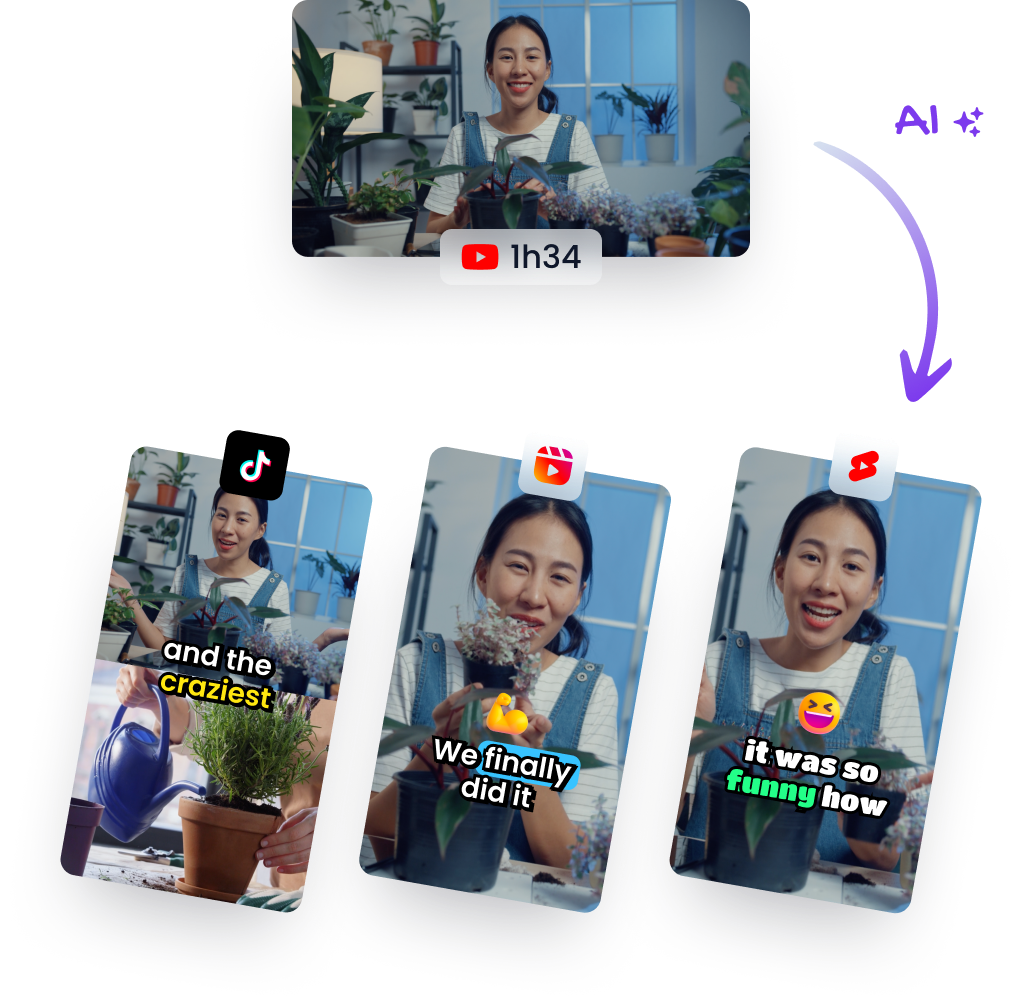
Some tools treat transcription as the finish line. Klap treats it as the first step in a repurposing workflow. It transcribes the source video, analyzes the text, identifies strong moments, and prepares short clips for vertical platforms with captions and reframing.
That difference matters if you're not trying to build an archive. You're trying to publish more often.
According to Klap's explanation of video transcription, modern AI-powered video transcription systems achieve up to 97% accuracy on clean audio, with top-tier services consistently reaching or exceeding 95% accuracy, which is strong enough for many repurposing workflows when the recording quality is solid.
What actually matters when picking a tool
Don't choose based on feature lists alone. Check the workflow around the transcript.
Look for these points:
- Transcript editing speed: Can you fix errors quickly?
- Speaker handling: Does the tool separate voices well enough for interviews?
- Export options: Can you get captions, text, and usable timestamps?
- Clip workflow: Does the transcript help you cut content, or does it just sit there?
- Input flexibility: Can you work from a file upload or an existing video link?
If your source material is mostly YouTube content, a dedicated YouTube video transcript generator can simplify intake before you move into editing and repurposing.
The workflow is easier to see than describe. Here's a quick walkthrough.
The key trade-off is this. A transcript-only tool gives you text. A repurposing tool gives you text plus a path to output. If you publish across TikTok, Reels, and Shorts, that second category is usually the better fit.
How to Achieve Professional Grade Accuracy
AI transcription is only as good as the audio you feed it. People often blame the software when the core problem started at recording.
That matters because the gap between a clean transcript and a frustrating one can be huge. According to Wordly's guide to AI video transcription, professional AI transcription tools achieve 95–99% accuracy on clear audio, but that can drop to 70–85% with background noise, overlapping speakers, or strong accents. The same source notes that the professional threshold is a Word Error Rate of 4–5% or less.

Fix the recording before you hit upload
The easiest accuracy gains happen before transcription starts.
- Use a proper microphone: The source guidance recommends placing high-quality microphones about 6–12 inches from the speaker. That gives the model cleaner speech and less room noise.
- Control the room: Quiet spaces with less echo beat “fix it in post” every time.
- Keep one person speaking at a time: Crosstalk breaks transcripts faster than almost anything else.
- Slow down slightly: Moderate pacing helps the model separate similar-sounding words.
- Record technical terms intentionally: Product names, acronyms, and industry jargon are common failure points.
Clean up strategically after transcription
The second mistake people make is over-editing. You usually don't need to polish every comma. You need the transcript accurate enough for the next task.
If the transcript will become a blog post, you'll edit heavily anyway. If it's feeding short clips, focus on the parts that break downstream workflows.
Start with this order:
- Correct names and branded terms first.
- Add speaker labels if multiple people are involved.
- Check timestamps around strong quotes or clip-worthy moments.
- Remove obvious filler only if it improves readability.
- Leave minor stylistic cleanup for the final content format.
Clean up the words that affect search, captions, and clip boundaries first. Perfection can wait.
When AI alone isn't enough
Some audio should go straight to a hybrid workflow. Legal records, medical files, specialized technical discussions, and multilingual conversations usually need human review.
Custom glossaries help a lot with proper nouns and domain-specific language. If your tool supports them, use them. They save more time than broad manual proofreading because they target the words AI most often gets wrong.
One more practical point. If your speakers have strong regional accents or switch between languages, don't judge the transcript by the first draft alone. Segment the content, label speakers clearly, and verify the sections that matter most for publication. That's usually faster than trying to force a single-pass transcript into perfect shape.
From Transcript to Viral Clips The Klap Workflow
A transcript becomes valuable when you use it to find moments people will watch.
Most long videos contain several short segments with standalone value. The problem is discovery. You need to locate the hook, the surprising line, the blunt opinion, the useful checklist, or the emotional beat that can survive outside the original context.

What to look for inside the transcript
When I review transcripts for clip creation, I'm not reading for completeness. I'm scanning for social structure.
The strongest clip candidates usually contain one of these:
- A fast hook: A line that creates curiosity in the first sentence
- A clean opinion: Something specific enough to agree or disagree with
- A useful list: Advice that can be understood in isolation
- A story turn: A moment where something changes, fails, or gets resolved
- A sharp quote: A sentence people would screenshot or repeat
Weak clip candidates tend to rely too much on previous context. If the sentence starts making sense only after two minutes of setup, it probably won't work as a short.
Why transcript-led clipping beats timeline scrubbing
Without a transcript, you're hunting through footage manually. That works, but it's slow and inconsistent. You miss lines. You forget timestamps. You stop spotting patterns because you're focused on playback controls instead of message quality.
According to Klap's article on transcript-based YouTube clipping, AI-assisted tools can identify viral moments from a video transcript in approximately 2 minutes, while manual review and timestamping often takes 1 to 2 hours, which the same source describes as a 60x speed improvement.
That's the difference between occasional repurposing and a repeatable workflow.
A transcript lets you judge ideas at reading speed. That changes how much content you can mine from one recording.
A practical repurposing sequence
Use a simple sequence after the transcript is ready:
- Scan for hooks first. Good openings are easier to spot in text than on a timeline.
- Highlight self-contained moments. If the line needs too much setup, skip it.
- Group similar ideas. One long interview often contains several clips around the same theme.
- Trim for momentum. Remove the throat-clearing and get to the point faster.
- Add captions and framing adjustments. The transcript already gives you the spoken structure. Now the clip needs visual packaging.
Transcript-driven clip tools find their greatest utility here. Instead of producing a text file and stopping there, they use the transcript to locate compelling segments and move directly into clip creation, subtitle handling, reframing, and export.
If your goal is growth on short-form platforms, that's the key workflow to optimize. The transcript is not the content. It's the selection engine.
Frequently Asked Questions About Video Transcription
Can I transcribe a video with multiple speakers?
Yes, but expect more cleanup. Multi-speaker recordings become harder when people interrupt each other, talk over each other, or sit at very different distances from the mic. Speaker labels help a lot, especially if the transcript will feed captions, blog content, or quote extraction.
What's the best option for multilingual videos?
Use a workflow that separates speakers clearly and review the transcript in sections. Mixed-language content, dialect variation, and accent changes can cause more transcription drift than creators expect. In practice, the safest approach is to break the job into smaller parts and verify the sections you plan to publish or clip.
Do I need a perfect transcript for short-form clips?
Usually, no. You need a transcript that's accurate enough to identify strong moments, generate captions, and avoid obvious errors in names or key phrases. If the final output is a short clip, clean up the lines that will be visible on screen and the lines that affect the hook.
Can I transcribe directly from a YouTube link?
Many tools support direct import from a video link, which is faster than downloading and re-uploading manually. That's especially useful if your archive already lives on YouTube and you want to turn existing uploads into shorts, captions, or blog drafts.
Are free transcription tools good enough?
They can be, for short clips or test projects. The trade-off is usually less control over formatting, weaker speaker separation, and more manual correction. If you're transcribing occasionally, free tools can work. If you're building a repeatable content system, paid tools usually save time in editing and output.
What should I do with the transcript after it's generated?
Don't leave it as a text file. Turn it into something publishable. Pull out clips, write show notes, build captions, create blog drafts, extract quotes, or organize it into a searchable archive. The transcript is most useful when it becomes the source material for other assets.
If you want a faster path from long-form video to short-form output, Klap is built for that workflow. You upload or link your video, the platform transcribes it as part of its analysis process, identifies clip-worthy moments, and prepares social-ready shorts with captions and reframing so you can spend less time scrubbing timelines and more time publishing.