Best YouTube Video Transcript Generator Tools 2026
Other
You publish a strong YouTube video, then the key work starts. You need captions, a blog post, a few social clips, maybe a newsletter angle, maybe a cleaned-up quote for LinkedIn. Most creators hit that wall and realize the video isn't the finished asset. The transcript is.
A good transcript changes how you work. It gives you searchable text, clean language you can edit, and time-linked moments you can turn into clips or subtitles. If you're evaluating a YouTube video transcript generator, the question isn't just how to get words off a video. It's what you want those words to do next.
Why Transcripts Are a Creator's Superpower
A transcript looks boring until you use one properly. Then it becomes the fastest path from one long video to an entire content system.
The transcript is the working file
When creators skip transcript generation, they usually end up rewatching the same video over and over. They pause to pull quotes, type rough notes by hand, and guess where a strong segment starts. That wastes time and makes repurposing inconsistent.
With a transcript, you can search for the exact sentence where the guest explained a key idea. You can pull that passage into captions, a blog draft, or a social post. You can hand it to an editor, a marketer, or an AI tool without asking them to scrub through the timeline first.
Practical rule: Treat the transcript as the master text version of your video, not as an afterthought for accessibility alone.
Why creators generate transcripts in the first place
The reasons usually stack up quickly:
- SEO use: Search engines can interpret text far more easily than spoken audio. A transcript gives you raw material for descriptions, supporting articles, FAQ sections, and on-page copy. If you're building a broader content engine, these actionable SEO strategies for startups are useful because they show how content assets fit into a bigger search strategy.
- Accessibility needs: Some viewers need text. Others prefer scanning before committing to a full watch.
- Faster editing: Editors can identify hooks, transitions, and repeated phrases from text much faster than from waveform alone.
- Repurposing: One transcript can become a blog post, email, subtitle file, show notes, quote cards, and short-form scripts.
Three levels of transcript workflow
Most creators move through transcript generation in stages.
MethodWhat it's good forWhere it falls short
YouTube built-in transcript
Free, immediate access
Harder to reuse cleanly
Dedicated transcript generator
Fast extraction and exports
Still needs review
Repurposing platform
Transcripts plus clip-making workflow
Better fit for teams that publish across formats
That progression matters. A free transcript is enough if you only need to read along. A dedicated tool makes sense when you need cleaner text. A repurposing workflow makes sense when transcript generation is just the first step in a larger publishing system.
The Built-In YouTube Transcript Method
A creator records a 40-minute interview, publishes it, and then needs three things by the end of the day: a pull quote for LinkedIn, a rough outline for a blog post, and the exact moment a strong soundbite appears. The built-in YouTube transcript is the fastest place to start.
If transcript access is enabled, YouTube lets you open the transcript panel directly from the video page, read line by line, and click any line to jump to that point in the video, as shown in YouTube's walkthrough on viewing and using video transcripts. For review work, that click-to-jump feature is a key advantage. It saves time when you are checking interviews, tutorials, webinars, or long talking-head videos.
How to use it
The workflow is simple:
- Open the YouTube video.
- Find the transcript option in the description area or menu.
- Open the transcript panel.
- Scan the text and click a line to jump to that moment in the video.
That makes the native transcript useful for locating hooks, checking wording, and confirming whether a section is worth turning into a clip or written asset.

Where the built-in method breaks down
The limits show up as soon as the transcript needs to leave YouTube.
You can read it easily enough, but cleaning it up for captions, article drafts, show notes, or short-form scripts is awkward. YouTube's transcript view is built for watching and reviewing, not for producing reusable text files. Recent interface changes also made the transcript less convenient to copy cleanly, especially if you want text without extra formatting or timestamps.
That trade-off matters. For a quick reference check, the native transcript is fine. For repurposing, it creates extra manual work right when speed matters most.
Native YouTube transcripts work for reviewing what was said. They are much less useful when you need text you can edit, export, and publish.
I still use the built-in option early in the workflow. It is the fastest way to verify that a video contains enough strong material to justify the next step. But once the goal shifts from “find the quote” to “turn this into clips, captions, and written content,” the free method starts costing time.
When the free method still makes sense
Use the built-in route when:
- You need reference text: You want to find a quote, topic change, or exact phrasing.
- You are reviewing long videos: Clicking transcript lines is faster than scrubbing a timeline.
- You are validating repurposing potential: You want to see whether the video has enough usable moments before putting it into a larger workflow.
- You do not need export files: Plain viewing is enough, and you are not creating subtitle files or polished text assets yet.
If that sounds like your current stage, YouTube's free transcript is a good first pass. If the transcript needs to become working material for captions, articles, or clip production, a cleaner YouTube video to text workflow makes more sense.
Using Automated Transcript Generator Tools
Dedicated transcript tools exist because creators outgrow the built-in option fast. Once you start publishing consistently, “can I see the transcript?” stops being the question. “Can I export, edit, subtitle, and repurpose this transcript quickly?” becomes the primary one.
What dedicated tools do better
Modern transcript generators usually work the same way. You paste a public YouTube URL, and the tool extracts the transcript without requiring you to upload the video manually.
OpusClip says its YouTube transcript tool can extract a transcript from a public URL in seconds, claims over 95% accuracy, and supports exports to TXT, SRT, and VTT in its YouTube video transcript tool overview. That's a useful benchmark because it reflects what people now expect from this category.
Other tools in this space compete on similar basics: fast turnaround, direct URL input, editable text, timestamp support, and export options.
How to evaluate a YouTube video transcript generator
Don't choose a tool based on the homepage promise alone. Check the workflow details.
- Input method: The easiest tools take a YouTube URL directly. If a tool makes you download and re-upload a public video, it adds friction.
- Export options: TXT works for writing. SRT and VTT matter for captions and subtitling.
- Timestamp handling: Some projects need timestamps preserved. Others need clean text without them.
- Language support: This matters immediately if you work with multilingual interviews or international channels.
- Editing experience: If the transcript opens in a cramped viewer with poor copy tools, the speed win disappears.
A useful way to think about it is this:
PriorityBest fit
Just need readable text
Built-in YouTube transcript
Need cleaner exports and captions
Dedicated transcript generator
Need clips, subtitles, and reuse in one flow
Repurposing platform
The trade-off nobody should ignore
Automation is fast, but speed isn't the whole story. Proper nouns, accents, crosstalk, and technical terminology still trip up many tools. So the right generator isn't the one that promises magic. It's the one that gets you to an editable draft quickly, in the format your next task requires.
If you're comparing options, this broader look at a video transcript generator workflow is helpful because it focuses on what you do after extraction, not just on getting text out of a video.
Beyond Transcription Turn Videos Into Clips with Klap
At a certain point, transcript generation stops being a standalone task. It becomes the first layer in a larger content workflow.

If your goal is only to read or download text, a standard generator is enough. If your real goal is to publish clips, captions, and platform-specific edits from one long video, the transcript needs to feed the rest of the system.
Why the transcript matters after extraction
Every strong short clip starts with language. A hook, a bold claim, a sharp answer, a useful explanation. Transcript text gives AI and editors something to search, rank, cut, and caption.
That's why a lot of creators no longer treat a YouTube video transcript generator as a separate utility. They use transcript data as the basis for clipping decisions, subtitle generation, reframing, and revision.
Many transcript generators focus on speed, but they often miss the need for reliable, timestamped, editable transcripts that can support accessibility and compliance when YouTube's native transcript isn't available or isn't sufficient, as discussed in this guide to transcript reliability and reuse. That distinction matters for agencies, educators, brands, and anyone building professional workflows from video assets.
What this looks like in practice
A practical repurposing workflow usually looks like this:
- Start with the source video: A webinar, podcast, YouTube upload, or interview.
- Generate transcript-linked segments: Use the text and timing to identify moments worth pulling out.
- Edit at the transcript level: Tighten wording, trim weak intros, and adjust clip boundaries.
- Export for channel-specific publishing: Short vertical clips, captioned assets, or supporting written content.
Tools start diverging. Some only extract text. Some also generate clips from that text and timing. For creators evaluating an integrated route, AI clip maker workflows are relevant because they connect transcript editing to short-form output rather than treating those as separate tasks.
The transcript isn't the deliverable for most creators. It's the raw material that tells you what to cut, caption, and publish next.
A lot of teams also use external discovery and clipping workflows around high-performing content. If you study what's working on social before choosing what to repurpose, a clipper for high-reach pages can help frame that process.
A quick product demo makes the workflow easier to visualize.
Where Klap fits
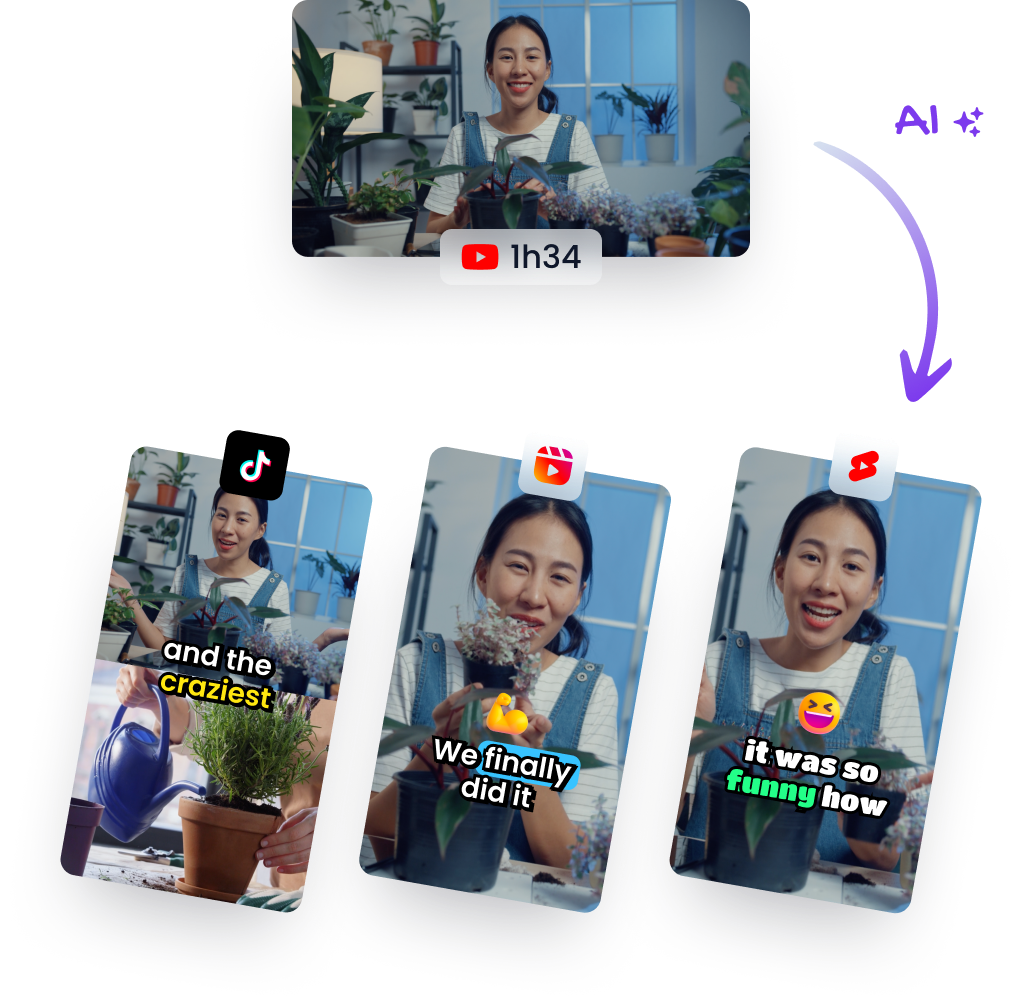
Klap is one option in this category. It takes long-form video, analyzes it, identifies clip-worthy segments, adds captions, and prepares social-ready short clips from that source material. In that setup, the transcript isn't an end product. It's the layer that helps drive selection, editing, and subtitle quality.
That's the main shift advanced creators make. They stop asking for “a transcript tool” and start building a workflow where the transcript powers the next five outputs.
How to Edit and Perfect Your Transcript
Even the strongest automated transcript needs review. If the transcript is heading into captions, client deliverables, accessibility workflows, or published articles, a quick skim isn't enough.
A practical QA workflow
Experts recommend a human pass after AI transcription, using headphones, slowing playback to 0.75x, working in 10 to 15 second chunks, and marking unclear audio with [inaudible], according to Transana's guide on reviewing and correcting automated transcripts. That advice is simple, but it works because it reduces context switching and catches the errors AI tools commonly miss.

Here's a straightforward editing routine:
- Listen once for obvious errors
Focus on names, jargon, acronyms, and locations first. Those are frequent failure points. - Slow difficult sections down
Fast speakers, overlapping voices, and poor audio need slower playback. Use shorter review bursts instead of trying to fix an entire paragraph at once. - Clean punctuation for readability
Transcript text often reads like one long breath. Add periods, question marks, and paragraph breaks where a real reader would expect them. - Standardize speaker labels
If more than one person is talking, use a consistent format such as Speaker 1, Host, Guest, or the actual names if you know them.
What to fix and what to leave alone
Not every transcript needs verbatim perfection. The right level depends on the use case.
Use caseEditing priority
Caption file
Timing, wording, readability
Blog draft
Clarity, structure, filler removal
Research or archival record
Speaker accuracy, unclear audio flags
Internal notes
Searchability over polish
If a word is unclear, mark it as [inaudible] instead of guessing. A visible uncertainty is better than a confident mistake.
A final pass should also remove repeated filler if the transcript is being repurposed into written content. Spoken language can handle repetition. Written language usually can't.
Putting Your Transcript to Work
A transcript earns its keep after the cleanup is done.
The practical win is repurposing. One accurate transcript gives you raw material for written content, captions, metadata, internal documentation, and short clips. That changes the economics of every video you publish because you stop starting from a blank page each time you need a new asset.
For creators, the transcript is often the first draft of the rest of the content system. A tutorial can become a blog post. A strong answer from an interview can become a quote post. A webinar can turn into searchable notes for sales or support. The transcript gives structure to work that usually feels manual.
High-value uses for one finished transcript
- Build a blog post faster: Pull the argument, group related points, and rewrite spoken language into readable paragraphs.
- Draft social posts from exact wording: Good lines are already in the transcript. Trim them, add context, and format them for LinkedIn, X, or quote graphics.
- Write stronger video copy: A cleaned transcript makes descriptions, chapter summaries, titles, and thumbnail text easier to draft.
- Create caption files: If the transcript is accurate, turning it into subtitles takes far less cleanup.
- Find clip-worthy moments: Scanning text is faster than scrubbing a full timeline. You can spot hooks, stories, objections, and punchy takeaways quickly.
- Store knowledge in a searchable format: Interviews, training sessions, meetings, and webinars become much easier to revisit once the spoken content exists as text.

The trade-off is simple. If you only need to quote a line or check a timestamp, the free YouTube transcript is often enough. If the transcript is feeding a blog post, polished captions, or a batch of social assets, cleaner text saves time later. That is usually where dedicated tools start to pay for themselves.
Klap fits the next step in that workflow. Instead of stopping at transcription, it helps turn long videos into short clips, refine captions, and package moments that are ready to publish. For creators who repurpose every recording, that matters more than text extraction alone.