Content Rights Management for Video Repurposing
Other
You can feel the problem before it shows up in the analytics. A long interview gets cut into shorts, a clip starts climbing on TikTok or Reels, and then a music claim, a guest's release issue, or a third-party segment embedded in the original sends the whole thing into review. That's the moment content rights management stops being a paperwork task and becomes the system that keeps a repurposing workflow from collapsing.
The scale behind that shift is already obvious in the market. The global digital rights management market was valued at USD 6.16 billion in 2024 and is projected to reach USD 14.48 billion by 2033 (Grand View Research). That growth matters because video teams are no longer managing rights as a niche legal function. They're running a commercial layer that supports streaming, social distribution, enterprise sharing, and every derivative clip that gets exported from a source asset.
When a Viral Clip Becomes a Legal Headache
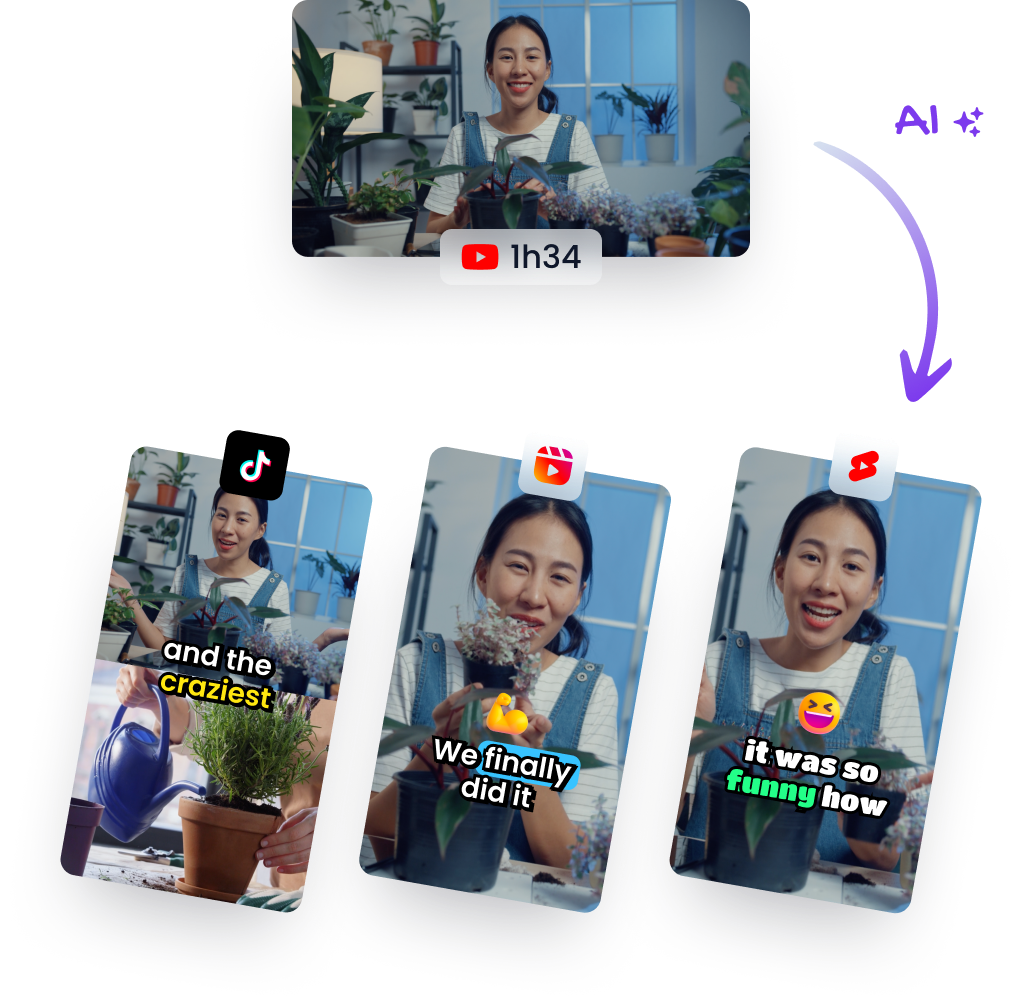
A familiar workflow goes sideways fast. A producer pulls a strong moment from a 45-minute interview, adds captions, reframes it for vertical, and schedules it across TikTok, YouTube Shorts, and Reels. The clip starts to perform, then someone notices the guest had only cleared the long-form interview, not every downstream edit, or the original episode included a music bed or a screen capture that never should've been carried into short-form.
That failure usually shows up after repurposing, not during the edit. The short clip can look clean and still carry the wrong rights state because the source file and the derivative file are no longer aligned. Once that happens, a mid-size video team is left guessing at permissions instead of enforcing them across each export.
The commercial pressure behind this is real. Rights control has moved into the same operational stack as publishing, review, and distribution, because teams are shipping more derivative clips from the same source footage and need a way to keep those clips tied to their original permissions. When that control breaks, the problem is not abstract. A high-performing clip can turn into a takedown risk, a platform review, or a scramble to trace who cleared what.
Practical rule: if a clip can be republished, remixed, or syndicated, it needs its own rights check, not just inheritance from the source upload.
If you are trying to catch those problems before they spread, a reverse lookup can help identify where a clip originated and whether it has already been reused elsewhere. That makes a tool like this video reverse search guide useful in the operational layer.
What Content Rights Management Means
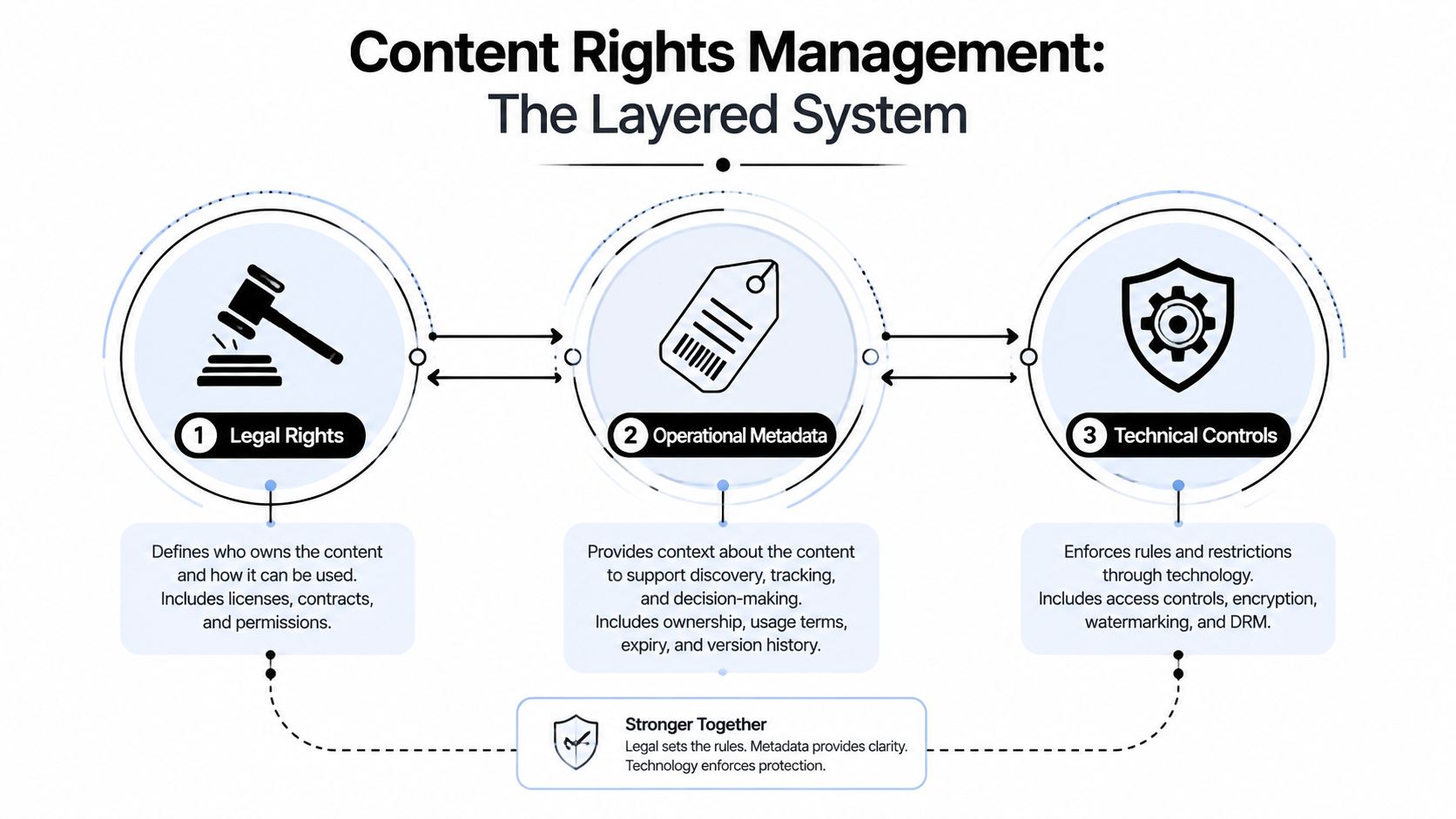
Content rights management works like a layered system. The legal layer defines who owns the asset and what has been licensed. The operational layer keeps track of who, what, where, when, and how long. The technical layer applies those rules when the video is uploaded, distributed, or played back.
A clip can look ready for TikTok, YouTube, or Reels and still carry a rights record that no longer matches the source. That mismatch usually starts after AI-assisted repurposing, when a derivative short is edited, reformatted, captioned, or trimmed without the permissions state being updated alongside it. The file moves forward, but the rights state drifts.
That drift is the operational problem. One team may treat the source asset as cleared, while another exports the same footage into a new clip with different music, different guests, or a different usage context, and the rights metadata never catches up. Once that happens, enforcement turns into guesswork, because the team cannot tell which derivative inherits what and which one needs a fresh review.
The classic DRM framework splits the system into IP asset creation and capture, IP asset management, and IP asset usage (Ianella, D-Lib Magazine). Rights have to be asserted at ingest, preserved while the asset is managed, and enforced when someone tries to consume it. In video workflows, that matters because one source file can turn into many short-form clips, and each derivative can carry a different rights state.
A practical way to use the model is to map the legal layer to ownership and permission, the operational layer to policy data, and the technical layer to enforcement. That keeps the work grounded in day-to-day operations instead of abstract compliance talk. Content rights management is broader than anti-piracy. It also has to keep every platform and every derivative clip aligned with what it is allowed to do.
For teams building that connection between rights tracking and asset workflow, the guide by Font Checker Pro is a useful reference.
Copyright, Licensing, and Permissions in Plain English
A creator doesn't need a law degree to ask the right questions. They need to know what they own, what they've rented, and what else has to be cleared before a clip goes live. That's the difference between a publishable edit and one that gets pulled after distribution.
Copyright is the default ownership position
Copyright is the baseline claim that attaches to original recorded work. If you shot the footage, you usually control the raw asset, but that doesn't automatically cover every element inside it. A podcast host may own the interview recording and still need permission for music, guest likeness, product shots, or third-party footage embedded in the episode.
Licensing is permission under conditions
Licensing is the deal that lets someone else use the content under specific terms. In practice, this gets operational. Is the license territorial? Is it exclusive? Does it allow repurposing into shorts, reposting on social platforms, or commercial promotion? Those aren't abstract clauses, they decide whether a clip can move from YouTube to Reels without friction.
Permissions are the missing approvals
Permissions cover the specific pieces that aren't fully owned by the creator. A guest release, a music license, a logo permission, or clearance for outside footage all sit here. If a podcaster records a guest, uses a stock music bed, and shows a branded product on camera, each of those items needs to be cleared before the clip is cut, especially if the clip will travel beyond the original audience.
For teams that want a clean way to think about generated audio and usage rights, these terms for generating music are a useful reminder that music creation and music clearance are not the same thing.
The safest assumption is simple. If you didn't create it, license it, or get it signed off in writing, treat it as unresolved.
The tricky part is platform terms. A clip can be legally cleared for one use and still conflict with a platform's expectations or a distributor's limits. That's why a fair use shortcut won't save a workflow built on repurposing. For a deeper operational lens on that boundary, the fair use guidelines are worth keeping nearby.
Rights Metadata and Tracking Across the Asset Lifecycle
Rights metadata is the record that keeps the legal layer attached to the asset as it moves through production, review, export, and reposting. Without it, the file may still exist, but the team loses the ability to prove what can be done with it. Most workflow failures start when someone trims, re-exports, or reuses a clip and the rights state drops out of the new file.
A simple tracker can handle the basics if the team stays disciplined. The point is not sophistication, it is consistency. Metadata has to travel with the file, the derivative, and the export, or the clip quickly drifts away from its original clearance.
Core rights fields that matter
FieldWhy It MattersExample Value
Source asset ID
Links the derivative back to the original file
Webinar_0425_Master
Owner
Shows who controls the asset
In-house marketing team
License type
Defines what kind of use is allowed
Editorial, commercial, stock
Territory
Limits where the clip can be published
U.S. only
Expiration date
Tells the team when access must end
End of quarter
Third-party inclusions
Flags outside material inside the clip
Guest footage, product UI
Music clearance status
Prevents accidental reuse of uncleared audio
Cleared for long-form only
Required attribution
Preserves credit obligations
Creator name in caption
The strongest habit is to embed rights at ingest and automate expiration rules. Adobe's guidance is direct on both points, enter copyright, licensing, and access-control information as soon as a new asset is created, then automate unpublishing when the license ends (Adobe). That is not glamorous, but it keeps a clip from living past its clearance window.
A rights tracker works best when it sits next to your DAM or spreadsheet naming conventions, not buried in someone's inbox. If your team also manages creative libraries or merch assets, this manage brand assets for merch resource is a useful reminder that rights metadata belongs in the same operational layer as version control and storage.
How Repurposing Changes the Rights Equation
Repurposing doesn't simplify rights, it multiplies them. A long-form source file can look clean at upload and still become a mess once extraction, reframing, captioning, and audio changes start producing derivative assets with different obligations. The edit that looks tiny in the timeline can create a new rights profile in the workflow.
A 45-minute webinar is a good example. One team cuts eight shorts from it. Three clips show the guest's face, two use a licensed track, and one includes a screen capture of a copyrighted product interface. Those aren't interchangeable outputs. Each clip has a different combination of identities, music terms, platform rules, and possible attribution needs.
Every derivative needs its own rights check
The best question to ask on each output is not “Did this come from something cleared?” It's “What changed?” If the answer includes a new speaker, a new soundtrack, a new crop, a caption translation, or a platform-specific export, the rights state may have changed too.
That's why the workflow should treat derivatives as separate assets, not just copies of the original. A clip that only existed in long-form can be repurposed into something that looks native to short-form but no longer fits the original license. That gap is where teams get into trouble, especially when publishing at scale across multiple platforms.
The real risk is often incorrect licensing
The more dangerous failure mode isn't always stolen content. It's correctly sourced material being republished under the wrong terms. That's harder to spot, and it often hits monetization before visibility. A clip can stay up long enough to perform, then trigger a claim, a review, or a takedown after the audience has already engaged.
Operational truth: rights problems in repurposing usually come from transformation, not from the original upload.
The old assumption that one license follows one video doesn't survive modern short-form workflows. Once AI-assisted extraction starts generating variants, the rights state has to travel with every variant, not just the source.
Tools and Workflows That Make Rights Stick
The tool choice depends on team size and output volume. A solo creator can manage with a lightweight setup at first. A growing team needs a system that keeps rights intact between editing, approval, and scheduling, because that handoff is where mistakes usually slip through and get published.
A spreadsheet plus a release template can work for a small operation if the team is strict about naming conventions and expiration dates. It is inexpensive, flexible, and easy to understand. The downside is just as clear, it depends on people remembering every rights change, every guest exception, and every platform-specific condition.
A DAM with rights fields gives a stronger middle ground. It keeps source ownership, license type, territory, and expiration in one place, and it helps repurposing because the metadata stays attached as assets move through review and export. Once multiple people touch the same clip, that consistency matters.
Platform-integrated workflows become the better choice when volume rises. They surface rights context at the point of export, which matters because content delivery often breaks when rights checks happen after publication. The data plane can stay open while the protection plane handles keys, licensing, and identity checks, which is why rights enforcement needs to live in export and packaging rather than as a post-publish cleanup step (Forasoft).
If your team relies on AI-assisted clip generation, this integrated tier has to carry rights context with the output. Tools that generate clips quickly are useful only when derivative clips inherit source permissions and any variant-specific overrides instead of dropping them during export. The same applies to third-party integrations guide setups, because a clean rights workflow can still fall apart if an integration strips metadata or republishes a clip without its clearance state.
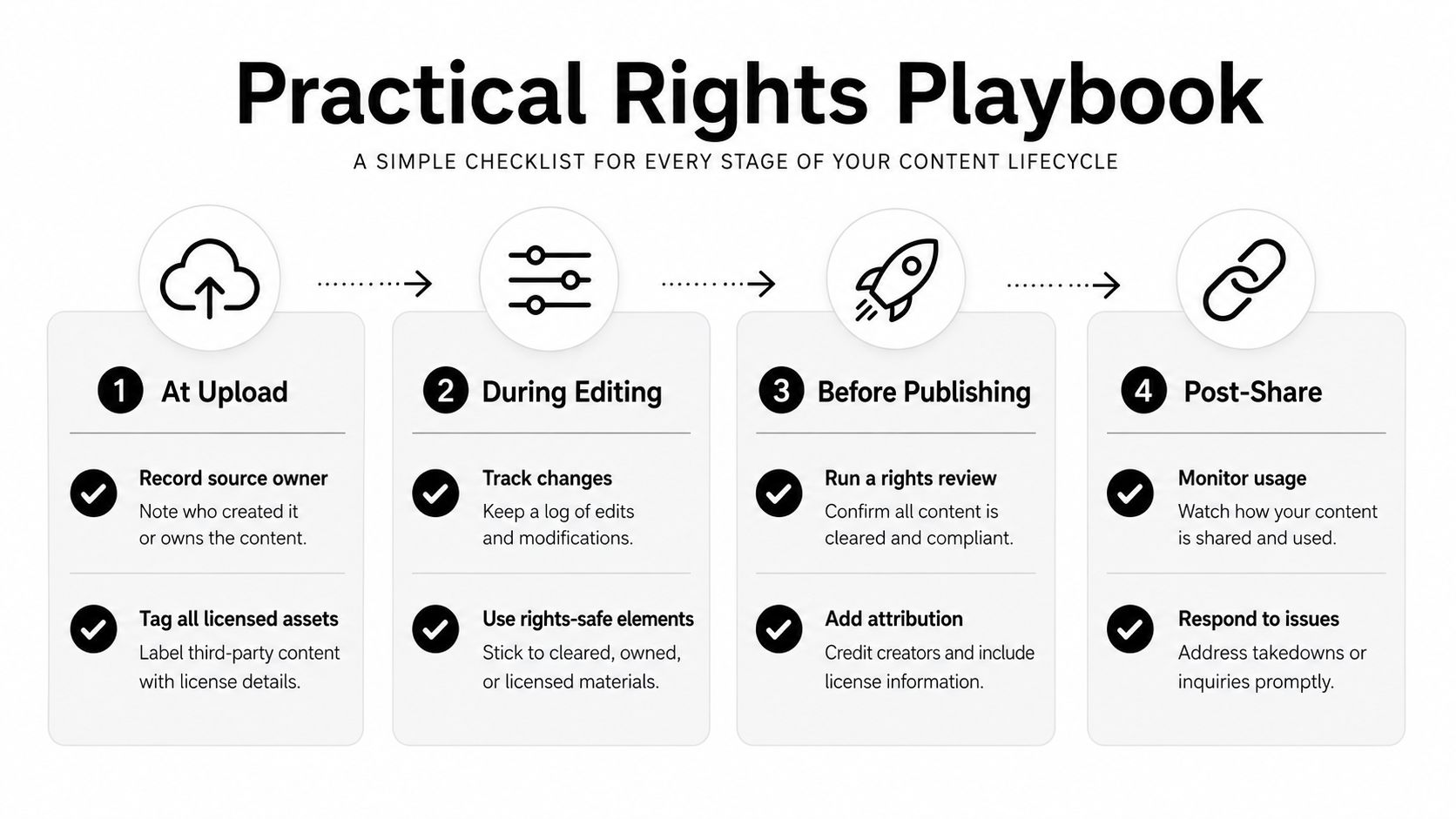
A Practical Rights Playbook for Creators and Teams
The easiest way to make this real is to tie rights checks to the video lifecycle. That keeps the process from living in a separate legal document that nobody opens when the edit is due.
At upload
- Record the source owner. Capture who controls the master file before editing starts.
- Tag every third-party element. Flag music, guest footage, logos, and any borrowed screen content.
- Attach license terms and expiry. Note what the asset can do and when that permission ends.
During editing
- Log every rights-changing edit. Music swaps, caption translations, and AI-generated segments can all change the clearance picture.
- Confirm the target territory. A clip may be fine for one region and off-limits in another.
- Track guest releases. If a guest appears, keep their approval attached to the derivative file, not just the original session.
Before publishing
- Attach rights metadata to the export. Use the file name, sidecar, or DAM record so the rights state doesn't disappear.
- Check platform terms against the license. A license can be valid and still conflict with the planned distribution channel.
- Verify music status one more time. A lot of otherwise clean clips fall apart at this stage.
After sharing
- Monitor claims and strikes. Don't wait for the platform to bury the alert.
- Calendar the expiration. A license ending is still a rights event.
- Archive the record. Future repurposing decisions should start from evidence, not memory.
If you need a guest release in a hurry, keep it structured and short. Name the guest, name the asset, specify the allowed uses, and include a signature line. That's enough to prevent most avoidable ambiguity. For music, keep a separate checklist for usage scope, territory, and expiration so the license is checked before the clip is exported, not after it gets traction.
Where Content Rights Management Is Heading Next
The category is moving toward the publishing pipeline itself. That's the lesson behind AI-assisted repurposing, multi-platform syndication, and stricter platform terms. Post-publish fixes are too slow and too expensive when clips are being generated and distributed continuously.
Three shifts are already visible. Rights metadata is becoming harder to separate from AI-generated derivatives. Territory and expiration rules are moving toward automatic enforcement inside publishing tools. Guest releases are also shifting away from paper forms toward structured digital records that travel with the asset.
The bigger change is mindset. Rights management is no longer the final gate before upload. It's becoming part of how the clip is created, modified, approved, and published. Teams that treat it that way can move faster without guessing which version is safe to post.
If you're turning long-form video into shorts, Klap helps you do that faster without losing track of the asset trail behind each clip. Visit Klap to see how AI-assisted repurposing can fit into a rights-aware workflow instead of creating one more place for permissions to drift.