Fair Use Guidelines for Video Creators
Other
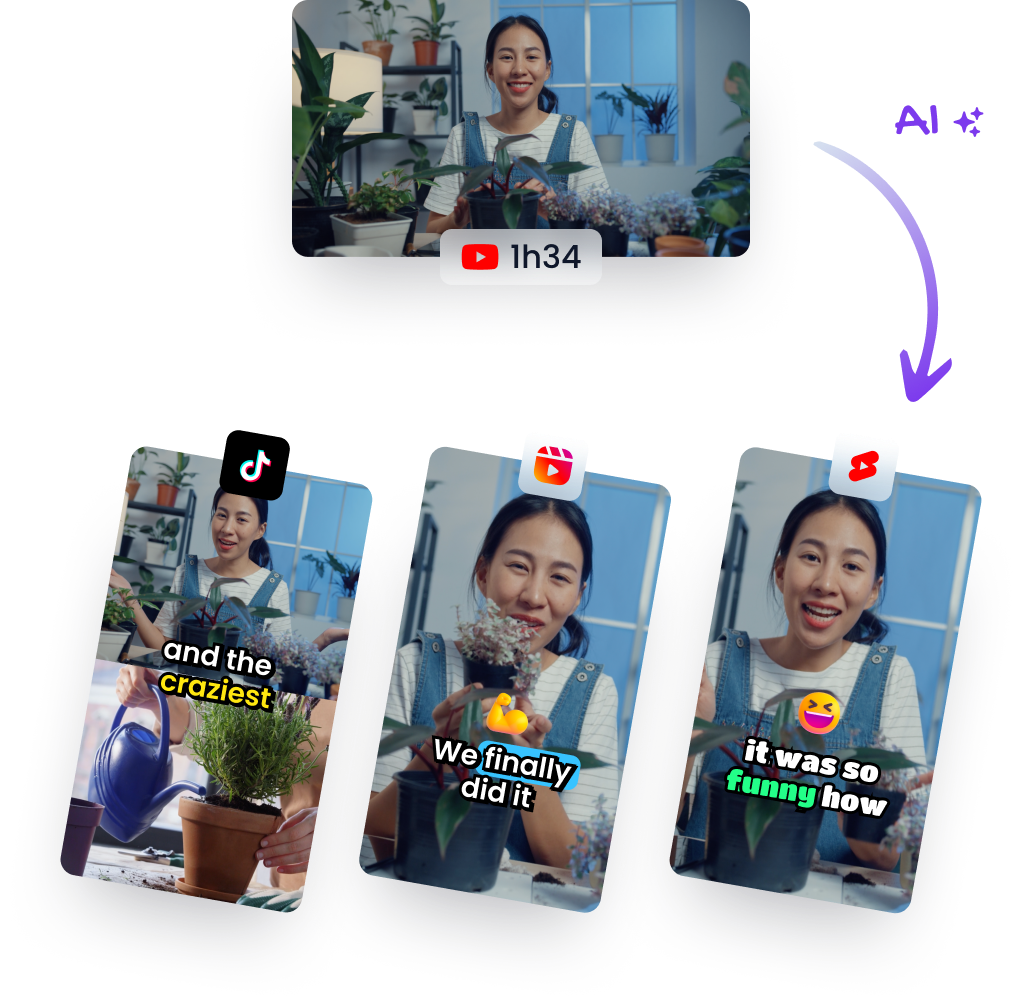
You upload a podcast, let an AI clipping tool pull out the strongest moments, add captions, resize everything for vertical video, and publish before lunch. That workflow feels efficient because it is efficient, until a creator, label, or brand complains that your clip took too much, said too little of its own, or aimed at the same audience as the original. That is where fair use guidelines stop being abstract copyright trivia and become a real publishing decision.
For video creators, the hard part is not finding tools. It is knowing when a repurposed clip is a legitimate new use and when it is just a faster way to copy someone else's work. The modern problem is bigger than classroom copying or parody, because short-form platforms reward rapid reuse, and AI now helps creators slice, reframe, caption, and distribute at scale. Many creators are operating in a gray zone without realizing it.
If you've ever wondered whether a 20-second excerpt from a webinar can become a Reel, or whether adding subtitles and a hook makes a clip “qualify,” you're already asking the right question. The answer depends on the facts, not on a shortcut rule. This content repurposing overview is a useful reminder that reuse can be strategic, but copyright still sets the boundaries.
Why Fair Use Matters When You Repurpose Video
A creator publishes a 45-minute podcast episode, feeds it into an AI clipping tool, gets ten polished Shorts back, and posts them across social platforms. The clips perform well at first, then a rights holder objects, and the creator has to explain why the new posts are more than copied excerpts. That scenario is common now because the workflow is so frictionless that the legal question gets pushed to the end, after publishing.
Short-form video changed the risk profile. TikTok, Reels, and YouTube Shorts reward fast packaging, tight hooks, and repeated distribution, which makes it tempting to treat every long-form source as raw material. That mindset can lead creators to assume that editing alone creates legality. It doesn't.
Fair use is not a permission slip. It's a balancing test that asks what you did, how much you took, what kind of source you used, and whether your clip competes with the original. For creators, that means the same tactic can be safer in one context and risky in another. A clip built for commentary, criticism, teaching, or analysis can look very different from a clip built to entertain the same audience that would otherwise watch the full source.
The biggest mistake is confusing “easy to make” with “safe to publish.”
That confusion is especially dangerous in AI-assisted workflows, because the tool can make the clip look polished before anyone asks whether the reuse is justified. The point of fair use guidelines is to slow that reflex down and replace guesswork with a repeatable review. Once you understand the test, you can make faster decisions with a lot more confidence.
The Four-Factor Fair Use Test Explained
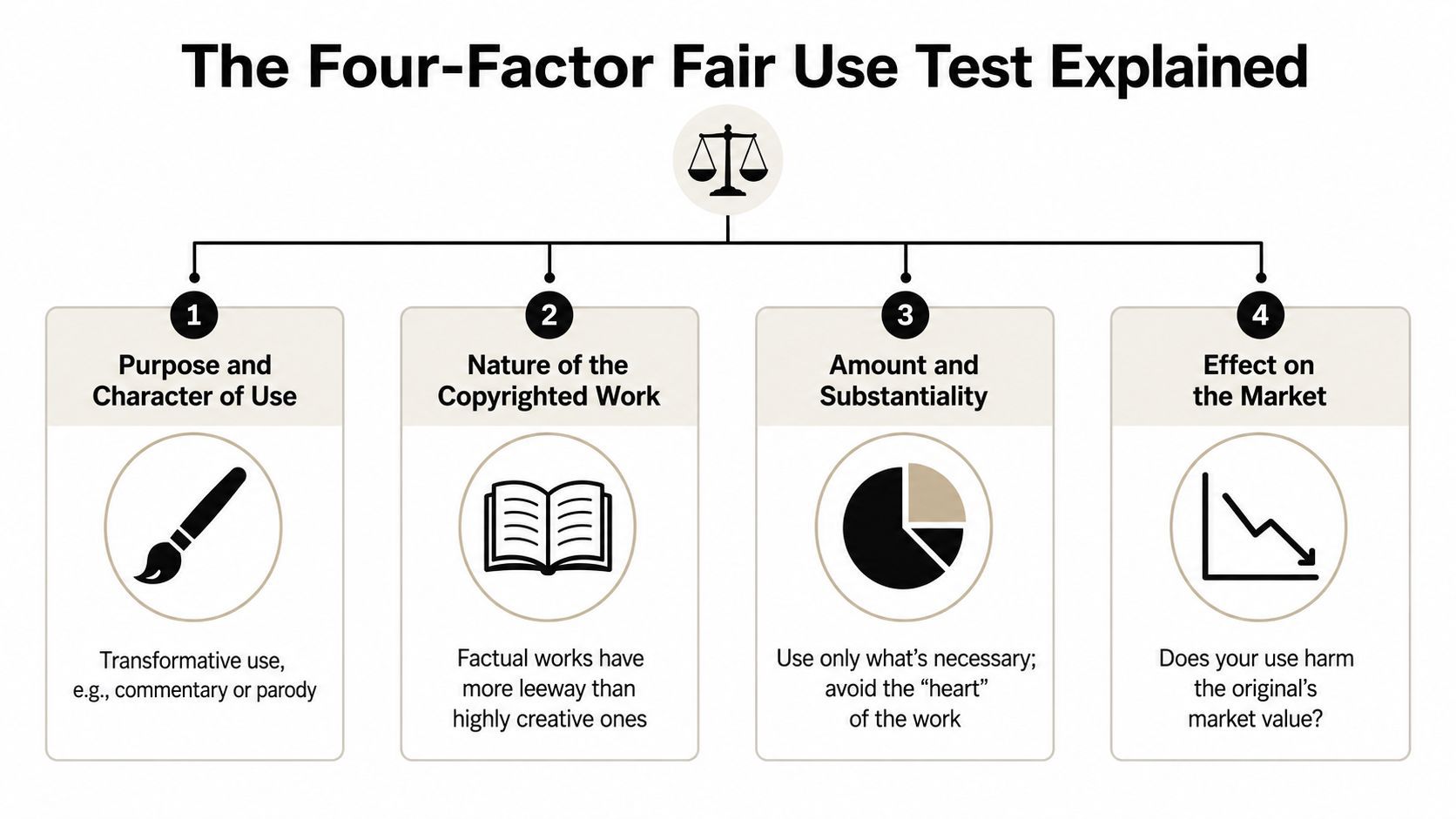
A creator trims a podcast clip for Shorts, adds captions, and uses an AI tool to place the sharpest line at the top. The edit looks new, but the legal question still comes back to the same test. In U.S. copyright law, Section 107 of the Copyright Act uses four factors, purpose and character, nature of the work, amount taken, and market effect, to guide the fair use analysis as summarized in the ACC's overview of Section 107. The U.S. Copyright Office describes the same four factors as the core fair use framework in its fair use FAQ. No single factor controls the result by itself.
Factor one, purpose and character of the use
Transformation matters. Courts ask whether the clip adds new expression, meaning, or a different purpose, and whether the use is commercial or nonprofit educational as Stanford explains in its fair use overview. A commentary clip that responds to a speaker's argument serves a different function from a repost that gives the same entertainment value in a shorter package.
For short-form video, this question often decides the first round of risk review. A vertical edit, subtitles, and a stronger hook can help presentation, but they do not automatically change the legal character of the reuse. If the AI-assisted clip still exists mainly to replace the original audience experience, the first factor weakens fast.
Factor two, nature of the original work
Courts are usually more forgiving with factual, published material than with highly creative or unpublished material a point also emphasized in ACM's fair use guidance. That matters for podcasts, interviews, webinars, and educational talks because those sources often mix informational content with performance, structure, and personal expression.
A business interview is not a movie scene. A conference lecture is not a comedy sketch. The more creative and unreleased the source is, the less forgiving the analysis tends to be, especially if the clip captures a polished segment chosen for its emotional pull rather than its informational value.
Factor three, amount and substantiality
This factor asks how much you took and whether you took the part that matters most. A short excerpt can still fail fair use if it captures the heart of the work. In creator workflows, that can happen when an AI tool pulls the most quotable sentence, the key reveal, or the moment that makes the full video worth watching.
Short is not the same as safe. The clip still has to fit the purpose of the reuse, and a tiny excerpt can still go too far if it carries the value of the original on its own.
Factor four, effect on the market
This factor asks whether your clip could replace demand for the original. Cornell Law's fair use summary treats market substitution as a central concern in its explanation of Section 107. If a viewer can watch your clip instead of the source, the fair use argument gets weaker.
That is why credit alone does not solve the problem. Attribution can be respectful and useful, but it does not erase market harm or turn copied material into a new work.
How Fair Use Applies to Short-Form Video Clips
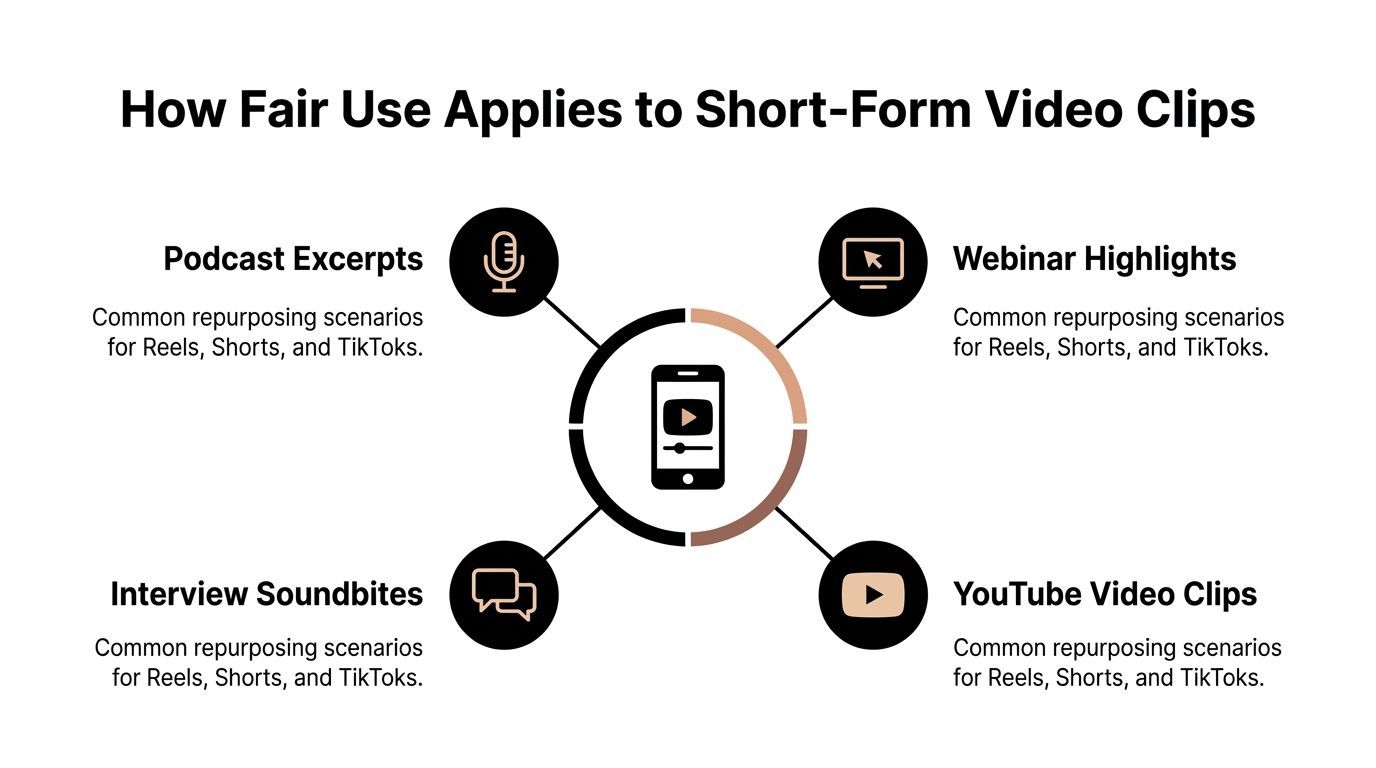
The gap in public guidance is obvious once you start clipping for social platforms. Most mainstream explainers still center classroom copying, criticism, parody, or scholarship, and they focus on the four-factor test without much practical help for commercial clip-making workflows as noted in the American Library Association sampler on fair use and repurposing. That leaves creators to guess whether captions, reframing, and AI-selected hooks are enough.
What changes in a clip-first workflow
AI-assisted edits can help with presentation, but they don't automatically change the legal analysis. If a tool trims a webinar into a vertical video, adds subtitles, and places the most compelling statement at the top, the first factor still asks whether the result adds new meaning or purpose. A cosmetic edit can make a clip look different while leaving its legal character largely unchanged.
Commercial use also matters. A monetized TikTok built from someone else's interview is more exposed than a classroom clip used for instruction, because the use is more likely to look like a substitute product. The question is not whether the clip feels polished. It is whether the new post is doing a different job.
Why market effect keeps showing up
Market substitution tends to be the most predictive concern in technical workflows because it lines up with how audiences behave. If your clip gives viewers enough of the original that they don't need to watch, rent, buy, or license the source, the risk goes up. That's true even if the source is public-facing.
A podcast excerpt, a webinar highlight, an interview soundbite, and a YouTube clip can all be fair use candidates in the right context, but the facts have to support the claim. AI selection does not replace judgment. It only speeds up the decision you still have to make.
If your clip delivers the same takeaway, to the same audience, with the same practical value, the fair use argument gets much harder.
Fair Use Examples for Video Creators
A good way to learn fair use guidelines is to compare real workflows side by side. The same source material can lead to very different outcomes depending on purpose, editing depth, and market impact. That's why creators should stop asking, “Is this a clip?” and start asking, “What does this clip do that the original doesn't?”
Three scenarios that show the spectrum
One creator uses a 15-second excerpt from a public interview, adds original commentary and reaction, and frames it as educational critique. That leans toward fair use because the clip is doing new work. Another creator extracts the strongest minute from a paid webinar, adds only auto-captions, and monetizes it on TikTok. That looks much weaker because it is close to republishing the original in a more convenient format.
The middle case is where most disputes live. A creator clips a public podcast, adds a brief intro, crops it vertically, and posts it without meaningful commentary. The source is public and factual, but the use may still be uncertain because the transformation is thin and the clip may still satisfy the audience's appetite for the original.
ScenarioPurpose and CharacterNature of OriginalAmount UsedMarket EffectLikely Outcome
Educational commentary clip
New commentary and analysis
Public interview, mostly factual
Brief excerpt
Less likely to replace the original
More likely fair use
Monetized webinar excerpt
Mostly repackaged entertainment or information
Paid webinar, likely market-sensitive
Strongest segment taken
More likely to substitute for the source
Likely infringement
Vertical podcast snippet with light edits
Some repackaging, little added meaning
Public podcast, mixed content
Short but possibly central excerpt
Unclear if it reduces demand for the original
Uncertain
The lesson is not that short clips are safe or unsafe on their own. The lesson is that the use has to justify itself. A practical look at mashups and repurposing helps show how combination and context can change the perception of a clip, but the legal analysis still turns on the four factors.
A Practical Fair Use Assessment Workflow

The safest creators use a repeatable review before every upload. That doesn't remove legal uncertainty, but it does reduce sloppy decisions, which is where a lot of avoidable risk starts. The process is simple enough to fit into a publishing workflow, and it becomes more useful the more often you apply it.
Step 1, identify the source and its status
Start by asking who made the original and whether the work is likely copyrighted. Assume the material is protected unless you have a clear reason not to. Then ask whether it's factual, creative, published, or unpublished, because those details matter in the analysis.
Step 2, define the purpose of your new clip
Write down what your clip is doing. Is it commentary, critique, education, reporting, or entertainment? The clearer the purpose, the easier it is to judge transformation accurately.
Step 3, measure how much you're taking
Look at the length, but don't stop there. Ask whether you captured the most important part of the source, because even a short excerpt can be too much if it carries the core value of the original. Historical educational multimedia guidance used practical thresholds such as 10% or 3 minutes for motion media, 10% or 1000 words of text, 10% or 30 seconds of music, no more than 5 images from one artist or photographer, and 10% or 2500 fields or cells from a database in the Multimedia Fair Use Guidelines. Those figures are not a universal safe harbor, but they're useful heuristics for thinking about amount and scope.
Step 4, test the market question
Ask the blunt question. Could this clip replace interest in the original? If the answer is yes, the risk rises. If your post is mostly drawing attention away from the source without adding a new reason to engage, you should slow down.
Step 5, document your reasoning
Keep a short note for each clip. Record the source, your purpose, the edits you made, and why you think the use is defensible. If a dispute appears later, that paper trail shows you made a thoughtful decision instead of a casual copy.
The reverse video search guide is also worth keeping handy, because it helps creators understand how easily a clip can be traced back to its source.
Risk Mitigation Best Practices for Repurposed Content
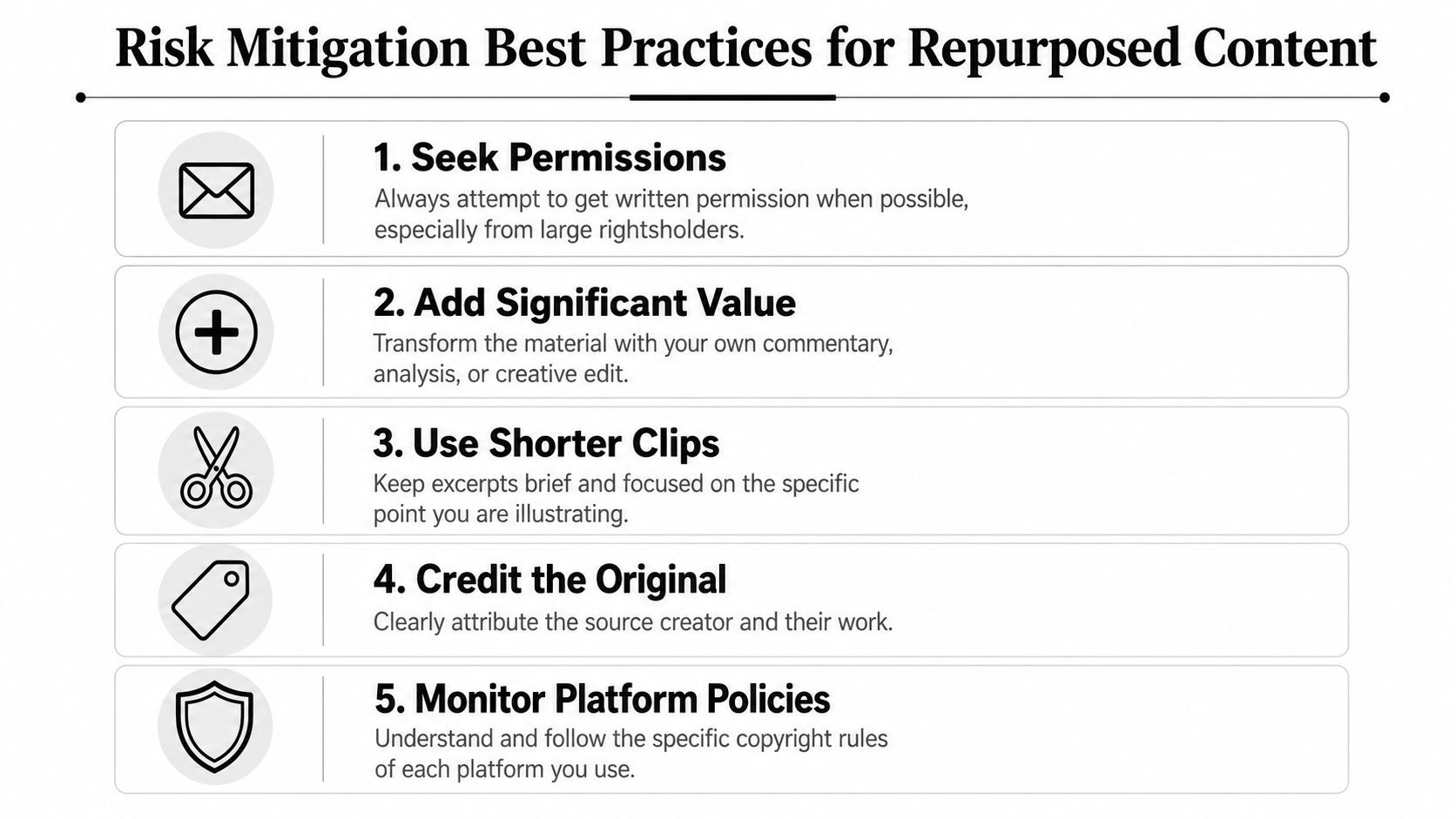
A creator pulls a short clip from a longer video, adds captions, and posts it through an AI clipping tool. The edit is quick, but the copyright question is not. Fair use risk is usually shaped by the choices around that clip, not by the fact that the workflow was automated.
The smartest creators treat fair use as risk management, not wishful thinking. Stronger choices begin before a takedown notice ever appears. That means looking at permissions, transformation depth, attribution, and monetization as practical levers, not afterthoughts.
Build stronger uses, not just shorter ones
Surface edits like captions, cropping, and reframing help distribution, but they do not do much on their own for fair use. Deeper transformation matters more. Add analysis, combine multiple sources, build a new narrative, or use the clip to critique the original point rather than just replay it.
AI-assisted clipping can make a source look fresh without making it meaningfully different. That is why creators should review whether the clip changes purpose, meaning, or audience understanding. A trimmed excerpt can still carry the same core value as the original.
Ask for permission when you can
If the source is from a clearly identifiable creator, show, brand, or business, written permission can remove a lot of uncertainty. That matters most when the content sits near the center of your content strategy. Permission is not always practical, but when it is, it can be the cleanest path.
For clips that are likely to be reused often, permission can also save time later. It gives you a clearer basis for republishing across formats, especially when a short-form workflow is built around repeating the same source material.
Credit the source, but do not confuse credit with legality
Attribution is still worth doing. It shows good faith, helps audiences trace the original, and can reduce the impression that you are trying to pass off someone else's work as your own. But credit does not replace fair use, and it does not fix a clip that competes with the source.
That distinction matters in AI-assisted repurposing, where clips can move fast from draft to publish. A visible credit line helps with transparency, but the legal question still turns on the underlying use.
Be careful with monetization
Monetization can push the first factor in the wrong direction because it makes the use look commercial. That does not automatically kill fair use, but it does raise the stakes. If the clip is borderline, it may make sense not to monetize it, or to use it in a way that clearly adds commentary or instruction.
For creators who use factual or published material, the balance can be more favorable, especially when the original is not actively sold and the clip does not threaten the market as ACM notes in its fair use guidance. That still does not mean every factual excerpt is safe. It means context matters more than raw clip length.
For a quick visual reference on careful content reuse, the policy for generating visuals shows the kind of structured review that helps teams publish with more discipline.
Good risk management often looks boring. That is a feature, not a bug.
Next Steps for Repurposing Video with Confidence
If you use AI-powered clipping tools, the best habit is to review every candidate clip before export, not after it's live. Look at the four factors, ask whether the clip adds new meaning, and be honest about whether it could replace the original. If you need a clear visual reference for creative compliance, the policy for generating visuals is a useful model for how structured review can support responsible publishing across digital tools.
For practical publishing, add your own commentary or reaction layer when the source is close to the line. Keep records of where the clip came from, what you changed, and why you believed the use was fair. That documentation won't guarantee safety, but it will make your process more defensible and more disciplined.
The best creators don't wait until a copyright claim forces a rethink. They build a workflow that treats fair use as an ongoing check, not a one-time guess. If you want to turn long-form video into short-form content faster while staying thoughtful about copyright risk, visit Klap and start with clips you'd feel comfortable defending.