Micro Content Creation: The 2026 Playbook for Short-Form
Other
Your long-form videos are done, the file folder is full, and the week's publishing plan is already slipping because every clip still needs a hook, a crop, captions, and a second pass. That's the 2026 bottleneck for most creators and small teams. The problem isn't a lack of raw footage. It's that micro content creation has become the main distribution job, and most workflows still treat it like an afterthought.
A better content marketing system starts upstream, before editing gets involved. If you want a practical example of how that thinking fits into broader promotion, the guide to content marketing for Fort Myers is a useful companion resource because it frames distribution as a planning problem, not just a posting problem. That same mindset is what makes short-form output sustainable.
The Creator's Real Bottleneck Right Now
You already know the scene. A podcast episode sits in the drive. Two webinar recordings are waiting to be cut down. A YouTube upload did fine, but the next three days are already filling up, and the feed keeps rewarding vertical clips that feel made for the platform instead of recycled from somewhere else.
That is why micro content creation has become a core distribution job. Brands are asking for short-form video first, and the clips that travel best are usually built around a tight runtime and one clear point. The pressure is coming from the market, not from creators suddenly caring more about a format. The benchmark report shows that short-form has become the default ask in micro-influencer work, and teams are increasing how many creators they work with to keep output flowing.
The real issue is topic selection
The hard part is not just trimming footage. It is choosing which moments deserve to become clips in the first place. A weak topic still looks weak after captions, jump cuts, and a better crop. A strong topic can survive a rough edit and still earn watch time.
That is the shift most weekly production systems miss. They start from the file and ask what can be salvaged. Better workflows start from the question, the objection, the result, or the sharp opinion that is worth isolating. That is the practical way to approach micro content creation from long-form assets, whether you are a solo creator, a marketer, or a small brand with one person handling filming and repurposing.
A clip pipeline only works if the source material already contains usable moments. A long recording is not valuable because it is long, it is valuable because it contains several separate ideas that can stand on their own.
Practical rule: treat the clip as the main product and the long video as the source file, not the other way around.
The other half of the job is editing with restraint. Pick one topic, keep one claim, and remove anything that makes the viewer wait for the point. That is the difference between a clip that gets watched and one that gets swiped past.
What Micro Content Is

Micro content is a self-contained unit of information that can stand on its own while still pointing back to something larger. In practice, the clip has to work even if someone never sees the original video, never reads the description, and never follows the account. It can support the bigger asset, but it cannot depend on it.
A labeled pantry jar is a useful way to picture micro content
A good jar does not need the whole recipe book taped to the lid. It needs a clear label, the right amount inside, and a reason to be opened. Short-form content behaves the same way when it is done well. It is usable on its own, and it still shows the viewer where the larger value lives.
The simple working definition is this. Micro content creation produces clips that can be consumed in a very short window, often under 30 seconds or in a 10 to 30 second range depending on the source, and the clip should answer one question and describe one feature at a time (micro-content definition). That is the difference between a clip and a fragment. A fragment is just a piece. A micro asset is a complete answer.
What it is not
It is not a highlight reel packed with context. It is not a repost with a caption slapped on top. It is not a tiny version of a long video that tries to preserve every idea from the original.
A short clip fails when it asks the viewer to do the editing in their head.
That is why the format works best when the structure is modular, with a tight question-answer shape and a clear route to the larger original. The clip is not a summary. It is a usable object in its own right, built for search, feeds, and quick understanding.
Why Short-Form Now Dominates the Feed
A short clip wins when the viewer can decide quickly whether it is worth another second. That is why brands keep asking for short-form first. As noted earlier, the strongest work in micro-influencer campaigns tends to live in the narrow attention window, not in a long setup. The practical shift is simple, the feed rewards clips that get to the point fast and give one clear reason to keep watching.
The scale behind that shift is hard to miss. A 2026 annual report placed the broader creator economy at $254 billion in 2025 and projected $480 billion by 2027, which points to a compound annual growth rate of about 22% to 24%. The same report said there were 207 million+ content creators worldwide in 2025, and it cited 200 billion YouTube Shorts daily views for 2025. Short-form is not a side layer on top of creator work. It is where distribution is concentrated.
Visibility is still the hard part
Supply keeps rising while attention stays tight. The same report said 76% of TikTok creators, 59.1% of long-form YouTube creators, and 39.94% of YouTube Shorts creators receive fewer than 1,000 views per post. That is the part many teams miss. More posting does not solve a weak clip if the opening does not earn a second look.
A separate 2026 roundup reported that short-form video generates roughly 2.5x more engagement and that 63% of consumers prefer short videos when learning about a product or service (short-form video statistics). The creative takeaway is straightforward. If you only get a few seconds, put the value proposition near the top and keep each clip focused on one takeaway.

Picking Topics Worth Clipping in the First Place
The biggest win in micro content creation is topic selection, because a poor choice wastes every minute you spend cutting, captioning, and publishing it. Starting with an editor and skimming a transcript for convenient clips is the wrong approach.
Use audience pull, not recording convenience
The cleaner method is to build a running list from repeated audience signals. Comments tell you what people keep asking. DMs expose what confused them. Search autocomplete shows which phrases people already use. Product questions, sales objections, and customer support patterns show what keeps resurfacing after the content goes live.
Then score each idea on three things. Pull, meaning how often the topic comes up. Rewatchability, meaning whether the idea has a sharp payoff or contrast. Linkability, meaning whether the clip can point back to a longer video, product page, or deeper explanation without feeling forced.
What the weekly topic list should look like
Keep ten themes active at all times, and refresh them weekly. Don't build this like a brainstorm wall with fifty half-formed ideas. Build it like a working queue. A topic with repeated customer demand beats a topic that only looks clever in the moment.
Recent content-strategy guidance also points toward this kind of upstream selection, recommending that marketers look for high-growth categories, seasonal demand, and supply-chain shifts to find under-served angles (under-served market angles guidance). The useful takeaway is not the jargon. It's the discipline. Pick the topic because the demand is there, then clip it because the format is ready.
Practical rule: if three different audience signals point to the same theme, that theme deserves a clip before the newest recording does.
Platform Rules That Shape Every Clip
TikTok, Instagram Reels, and YouTube Shorts all reward short-form, but they don't read a clip the same way. If you export one generic version and blast it everywhere, you're asking each platform to forgive your formatting mistakes. It usually won't.
ConstraintTikTokInstagram ReelsYouTube Shorts
Hook placement
Put the core promise in the first seconds, because the clip has to earn attention fast
Keep on-screen text clear of UI overlap, especially near the lower area
Make the title and opening frames work together, since metadata and visuals both matter
Captions
Use captions for silent viewing and fast comprehension
Use captions, but keep them away from interface clutter
Use captions and make sure they don't fight the thumbnail/title combo
Framing
Vertical-first editing is the default
Vertical-first, with safe zones in mind
Vertical-first, with speaker tracking and reframing kept tight
Message shape
One clip, one takeaway
One clip, one takeaway
One clip, one takeaway
The practical difference is export intent. You're not making one master and hoping it survives everywhere. You're shaping the clip to fit the feed it enters. For Reels-specific publishing behavior, the Instagram Reels video guidance is a useful reference point because it reflects how formatting choices affect delivery and presentation.
Edit for the platform before the export button
On TikTok, a strong opening matters because the viewer decides fast. On Reels, text placement matters because interface elements can crowd the frame. On Shorts, metadata and the visual hook should work together instead of fighting for attention.
The rule that keeps all three from becoming a mess is simple. Decide where the hook text lives, what the viewer sees first, and how much context the clip can survive without. If a clip needs a long setup to make sense, it's probably not a micro asset yet. If it lands instantly, you've got something useful.
Turning Long Videos Into Shorts With Klap

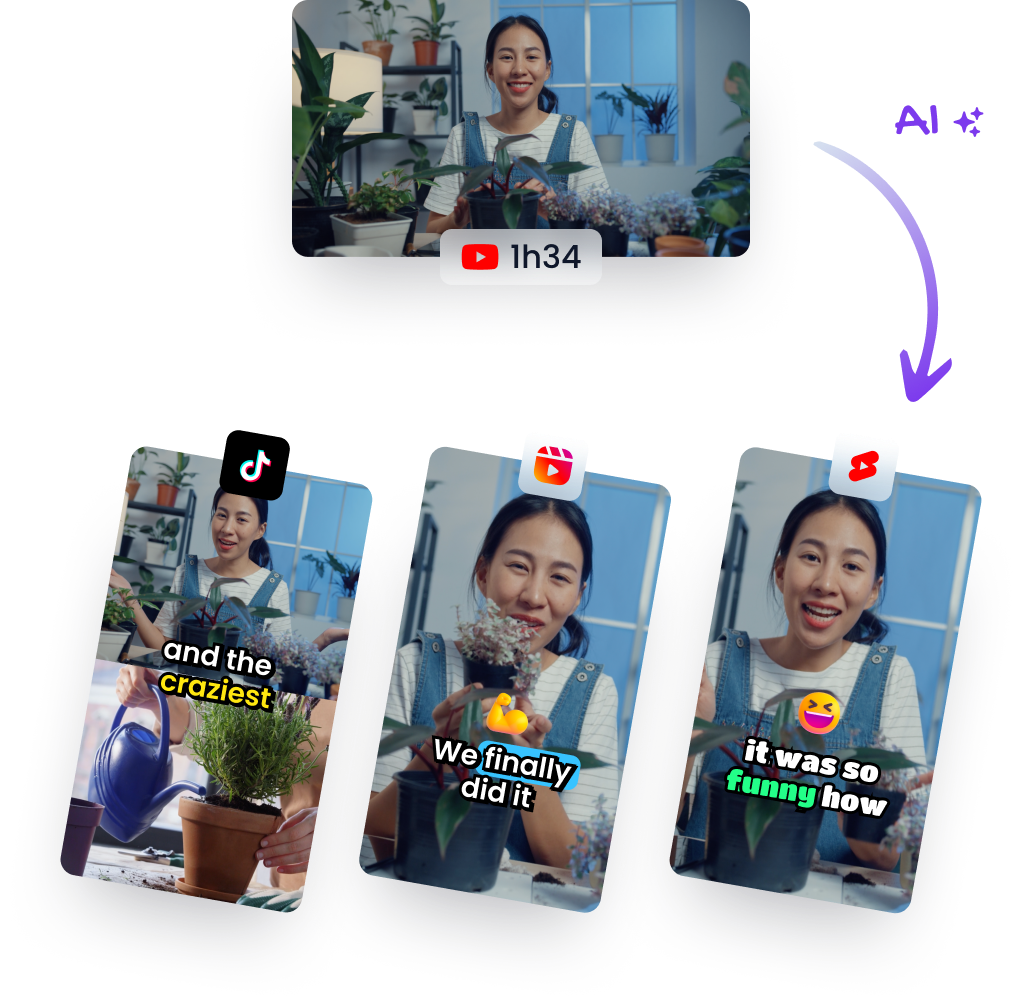
The cleanest repurposing workflow starts with a long-form source and ends with a short clip that already feels native. One tool that does this is Klap, which turns long-form video into short clips for TikTok, Reels, and Shorts through an upload-or-link flow, AI clip detection, reframing, captions, review, and export (long video to short video converter). That sequence maps well to a weekly production system because it reduces the number of manual decisions you need to make from scratch.
The four-stage workflow
Start by linking or uploading the source video. Then let the system identify engaging segments and generate clip candidates. After that, review the cut points, captions, and framing, and adjust anything that feels too broad or too cramped. Export the version that matches the platform you're publishing to.
The editing logic matters more than the software label. Let automation handle the first pass, especially when the source video is long and the obvious moments are buried in the middle. Override the AI when the punchline lands too late, the opening feels weak, or the clip tries to include two ideas at once.
Where the human pass still wins
The best short-form cuts usually follow the hook-first rule. The opening should carry the message in the first 10 to 15 words, and the clip should resolve one problem or one feature only. Captions shouldn't be an afterthought either, because silent viewing is still common in social feeds and captions help the viewer stay with the point.
The smart move is to use captions as part of the creative layer, not just accessibility. Tight caption timing can reinforce the hook, clarify jargon, and keep pacing brisk. If the clip looks good but the first line still rambles, cut it harder.
Later in the process, watch the framing. Reframing is not cosmetic. If the speaker's face or the key visual lands awkwardly in the crop, the whole clip feels less deliberate. The goal is a version that looks edited for vertical viewing, not merely resized.
The platform works because it takes the manual burden out of the first pass. You still need judgment, but you don't need to hand-cut every candidate from zero.
Metrics That Actually Predict Growth
Views are easy to celebrate and easy to misread. A clip can rack up reach, then stall out because nobody saves it, shares it, or taps through to the profile. That's why micro content creation needs a better scorecard than vanity numbers.

What to watch every week
- Hook performance: Look at whether the opening earns attention fast enough to keep the clip alive past the first few seconds.
- Completion behavior: A clip that finishes cleanly usually teaches you more than one that gets lots of accidental reach.
- Saves and shares: These tell you the viewer thought the clip was useful enough to keep or pass on.
- Profile visits: This shows whether the clip moved anyone toward deeper interest.
- Follow-through: Check whether viewers take the next step to long-form content or a product page.
One useful internal benchmark is the watch-time improvement guidance, because it reinforces the idea that retention has to be designed into the opening, not patched in after publication. If a post performs well on reach but weakly on save behavior and profile movement, it probably looked entertaining without creating enough intent.
A clip that gets views but no profile lift is often a topic problem, not an algorithm problem.
The habit that helps most is reviewing the last ten clips as a batch. Don't judge each post in isolation. Look for repeat patterns in the hooks, topics, and first-frame choices. When the same failure shows up three times, that's your editing style telling you something.
A Weekly Micro Content Operating System
A stable workflow beats a heroic sprint. Monday, pull topics from audience signals and search patterns. Tuesday, publish the long-form source. Wednesday and Thursday, generate clip candidates, trim hooks, rewrite captions, and reframe the strongest takes. Friday, publish, review the metrics, and move the best topics back into the list.
That cadence works because each day has a single job. Topic selection happens before filming pressure builds. Repurposing happens after the source asset exists. Review happens after enough clips have shipped to reveal a pattern.
A lean tool stack keeps it workable. Use your long-form capture tool, your clip generator, your editor, and a simple notes file for recurring audience questions. If you're using a repurposing platform like Klap, keep it focused on the conversion step, then let your own review process decide what deserves to go live. The system should make the next clip easier to create than the last one.
If you're trying to turn finished long-form videos into short clips without rebuilding the process every week, Klap can handle the repurposing step with AI clipping, reframing, captions, and export-ready shorts. Use it to speed up the mechanical part of micro content creation, then keep your attention on topic selection, hook quality, and the metrics that compound.