Unlock Huge Watch Time Increase in 2026
Other
You publish a video you know is good. The topic is strong, the thumbnail gets clicks, and the first few comments are positive. Then you open YouTube Analytics and see the underlying problem. People are leaving early.
That’s the moment most creators start chasing the wrong fix. They tweak titles, post more often, or obsess over subscribers. Those things matter, but they don’t solve the core issue. If viewers don’t stay, the channel doesn’t grow the way it should.
A real watch time increase comes from one shift in mindset. Stop treating a view as the win. Treat earned minutes as the win. YouTube is crowded, but the upside is enormous for creators who can hold attention and turn that attention into longer viewing sessions across the channel.
Why Watch Time Is Your Most Important Metric
A lot of creators have lived through the same pattern. A new upload gets enough clicks to feel promising. Then the retention graph falls hard, and the video never gets momentum. That usually isn’t a packaging problem anymore. It’s a satisfaction problem.
Watch time matters because it measures whether the click was justified. A title and thumbnail can earn curiosity. Only the video itself can earn time. That’s why watch time sits closer to the business end of channel growth than vanity metrics do.
Views tell you who arrived
Views answer one question. Did people click?
That’s useful, but incomplete. A weak video can still pull clicks if the topic is hot or the packaging is sharp. If viewers leave quickly, YouTube has a reason to reduce distribution. The platform wants to keep people watching, and videos that lose attention early create friction.
Watch time tells you who stayed
YouTube’s scale makes this obvious. YouTube Gaming reached 8.8 billion hours of watch time in 2025, up 12% year over year. That kind of consumption shows what the platform rewards. Not just clicks. Sustained viewing.
For creators, the implication is simple. If your videos hold attention, you’re aligned with what the platform already wants more of. If they don’t, more uploads won’t fix the underlying issue.
Practical rule: The algorithm doesn’t owe you reach because you published. It responds when viewers consistently choose to stay.
There’s also a strategic reason to care about watch time over almost everything else. It compounds. A strong video doesn’t only perform by itself. It can lead viewers into a second video, then a third, and that session-level behavior strengthens the channel.
Many monetization-focused creators get stuck thinking in single uploads instead of viewing systems. If you want a meaningful watch time increase, you need each video to function as part of a broader content path. That’s why channel structure, sequencing, and repurposing matter just as much as the individual edit.
For creators working toward revenue, authority, or both, the smartest move is to build around watch time first and let the other metrics follow. If you want more ideas on the monetization side of that equation, Klap’s content monetization resources are a useful next read.
Understanding Your Watch Time Analytics
Most creators open analytics looking for reassurance. The better approach is to look for friction.
The audience retention graph is one of the clearest diagnostic tools in YouTube Studio. If you know how to read it, it will tell you where viewers got excited, where they got bored, and where your structure made them leave.

Read the opening like a verdict
The first part of the graph is usually the most revealing. If the line drops fast, the hook didn’t match the promise of the click, or the intro delayed the value.
That doesn’t always mean the idea was bad. Often the issue is simpler. The creator opened with branding, context, disclaimers, or a slow setup when the viewer wanted the payoff to start immediately.
When I audit videos, I look at the opening as a trust test. The viewer clicked with an expectation. The first moments either confirm that expectation or weaken it.
Flat lines, spikes, and dips each mean something different
A retention graph isn’t random. It behaves like a reaction log.
Use this quick interpretation table when reviewing a video:
Graph patternWhat it usually meansWhat to do next
Sharp early drop
The hook was weak, delayed, or mismatched
Rewrite the opening around the main payoff
Flat section
The pacing and value were steady
Study what made this segment easy to watch
Spike
Viewers rewatched a moment
Turn that moment into its own clip or repeat that format
Dip mid-video
The segment felt slow, confusing, or off-topic
Cut, reorder, or tighten similar sections in future videos
The key is not to treat every drop as failure. Some decline is normal. What matters is where people leave and whether that pattern repeats across multiple uploads.
Benchmark against your own library first
A lot of creators ask what counts as “good” retention. The better question is what your strongest videos do that your weaker ones don’t.
Global data cited by Statista notes that only 16.8% of videos exceed 50% retention, and the average is 23.7%. That’s useful context, but channel strategy gets sharper when you compare your own videos by topic, format, and length.
Don’t chase abstract benchmarks before you identify your own repeatable winners.
Create a simple content audit. Pull your top videos by watch time, then review:
- Openings that held viewers
Look for specific patterns. Maybe you started with the result, asked a sharp question, or used a visual payoff before explanation. - Segments with rewatch behavior
Spikes often point to teachable moments, strong demonstrations, or emotionally charged lines. Those are prime candidates for future hooks. - Drop-off points that recur
If viewers leave during housekeeping, long transitions, or broad explanations, those sections need compression. - Format-specific strengths
Tutorials, commentary, podcasts, and vlogs each produce different retention behavior. Don’t force one retention standard across all formats.
Separate watch time from retention
Creators often mix these up. They’re connected, but they’re not the same.
Watch time is total minutes watched. Audience retention is the share of a video people continue to watch. A longer video can generate more watch time with lower retention, while a shorter video can have stronger retention but less total time.
That’s why analytics need context. A watch time increase that comes with collapsing retention can be misleading. You want more minutes because viewers are engaged, not because the video is longer.
The First 30 Seconds Crafting Unskippable Hooks
If your opening misses, the rest of the edit barely matters. The first 30 seconds decide whether the viewer commits or leaves.
Most weak intros fail for one of three reasons. They start too far from the payoff. They explain before they intrigue. Or they sound like the creator is warming up instead of leading the viewer somewhere.
The cold open
A cold open starts inside the most interesting moment instead of walking toward it.
This works because it removes friction. The viewer doesn’t have to wait for the video to become relevant. It already is.
Here’s the difference:
- Weak tutorial intro
“Hey everyone, welcome back to the channel. Today I’m going to show you how I edit my podcast clips.” - Better cold open
“This one cut changed which clips people watched all the way through.”
The second version puts the result first. It creates forward motion before any housekeeping starts.
For vloggers, a cold open can be a moment of conflict. For educators, it can be the finished outcome. For commentary channels, it can be the sharpest claim in the video.
The promise of value
Some viewers don’t need mystery. They need clarity.
A promise of value tells the audience exactly what they’ll get if they stay. This is especially strong for tutorials, strategy videos, and business content where people clicked with a problem in mind.
Good promises are concrete without becoming bloated. They answer, “What will I be able to do by the end of this?”
Examples:
- “I’m going to show you how to turn one webinar into a month of short-form clips without rebuilding the whole edit.”
- “By the end of this video, you’ll know why your retention graph collapses in the opening and how to fix it on the next upload.”
- “I tested three hook styles on the same topic, and one of them held attention much better than the others.”
This format works because it lowers uncertainty. The viewer knows the destination.
The curiosity gap
The curiosity gap keeps someone watching because there’s an unanswered question they want resolved.
Many creators go wrong by trying to be vague instead of specific. Vague hooks feel manipulative. Real curiosity comes from tension with a clear payoff behind it.
Compare these:
- Weak curiosity hook
“You won’t believe what happened next.” - Stronger curiosity hook
“One small change in the intro completely changed where viewers started dropping off.”
The second one creates an open loop, but it still tells the viewer what kind of value is coming.
A strong hook doesn’t hide the subject. It sharpens the question.
Three practical hook models
Use these as working templates:
- Result first
Lead with the before-and-after. This is strong for tutorials and educational content.
Example: “My clips looked busy but still lost viewers. This is the edit that fixed the pacing.” - Mistake first
Lead with the problem creators often don’t see. This works well for advice and breakdown content.
Example: “Most creators think their title is the reason the video failed. Usually it’s the first sentence.” - Tension first Lead with a trade-off or conflict. This suits commentary, creator business content, and reviews. Example: “Short-form can grow your reach fast, but it can also distract you from the watch hours that move the channel forward.”
What to remove from your intro
A better hook often comes from subtraction, not invention.
Cut these first:
- Channel greetings that add no value
If the greeting doesn’t build tension or move the idea forward, it costs attention. - Long context before the viewer cares
Backstory belongs later, once the audience trusts that the payoff is worth it. - Logo stings and branded animations
These may look polished, but they often delay the reason the viewer clicked. - Apologies and disclaimers
Weak energy is contagious. Open with conviction instead.
Match the hook to the thumbnail promise
A hook only works if it completes the promise made before the click. If your thumbnail suggests speed, conflict, or a specific outcome, the intro has to validate that immediately.
That’s why the best openings aren’t written in isolation. They’re built in tandem with the title and thumbnail. The packaging creates the question. The opening confirms the viewer asked the right one.
Channels usually observe their first meaningful watch time increase. It comes not from a full content overhaul, but from replacing soft openings with intros that get to the point, create tension, and make the next few minutes feel worth the commitment.
Advanced Editing for Sustained Audience Retention
A strong hook earns the first chunk of attention. Editing is what keeps that attention from fading once the novelty wears off.
Most retention problems in the middle of a video come from monotony. The information may be useful, but the delivery feels flat. Viewers don’t always leave because the topic is wrong. They leave because the pace stops renewing their interest.
Use pattern interrupts on purpose
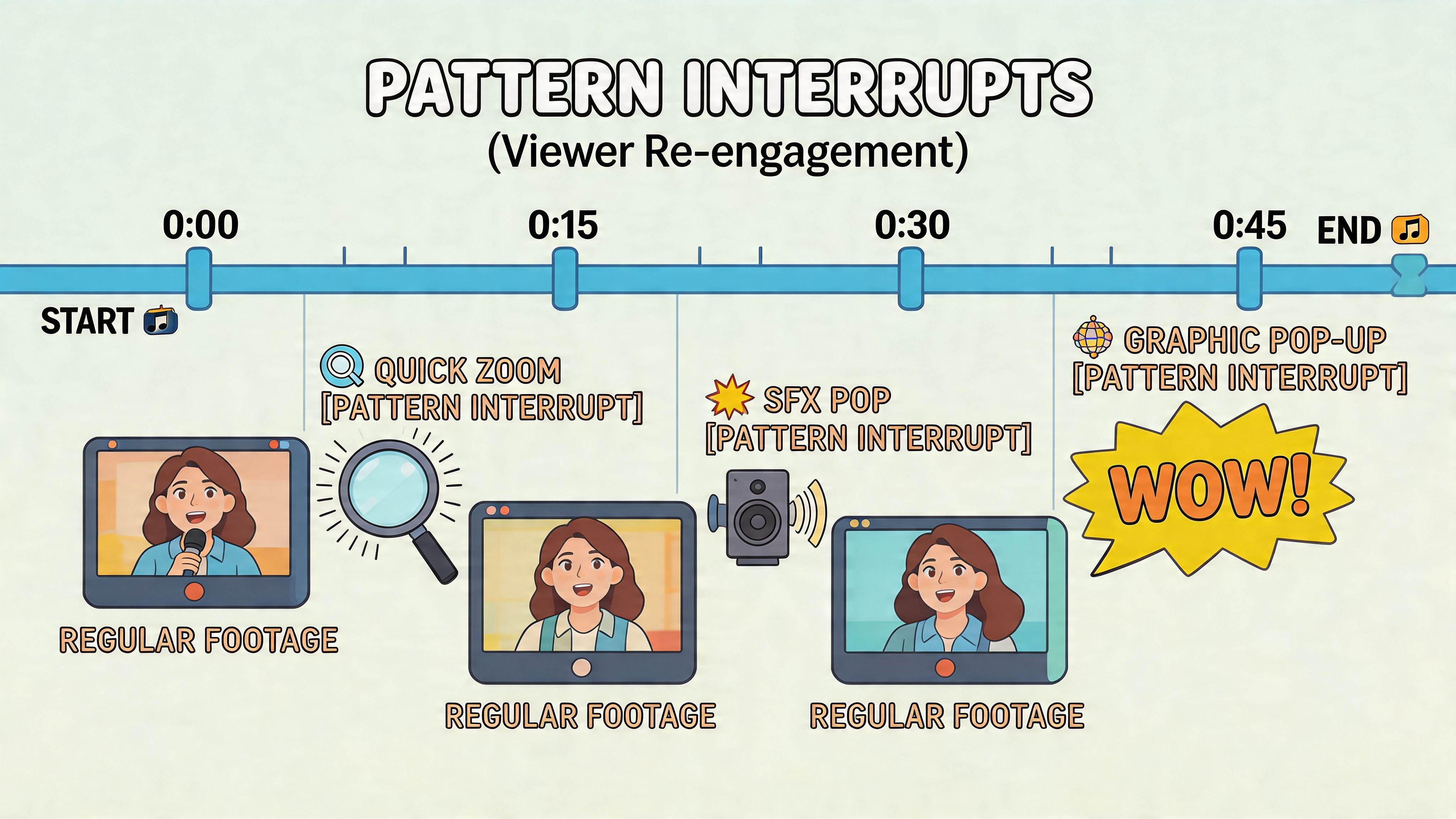
Research from vidIQ notes that using pattern interruption techniques every 30 seconds can significantly improve retention. That doesn’t mean forcing random effects into your timeline. It means giving the viewer a fresh stimulus before fatigue sets in.
A pattern interrupt can be visual or narrative:
- Visual reset
A zoom, cut-in, on-screen phrase, or short piece of B-roll that changes what the viewer sees. - Narrative reset
A new question, an objection, a reveal, or a quick reframing of the point you’re making.
The important part is intent. If an effect doesn’t clarify, emphasize, or reset attention, it’s decoration.
Good B-roll adds meaning
Weak B-roll just fills silence. Strong B-roll advances understanding.
If you’re explaining retention, show the graph. If you’re discussing repurposing, show the workflow. If you’re teaching a process, let viewers see the exact screen, cut, or sequence you mean.
For educators, this matters even more because cognitive fatigue shows up fast when viewers only see a talking head. Teams producing lessons can learn a lot from LearnStream’s guide to online course videos, especially around making explanation-heavy content feel easier to follow.
Tight edits beat busy edits
Creators often overcorrect after learning about retention editing. They add sounds, punch-ins, captions, and graphics to every sentence. The result feels frantic.
A cleaner rule is to change something when the viewer needs help staying oriented. Not every line needs a flourish. The timeline should breathe when the idea is clear, then tighten when attention is likely to drift.
Editing check: If a sequence feels slow, don’t ask what effect to add first. Ask what can be cut.
J-cuts and L-cuts keep momentum alive
Two of the most overlooked retention tools are J-cuts and L-cuts.
A J-cut lets the next audio start before the video changes. An L-cut lets the current audio continue after the visual cut. Both techniques smooth transitions because they prevent the stop-start feeling that makes edits feel mechanical.
Use them when:
- moving from one example to the next
- introducing B-roll without breaking the sentence
- transitioning between speaker shots and screen recordings
- keeping a story flowing while changing visuals
This is especially useful in interviews, podcasts, and educational content, where abrupt cuts can make the pacing feel choppy even when the information is strong.
A simple way to study this in action is to watch a polished creator breakdown and pay attention only to transitions.
Captions aren’t just for accessibility
Captions help viewers stay connected when they’re watching in low-volume environments or splitting attention across multiple inputs. They also reinforce key phrases visually, which can keep the message landing even when the pacing picks up.
If you’re building clips for short-form platforms, caption styling matters even more because mobile viewing is fast and distracted. Klap’s guide on adding captions to YouTube Shorts is a solid reference for the practical side of this.
An editor’s retention checklist
Before exporting, review the middle of the video with these questions:
CheckpointWhat to look for
Pacing
Does any section repeat the same point longer than needed?
Visual change
Does the screen stay static too long without a reason?
Clarity
Does every graphic or insert make the explanation easier to grasp?
Transition quality
Do cuts feel smooth, or do they create friction between ideas?
Energy control
Does the edit vary rhythm without becoming chaotic?
The best editors think like attention designers. They don’t just remove mistakes. They shape the viewer’s experience minute by minute.
Building a Content Flywheel with Short-Form Video
A lot of creators use short-form the wrong way. They chase clip views as if those views are the finish line.
They aren’t. Short-form is strongest when it feeds something larger. If your goal is a real watch time increase on YouTube, the smartest role for short-form is discovery that pushes viewers toward long-form content where deeper engagement happens.

The monetization detail creators miss
This is the part many people overlook. Watch time from videos viewed on the Shorts shelf does not count toward the 4,000 public watch hours required for YouTube Partner Program eligibility.
That doesn’t make Shorts unimportant. It makes their job clearer.
Shorts help people discover you. Long-form helps them spend meaningful time with you. When those two formats support each other, you stop treating content as isolated uploads and start building a system.
The flywheel model
Think of the flywheel as a loop, not a funnel.
A strong long-form video gives you source material. From that source material, you cut short clips built to grab attention quickly. Those clips travel across Shorts, Reels, and TikTok. A portion of viewers gets curious enough to seek out the full video, subscribe, or keep watching related content. Their behavior then tells you which long-form topics deserve more depth, which creates better source material for the next round of clips.
That loop compounds because every asset does more than one job.
How the workflow actually looks
This strategy works best when you use long-form as the anchor.
A practical workflow looks like this:
- Start with one substantive long-form asset
Use a podcast, webinar, interview, tutorial, or commentary video that already has clear ideas and multiple moments of tension. - Identify the sections with standalone pull
Not every moment should become a clip. Look for lines that create curiosity, disagreement, or immediate utility. - Turn those moments into platform-native shorts
Reframe vertically, tighten the opening, and add readable captions. - Publish clips with a clear next step
Tell viewers where to go if they want the full explanation. That might be the YouTube full video, a playlist, or the next related upload. - Watch which clips send intent, not just views
The best clip isn’t always the one with the broadest reach. It’s often the one that attracts the right viewer into deeper content.
Where an AI clipping workflow fits
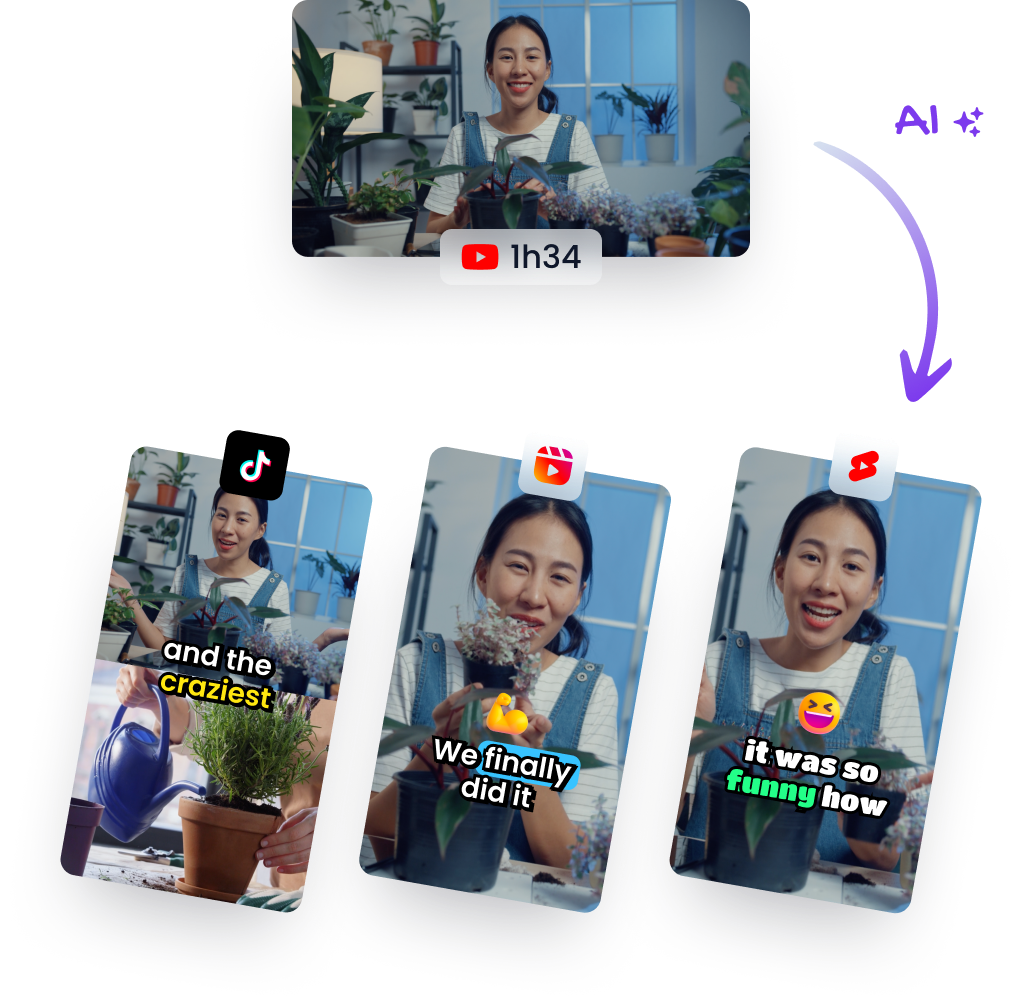
If you already publish long-form consistently, manual clipping can turn into a bottleneck fast. One practical option is Klap’s long to short video converter, which takes a longer video, identifies engaging segments, reframes for vertical platforms, and adds captions so those clips are ready for review and export.
Used correctly, that kind of workflow saves time on mechanical editing so you can focus on strategy. The strategic part still matters most. Which moments deserve clipping, what promise the caption should make, and how the clip should hand viewers off to long-form content are decisions the tool can’t make for you.
Shorts should create demand for the deeper video, not replace it.
What makes a clip useful in the flywheel
A good discovery clip usually does one of four things:
- It presents a partial answer
Enough value to be useful, but enough tension left unresolved that the viewer wants the fuller explanation. - It isolates the sharpest moment
A surprising line, hard-earned lesson, or concise demonstration. - It reframes a broad topic into a narrow angle
Broad themes feel generic in short-form. Narrow claims travel better. - It signals there’s more depth behind it
The clip should imply that the long-form version contains the full framework, story, or proof.
Many creators sabotage themselves. They post clips that are self-contained and have no reason to continue the journey. Good for views. Bad for channel depth.
Cross-platform clips should still point somewhere
This matters beyond YouTube. Reels and TikTok can send strong discovery traffic when the clip earns curiosity, especially if the creator gives viewers a direct path to the full piece.
Sometimes the best tactic is to make the short-form clip conversational by building on platform-native mechanics. If you’re using TikTok as part of your distribution mix, EntreResource’s walkthrough of the tiktok stitch format is useful because it shows how to respond to existing content while still pulling attention back to your own perspective and longer material.
The key is intent. Don’t just republish the same cut everywhere and hope. Adapt the clip to the platform, but keep the destination consistent.
A simple flywheel map
StagePurposeWhat to optimize
Long-form upload
Create depth and total channel watch hours
Topic strength, structure, retention
Short-form clipping
Generate discovery from the strongest moments
Hook speed, vertical framing, captions
Distribution
Reach viewers where they already scroll
Platform-native packaging and CTAs
Return path
Move interested viewers to fuller content
Links, pinned comments, end-screen logic
Feedback loop
Learn what ideas deserve expansion
Which clips create deeper viewing behavior
The trade-off most creators need to hear
Short-form can make you feel productive because output rises fast. That’s useful, but it can also create a false sense of progress if the clips never feed long-form behavior.
The flywheel only works when you judge clips by the quality of viewers they attract. A clip that sends fewer but more interested people into your longer videos is often more valuable than a clip that racks up empty attention.
That’s the shift. Don’t ask, “How many views did this short get?” Ask, “Did this short create the right next action?” That’s where short-form stops being content filler and starts becoming infrastructure for channel growth.
Measuring and Amplifying Your Success
Once the flywheel is running, the next job is measurement. Not vague observation. Actual evidence that your edits, hooks, and clips are pushing viewers into longer sessions.
Many creators stop too early here. They notice one clip performed well and assume the strategy worked. That’s not enough. You need to see whether discovery turns into deeper watch behavior.

Track the path, not just the post
Inside YouTube Analytics, focus on behavior that reveals movement across content:
- Traffic sources
Look for viewers arriving from external platforms and short-form surfaces. - Watch time by video Identify which long-form videos are converting interest into sustained viewing.
- End screen and related video paths
See whether people continue to another piece of content after the first video ends. - Audience overlap by topic
Pay attention to which themes create repeat viewing across the channel.
Creators often discover that the most viral clip wasn’t the most useful one. Sometimes the quieter clip brought in viewers who watched longer and stayed on the channel.
A/B test the entry point
A retention strategy only works if enough people click in the first place. Better titles and thumbnails produce more data, which makes it easier to evaluate whether your opening and pacing are working.
Don’t test randomly. Change one major variable at a time. If both the title and thumbnail change at once, you won’t know which one altered behavior.
A simple testing sequence:
- Keep the video the same
- Test a sharper title angle
- Review click behavior and downstream watch patterns
- Then test a new thumbnail concept if needed
The goal isn’t just a higher click-through rate. It’s a better fit between the promise of the packaging and the experience of the video.
Publish when your audience is actually online
Timing matters more for some channels than others, but it matters a lot when your audience is spread across countries.
Analytics can show a 20% to 40% variance in initial watch time based on timezone alignment, and posting around 9 PM IST in India can produce up to 25% higher retention. If a large share of your viewers is in India, Japan, or another region outside your own timezone, a “good” upload can underperform because it launched when your audience was unavailable.
That changes how you should schedule repurposed content too. A short-form clip timed for a local evening can build discovery in-market, which may later feed long-form viewing on YouTube.
When performance is inconsistent, check the publish time before you rewrite the whole strategy.
Use a review loop after every release
The best channels improve because they close the loop quickly.
After each upload, ask:
QuestionWhy it matters
Did the title and thumbnail attract the right viewer?
High clicks with weak retention suggest mismatch
Did the opening hold attention?
Early drop-off points to a hook issue
Did any segment create rewatch behavior?
Rewatched moments can become future clips
Did short-form distribution send engaged viewers back?
This validates the content flywheel
Was the publish time aligned with audience geography?
Poor timing can suppress initial momentum
You don’t need perfect data from every upload. You need consistent learning. Channels that achieve a lasting watch time increase usually don’t do one magical thing. They stack many small corrections, then let those corrections compound over time.
Frequently Asked Questions About Watch Time
What’s the difference between watch time and audience retention
Watch time is the total amount of time viewers spend watching. Audience retention is the percentage of a video they keep watching. They work together. More retention usually improves total watch time, but a longer video can still generate more total minutes with a lower retention rate.
Should you buy watch hours
No. YouTube can detect inauthentic watch time with high accuracy, and channels using bots or fake accounts risk algorithmic penalties, demonetization, or termination. Even if inflated hours appear in the short term, they create no real engagement value and can distort your analytics.
How long does it take to see a watch time increase
Usually not overnight. The fastest gains tend to come from fixing openings, tightening edits, and building clearer paths from one video to the next. The more durable gains come after several uploads, when patterns become visible and you start repeating what your audience already responds to.
Do short clips help if they don’t count toward monetization watch hours
Yes, if they drive discovery and send the right viewers into your long-form content. That’s the point of the flywheel. Short-form creates attention. Long-form converts that attention into meaningful channel depth.
If you already have podcasts, webinars, interviews, or YouTube videos sitting in your library, Klap gives you a practical way to turn them into short clips that can support that flywheel. Use it to pull strong moments from long-form content, publish them where discovery happens, and send interested viewers back to the videos that build real watch time.