English to French Vocal Translation A Creator's Workflow
Other
You've already done the hard part. You recorded the webinar, interview, course lesson, or podcast episode. The ideas are solid, the clips are there, and the English version is performing.
Then the scaling problem shows up. You know French-speaking viewers would understand and share this content, but traditional dubbing is slow, expensive, and hard to repeat every time a new video goes live. Often, organizations struggle at this point. They either publish subtitles only, or they postpone localization until “later” and never build a repeatable system.
That's why english to french vocal translation matters now. It's no longer a specialist workflow reserved for large media teams. It's become practical enough for creators, marketers, educators, and agencies that need to turn one long-form video into many localized assets without rebuilding the whole production process each time.
Unlocking a New Audience with Vocal Translation
A lot of creators treat translation like a finishing touch. In practice, it works better as a growth system.
If you publish long-form English content, you already have raw material for French YouTube uploads, French-native cutdowns, French subtitles, and short clips designed for Reels, Shorts, and TikTok. The bottleneck isn't ideas. It's whether you can move from one source video to a multilingual production workflow fast enough to keep publishing.
That shift has become more realistic because AI translation infrastructure is now broad and mature. In 2024, major platforms supported over 300 languages, and English-French remained a core, high-volume pair with strong vendor support from companies like Transword and Murf, according to KUDO's 2024 AI speech translation summary.
Why French is a practical first expansion
French works well as a first localization target for a simple reason. The language pair is common, commercially important, and well supported across transcription, translation, and voice tools.
That matters if your real goal isn't “translate one video,” but build a repeatable engine for multilingual distribution. Once you start thinking in terms of content repurposing workflows, the job changes. You're not buying a translation output. You're designing a pipeline that can take one source file and produce multiple French-ready assets.
A good workflow can give you:
- A French voice track for dubbed uploads or social edits
- French captions for silent-first social viewing
- Localized short clips with tighter hooks for French-speaking audiences
- Reusable terminology decisions so future videos stay consistent
Practical rule: If you're publishing the same message across markets, translation shouldn't happen at the end. It should happen early enough that audio, captions, and clip editing all stay aligned.
The teams that get value from english to french vocal translation don't chase perfect automation. They build a system that's fast enough for regular publishing and controlled enough that the final video still feels intentional.
The Modern Vocal Translation Workflow
The clearest understanding of this workflow is to view it as a production line. Each stage hands off to the next, and each handoff can either preserve quality or damage it.
The three core stages are ASR, MT, and TTS. In plain terms, that means: transcribe the English speech, translate the text into French, then generate or record the French audio. If one stage is weak, the rest inherit the problem.

Stage one starts with the transcript
If the English transcript is wrong, the translation won't save you. Names, acronyms, product terms, and filler words all matter because they shape the meaning and rhythm of the French version.
For spoken content, a “good enough” transcript often isn't good enough. You want a transcript that accurately reflects what was said, but also one you're willing to edit before translation. Many teams improve quality fastest at this stage. They clean the source text first.
Stage two is where nuance can slip
Translation engines are strong on common language pairs, but natural spoken French depends on more than literal accuracy. It depends on whether expressions still sound like someone talking, not like a document being read aloud.
A comparative study found that DeepL and Google Translate achieved 89% and 86% average accuracy on high-frequency idiomatic expressions in French, based on French-to-English abstracts, according to the comparative machine translation study in PMC. That's useful because idioms and recurring expressions are exactly where spoken content often sounds natural or awkward.
What to review manually after machine translation:
- Idioms and recurring phrases that may have been translated too directly
- Domain vocabulary such as legal, medical, financial, or product-specific terms
- Discourse markers like “so,” “right,” “basically,” or “the thing is,” which often need adaptation rather than direct conversion
- Sentence length because spoken French may need compression or rewriting to fit timing
The translation stage doesn't just convert language. It decides whether your dubbed video sounds like speech or like software.
Stage three is voice production, not text export
Once the French text is approved, you still need audio that fits the video. That means choosing a synthetic voice, cloned voice, or human voiceover that matches the intended use.
For a webinar clip, slight mismatch may be acceptable. For a founder video or creator commentary, the voice choice affects credibility immediately. The final pass should check timing against cuts, subtitle sync, and whether the generated delivery feels too flat, too formal, or too rushed.
Choosing Your Translation Technology Stack
The tooling decision usually comes down to one of two models. You either use an all-in-one platform that handles transcription, translation, and voice generation together, or you build a component pipeline with separate tools for each job.
Neither option is automatically better. The right choice depends on how often you publish, how much review capacity you have, and whether your bottleneck is editing time or quality control.
The two stack models in practice
All-in-one tools are easier to operate. You upload a file, choose English to French, and get subtitles, translated text, and often synthetic dubbing in one interface. Platforms such as Maestra or Rask.ai fit this model.
A component pipeline is more modular. A team might transcribe with Whisper, translate with DeepL, then generate French audio with ElevenLabs or another voice platform. This setup gives more control, but it also creates more points where someone has to check files, timing, and consistency.
Here's the trade-off in plain terms.
FactorAll-in-One Platforms (e.g., Maestra, Rask.ai)Component Pipeline (e.g., Whisper + DeepL + ElevenLabs)
Setup speed
Faster to launch
Slower to configure
Control over each stage
Lower
Higher
File management
Simpler
More manual
Voice choice flexibility
Depends on vendor
Usually broader
Error tracing
Harder when output fails
Easier to isolate issues
Best fit
Small teams, fast publishing
Teams with editing standards and review capacity
Cost isn't just tool pricing
A lot of teams compare only subscription costs. That's a mistake. The key budget question is how much post-editing the output creates.
For English-French, professional human translation or editing typically costs $0.15 to $0.30 per word, according to Smartling's translation cost and turnaround guidance. That matters because a cheaper automated workflow can become expensive if every script needs heavy cleanup before it's publishable.
A practical decision filter looks like this:
- Choose all-in-one if you need speed, your content is repetitive, and minor phrasing issues won't damage trust.
- Choose component tools if terminology matters, brand voice matters, or different clients require different voice styles.
- Add human review when the content drives revenue, compliance, or executive visibility.
What works for creators and lean teams
For many creators, a hybrid setup is the most realistic choice. Use one tool to move fast, then insert human checks only where errors are costly.
That could mean generating a first-pass translation automatically, reviewing the script manually, then sending only the final French text into a voice tool. It keeps turnaround manageable without pretending machine output is final.
If you're evaluating voice workflows more broadly, the Yellow.ai Voicehub platform is worth looking at for a broader view of how full-stack voice systems are being assembled in production environments. For video-specific localization, tools that translate videos into target-language subtitles can also fit into the stack when your immediate need is captioned French distribution rather than full dubbing.
Budget check: The cheapest automation is often the one that creates the fewest editing hours afterward.
Ensuring High-Quality French Audio and Captions
A translated script can be correct and still fail on screen.
This happens all the time. The French wording is fine, but the pacing feels wrong, the captions are too dense, or the dubbed line lands after the visual beat has already passed. Viewers don't experience translation as text quality alone. They experience it as timing, tone, readability, and trust.

Expect strong output, not flawless output
AI performs well on major European language pairs, but it still has limits. A 2024 industry summary noted that some tests showed English-to-Spanish reaching up to 94% accuracy, with major European languages performing similarly, which implies that even strong systems can still leave a 5% to 10% band of error or awkwardness for high-value content, based on Sonix's translation accuracy summary.
That's the right mindset for quality control. Don't review the French version because the whole output is probably wrong. Review it because a small number of awkward lines can hurt the entire video.
A practical review checklist
Check the French version in this order, not all at once:
- Meaning first
Confirm that the message survived. Product claims, instructions, offers, and calls to action should match the English intent. - Timing second
Play the dubbed track against the edit. French may run longer or shorter than the original line. If the sentence collides with a cut, rewrite it. - Tone third Is the voice calm when the original was urgent? Is it too formal for a creator-led clip? Synthetic audio frequently strays in these tonal aspects.
- Caption readability
Short-form clips need captions people can scan instantly. Break lines for reading, not just for literal transcript fidelity. - Pronunciation and audio polish
Listen for names, acronyms, and unnatural stress. A clean translation still feels low quality if the audio sounds detached or oddly emphasized.
What editors should change without hesitation
Some lines should be rewritten even if they're technically accurate.
- Compress long openings when French phrasing delays the point
- Replace literal transitions with spoken French that feels natural
- Shorten captions if viewers won't finish reading before the next cut
- Remove duplicate meaning when the dubbed line and on-screen text compete
If you're testing different synthetic narration styles, a tool like Aicut AI voice over can help teams compare voice output approaches before they lock a production method. The bigger issue is less about the tool and more about whether the chosen voice suits the content format. The same review logic also applies if you're refining your broader voice-over production process.
A translation passes quality control when viewers stop noticing it's translated.
Common Pitfalls That Derail Vocal Translations
The biggest failure in english to french vocal translation usually isn't grammar. It's identity.
A lot of teams judge the output by asking, “Are the words correct?” Viewers ask a different question. They ask whether the speaker they're hearing feels believable for the person on screen.

Brand voice mismatch is the quiet killer
Adobe says its workflow can generate French voiceovers while preserving the speaker's tone and pacing, but the harder issue is whether the result still sounds like the original creator in a way that preserves brand identity, as discussed on Adobe Firefly's English-to-French audio translation page.
That distinction matters. Tone and pacing are only part of voice identity. Creator-led content also depends on timing, emphasis, confidence, warmth, humor, and personality. A synthetic French track can be factually accurate and still feel generic.
When synthetic dubbing is usually fine
Some content types tolerate synthetic output well because the value is mostly informational:
- Tutorials where clarity matters more than personality
- Explainers with structured narration
- Webinars where viewers mainly need access to the ideas
- Internal training where consistency matters more than performance
When to be more careful
Other formats depend heavily on how the speaker sounds:
- Personal storytelling
- Comedy or irony-heavy commentary
- Emotional interviews
- Founder videos and creator monologues
In those cases, a flat French dub can weaken trust fast. The audience may not know why it feels off. They'll still feel the mismatch.
If the original video works because of the speaker's personality, the translated voice is part of the product, not just a delivery layer.
Another common mistake is choosing a French register that doesn't match the brand. Some scripts come back too formal. Others sound too casual for B2B, education, or expert-led content. Good localization isn't only about language transfer. It's about matching the social context of the original performance.
From Translation to Virality with Video Repurposing
Once you have a usable French voice track and cleaned French captions, the most impactful step is to turn those assets into many short pieces of content.
That's where translation becomes a system instead of a one-off deliverable. One webinar can become multiple vertical clips. One interview can become a week of French social posts. One training video can become a set of localized explainers for different channels.

The scalable content engine
The workflow is straightforward when it's set up properly. Start with the original long-form video. Produce the French translation assets. Then cut the content into shorter units that fit vertical platforms and fast-viewing behavior.
The point isn't to translate the full video and stop there. The point is to reuse that translation work across many formats:
- Short French clips for TikTok, Reels, and Shorts
- Caption-first edits for muted autoplay environments
- Topic-specific snippets for campaigns or product angles
- Localized quote clips from interviews, podcasts, or webinars
Where repurposing tools fit
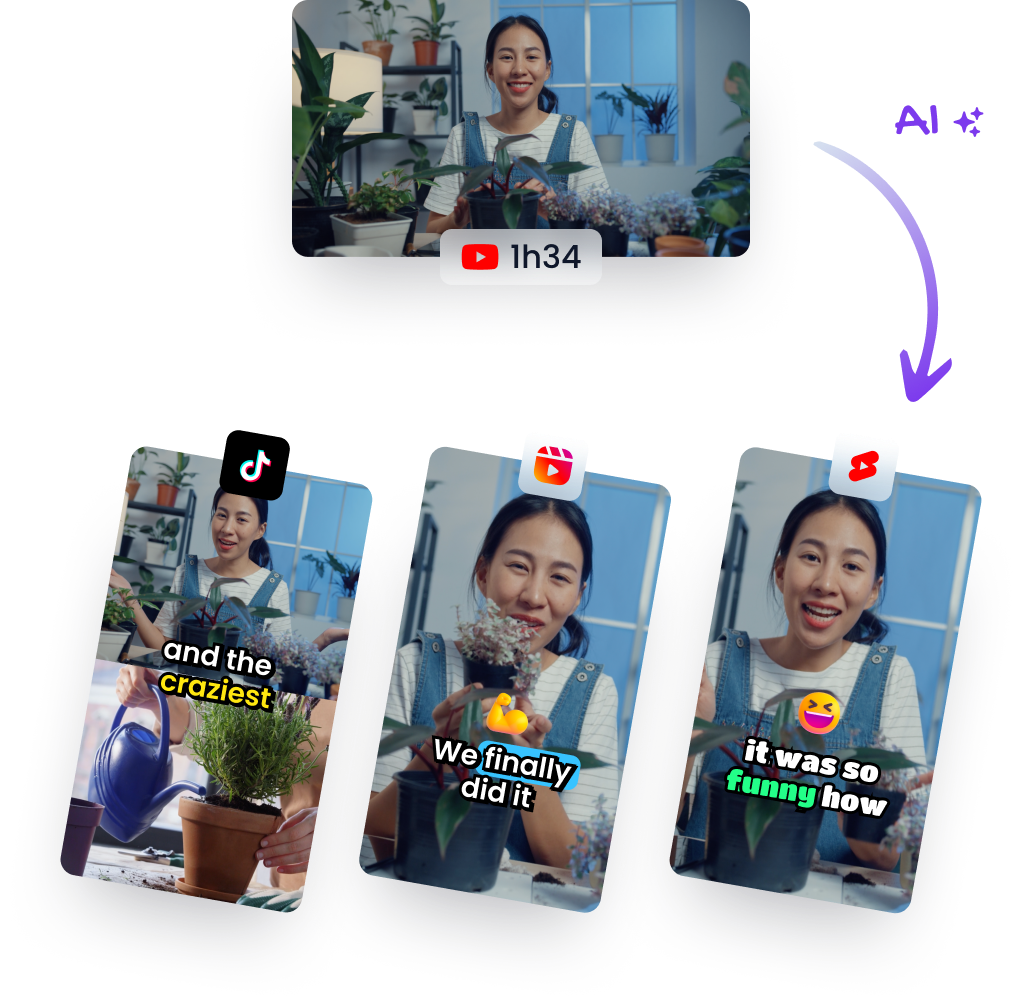
A repurposing platform proves useful. Instead of manually rebuilding every clip in an editor, you can use a system that identifies strong moments, reframes for vertical video, and lets you refine subtitles and timing around the translated assets.
Klap fits here as a practical option because it turns long-form video into social-ready short clips with reframing, captioning, and editing controls. For teams that want to expand beyond recorded source footage, a text-to-video generator can also be useful in adjacent workflows where translated scripts need to become entirely new video outputs rather than dubbed edits.
What actually scales
The teams that publish multilingual clips consistently usually standardize three things:
- A terminology list so product names and phrases stay consistent
- A review pass focused on the lines most likely to sound awkward
- A clip selection process that favors segments with clean standalone meaning
At this point, english to french vocal translation stops being a language feature and starts acting like a distribution engine. The translation creates access. Repurposing creates volume.
Conclusion The Future of Multilingual Content
Creators used to treat localization as extra work. Now it's part of distribution.
That doesn't mean every video needs full dubbing. It means the teams that want broader reach should think in systems. Clean transcript. Smart translation. Careful voice choice. Tight quality control. Then repurpose the result into formats people watch.
English to french vocal translation is especially useful because it sits at the intersection of speed, accessibility, and market relevance. The tools are good enough to move fast, but not so perfect that you can skip editorial judgment. That's the actual operating model. Use automation for throughput. Use human review for the moments that shape trust.
The long-term advantage isn't just publishing in another language once. It's building a workflow that lets one source video become a library of localized assets without starting over every time.
Teams that do this well won't think of translation as a cost center. They'll treat it as infrastructure for audience growth.
Frequently Asked Questions About Vocal Translation
A few practical questions come up on almost every project. These are the ones worth settling before you publish.
QuestionAnswer
Should I keep the original music bed in a translated video?
Usually yes, if you already have the rights to use it in the localized version and the music doesn't interfere with speech clarity. The problem is mix balance. A music bed that worked under the English voice may mask consonants or reduce intelligibility in the French dub, so always recheck levels after replacing the vocal track.
What's the difference between text-to-speech and voice cloning?
Standard text-to-speech generates speech from a preset synthetic voice. Voice cloning tries to approximate the original speaker's vocal character more closely. For tutorials and explainers, standard synthetic voices are often acceptable. For creator-led content, interviews, or brand-sensitive messaging, cloning or a human French voice actor may preserve identity better.
If my video already has French audio, do I still need French subtitles?
In most cases, yes. Subtitles still help on silent autoplay, improve comprehension when pacing is fast, and give you another layer of message control. They also let you shorten or clarify spoken lines visually if the dubbed phrasing has to stay longer for natural delivery.
Should I translate word for word to stay accurate?
No. Spoken video usually performs better when you preserve meaning, emphasis, and pacing rather than literal wording. A line that is technically exact but unnatural in French can hurt retention more than a well-adapted line that sounds native.
When should I hire a human reviewer?
Bring in a reviewer when the video supports sales, paid campaigns, executive communication, education, or anything with legal or reputational risk. If the content is casual and short-lived, machine output with internal review may be enough.
What should I review first when time is tight?
Prioritize the hook, the call to action, names and product terms, and any line tied to a visual cut. Those are the places where awkward wording or bad timing is most visible.
If you're turning webinars, podcasts, interviews, or YouTube videos into multilingual short-form content, Klap helps you convert long-form footage into social-ready clips with captions, reframing, and edit controls. It's a practical way to turn your translation work into a repeatable publishing workflow instead of another folder of unused assets.