AI Clip Maker for YouTube: Turn Long Videos Into Viral
Other
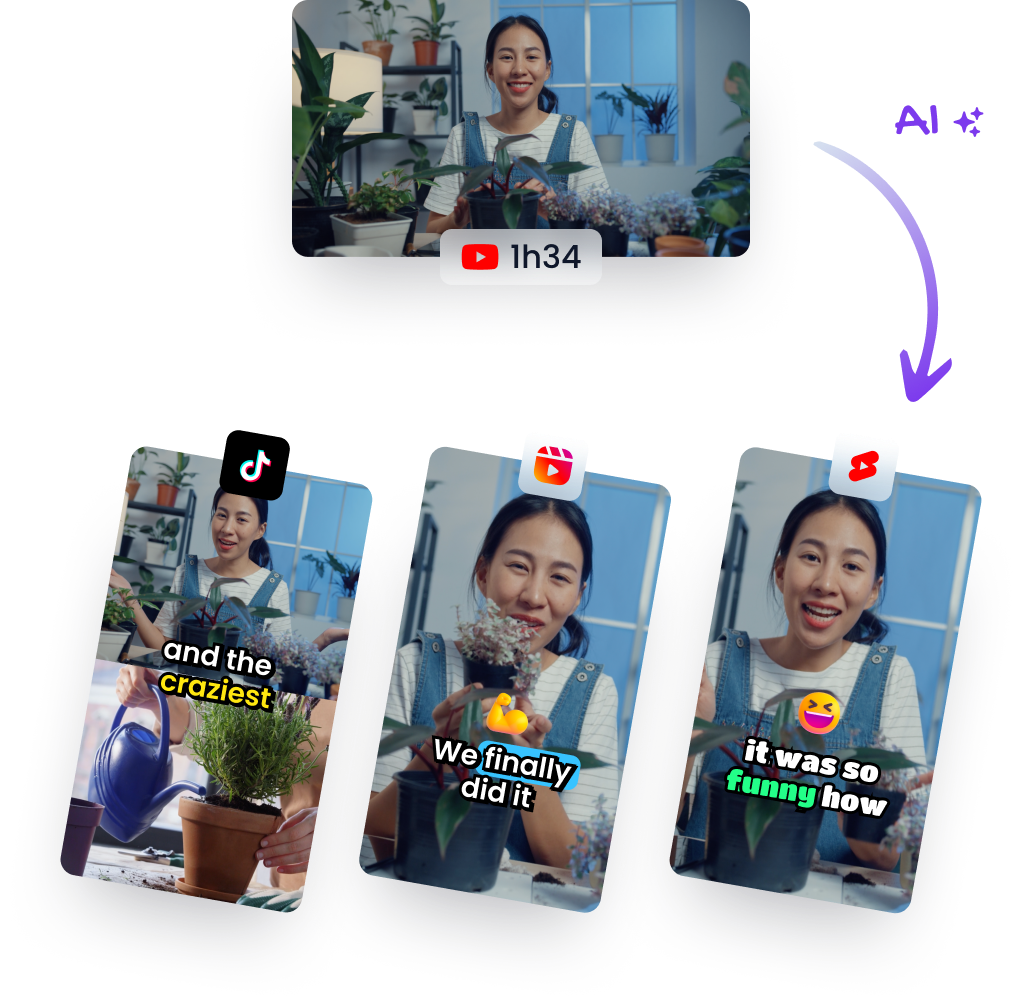
Short-form video is the top ROI-driving format for 49% of marketers, and YouTube Shorts averages 5.91% engagement, making it the highest-engagement short-form platform. An AI clip maker for YouTube makes that opportunity practical by turning one long upload into multiple discovery-ready clips without forcing you to rebuild every edit manually.
That promise has a catch. More clips don't automatically produce better retention, and faster exports don't protect a channel from repetitive-content concerns. The useful question isn't just which tool generates Shorts fastest. It's whether the system can identify a complete idea, frame it for mobile viewing, preserve context, produce accurate captions, and leave enough room for human judgment.
Why Creators Are Shifting to AI-Generated Shorts
Short-form video has moved from an experimental format into a planned media channel. Short-form video leads marketers for ROI at 49%, while long-form video is cited at 29% and live streaming at 25%; YouTube Shorts is reported at about 5.91% engagement, higher than TikTok and Instagram Reels in that comparison set. More than 57% of marketing budgets include a dedicated short-form video line item, according to the same short-form video marketing data.
That scale changes the production problem. A creator may already have YouTube videos, podcast episodes, interviews, webinars, or lessons, but those assets weren't necessarily recorded in a format that works in a vertical feed. Someone still has to find the strongest moment, remove the slow setup, preserve enough context, crop the frame, caption the speech, and package the result for Shorts.

Scale creates a quality problem
Short-form publishing rose 71% year over year, while the number of accounts using the format rose 51%, according to the Repurpose-10K research discussion. At the same time, a 2025 industry summary reported that likes fell 47%, engagement fell 36%, and reach declined 31%. Those figures point to a crowded environment where volume alone has less value.
An AI clip maker becomes useful when it reduces mechanical labor while improving selection discipline. It can scan a complete recording for topic shifts, strong statements, reactions, and visually salient moments instead of asking an editor to scrub through every minute. The human still decides whether the clip deserves publication, but the first pass becomes faster and more consistent.
Practical rule: Treat AI output as a ranked shortlist, not a finished content strategy.
Creators who use these systems well build a feedback loop around retention, not vanity metrics. They examine whether viewers stay through the opening, whether the clip delivers a coherent payoff, and whether the edit attracts the right audience for the long-form channel. A useful overview of how short-form supports broader distribution is available in this guide to short-form video marketing.
What an AI Clip Maker Actually Does
An AI clip maker for YouTube analyzes long-form footage, identifies promising sections, and turns those sections into short, platform-ready videos. Think of it as a junior editor that can review a recording at machine speed. It doesn't understand your business perfectly, and it doesn't know your audience's strategy unless the workflow gives it useful signals, but it can perform the repetitive discovery and formatting work quickly.
The process usually has three connected stages.
Scan and score
First, the system transcribes the speech and examines the video over time. It looks for signals such as a clear claim, a question followed by an answer, a surprising statement, a change in speaker energy, or a visual event that gives the segment a natural entry point.
More advanced systems rank candidate windows rather than chopping the recording into equal pieces. A recent clip-selection model reported gains of up to 8.1% on Video-MME, 5.6% on LongVideoBench, and 10.3% on MLVU versus uniform sampling without additional training, as described in this research summary on automated YouTube clipping. The practical lesson is simple: a good system searches for concentrated value instead of assuming every section deserves equal treatment.
Select and crop
After scoring, the tool chooses a start and end point and converts the original composition into a vertical layout. Shot detection helps it recognize cuts, while subject or face tracking keeps the important person in view as the camera or speaker position changes.
That step matters most for interviews and podcasts. A static center crop can cut off a second speaker, lose hand gestures, or leave the active person outside the frame. The better workflow preserves the visual relationship that made the original shot understandable.
Polish and export
Finally, the tool adds captions, applies a visual style, and prepares the output for the selected platform. You should still review the transcript, because automatic punctuation, names, technical terms, and speaker changes can fail even when the overall clip is strong.
The most useful mental model is candidate discovery plus production assistance. It isn't a replacement for editorial judgment. It helps you find plausible moments and handles formatting tasks, while you decide whether the opening works, whether the context is sufficient, and whether the clip sounds like your channel.
For a deeper explanation of the workflow, see this guide to an AI video clipping tool.
The Three Core Mechanics Behind Every Good Clip
A publishable Short usually depends on three mechanics working together: hook detection, scene scoring, and smart cropping, with captions acting as the layer that makes the result understandable in a feed. If one fails, the others can't fully rescue the clip.

Hook detection starts before the conclusion
A strong clip doesn't necessarily begin at the exact moment the speaker starts talking. Long-form speakers often spend several seconds setting up a point, referring to an earlier question, or using a phrase that only makes sense with prior context.
Hook detection looks for an opening with immediate informational or emotional value. Audio cues can include a direct claim, contrast, question, or emphatic delivery. Visual saliency can include a face turning toward the camera, a meaningful gesture, a reaction, or a scene change. The editor's job is to keep enough setup for comprehension without making viewers wait for the point.
Scene scoring then ranks the broader segment. A loud moment isn't automatically a useful moment. The best candidate often contains a complete thought, a recognizable problem, and a payoff that arrives before the viewer loses interest.
Smart cropping protects the subject
Vertical 9:16 framing fits mobile short-form viewing better than traditional 16:9 format. An academic comparative study found that portrait videos outperform landscape videos in audience engagement for short-form content, as documented in this comparative study of portrait and landscape video.
Auto-reframing should follow the face or active subject rather than place the original center in a narrow box. For a two-person conversation, that might mean switching focus between speakers. For a demonstration, it may mean following the hands or product instead of the presenter.
Captions carry the silent version
Burned-in captions are essential in many short-video contexts because viewers often watch without sound. A YouTube Shorts editing guide recommends keeping text inside the central safe area, away from interface elements such as the progress bar and right-side controls.
Caption accuracy also affects trust. A summary of 3Play Media's State of Captioning research reported that only 28% of online videos meet caption accuracy standards, creating a clear quality risk for automated workflows. Captions need to be readable, synchronized, and easy to correct before export.
The three mechanics form one chain. Selection creates the message, reframing preserves the visual subject, and captions keep the message accessible. A tool that offers only one or two of these features may save time in one stage while creating review work in another. More ideas about the structure of effective short-form content appear in this analysis of what makes a video go viral.
Feature Checklist for Evaluating AI Clip Tools
Tool demos often emphasize how quickly a system produces clips. That isn't enough for a channel with a recognizable voice, multiple contributors, or monetization goals. Evaluate the system by inspecting the decisions it makes, the corrections it allows, and the safeguards it provides before publication.
Questions worth asking before you choose
- Selection control: Can you tell the tool to find explanations, objections, reactions, or product demonstrations instead of accepting a generic highlight score?
- Context preservation: Does each suggestion begin at a natural point and end after a complete idea?
- Reframing quality: Does face and subject tracking work when speakers move or when several people appear?
- Caption accuracy: Can you edit words, punctuation, timing, and speaker attribution without rebuilding the clip?
- Platform safety: Does the workflow encourage meaningful editing and distinct source material rather than repetitive templates?
- Export flexibility: Can you produce vertical, square, and horizontal versions without losing the focal subject?
- Team workflow: Does the platform offer collaboration, review permissions, or API access where a larger operation needs integration?
- Brand consistency: Can you control caption styling, colors, intro treatment, and recurring visual elements without making every clip identical?
A practical evaluation should use your hardest source video, not a polished demonstration file. Test an interview with overlapping speakers, a webinar with slides, and an educational explanation with specialized vocabulary. Compare the suggested opening, transcript accuracy, crop behavior, and the amount of manual cleanup required.
AI Clip Maker Feature Comparison
FeatureBasic ToolsProfessional Platforms
Segment selection
Generic highlights or manual trimming
Ranked candidates with topic and content signals
Reframing
Fixed crop or limited tracking
Face and subject tracking with editable focus
Captions
Automatic text with basic styling
Editable, synchronized captions with brand controls
Export
One primary format
Multiple aspect ratios and platform-ready outputs
Team use
Individual workflow
Collaboration, integrations, and possible API access
Quality control
Minimal review tools
Transcript editing, approval steps, and reusable standards
If your team also creates paid social assets, ShortGenius AI ad generator is a useful adjacent resource for comparing how an AI video workflow handles ad-oriented creative rather than organic Shorts. Keep that distinction clear. A tool optimized for advertisements may prioritize product visibility and calls to action, while a YouTube clip maker should prioritize narrative clarity and audience retention.
From Long Video to Viral Shorts a Real Workflow
A practical workflow starts with one source video and ends with a reviewed set of platform-specific exports. Using Klap as the concrete example, the process begins when a creator pastes a YouTube link or uploads a video file.
Step one starts with the source
The creator imports the full recording instead of manually downloading and pre-cutting sections. That preserves the broader context, which gives the analysis more information about topic changes, questions, answers, and recurring themes.
The first review should happen at the candidate level. Look at the proposed opening and transcript before opening every edit. A useful candidate answers three questions quickly: what is this about, why should the viewer care, and does the ending deliver something worth staying for?
Step two turns a timeline into a shortlist
The AI scans the video and surfaces multiple high-scoring segments. It may identify a strong explanation buried after a slower introduction, a concise answer in the middle of an interview, or a moment where the speaker's delivery changes enough to support a clean cut.
Human review prevents generic output. Reject clips that depend on a question viewers can't hear, pronouns with no clear reference, or conclusions that arrive after the exported window ends. A shorter clip with a complete idea usually has more practical value than a dramatic fragment that requires the original video for meaning.
Step three is the editorial pass
Adjust the start and end points, rewrite obvious caption errors, and choose the aspect ratio for the destination. Check the safe area, inspect faces at the beginning and end, and remove pauses that make the opening feel hesitant.
The same source can support different versions. A YouTube Short may need a direct insight, while an Instagram version may benefit from a stronger visual opening. Don't publish identical exports everywhere without checking how titles, captions, and framing translate across platforms.
A demonstration of this type of video repurposing workflow can be viewed below.
Step four is distribution with measurement
Export the approved clips, then organize them by topic and source episode. Scheduling helps maintain a deliberate publishing rhythm rather than dumping every candidate into the feed at once. For operational guidance, creators can browse Shorts scheduling tips.
Measure the first seconds, average viewing behavior, replays, comments, and movement from Shorts toward the broader channel. A clip that earns attention but attracts the wrong viewers may look successful in isolation while weakening the content strategy. The export is only complete when the clip has a clear purpose.
The Compliance Question No One Is Asking
The central buying question has changed from “How fast can this generate clips?” to “Can this workflow produce original, differentiated content consistently?” YouTube announced in 2025 that it renamed its “repetitious content” policy to “inauthentic content” and clarified that mass-produced, repetitive videos aren't eligible for monetization, as summarized in this analysis of AI video creation trends.
That policy distinction matters for anyone using an AI clip maker for YouTube at scale. Repurposing your own long-form material doesn't automatically make every export valuable. If each Short uses the same opening template, identical caption treatment, repeated pacing, and little editorial variation, the channel can begin to look assembled by a content machine rather than built around distinct viewer value.
Guardrails for responsible repurposing
- Add meaningful edits: Remove dead air, clarify the opening, correct captions, and tighten the sequence so the clip works independently.
- Vary the source material: Pull from different episodes, topics, speakers, and formats instead of generating near-duplicates from one narrow segment.
- Preserve distinct value: Each Short should deliver a separate insight, answer, reaction, or demonstration.
- Review every export: Human review should check context, rights, accuracy, branding, and whether the clip belongs on the channel.
- Avoid template dependence: Consistent branding is useful, but identical visual treatment shouldn't replace editorial differentiation.
The broader performance environment reinforces that caution. The reported declines in likes, engagement, and reach show why increasing output without improving audience fit can produce more inventory but less attention. Automation should support originality, not disguise repetition.
Making the Right Choice for Your Content Strategy
The right setup depends on the gap you're trying to close. A solo creator with occasional long-form uploads may need simple clipping and caption correction. A creator publishing regularly needs reliable selection and reframing. A team managing several channels needs permissions, repeatable review standards, and workflow integration.

ApproachEffortCost profileOutput quality
DIY editing
Highest manual involvement
Mainly time and existing software
Strong when the editor has time and skill
Basic AI tool
Lower selection and formatting effort
Lower software commitment
Variable, requires careful review
Professional platform
Structured workflow with human approval
Higher software commitment
More consistent across recurring content
Start with one representative video. Compare the time required to find candidates, repair captions, correct framing, and prepare exports. Then track retention and audience fit rather than judging the tool by the number of clips it creates.
Klap offers a workflow for importing long-form video, identifying potential moments, reframing them for vertical viewing, adding captions, and reviewing clips before export. If that matches your production bottleneck, visit Klap and test the process with a real YouTube upload, then keep the workflow only if it improves both editing efficiency and the quality of what you publish.