10 Ways for Video to Text Transcription Free in 2026
Other
You've already done the hard part. You recorded the podcast, webinar, interview, course, or client call. Now the useful part is trapped inside a video file, and digging it out line by line is the kind of work that kills momentum fast.
That's why video to text transcription free tools matter so much now. A transcript turns a long video into something searchable, editable, captionable, and reusable. It helps with accessibility, gives you raw material for blog posts and newsletters, and makes it much easier to find the one sentence that should become a short clip. If you're also cleaning up rough audio before clipping content, this guide on noise reduction for social ops pairs well with the workflows below.
A big shift happened when large scale speech recognition became widely accessible after the public release of OpenAI's Whisper model in 2022, trained on about 680,000 hours of multilingual audio and audio text pairs. That pushed transcription from specialist software into mainstream web tools, and now most creators can get usable text from video without much setup.
The problem isn't finding a tool. It's picking the right workflow. Some free options are best for quick YouTube transcripts. Some are better for editing captions in-browser. Some are strongest when privacy matters and you want everything local. And some aren't really “free” in a practical sense once exports, file limits, or credits get in the way.
Easy and integrated workflows
1. Klap

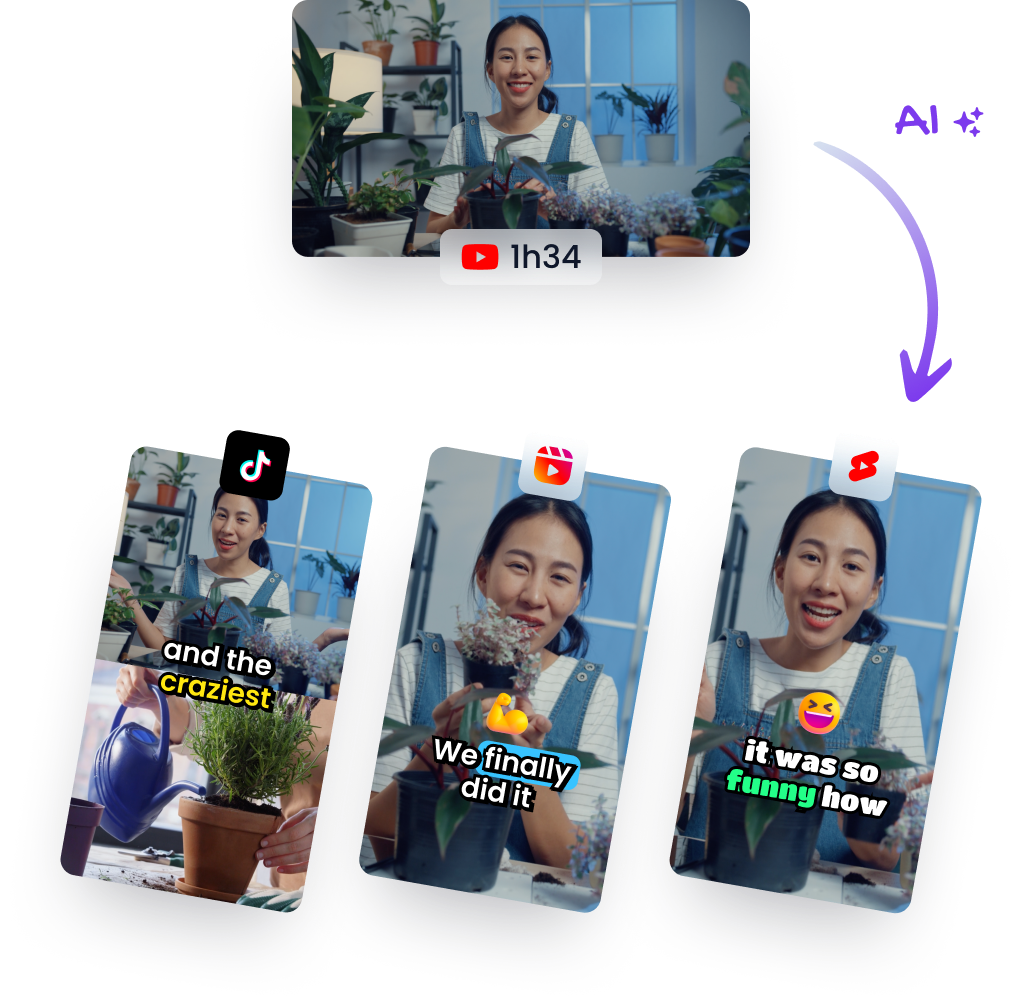
Klap is the strongest option here if your real goal isn't just getting text. It's getting clips out of long videos fast. That distinction matters because a lot of creators search for video to text transcription free tools when what they need is a workflow that turns a podcast or webinar into publishable short form content.
The friction is low. You upload a file or paste a YouTube link, Klap scans the content, finds promising moments, adds captions, reframes for vertical formats, and gives you clips you can review instead of building everything from scratch. If you want a broader look at that workflow, Klap's own guide to video to text workflows is useful context.
Where Klap fits best
Klap works best for speech-heavy content. Podcasts, interviews, tutorials, explainers, talking-head YouTube videos, and webinars are where it saves the most time. If the source footage depends more on visuals than spoken ideas, you'll still get value from captions and transcript-based review, but you may need more manual choices around what deserves to become a clip.
The practical advantage is workflow compression. Instead of using one tool for transcription, another for subtitles, another for aspect ratio changes, and another for scheduling, you stay in one environment.
Practical rule: If the transcript is only a stepping stone to Reels, Shorts, or TikToks, use the tool that shortens the whole chain, not just the first step.
Klap also supports captions in multiple languages and includes branding controls, which makes it useful for solo creators and social teams that need consistency across output.
The trade-off most creators should know
The free entry point is small. You can try one video for free, which is enough to test whether the clipping and caption quality fit your content. If you publish regularly, you'll hit the ceiling quickly and likely move to the paid plan listed at $29/month on the product page.
That makes Klap less attractive if all you want is raw text from a single file every few weeks. But if your bottleneck is turning long form into repeatable short form, it's one of the few tools on this list that treats transcription as part of distribution, not just documentation.
2. YouTube Studio

If your video already lives on YouTube, YouTube Studio is the easiest zero-cost option. Upload the video as public or unlisted, let YouTube generate auto-captions, then open the transcript and copy the text.
This is the fastest route for many creators because there's no extra software to learn. Klap also explains a simple version of this process in its post on how to transcribe a YouTube video to text.
What works and what doesn't
YouTube Studio is great for rough transcript extraction, idea mining, and pulling quotes from your own published content. It's especially handy when you want to scan a long interview, locate a specific answer, and copy it into notes or a script draft.
The trade-off is control. Accuracy varies, not every language or video gets the same quality of auto-captions, and the workflow depends on uploading to YouTube in the first place.
- Best use case: Existing YouTube content you want to mine for quotes, chapters, or short clip ideas.
- Main frustration: It's not ideal for private client media, internal recordings, or teams that don't want platform upload as a first step.
For many creators, though, it's the baseline free method. If you need text now and your video is already on YouTube, start here before reaching for anything more complex.
3. Microsoft Clipchamp

Microsoft Clipchamp is a good fit when you want captions and basic editing in the same browser session. It's not the leanest raw transcript tool, but it's convenient for creators who are already trimming videos, styling text, and exporting social content in one place.
Clipchamp's autocaptions workflow is straightforward. Import the video, generate captions, review the text, and export or burn captions into the video.
Why creators like it
Clipchamp makes sense for short form teams that don't want a separate transcription step. If your main output is captioned talking-head content, product walkthroughs, or tutorial snippets, the tool feels familiar fast.
A lot of “free” transcription tools now market themselves as full production utilities rather than simple transcript generators. The broader market has moved that way because tools increasingly combine captions, exports, summaries, and sharing instead of just giving you a text file. UniScribe, for example, highlights export options including txt, pdf, docx, srt, csv, and vtt, which reflects how reusable output has become the expectation.
Free transcription is less about getting words on screen now. It's about whether those words are usable in your next step without extra cleanup.
Clipchamp's downside is that if you only need plain text, the editor can feel heavier than necessary. You're stepping into a video tool, not a pure transcript utility. But for creators who want to caption and publish quickly, that extra weight is often worth it.
4. Kapwing

Kapwing sits in a practical middle ground. It's browser-based, easy to start, and useful for creators who want subtitles, transcript editing, and lightweight repurposing without opening a full pro editor.
You can upload video files or paste links, generate subtitles, and work from an editable transcript. That makes it a strong fit for social video teams, solo creators, and anyone working from a laptop who doesn't want installs or local setup.
The real trade-off with the free tier
Kapwing is a good example of why “free” needs scrutiny. Some tools advertise free transcription, but the limit shows up later through watermarks, export restrictions, file caps, or upgrade prompts. VEED openly says its free version can export watermarked videos and positions transcript exports like VTT, SRT, or TXT as part of the upgrade path, and that pattern shows up across this category.
Kapwing works well when your bottleneck is speed, not volume. It's easy to get a transcript and turn it into captions for clips. The downside is that if you need polished exports at scale, free usage usually stops being enough.
- Use it for: Browser-first caption work, quick turnaround reels, and editable transcripts.
- Skip it for: Heavy weekly production where watermarks or usage ceilings will force a plan upgrade quickly.
5. Descript

Descript is the tool I'd point to when someone says, “I don't just want the transcript. I want to edit the whole video by editing the text.” That's Descript's core strength.
It pulls transcription into the editing process itself. Delete a sentence in the text, and you're also cutting that section from the media. For podcasters, educators, interview-based channels, and internal comms teams, that model can be much faster than timeline editing.
Best for transcript-first editing
Descript supports automatic transcription in multiple languages and handles speaker-based workflows better than many lightweight tools. If you record interviews, panel discussions, or tutorials with multiple speakers, that matters.
The cost of that power is complexity. Descript is not the fastest option for a creator who only needs plain text from one file. The free plan also has a published monthly allowance, so it's test-friendly but not unlimited.
Here's the practical split:
- Choose Descript when: You want transcript plus editing in one place.
- Avoid it when: You just want to dump a file, grab the text, and leave.
Creators often underestimate how much edit time matters after transcription. That's why transcript quality isn't only about word accuracy. Speaker labels, timestamps, and editability matter just as much when the end goal is publishable content.
6. Otter.ai

Otter.ai started as a meeting transcription habit for a lot of people, and that's still the best way to think about it. It's strong on spoken content, summaries, and clean text output. If you already use it for meetings, importing the occasional video or audio file is a natural extension.
It's less of a creator editing suite and more of a transcript workspace. That's why many people like it for interviews, coaching calls, recorded discussions, and lecture-style content.
Where Otter runs into limits
Otter's Basic plan is usable, but strict enough that you should check limits before committing to it as a regular video workflow. Long recordings can force you to split files or reserve Otter for shorter segments.
For transcript drafting, quotes, and searchable archives, it's still convenient. If you're turning interviews into articles or show notes, it gets you there with less friction than command-line tools. Klap's article on how to write a transcript also helps if you need to turn raw machine output into something cleaner for publication.
The best transcript for writing isn't always the prettiest one. It's the one that preserves enough speaker structure that you don't lose context while editing.
If your content library is mostly conversations, Otter remains a dependable free starting point. If your files are long and frequent, you'll probably outgrow the Basic plan quickly.
7. Notta

Notta is one of the easier tools to test because its free plan is transparent. You can see the allowance, try uploads, and decide quickly whether it fits your content style.
That clarity is useful. Many creators waste time signing up for “free” tools only to discover their actual restrictions after the upload finishes.
Good for testing, weaker for long sessions
Notta is best for short clips, quick meetings, and creators who want web, desktop, mobile, and extension access from the start. Speaker identification is helpful, and the multi-device availability makes it flexible for people who switch between laptop and phone.
The catch is that the free plan's per-recording cap is very short. That makes it more of a test bed than a real home for long interviews, podcasts, or webinars.
- Strong fit: Short content, evaluation, mobile-heavy workflows.
- Weak fit: Long-form archives and full episode transcription.
If you want a fast way to compare transcript feel across devices before paying for anything, Notta is a fair candidate. Just don't mistake a transparent free plan for a generous one.
Pro-level and technical workflows
Google Cloud Speech-to-Text fits teams that already work inside Google's stack and want transcription to plug into a larger production process, not just a one-off upload. For creators handling interview libraries, recurring webinars, or media archives, that matters.
The trade-off is setup friction.
Unlike browser-first tools built for quick edits, Google Cloud is better for people who are comfortable with APIs, cloud storage, service accounts, and usage controls. You get more flexibility over how audio moves through your workflow, but you also take on more configuration before you see your first transcript.
That makes it a practical choice for production teams, developers supporting creator businesses, and operations-heavy environments that need stable transcription pipelines at scale. It is less appealing for solo creators who just want to drag in a file, skim captions, and publish within minutes.
Better for infrastructure than convenience
The strongest reason to choose Google Cloud is control over how transcription fits into your existing systems. You can connect uploads, automate processing, route outputs into databases or review tools, and build a repeatable workflow for large media volumes.
That flexibility comes with a familiar cloud-platform downside. Billing, quotas, audio formatting, and implementation details can slow down small teams that only need occasional transcripts. If your project is a few social clips per week, this route often creates more overhead than value.
Google Cloud works best when transcription is one step in a broader media operation. If your real goal is speed and low friction, the simpler tools in the Easy and integrated workflows category usually fit better.
8. OpenAI Whisper and whisper.cpp

A creator handling private interviews, unreleased client footage, or a large archive usually has a different priority than someone clipping shorts for social. The goal is control. OpenAI Whisper fits that workflow because you can run transcription locally, keep files off third-party platforms, and process media in batches. whisper.cpp lowers the hardware barrier and makes local transcription more practical on everyday machines.
This option belongs firmly in the Pro-level and technical workflows category. It is not just another caption tool with a free tier. It is a workflow choice for creators who are willing to trade convenience for privacy, flexibility, and lower long-term cost.
Whisper became a serious option for independent creators after its public release because local, multilingual speech recognition stopped being limited to expensive enterprise setups. OpenAI's Whisper paper reported a 50% relative reduction in word error rate versus prior models across multiple datasets, which helps explain why editors, researchers, and documentary teams still use it for difficult audio.
The trade-off shows up immediately in setup and review time. You often need FFmpeg or another way to extract audio, enough command-line comfort to run jobs reliably, and time to clean speaker labels or punctuation after the transcript is generated. If your real job is publishing three clips before lunch, that friction matters.
For long interviews and sensitive recordings, the trade can be worth it.
- Best for: Private media, archived interviews, multilingual transcription, batch processing, technical users.
- Worst for: Fast social workflows, drag-and-drop editing, creators who need captions and exports in one browser tab.
I recommend Whisper or whisper.cpp when transcription is a production step, not the whole project. If you need a transcript you can store, search, subtitle, or feed into another editing system, local processing gives you more control than the easy, integrated tools. If you need quick turnaround and built-in publishing, those simpler workflows usually fit better.
9. Google Cloud Speech-to-Text

Google Cloud Speech-to-Text is for developers, technical operators, and teams building transcription into a larger workflow. You don't come here for convenience. You come here for automation, API access, timestamps, diarization, and the ability to scale.
Its free allowance makes it practical for testing, especially if you want to estimate how your own pipeline might behave before spending.
Best when transcription is infrastructure
Google Cloud is useful when transcription isn't a one-off task. It's part of a system. Maybe you're processing uploaded webinar recordings, auto-generating searchable archives, or feeding transcripts into another internal app.
Because software accounted for 74.6% of the AI transcription market in 2024, cloud and SaaS style workflows clearly dominate how organizations consume this category. Google Cloud fits that broader direction well.
Still, this is not the easiest route for creators who just want captions on a reel. You'll need to extract audio, work with the API, and keep an eye on billing details once you move beyond the free level.
For technical teams, that's normal. For solo creators, it can be overkill.
10. Microsoft Azure Speech to Text

Microsoft Azure Speech to Text belongs in the same bucket as Google Cloud, but it tends to make more sense for teams already inside Microsoft's ecosystem. If your company uses Azure services elsewhere, adding speech workflows can be the path of least resistance.
It supports real-time and batch transcription, and the always-free allowance is enough to test short content without immediate spend.
Best for Microsoft-heavy teams
Azure is a sensible option when transcription feeds enterprise workflows, internal applications, or compliance-minded environments. The diarization support is useful for meetings, interviews, and recordings where speaker separation matters.
The trade-off is exactly what you'd expect. This is a developer setup. You need an Azure account, some API comfort, and a willingness to treat transcription like a service layer instead of a simple app.
The larger market direction also supports this kind of build-out. The global AI transcription market is projected to grow from USD 4.5 billion in 2024 to about USD 19.2 billion by 2034, with a 15.6% CAGR. That doesn't tell you which tool to choose by itself, but it does explain why enterprise APIs keep getting better and why more teams are building transcription directly into their workflows.
Top 10 Free Video-to-Text Transcription Tools
Product✨ Core features★ Quality👥 Target audience💰 Price / Value
Klap 🏆
✨ AI clip generation, Auto‑Reframe 2, captions (52 langs), viral‑score, direct publish & scheduling
★★★★☆ Fast, platform‑optimized shorts with pro layouts
👥 Creators, social teams, agencies
💰 $29/mo Pro; 1 free video trial, high ROI for scale
YouTube Studio (Auto‑captions)
✨ Auto captions + transcript with timestamps, in‑studio editing
★★★☆☆ Varies by audio quality & language support
👥 YouTube creators who publish on platform
💰 Free (must upload/public or unlisted)
Microsoft Clipchamp (Autocaptions)
✨ Browser editor, Azure‑powered autocaptions, caption styling & burn‑in
★★★☆☆ Good for simple captioning workflows
👥 Short‑form creators, Microsoft users
💰 Free autocaptions; premium for advanced exports/assets
Kapwing – Auto‑Subtitle & Transcript
✨ Auto‑subtitles, downloadable transcript, link uploads, translations on tiers
★★★☆☆ Fast browser workflow; watermark on free exports
👥 Social creators needing quick captions
💰 Free w/ watermark; paid for more minutes/features
Descript (Free plan)
✨ Automatic transcription, text‑based video editing, speaker detection
★★★★☆ Excellent for edit‑by‑text workflows
👥 Creators wanting transcript + quick edits
💰 Free tier (60 min/month); paid for more minutes/features
Otter.ai (Basic)
✨ Meeting transcription, summaries, import audio/video, TXT export
★★★★☆ Reliable speech capture; best for spoken content
👥 Teams, meeting users, occasional video imports
💰 Free basic plan with strict per‑import & monthly caps
Notta (Free)
✨ 120 free mins/month, file uploads, speaker ID, web/mobile apps
★★★☆☆ Good cross‑device testing & quick transcripts
👥 Users testing transcription on multiple devices
💰 Free 120 mins/mo; per‑recording cap (3 min) on free plan
OpenAI Whisper / whisper.cpp
✨ Multilingual ASR & translation, local/offline processing, multiple model sizes
★★★★☆ High accuracy; depends on setup & compute
👥 Developers, privacy‑focused users, batch processors
💰 Free open‑source (setup/compute costs apply)
Google Cloud Speech‑to‑Text (API)
✨ Word timestamps, diarization, async/batch transcription, multiple models
★★★★☆ Scalable, reliable enterprise quality
👥 Developers, enterprise apps needing scale
💰 Free 60 min/mo (v2); pay‑as‑you‑go beyond free tier
Microsoft Azure Speech to Text (API)
✨ Real‑time & batch, diarization, integrates with Azure AI
★★★★☆ Enterprise‑grade accuracy & stability
👥 Devs, enterprises requiring robust pipelines
💰 Always‑free 5 hrs/mo (real‑time); billed beyond allowance
From Text to Traffic
The best free transcription tool is the one that matches the job you're trying to do. That sounds obvious, but it's a common pitfall for those who compare “accuracy” in the abstract and overlook the bigger friction points, like upload requirements, watermarking, export limits, editing overhead, or whether the transcript is usable for shorts without a lot of cleanup.
If you already publish on YouTube, YouTube Studio is the easiest first stop. If you want a browser-based editor that can handle captions and quick social video work, Clipchamp and Kapwing are both practical. If your workflow is transcript-first editing, Descript is much stronger than a simple caption tool. If you mostly handle meetings, interviews, or spoken conversations, Otter and Notta are reasonable entry points, though their free limits matter.
For technical users, the split is cleaner. Whisper is the best choice when you want private, local, no-per-minute transcription and you can handle a little setup. Google Cloud and Azure make more sense when transcription is part of a repeatable system, not just a one-off upload.
There's another angle most listicles miss. Leading tools now commonly advertise accuracy in the mid-90s to 99% range and broad language coverage. Riverside advertises 99% accuracy and support for 100+ languages, HappyScribe advertises 85 to 99% accuracy in 80+ languages, Rask AI claims 95%+ accuracy, and TicNote says its free converter supports 120+ languages, all summarized in this overview of the current free transcription landscape. That sounds impressive, but it doesn't remove the main creator question: how much editing will you still need before the output is publishable?
That's why I'd separate transcript tools from repurposing tools. A transcript tool gives you words. A repurposing tool should help you turn those words into clips, captions, and posts people will watch.
For many creators, that's where Klap stands out. It doesn't treat transcription as the finish line. It treats it as the first useful layer in a short-form workflow. If your real goal is to get more value from podcasts, interviews, webinars, and YouTube videos, that matters more than getting a text file alone.
If you want more than a raw transcript, Klap is the simplest upgrade from “I need text from this video” to “I need ready-to-post shorts from this video.” Paste a link or upload a file, let the AI find strong moments, add captions, reframe for vertical video, and turn one long recording into a steady stream of social content.