Transcribe YouTube Video to Text: Free & AI Tools 2026
Other
You publish a solid YouTube video, feel good about it for a day, then move on to the next thing. Meanwhile, that video just sits there. One asset. One format. One shot at attention.
That's usually the bottleneck.
If you can transcribe a YouTube video to text, you stop treating the upload as a finished product and start treating it like raw material. The transcript becomes the working document behind captions, blog drafts, quote banks, email copy, topic summaries, and short-form clips. That's where the true advantage is.
Most articles stop at “paste the link, get the words.” That helps, but it misses the harder and more valuable part. The transcript itself isn't the end product. It's the handoff point into a repurposing workflow that saves time and gives each video more chances to perform.
Why Your YouTube Videos Need a Text Transcript
A transcript solves a problem most creators feel but don't always name clearly. You already recorded the thinking. You already explained the idea. You already found examples, stories, and phrasing that landed well on camera. But without text, all of that value stays trapped in the video timeline.
That's why transcription matters beyond convenience.
A readable transcript makes your content easier to search, easier to revisit, and easier to reshape. It also supports accessibility. If someone can't reliably follow the audio, the transcript and captions help them stay with the content instead of dropping off. HyperWhisper's view on transcription necessity is useful on this point because it frames transcription as part of making spoken content usable, not just archived.
The transcript is the asset behind the asset
There's also a workflow gap in most guidance on this topic. ElevenLabs' discussion of the post-transcription gap notes that most coverage treats YouTube transcription as a one-click export task, while far fewer pages deal with what happens after, such as editing, summarizing, format-specific exports, or repurposing into captions and clips.
That matches how creators work. Getting the text is easy compared with turning that text into something publishable.
Here's what a transcript helps you do in practice:
- Pull usable hooks: Find the cleanest opening lines, strongest opinions, or sharpest transitions without scrubbing through the full video again.
- Build companion content: Turn one discussion into a newsletter, article outline, carousel copy, or FAQ page.
- Improve packaging: Strong transcript lines often become better titles, thumbnail copy, and social captions.
- Support distribution: If you're trying to boost YouTube views without paying for promotion, stronger supporting assets around the video matter.
A long-form video usually contains more publishable material than the upload itself reveals. The transcript is how you extract it.
Text makes review faster
Creators also underestimate how much better editing decisions get when the words are visible. Reading exposes repetition, weak transitions, and buried insights much faster than rewatching from the start.
That matters whether you're a solo creator, marketer, educator, or podcast host. Once you start treating the transcript as a working draft instead of a byproduct, the whole content system gets easier to scale.
The Quick Method Using YouTube's Built-In Tool
If you need a transcript fast, start with YouTube itself. For many videos, YouTube already provides one. It's the fastest zero-cost option, and for rough note-taking it's often enough.
According to Tactiq's walkthrough of YouTube transcript access, users can open a video, choose Show transcript from the three-dot menu, then copy the text or jump to exact timestamps. The same reference also notes that transcripts aren't available for every video, so this method depends on whether captions or auto-generated text exist for that upload.

How to pull the transcript
Use this process on desktop:
- Open the video page: Go to the YouTube video you want to work from.
- Find the menu: Click the three-dot menu near the video controls or metadata area.
- Select Show transcript: If the video supports it, a transcript panel opens.
- Use timestamps if helpful: Click lines in the transcript to jump to exact moments.
- Copy the text: Paste it into Google Docs, Notion, Word, or your editing tool.
For quick research, this is very useful. If you want to confirm what a speaker said, pull a quote draft, or find a section again, YouTube's native transcript does the job.
Where it falls short
The issue is quality control. Built-in transcripts often read like machine output, because that's what they are. You'll usually see weak punctuation, awkward line breaks, inconsistent capitalization, and trouble around names, acronyms, and overlapping speakers.
A few common problems show up fast:
- Run-on text: Ideas blur together because sentence boundaries are unclear.
- Term errors: Brand names, product names, and niche vocabulary often come through wrong.
- Messy copy-paste output: Timestamps and broken lines make the text harder to reuse.
- Limited reliability: If the transcript isn't available, the workflow stops right there.
Useful baseline: YouTube's transcript is a good first draft for internal use. It usually isn't the version you want to publish, subtitle, or hand to a client untouched.
When this method makes sense
Use YouTube's built-in transcript when you need speed more than polish.
A few good use cases:
- pulling rough notes from your own upload
- scanning an interview for a quote
- locating the exact section you want to clip later
- checking whether a topic is worth deeper repurposing
If the transcript needs to become captions, website copy, or a public-facing asset, move to a dedicated workflow.
Using Automated AI Tools for Accurate Transcription
Dedicated AI transcription tools exist for the moment when YouTube's built-in option stops being enough. That usually happens fast. You need cleaner text, more control, speaker labels, and export formats that fit what comes next.
Modern tools also compete on speed. Opus Pro's overview of YouTube transcript generation says one AI transcription tool can extract a transcript in under a minute with over 95% accuracy, while other tools promote instant conversion to searchable text and exports like TXT, SRT, and VTT.

What you're paying for
The jump from built-in transcripts to dedicated software isn't just about accuracy. It's about reducing downstream editing work.
A good AI transcription platform usually gives you more than raw text:
Workflow needBuilt-in transcriptDedicated AI tool
Basic text access
Yes, when available
Yes
Speaker labels
Usually limited
Often included
Searchable workspace
Minimal
Common
Export formats
Limited
Commonly includes TXT, SRT, VTT
Editing workflow
Basic copy-paste
More structured
That changes the economics of the task. If you regularly transcribe YouTube video to text for content marketing, podcast repurposing, interviews, webinars, or training videos, the time saved in cleanup matters more than the initial extraction.
What works well
Dedicated tools are strongest when you need a repeatable process.
They help with:
- Caption production: Exporting SRT or VTT files for timed subtitles.
- Editorial review: Scanning a searchable transcript instead of replaying the whole video.
- Team handoff: Letting editors, marketers, or clients work from text instead of a video timeline.
- Multi-output publishing: Turning one transcript into several formats without rebuilding from scratch.
If your operation is moving toward automation, it also helps to look at how broader service providers think about workflow design. An AI automation agency can be a useful reference point if you're mapping how transcription, editing, and publishing fit into one repeatable system instead of a collection of disconnected tasks.
Where AI still needs human review
Even strong AI output isn't self-finalizing.
You'll still need to check:
- names
- specialized terminology
- speaker turns
- numbers
- sections with crosstalk or poor audio
That's normal. The goal isn't to remove all review. The goal is to start from a much better draft.
If you're comparing options for your wider stack, this roundup of AI tools for content creators is a practical place to evaluate where transcription should sit in your process.
How to Clean and Format Your Transcript for Quality
Raw transcript in hand, you're still not done. A lot of creators lose value at this stage. They extract the text, glance at it, and either abandon it or publish it with barely any cleanup.
That usually creates one of two bad outcomes. The transcript looks sloppy, or the editor spends too long fixing preventable issues.
Elite Research's note on transcription pitfalls says manual transcribing and subtitle creation can take up to 5 hours per hour of video, while automated transcription is much faster but still needs verification for fast speech, accents, jargon, and speaker-label mismatches. The same source flags common errors such as misheard homophones, deleting real numbers while removing timestamps, and guessing missing words instead of replaying the segment.

The cleanup pass that actually matters
You do not need to obsess over every line on the first read. You need a disciplined pass.
Use this order:
- Fix proper nouns first: Names, product terms, acronyms, and branded language create the most visible errors.
- Remove mechanical clutter: Strip timestamps if you don't need them, but watch for real numbers in the text.
- Repair sentence flow: Add punctuation and paragraph breaks so the transcript reads like writing, not a caption dump.
- Check speaker labels: Interviews and podcasts become unusable fast when the wrong person is attributed.
- Decide on filler words: Keep them for verbatim records. Cut them for blog drafts, captions, and most marketing uses.
Clean transcript versus verbatim transcript
Not every transcript should sound the same.
A verbatim transcript keeps the spoken rhythm, including pauses, false starts, and filler. That's useful for legal review, research, or precise quoting.
A clean transcript preserves meaning but edits for readability. That's usually better for creators.
If the transcript is meant to be read, not audited, clean it like an editor. Don't preserve every “um” just because the microphone captured it.
A simple quality checklist
Before you call the transcript done, ask:
- Can someone read this without hearing the original audio?
- Do the names and terms match your brand or niche?
- Would you feel comfortable turning this into captions or a blog draft?
- Are any uncertain words still guesses rather than verified fixes?
That last point matters. Guessing is where transcript quality imperceptibly falls apart. Replay the section. Check context. Fix it once.
Beyond Text Repurposing Transcripts into Viral Clips
The biggest payoff from transcription usually isn't the text file itself. It's what the text lets you find.
A clean transcript turns a long video into something you can mine. You can spot strong hooks, emotional turns, clean explanations, objections, punchlines, and quotable phrases without dragging the playhead across the entire timeline. That's why transcript-based repurposing is so much more efficient than manually hunting for clips.

The transcript becomes your clip map
A solid workflow has two stages. GoTranscript's guide to converting YouTube captions into a clean transcript describes it as first generating or exporting the raw captions in a timed format such as SRT or VTT, then cleaning the result by removing timestamps, correcting names and terms, and adding punctuation, paragraphs, and speaker labels. The same guide recommends splitting long recordings into 10-30 minute chunks with a 2-3 second overlap to reduce boundary losses and speed review.
That advice matters even if your goal is short-form video, not a polished document. Good clips depend on clean boundaries. If a sentence gets cut awkwardly or a key phrase lands across a chunk break, you create extra editing work later.
What to pull from the transcript
Once the text is clean, look for moments that fit short-form behavior:
- Strong openings: Statements that create curiosity quickly.
- Tension points: Disagreement, surprise, mistakes, or sharp lessons.
- Clear standalone ideas: Segments that make sense without the full episode.
- Audience language: Phrases your viewers would repeat back in comments or DMs.
Transcript review beats intuition alone. Reading exposes concise moments that are easy to miss while watching passively.
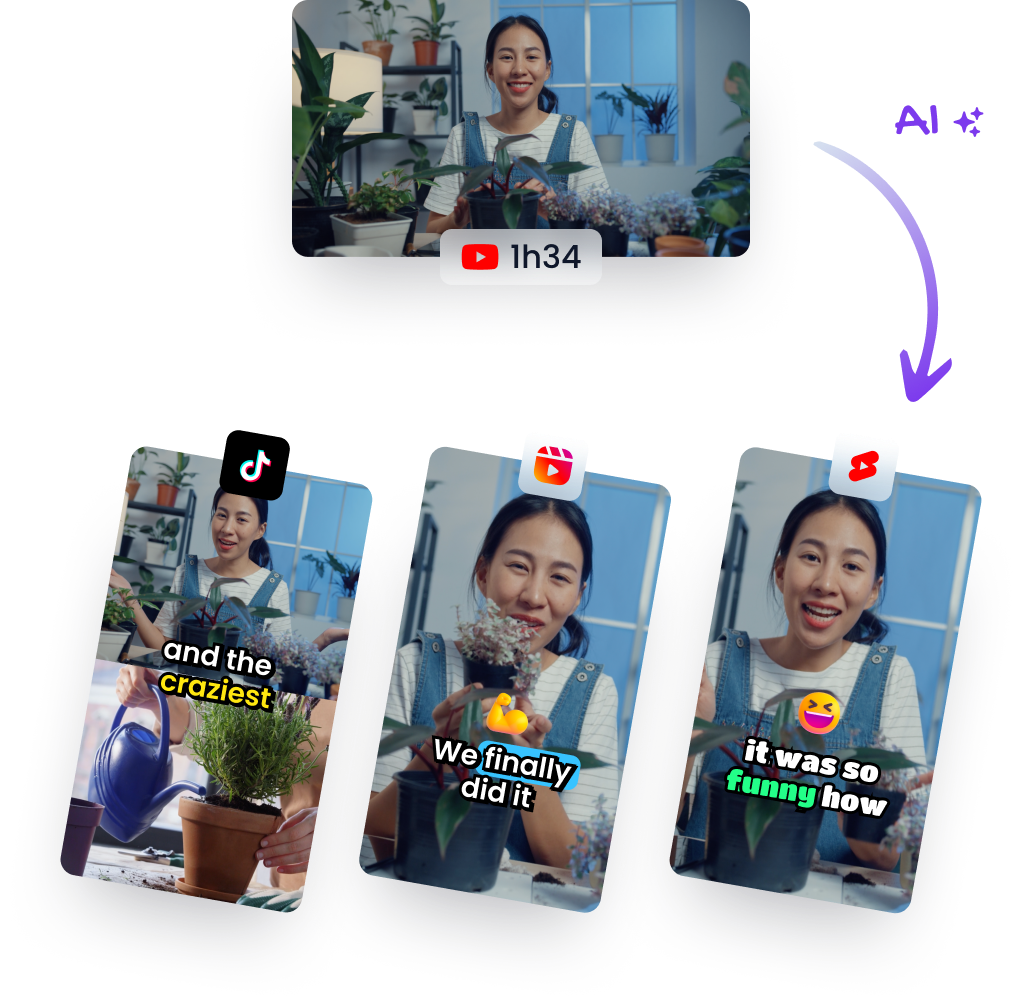
One practical option here is Klap's AI clip maker, which works from long-form video inputs and helps turn them into short clips with captions and social-ready framing. In a workflow like this, transcription isn't a side feature. It's part of how the tool identifies usable moments and gives you text-level control over what gets cut.
A transcript doesn't just tell you what was said. It shows you where the clip starts, where the idea lands, and whether the ending is strong enough to stand alone.
After you've identified the best segments, it helps to see the clipping workflow in motion:
The repurposing move most creators skip
A lot of people stop after making one blog post or one caption file. That leaves value on the table.
The smarter move is to treat the transcript as the source document for a batch:
- a set of clip candidates
- subtitle text
- quote graphics
- post copy
- angle testing for future thumbnails and titles
That's how one long-form video starts generating multiple assets without forcing you back into production mode.
Starting Your Content Repurposing Flywheel
Once you've done this a few times, the process stops feeling like “transcription work” and starts feeling like content operations.
You record one long-form video. You turn it into text. You clean the transcript enough to trust it. Then you use that document to create derivative assets that fit different channels and different attention spans. The result is a repeatable system, not a one-off task.
What the flywheel looks like
A practical version looks like this:
- Publish the long-form video
- Transcribe the audio into workable text
- Edit the transcript for readability and accuracy
- Extract hooks, quotes, summaries, and clip candidates
- Distribute those assets across other formats
- Use audience response to inform the next video
Each turn of that cycle makes the next turn easier. Your transcript library becomes searchable. Your best hooks become easier to recognize. Your short-form output gets faster because you aren't starting from a blank screen every time.
Why this mindset helps creators
This approach also reduces the pressure to constantly produce from scratch. You don't need a brand-new idea every time you want to post. Often, you need better extraction from what you already made.
That's especially useful for YouTubers, podcasters, marketers, educators, and small teams that have more recorded material than editing bandwidth.
The creators who get the most value from long-form content usually aren't filming more. They're extracting more.
If you want to transcribe a YouTube video to text, do it with the next step in mind. Not “How do I get the words?” Ask, “What will these words become?”
If you already have YouTube videos, webinars, interviews, or podcast recordings sitting in your archive, Klap gives you a practical way to turn those long videos into short-form assets built for social distribution. Paste in the source video, review the suggested clips, adjust what you need, and use the transcript-driven workflow to get more mileage from content you've already made.