10 Television Advertising Examples to Inspire Your Strategy
Other
What do most roundups of television advertising examples get wrong?
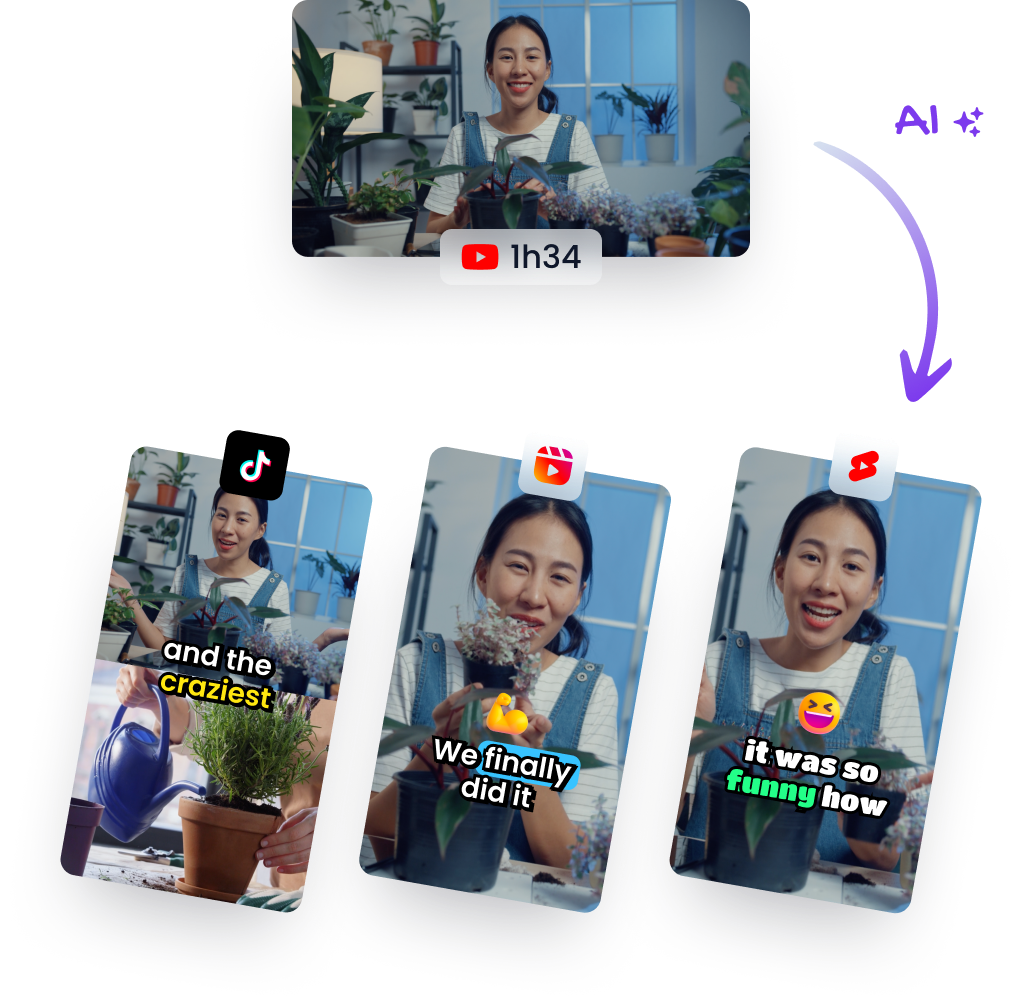
They treat great TV ads like museum pieces. Marketers need a working model instead. The useful question is not whether a spot was famous. It is what job the creative was doing, and how to turn that same job into clips for TikTok, Reels, Shorts, YouTube, and connected TV.
Classic TV campaigns still reward close study because the mechanics have not changed much. Strong ads still earn attention fast, frame a clear point of view, build tension, and end on a line or image people remember. What has changed is distribution. One long-form asset now has to produce a full set of short edits, each built for a different feed, audience, and viewing habit.
That translation layer is where many teams lose the plot. They copy the tone of a famous commercial, but miss the structure underneath it. A founder documentary becomes a vague brand reel. A customer interview gets cut by timestamp instead of by emotional peak. A product demo turns into feature overload because nobody identified the one moment worth clipping. If you need a process for turning longer footage into platform-ready assets, this guide to making social media videos is a useful reference point.
The examples below focus on transferable strategy. For each campaign, the core value is the pattern behind the execution. What was the ad trying to make the viewer feel, believe, or do? What usually breaks when marketers imitate it? And which moments from your existing webinars, podcasts, interviews, brand films, or product videos can be recut into short social clips that carry the same effect?
1. Apple's Think Different Campaign
Apple's “Think Different” spots worked because they sold a worldview before they sold a product. Black-and-white footage, iconic cultural figures, sparse narration. The ad didn't explain features. It made ambitious people feel seen.
That's still one of the strongest moves in video advertising. If your brand has a point of view, don't bury it under product screenshots. Lead with identity, then let the product inherit meaning from the story.
Why the strategy still works
Emotional branding travels well across formats because the core unit is not the full ad. It's the belief statement. In long-form content, that usually appears as a sentence, a visual juxtaposition, or a turning-point clip where the speaker says what they stand for.
For social, I'd pull the segment where the emotional idea crystallizes, not the setup around it. The clip should feel complete even if the audience never sees the full interview, documentary, or brand film. If you need help shaping those cuts, Klap's guide on making social media videos is useful for thinking through platform-ready edits.
Practical rule: Don't cut the most informative section. Cut the moment that best expresses the brand's belief.
A common mistake is copying the Apple mood without copying the discipline. Teams make slow, vague “cinematic” videos with soft piano and no thesis. That doesn't create meaning. It creates drift.
Use this pattern instead:
- Find the belief line: Pull the sentence that defines what the brand believes about the customer, not about itself.
- Trim the runway: Remove throat-clearing intros. Social viewers don't need the historical setup.
- Let visuals carry weight: Keep captions minimal when the imagery is doing the emotional work.
- Test multiple lengths: The same brand idea can work as a short hook and as a longer narrative cut.
Modern versions of this approach show up in lifestyle-led Beats by Dre work and in many founder-led brand films. The lesson isn't “make it look like 1997 Apple.” It's “give people a belief they want to join.”
2. Super Bowl Flash Sales
What makes a TV ad drive action right now instead of just earning recall next week? Clear urgency, shown early and repeated often.
Super Bowl flash-sale ads are useful because they solve a hard creative problem. They make a deadline feel like part of the entertainment, not a legal disclaimer stapled onto the end. That pattern still works for limited drops, event pushes, seasonal promos, and short registration windows.
The part marketers should copy is not the media spend. It is the structure.
What to borrow for short-form clips
Strong urgency ads reveal the offer fast. They reinforce it with on-screen text, product shots, or countdown cues, then close with one obvious next step. That matters even more in feeds, where plenty of viewers will never reach your final frame.
For social execution, start with the long-form asset. Pull the moment where the offer becomes concrete, then build several short edits around it. One cut can open with the deadline. Another can open with the product and bring the deadline in by the third second. If you want a framework for shaping those repurposed edits, this guide to creating viral content from stronger hooks is a useful reference.
Urgency creative usually breaks in predictable ways.
- The offer shows up too late: The audience remembers the setup and misses the action.
- The joke outruns the CTA: People share the bit but cannot tell what to do next.
- The deadline feels invented: Generic phrases like “limited time” get ignored unless the ad gives a real reason to act now.
A practical build looks like this: cut a 15 to 30 second version around the offer reveal, add text overlays that state the deadline plainly, and test one version with the CTA in the first beat against one that pays it off at the end. For product drops, make multiple clips from the same source footage. One should stress scarcity. One should show the use case. One should show proof that other buyers already want it.
Doritos, Coca-Cola, and Old Spice have all used versions of this approach. The polish gets attention. The timing of the offer gets the click, visit, or purchase.
3. Dollar Shave Club's Viral Launch Ad
Dollar Shave Club proved that a strong brand voice can beat expensive production. Michael Dubin's launch ad felt like a person talking, not a company presenting. That distinction matters more now than it did then.
You can see the same principle across founder videos, podcast clips, and behind-the-scenes brand content. People forgive roughness. They don't forgive stiffness.
Personality beats polish when the voice is real
This format works when the speaker has rhythm, conviction, and a point of view. It fails when teams try to script “authenticity” so tightly that every line sounds approved by legal, product marketing, and three executives.
If you're repurposing long-form video, look for candid moments, opinionated lines, and slightly imperfect delivery. Those often outperform the clean take because they feel inhabited. Klap's viral content guide is relevant here because this style depends less on visual gloss and more on selecting the strongest hooks from longer footage.
The right founder clip doesn't sound optimized. It sounds undeniable.
A few practical editing choices help:
- Keep the natural cadence: Don't cut every pause out. Micro-pauses can make a line hit harder.
- Build around one strong sentence: A contrarian claim or sharp observation travels farther than general brand copy.
- Use B-roll selectively: Support the line. Don't smother it.
- Avoid over-captioning jokes: Comedy needs timing, and too much on-screen text can crowd it.
This is also where TV is becoming more direct-response friendly. As AdWave's overview of TV ad examples notes, DTC brands such as Bonobos and Blue Apron used TV spots with specific CTAs, landing pages, and promo codes to push measurable digital action. That's the right lens for interpreting Dollar Shave Club now. It wasn't just funny. It was operationally clear.
4. GoPro's User-Generated Content Spots
GoPro built one of the best arguments against over-explaining a product. Instead of talking about capability, it showed capability through the customer's point of view. Action came first. Branding came through association.
That format still works because footage shot by users often carries stakes that staged footage can't fake. The camera shakes. The framing isn't perfect. That's part of why it feels earned.
Here's the visual language this style relies on:

How to make UGC-style TV creative work now
For social, the obvious move is to pull the biggest stunt or most dramatic angle. That's fine, but it's incomplete. What usually performs better is the moment right before or right after the action peak. Anticipation and reaction often create more retention than the trick itself.
If you're working from adventure vlogs, customer footage, or event recaps, this UGC strategy guide from Klap maps well to the workflow. Upload the long footage, identify the highest-energy segments, then reframe them for vertical viewing so the viewer stays inside the action.
A few trade-offs are worth knowing:
- Raw footage wins attention, but context keeps viewers: Add short captions if the action isn't instantly legible.
- Music can help pacing, but don't bury the environment: Sound design often carries realism.
- Series beat one-offs: One long adventure can yield multiple clips with different hooks.
GoPro and Red Bull showed marketers that television advertising examples don't need a voiceover-heavy sales pitch. Sometimes the most persuasive ad is proof of experience.
5. Nike's Inspirational Athlete Testimonials
What makes a testimonial feel bigger than a testimonial? Nike's answer is simple. Build it like a short documentary, then cut it down to the emotional turn.
The athlete's story carries the ad. The brand stays present through tone, casting, and selective product visibility, but effective persuasion comes from tension. That is the part many teams miss. They interview for accomplishments, then edit for clarity. Nike-style work edits for emotional movement.
Here's the emotional posture this kind of creative aims for:

The edit pattern to copy
Start with the hardest line in the interview. Skip the biography unless it sharpens the conflict. A sentence about fear, injury, rejection, or pressure will usually hold attention better than a polished summary of success.
Then make the turn visible. The viewer needs to see the moment the person changes their interpretation of the setback. That can be a quote, a training shot, a pause, or even a look straight into camera. Keep the edit spare so the face and voice do the heavy lifting.
A practical structure looks like this:
- Open on tension: Use the line that reveals cost, doubt, or friction.
- Cut to the turn: Show the decision, mindset shift, or daily habit that changed the outcome.
- Close on identity: End with who the person became and what they stand for.
This format translates cleanly to social if you start with longer footage. Pull a 20 to 40 minute interview, podcast, documentary segment, or founder story. Then cut three separate clips from it, one built around struggle, one around the turning point, and one around the belief that came out of it. That gives you a campaign arc instead of a single motivational post.
The trade-off is control versus authenticity. Overwrite the captions, add too much music, or stack every cut with motion graphics, and the clip starts to feel manufactured. Leave a little silence in. Keep some breath in the delivery. Test the rawer version first. In this style, restraint usually improves credibility.
6. Mailchimp's Quirky Brand Personality Spots
Mailchimp's offbeat work shows that product education doesn't have to look educational. Absurd images, deadpan delivery, and lightly embedded product cues can make a software brand memorable without turning the ad into a tutorial.
That's useful if you market a product people think they already understand. Email, payments, scheduling, accounting. The danger in those categories is making videos that are correct but forgettable.
Use weirdness with control
Humor in television advertising examples usually breaks in one of two ways. Either the joke overwhelms the product and viewers remember the bit but not the brand, or the brand message crushes the joke and nothing feels alive.
Mailchimp-style creative sits in the middle. It lets the weird visual do attention work while the brand signal stays simple and repeated. For short-form clips, I'd pull one strange visual idea or one dry line from a longer webinar, explainer, or office skit, then pair it with tight framing and concise captions.
Counterintuitive move: If the joke needs explanation, cut it. If the product needs explanation, move it to the next clip.
This pattern works especially well in content series. One webinar can produce several social cuts, each built around a different odd image, phrase, or problem statement. The audience doesn't need the whole lesson in one video. They need a memorable reason to keep watching your next one.
Old Spice and MoonPie use adjacent humor logic in different ways. The lesson isn't to become random. It's to make the message easier to remember by attaching it to a distinctive tonal signature.
7. Spotify's Data-Driven Personalized Ads
Spotify's personalized campaigns work because they turn data into a social mirror. The viewer recognizes themselves, or someone they know, in the pattern being shown. That's what gives the stat emotional value.
A lot of marketers miss that and produce “data-driven” creative that feels like a dashboard export. Numbers don't become compelling because they're precise. They become compelling when they reveal a habit, contradiction, or identity cue.
Make the data feel human
This format is ideal for brands sitting on audience insights, usage trends, purchase patterns, or support-ticket themes. The best social adaptation is not a dense infographic. It's one data point, one implication, one audience.
For TV and CTV, this approach also benefits from modern targeting and measurement. EDO's guide to measuring TV advertising effectiveness explains that advanced attribution models connect ad exposure with downstream behaviors such as search trends and web traffic, and notes a Comcast Advertising case study where Mastercard used data-driven purchase insights for TV campaign measurement. The practical takeaway is simple: if your creative is segmented, your analysis should be segmented too.
When building short clips from longer analyst videos or reports, try this sequence:
- Lead with the surprising behavior: The line that makes the audience say, “That's me.”
- Visualize one idea: Don't stack five charts into one edit.
- Match each version to a segment: Different audiences respond to different self-recognition cues.
- Keep branding quiet but present: The insight should feel useful, not self-congratulatory.
Spotify's “Wrapped” logic works because it turns audience data into identity content. That's a far more powerful use of analytics than merely proving you have analytics.
8. Dollar General's Community Impact Stories
Community-impact advertising often fails because it sounds institutional. The language is abstract, the narration is polished, and the people affected by the work barely get room to speak.
The better version is testimonial-led. Put a real person at the center, keep the explanation short, and let the viewer infer the brand's values from what changed in that person's life.
Show one human outcome, not the whole initiative
Often, a lot of brand teams overproduce. They try to summarize the entire program, list every partner, and include every stakeholder quote. The result feels dutiful instead of moving.
A stronger edit picks one story strand. The individual voice carries the emotion, and the program context appears only as much as needed. That before-and-after framing also mirrors how effective TV measurement often works. In Zion & Zion's Shoppers Supply case study, a two-week awareness-focused TV flight was evaluated through sales lift plus branded-search lift, which is a useful reminder that “brand” doesn't have to mean “unmeasurable.”
That case doesn't mean every community story should be judged the same way. It does mean marketers should stop treating goodwill creative as exempt from performance thinking.
A few execution notes matter here:
- Use natural speech: Don't rewrite a participant's words into brand language.
- Keep the organization in the background: The community member should be the protagonist.
- Cut around emotional specificity: Small details often hit harder than broad mission statements.
Patagonia and similar brands have done this well by grounding impact in lived experience rather than broad declarations.
9. Peloton's Lifestyle and Community Spots
Peloton-style ads don't just sell exercise. They sell membership in a routine, a mood, and a peer group. That's why these spots often blend product use with relationship cues, instructor presence, home environment, and moments of personal breakthrough.
This category is crowded with polished sameness. High-energy music, attractive lighting, montage, finish strong. The brands that stand out usually build around one emotional angle instead of trying to show the whole lifestyle stack at once.
Aspiration works better when it feels reachable
If the viewer sees the ad and thinks, “That person is not me,” you lose. If they think, “That could be me next month,” you have momentum.
For repurposing long-form content, I'd look for moments of consistency rather than extremes. A customer saying they finally stuck with a routine. An instructor delivering one line that reframes motivation. A short moment of visible effort followed by relief or pride. Those clips often outperform polished transformation reels because they feel attainable.
This is also where local and measurable CTV tactics are becoming more relevant than broad lifestyle montage alone. AI Digital's examples of CTV advertising highlight practical methods such as localized messaging, geo-targeting, CRM suppression, and matching household exposure to mobile location data with dwell-time validation for store visits. Even if you're not running a dealership campaign, the lesson applies. Lifestyle creative works better when the distribution strategy is precise.
For fitness, wellness, and habit-based products, combine aspiration with proof. Show the environment. Show the coach. Show the small win. Then make the next action obvious.
10. Slack's B2B Efficiency and Productivity Spots
Why do so many B2B ads describe productivity without ever showing work getting easier?
Slack's stronger spots solve that by staging a familiar workplace problem, then letting the product remove friction in plain view. The creative is usually simple. A delayed approval, a messy handoff, a buried update. Then one clear action inside the tool changes the pace of the job.
That choice matters in B2B because buyers are judging plausibility. They do not need a broad brand manifesto in a 30-second product spot. They need to see a problem they deal with, a fix they understand, and an outcome that feels credible.
Demonstrate one use case cleanly
The repeatable tactic is focus. One workflow. One blocked moment. One resolution.
Teams repurposing webinars, demos, or onboarding videos into social clips often lose the plot by trying to summarize the whole platform. That usually creates fast cuts, tiny UI callouts, and a message no one remembers. A better approach is to isolate a single job to be done and build the clip around the before-and-after.
Use this framework:
- Start with the delay: Open on the missed message, scattered feedback, or approval bottleneck.
- Show the exact action: One search, one channel update, one automated handoff, or one file share.
- Keep the interface readable: Crop tighter, enlarge the key area, and remove extra annotations.
- Edit by function: Make separate cuts for sales, ops, support, or recruiting instead of one generic version.
This is the translation layer marketers can use. Pull a two-minute webinar segment where a customer explains a broken workflow. Cut the 8 to 12 seconds where the pain is obvious. Follow it with the product moment that resolves it. Then add captions that name the role, the task, and the result in plain language.
Slack, Loom, HubSpot, and Zapier all benefit from this structure because the sale happens inside the workflow, not around it. Show the task. Show the fix. Let the viewer connect that improvement to their own team.
10 TV Ad Campaigns: Strategy & Creative Comparison
ExampleImplementation Complexity 🔄Resource Requirements ⚡Expected Outcomes 📊Ideal Use Cases 💡Key Advantages ⭐
Apple's "Think Different" (Storytelling & Emotional Branding)
High, cinematic production, long prep
High, agency, talent, production budget
Strong brand lift and long-term shareability (⭐⭐⭐)
Brand identity campaigns; extracting hero moments from long-form films
Timeless emotional appeal; highly memorable quotable moments
Super Bowl Flash Sales (Urgency-Driven Product Spots)
High, broadcast standards, tight timing
Very High, media buy, celebrity talent
Immediate awareness and conversions; measurable short-term ROI (⭐⭐)
Limited-time offers, major product launches, event-driven promotions
Drives fast action and large-scale buzz
Dollar Shave Club (Authentic, Humorous Brand Voice)
Low, single-location, simple shoots
Low, minimal budget, founder-led talent
High virality and brand differentiation at low cost (⭐⭐⭐)
Startup launches, personality-driven storytelling, founder content
Cost-effective authenticity; relatable and shareable voice
GoPro UGC (Adventure & Action Format)
Medium, curation, dynamic reframing
Low–Medium, relies on user submissions and tooling
High engagement and community growth; scalable output (⭐⭐⭐)
Action/adventure compilations, user-submitted highlights
Authentic POV footage; scalable UGC library
Nike Athlete Testimonials (Documentary-Style Narratives)
High, documentary interviews and cinematic shoots
High, talent fees, production crews
Powerful emotional connection and credibility (⭐⭐⭐)
Inspirational campaigns, cause alignment, athlete storytelling
Athlete credibility paired with cinematic storytelling
Mailchimp Quirky Spots (Offbeat Humor & Product Integration)
Low–Medium, concept-driven short spots
Low, animation/creative-focused, modest budgets
High memorability and social performance (⭐⭐)
Educational content reframed as short humorous clips
Distinct brand voice; entertaining education
Spotify Data-Driven Personalized Ads (Data Visualization & Relatability)
Medium, data integration + creative execution
Medium, analytics, personalization infrastructure
High relevance and engagement; scalable personalization (⭐⭐⭐)
Personalized campaigns, analytics-driven creatives, year-in-review pieces
Highly relevant messaging; measurable and meme-worthy
Dollar General Community Impact Stories (Social Responsibility Narratives)
High, documentary realism and coordination
High, production + genuine community programs
Builds trust, reputation, and long-term goodwill (⭐⭐)
CSR storytelling, nonprofit partnerships, impact reports
Authentic social proof and values alignment
Peloton Lifestyle & Community Spots (Aspirational Fitness Content)
High, cinematic production + testimonials
High, talent, production, music licensing
Aspirational engagement and community loyalty (⭐⭐)
Customer transformations, instructor spotlights, seasonal pushes
Motivational transformation storytelling; community belonging
Slack B2B Efficiency & Productivity Spots (Screen Recording Tutorials)
Low, screen captures and concise edits
Low, minimal budget, product expertise
Clear product understanding and actionable adoption (⭐⭐)
Onboarding clips, feature demos, webinar snippets for B2B channels
Practical, updateable demos that drive product usage
Your Playbook for Turning Inspiration into Action
The best television advertising examples aren't museum pieces. They're strategic templates. Apple teaches identity framing. Super Bowl urgency spots teach CTA sequencing. Dollar Shave Club shows how far a strong voice can carry weak production. GoPro proves experience can beat explanation. Nike shows that tension drives emotion better than résumé copy. Spotify turns data into self-recognition. Slack demonstrates that one workflow can sell a complex product better than ten features.
The common thread is simple. Great TV ads know what job they're doing. They don't try to be memorable, educational, funny, emotional, urgent, and product-heavy all at once. They pick one dominant mode and execute it with discipline. That matters even more on social because short-form punishes mixed signals.
A practical workflow helps. Start with long-form assets you already have. Founder interviews, webinars, customer calls, podcast episodes, documentaries, training videos, launch films, event footage. Watch them with one question in mind: where is the strongest conversion of attention into meaning? Sometimes that's a quote. Sometimes it's a reaction shot. Sometimes it's the one moment where the problem becomes obvious.
Then cut by intent, not just by length. A 60-second TV-style story can become several social assets if you separate the jobs clearly. One cut for the emotional hook. One for the proof point. One for the CTA. One for the community angle. One for retargeting. Marketers often assume repurposing means making a shorter version of the same thing. It usually works better to make several narrower versions that each do one thing well.
Modern TV planning should also include measurement from the start. EDO's guidance emphasizes that TV effectiveness can be evaluated using signals such as search trends and web traffic, while advanced attribution models connect exposure with downstream actions like purchase or visits. That's the right mindset whether you're running national linear, CTV, or social video. Creative decisions get better when the team agrees upfront on what response they expect the ad to produce.
There's also a broader media reality to respect. Traditional linear budgets may be flattening while connected TV grows, but that doesn't mean old TV lessons are obsolete. It means the old lessons need translation. The emotional hook still matters. Story arc still matters. Distinctive brand voice still matters. Clear offers still matter. What changes is the packaging, the targeting, and the speed of iteration.
If I were building from scratch, I'd create a library of repeatable clip types mapped to these ad archetypes. Belief clip. Urgency clip. Founder voice clip. UGC proof clip. Testimonial clip. Weird humor clip. Data insight clip. Community impact clip. Lifestyle clip. Workflow demo clip. Once that system is in place, your team stops chasing random content ideas and starts adapting proven video patterns to each platform.
That's the primary bridge between television and social. Not nostalgia. Structure.
If you already have long-form video sitting on YouTube, in webinars, podcasts, interviews, or customer recordings, Klap helps you turn it into social-ready shorts fast. Upload the video, let the AI identify strong hooks, generate vertical clips with captions and reframing, then review and publish. It's a practical way to turn the strategies behind strong television advertising examples into a steady stream of short-form content without rebuilding every edit from scratch.