How to Create Viral Content: A Playbook for Turning Videos into Shorts
Other
Going viral isn't about working harder—it's about working smarter. Believe it or not, the secret is probably already sitting in your content library. By leveraging AI to find and clip high-potential moments from the long-form videos you've already made, you can turn a single video into dozens of shareable shorts. It’s the fastest way to build an engine that consistently produces viral-worthy content.
The New Rules of Virality in Short-Form Video
If you're still creating every social video from scratch, you're playing by an outdated rulebook. Short-form video—TikTok, Reels, and Shorts—is the undisputed engine of modern virality, and it has completely rewired how audiences consume content. Let's be real: viewers don't have patience anymore. They want value or entertainment delivered in seconds, not minutes.
This means the old strategy of brainstorming, scripting, and filming every single clip is a massive time sink with diminishing returns. The new game is all about repurposing. Your podcasts, webinars, and long-form YouTube videos are a goldmine of untapped clips just waiting to be discovered. To get ahead, you have to understand how to make a video go viral by mining the content you already own.
Why Repurposing Is Non-Negotiable
The data doesn’t lie. Short-form video isn't just a trend; it's the main event. It’s the most noticed content type across every platform, and a staggering 81% of consumers want brands to create more of it.
This is where all the major platforms are putting their energy. TikTok, for example, boasts an average organic engagement rate of 2.5% per post, a number that can jump to 7.5% for smaller, growing accounts. In a world where social ad spend has hit $276.7 billion, mastering short-form isn't just a good idea—it's your fastest path to organic reach. In fact, 73% of marketers point to increased exposure as the #1 benefit.
Actionable Insight: Learning how to create viral content isn't about creating more content. It's about being smarter with the content you already have.
This approach lets you step off the content hamster wheel and build a sustainable system for growth.
The platforms have spoken, and the data below shows just how critical each one is for a short-form strategy.
Short-Form Video Engagement at a Glance
This table compares key engagement metrics and user stats for the top short-form video platforms, highlighting why they are crucial for viral content strategies.
PlatformAverage Engagement Rate (Organic)Key User StatisticPrimary Advantage for Virality
TikTok
2.5% (up to 7.5% for smaller accounts)
1.5 billion monthly active users
Powerful 'For You' algorithm that surfaces content to new audiences rapidly.
Instagram Reels
1.95%
2.35 billion users interact with Reels monthly
Seamless integration with the broader Instagram ecosystem (Stories, Feed, DMs).
YouTube Shorts
0.8% - 1.2%
Over 2 billion logged-in users watch Shorts monthly
Leverages YouTube's massive search and recommendation engine for long-term discovery.
Each platform offers a unique path to virality, but they all reward the same thing: a consistent flow of high-quality, short-form video. Repurposing is the only sustainable way to feed all these channels at once.
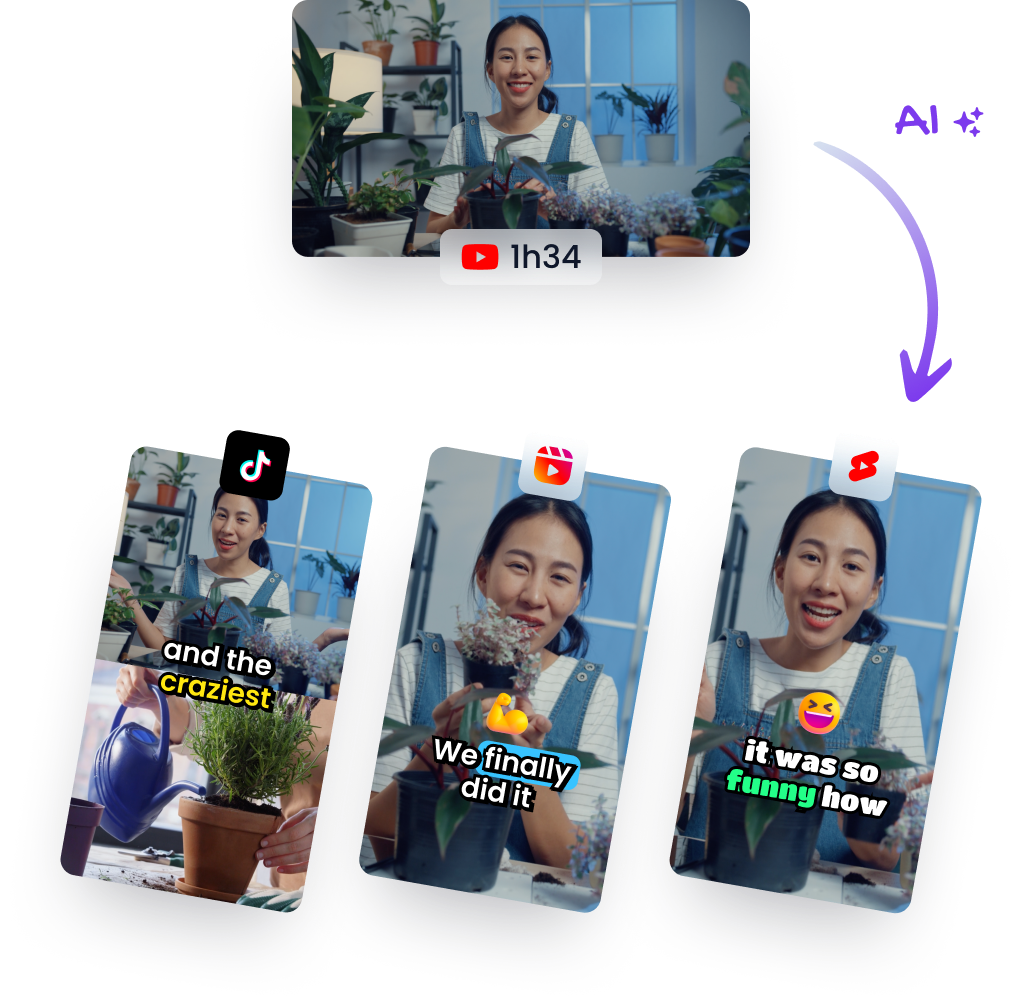
This image below perfectly captures the idea. One piece of long-form content becomes the source for multiple mobile-first clips.

This is the essence of AI-powered repurposing: intelligently finding the golden nuggets in your video timeline and spinning them into engaging, vertical clips built for how people watch today.
The Shift in Audience Behavior
Let's be honest—attention spans are shot. Your content is up against an infinite scroll of distractions, and you have less than a second to grab someone's attention. Repurposed clips are tailor-made for this reality.
Here's why they work so well:
- High-Impact Moments: They cut straight to the chase. No long intros, just the punchline, the shocking stat, or the powerful quote.
- Sound-Off Viewing: With big, dynamic captions, your clips are just as effective when viewed on silent—perfect for people scrolling on the bus, in a waiting room, or at their desk.
- Shareability: A tight, 30-second clip is infinitely more shareable than a 20-minute video. It's easy to send in a DM or post to a Story.
By adopting this model, you’re not just making more content; you're making content that aligns perfectly with how people actually use their phones right now.
Finding Viral Moments Hidden in Your Videos
Your existing content library is a goldmine, but most creators are digging in the wrong places. They assume virality comes from brand-new ideas, but the real secret is hiding in plain sight: within the podcasts, webinars, and interviews you’ve already published.
It's time to stop thinking of your long-form videos as single assets. Instead, see them for what they are—an inventory of future viral hits just waiting to be discovered. This isn't about randomly scrubbing through hours of footage. It’s about developing an eye for what makes people stop scrolling and share.
The Three Pillars of a Viral Clip
Viral moments aren't accidents. They're built on a solid foundation of human psychology. As you review your content, hunt for clips that tap into one of three powerful categories. The best clips often blend two or even all three.
- Strong Emotional Triggers: Emotion is the rocket fuel of virality. A study of viral content confirmed what we all instinctively know: content that triggers high-arousal emotions—like awe, anger, or amusement—gets shared. Look for moments of genuine laughter, a surprising gasp, a passionate rant, or a vulnerable, heartfelt story.
- Concise 'Aha' Insights: These are the moments that make your audience go, "Wow, I never thought of it that way." An 'aha' moment simplifies a complex idea, solves a nagging problem, or offers a piece of wisdom that’s immediately useful. It’s a mini-epiphany packaged in a 30-second clip.
- Compelling Micro-Stories: We’re all wired for narrative. A short, self-contained story with a clear beginning, middle, and end is incredibly sticky, even if it’s only 45 seconds long. This could be a quick client success story, a personal anecdote about a mistake you made, or a fascinating case study.
Actionable Takeaway: The most shareable clips don't just inform; they make the viewer feel something. Whether it's the joy of a relatable joke, the anger from a controversial opinion, or the satisfaction of a new insight, emotion is the currency of the scroll.
Think about it in practical terms. If you're a podcaster, listen for that 30-second segment where your guest drops an unpopular opinion. That clip is engineered for debate and comments. If you're a business coach, find that powerful, 20-second client testimonial in a 90-minute webinar. That's a micro-story packed with social proof.
Using AI to Unearth Hidden Gems
Let’s be honest: manually sifting through hours of video is a soul-crushing task that kills all creative momentum. This is where AI-assisted discovery isn't just a nice-to-have; it's a game-changer.
Modern tools like Klap are built to do the heavy lifting for you. They act as a super-powered assistant that never gets tired of watching your footage.
Instead of you watching every second, the AI analyzes the entire video in minutes. It scans the transcript for keywords, identifies shifts in vocal tone and energy, and even recognizes when a speaker becomes more animated. It then automatically surfaces the most promising segments, often complete with a "virality score" to guide you.
This completely flips the workflow from a hunt to a harvest. Rather than searching for a needle in a haystack, you get a curated list of high-potential clips ready for your final touch. This doesn't replace your creative judgment; it sharpens it. You can now focus your energy on refining the best moments instead of just finding them.
What used to be a week's worth of tedious editing can now be knocked out in an afternoon.
Your AI-Powered Clipping Workflow
Once you've trained your eye to spot potential viral moments, it’s time to let technology do the heavy lifting. Manually finding, cutting, and reformatting clips is a massive bottleneck. It drains your time and, worse, your creative energy. An AI-powered workflow automates the most tedious parts of this job, turning what used to be hours of painful editing into just a few minutes.
Before we dive in, it's helpful to understand what AI video generation is and how these tools "think." They don’t just randomly chop up your video. Instead, they use intelligent analysis to make smart editing decisions, acting like a high-speed video editor that never gets tired. This is where the magic of creating viral content at scale really happens.
From Long Video to First Clips in Minutes
The first step couldn't be simpler. Forget setting up a complex editing project. You just need one thing: your long-form video. Most AI clipping tools, like Klap, let you either paste a YouTube link or upload a video file directly. That's it.
From there, the AI takes over. It runs a full analysis of your video, looking at a few key things all at once:
- Topic Identification: The AI scans the transcript to figure out the main subjects you’re discussing, grouping related ideas together.
- Virality Scoring: It actually scores different segments for their potential to go viral, looking for strong emotional cues, juicy questions, or powerful statements.
- Speaker Detection: The tech identifies who is talking and when, which is absolutely critical for the next step: auto-reframing.
Within minutes, this automated analysis gives you a curated list of potential clips. It's like having an assistant who already watched your entire hour-long video and flagged all the best parts for you to review.
Auto-Reframing for a Mobile-First World
One of the most tedious parts of traditional editing is converting a horizontal (16:9) video into a vertical (9:16) format for TikTok, Reels, and Shorts. If you have multiple speakers or even just one person who moves around, you’d have to painstakingly keyframe the shot to keep them centered.
AI completely automates this. Using speaker detection data, tools like Klap automatically reframe every single clip. The AI creates a "virtual camera" that follows the active speaker, making sure their face is always perfectly centered in the vertical frame.
A video marketing study found that vertical videos on platforms like Facebook have a 13.8% higher 6-second view-through rate than square videos. Auto-reframing ensures every clip is built for the format where it will perform best.
This feature alone removes a huge technical barrier. You no longer need to be a skilled video editor to produce professional-looking vertical clips. The AI handles the tricky reframing, so you can focus on the actual content.
This simple flow is what the AI is trained to find—the core human elements that make people want to share.

From emotion to insight to story—that's the blueprint for a shareable clip, and it’s what these AI tools are designed to surface for you automatically.
Editing and Customizing Your AI-Generated Clips
AI gives you a massive head start, but you always have the final say. The best clipping platforms give you a simple, intuitive editor to polish the clips. This is where your human touch comes in.
Here are a few common adjustments you can make with just a few clicks:
- Trimming Start and End Points: If the AI-selected clip starts a second too early or ends too late, just drag the handles to tighten it up.
- Refining Captions: The AI generates a full transcript and captions, but it might misspell a name or a niche term. You can click right on the text to make quick fixes.
- Applying Visual Styles: Choose from different caption styles, fonts, and color palettes to match your brand. Many tools offer dynamic, word-by-word captions (often called karaoke-style) that are proven to hook viewers and keep them watching.
The whole point is to refine, not create from scratch. You’re no longer staring at a blank timeline. Instead, you're working with a nearly-finished clip, just making small tweaks to get it perfect.
If you want to see the features in action, you can explore a dedicated long-to-short video converter to get a feel for the workflow. This approach bridges the gap between raw footage and polished, shareable content, making the entire process incredibly efficient.
Fine-Tuning Your Clips to Go Viral
Getting a great clip from your AI tool is a solid start, but it's only half the battle. If you want to learn how to create truly viral content, you have to master optimization. These are the small but crucial tweaks that give your videos an algorithmic edge and turn a good clip into a legendary one.
These adjustments are what make someone stop their endless scroll, watch all the way through, and smash that share button.
It all begins with a simple truth: most videos are watched on mute. A study revealed that as much as 85% of video on Facebook is watched with the sound off. If your video depends on audio to make its point, you're immediately losing the vast majority of your potential audience.
Dynamic Captions That Command Attention
The single most impactful optimization you can make is adding dynamic, easy-to-read captions. This isn't just about accessibility anymore; captions are a core part of the modern viewing experience. Your mission is to make the video just as engaging and understandable on silent as it is with the sound on.
Think of your captions as a visual tour guide. Ditch the plain, static text at the bottom of the screen. Instead, use dynamic, word-by-word (or "karaoke-style") captions that highlight words as they’re spoken. This trick keeps the viewer's eyes glued to the screen, actively following along.
Here’s how to make your captions work even harder for you:
- Use Color and Emojis: Don't be shy about adding a pop of color to emphasize a keyword or phrase. A flash of yellow on a surprising statistic or a well-placed emoji next to a powerful word can instantly recapture wandering attention.
- Keep It Legible: Go for bold, clear fonts that are easy to read on a tiny screen. Contrast is your best friend—if the background is light, use dark text, and vice versa.
- Don't Overdo It: The goal is to highlight, not to create a visual mess. Use emphasis sparingly on the most important words to avoid clutter and maximize their impact. You can find more practical advice on how to add captions to YouTube Shorts and other platforms in our detailed guide.
This level of detail turns a passive viewing experience into an active one.
The Scroll-Stopping First Frame
You have less than a second. The very first frame—what someone sees before they even decide to let the video play—is your most valuable real estate. A boring or confusing opener is a guaranteed swipe-away.
Your first frame must do one of two things: spark curiosity or present a bold statement. Think of it as your video's headline. Instead of a weak opening like, "So today I want to talk about…," cut straight to the most controversial or surprising part of your statement.
Actionable Tip: Always manually select your video's thumbnail or cover image on platforms like TikTok and Instagram. Never let the algorithm pick a random, blurry frame. Choose a shot where the speaker has an expressive face or, even better, add a text overlay with a killer hook like "You're Making This Mistake…" or "My #1 Unpopular Opinion…".
This initial hook is what stops the scroll. A powerful first frame combined with an intriguing caption hook is the one-two punch that buys you the next three to five seconds—and that's often all you need to get them hooked.
Tailoring Your Clips for Each Platform
While the core clip might be the same, you can't just post it identically across all platforms and expect the same results. Each platform has its own culture, features, and algorithmic quirks. A few small tweaks can make a world of difference.
- For TikTok: Find a trending sound and layer it into your video. Even if you turn the volume down to just 1-2% behind your main audio, the algorithm often gives a nice bump to videos using popular sounds. It’s a simple trick for an extra boost in visibility.
- For Instagram Reels: Focus on relevant hashtags and trending audio. While not as sound-dependent as TikTok, using audio that’s currently "trending" on Reels can still give you a leg up. More importantly, use a smart mix of broad and niche hashtags to help Instagram categorize your content and serve it to the right people.
- For YouTube Shorts: Nail the search-friendly title. Unlike the feed-first nature of TikTok and Reels, remember that YouTube is a massive search engine. Craft a title with keywords people are actually searching for. For instance, instead of a vague "Mindset Hack," go with "A Simple Mindset Hack to Beat Procrastination." This strategy helps your Short gain long-term traction as it starts appearing in search results over time.
Building a Sustainable Viral Content System

In the chase for virality, inconsistency is the ultimate momentum killer. A single perfect clip might give you a temporary spike, but it won't build the flywheel effect that social media algorithms love. Going viral isn't about a lucky shot; it's about building a system that makes consistency feel almost effortless.
This is where an AI-powered repurposing workflow really changes the game. It’s not just about shaving a few hours off one clip. It’s about fundamentally changing your content output, turning a single long-form video into a month’s worth of social media ammo.
The Volume Play From a Single Video
You need to stop thinking in terms of one-to-one creation. The new math is one-to-many. A single, one-hour podcast episode or webinar is a goldmine that can easily be spun into 20-30 unique short-form clips. That's not an exaggeration; it's a strategic shift in perspective.
Let's say you just wrapped up a one-hour interview. Buried inside that recording, you probably have:
- 3-4 strong, controversial opinions.
- 5-6 actionable "how-to" moments.
- 2-3 funny anecdotes or personal stories.
- 4-5 insightful quotes or "aha" moments.
- A handful of audience questions with thoughtful answers.
Every single one of these is a potential clip. When you use a tool like an AI shorts maker, you can pull out all of these moments in a fraction of the time it took to hit record. This volume is what you need to feed the algorithm what it wants most: a steady stream of engaging content.
Creating Your Themed Content Calendar
Once you have a library of 20+ clips from a single video, the "what do I post today?" panic just disappears. Now you can build a simple, themed content calendar that gives you structure and keeps your audience hooked. The right system allows you to post daily without a daily scramble.
For instance, a week's worth of content could look like this:
- Monday Motivation: Kick off the week with an inspirational clip or a powerful mindset shift from your video.
- Tuesday Tip: Share a practical, "how-to" segment that offers immediate value.
- Wednesday Wisdom: Post a thoughtful insight or a profound quote from your discussion.
- Thursday Throwdown: Drop that slightly controversial opinion to spark comments and debate.
- Friday Funny: End the week with a moment of laughter, an outtake, or a relatable story.
This kind of structure doesn't just make your life easier; it trains your audience on what to expect. Soon enough, they'll start looking forward to your "Tuesday Tips" or "Thursday Throwdowns," building a loyal viewership over time.
Building this kind of consistency is the secret weapon for viral success. Data shows that creators who post at least once per week for 20 weeks or more achieve engagement rates 4.5 times higher per post than those who are inconsistent. When you consider that 93% of marketers are prioritizing social media, but many fail due to burnout, a sustainable system is your competitive edge. You can find more compelling data in this social media marketing statistics report from Dreamgrow.
This high-frequency posting strategy is the real secret behind creating viral content consistently.
A/B Testing Your Way to Virality
With a huge bank of clips at your disposal, you finally have the freedom to experiment. Don't just post a clip once and hope for the best. A/B testing is how you figure out what your audience truly loves, and it's remarkably easy to do when you have a system.
Take one powerful 30-second clip and create two different versions of it.
- Version A: Start with a question as the hook.
- Version B: Start with a bold, declarative statement as the hook.
Post them a week apart and check the numbers. Which one got more shares? Which had a higher watch-through rate? The data gives you a clear answer, which then informs your strategy for every clip you make going forward. You can test different hooks, captions, calls to action, or even just the first three seconds of the video. This constant feedback loop is what turns good content into viral content.
Got Questions About Going Viral? We've Got Answers.
You're ready to start clipping, but a few questions are probably still rattling around in your head. That's totally normal. This whole world of short-form video can feel like it has a secret rulebook.
Think of this section as your personal cheat sheet. We're tackling the most common questions we hear from creators, giving you straight, no-fluff answers to help you turn this playbook into a real, repeatable process.
How Long Should My Viral Clips Actually Be?
There's no single magic number, but the data points to a clear sweet spot: 15 to 45 seconds. This range gives you just enough runway to deliver a solid insight or tell a complete micro-story without testing your viewer's ever-shrinking attention span.
If you want to get more specific, clips under 30 seconds consistently see the highest watch-through rates. That's a huge signal to the algorithm that people are loving your content. The big takeaway? Be ruthless with your editing. If you can make a powerful point in 20 seconds, don't you dare stretch it to 40.
Can I Seriously Go Viral With Old Content?
Absolutely. In fact, your back catalog is a goldmine. Think about it: great ideas, strong opinions, and universally relatable stories don’t just expire. That killer point you made on a podcast two years ago is still just as sharp today.
Repurposing breathes new life into your best ideas. It’s your chance to introduce them to a whole new audience on platforms like TikTok and Reels who almost certainly never saw the original. The algorithm doesn't care if the footage is a few years old; it only cares if people are engaging with it right now.
You're not just re-posting; you're recycling a proven concept and giving it a fresh, modern format built for how people consume content today.
What's More Important: Video Quality or The Hook?
The hook. Every single time. No contest.
You could have a masterpiece shot in 8K, with perfect lighting and a studio-quality mic. But if the first three seconds are boring, it's dead on arrival. It will get skipped.
On the other hand, a raw, slightly shaky iPhone video with a hook that immediately sparks curiosity, surprise, or even a little outrage can stop the scroll in its tracks. That's what goes viral. The data is clear: evoking a strong, immediate emotional response is what matters most. Your number one job is to craft an irresistible opening. Polish can come later.
How Many Clips Can I Realistically Get From One Long Video?
This is where you need to shift your entire mindset. Stop thinking "one video, one asset." Start thinking "one video, dozens of assets."
A single one-hour video can easily produce 10, 20, or even 30 fantastic clips. You just need to know what to look for.
Go on a treasure hunt for every single micro-moment:
- Every controversial take or strong opinion.
- Every practical, useful tip.
- Every funny story or relatable anecdote.
- Every powerful, quotable line.
Building a deep library of clips from one recording is the secret to the high-frequency posting schedule that the algorithms love. This volume is how you build a sustainable system for going viral, not just getting lucky once.
Ready to stop manually scrubbing through hours of footage and start effortlessly creating a steady stream of viral shorts?
With Klap, you can turn one long-form video into a month's worth of content in just a few clicks. Just paste your YouTube link, and our AI finds the best moments, adds dynamic captions, and delivers ready-to-post clips in minutes.
Try it for free and see just how simple creating viral content can be.