How to Make Social Media Videos That Capture Attention
Other
If you're wondering how to make social media videos that actually get noticed, you first need to understand why they work. Short-form video has completely taken over social media, and it’s no accident. It’s the perfect match for our fast-paced lives, delivering quick, valuable, and authentic content that’s incredibly easy to consume.
Why Short-Form Video Dominates Social Media Feeds
The way we consume content has fundamentally changed. Gone are the days when you needed a polished, high-budget production to grab someone's attention. Today, the algorithms on TikTok, Instagram, and YouTube are hardwired to favor content that feels immediate, engaging, and genuinely human. This isn't just a passing trend—it's a massive shift in how people connect online.
Let's be honest, people want to get straight to the point. They're looking to learn a new hack, get a quick laugh, or feel a spark of connection, all in under 60 seconds. This demand for instant gratification has made short-form video non-negotiable for anyone trying to build a brand or a following.
The Power of Quick, Authentic Content
Think about your own scrolling habits. You probably fly past dozens of posts until something—a compelling hook, a surprising visual, an interesting sound—stops you in your tracks. This critical moment happens in the first three seconds. This is the new battlefield for attention.
Short videos are built for this world. They win because they’re all about:
- Immediacy: Giving the viewer value right away, without long, boring intros.
- Authenticity: Raw, unpolished content often feels more trustworthy and relatable than a slick, overproduced ad. In fact, 88% of consumers say authenticity is important when deciding which brands they like and support.
- Value Exchange: Every single video must answer the viewer's silent question: "What's in it for me?"
Mastering this format is essential. The data backs it up, too. Short-form video now brings in the highest ROI of any social media marketing strategy. A massive 90% of marketers using short-form video plan to increase or maintain their investment next year.
The core principle is simple: respect the viewer's time. If you can deliver a powerful message, a useful tip, or a genuine laugh quickly, you will win their attention.
Understanding this is step one. To really get into the weeds of how each platform works, check out our guide comparing the nuances of TikTok vs YouTube Shorts. It all boils down to creating content that feels like it belongs in the feed—short, sharp, and impossible to ignore.
Planning Your Video Content for Maximum Impact
You know those viral videos that feel totally spontaneous? Nine times out of ten, a solid plan was in place before the camera ever started rolling. The secret to creating content that stops the scroll is knowing exactly what you want to achieve.
It all starts with one simple question: What is the single goal of this video?
Seriously, just one. Are you trying to teach your audience something specific? Make them laugh with a relatable skit? Or inspire them with a powerful story? Trying to cram all three into a 30-second clip is a surefire way to create something confusing and forgettable. A clear, single objective is your north star—it guides every decision, from your script to your final edit.
Once your goal is set, get inside your audience's head. What are their real-world problems, curiosities, and frustrations? Don’t guess. Dive into the comment sections of creators in your niche, browse relevant Reddit threads, and use free tools like AnswerThePublic to find what people are actively searching for. This is how you create content that truly resonates and builds a loyal community.
To keep everything straight before you roll the camera, a quick pre-production check is a lifesaver. It forces you to iron out the core components so you're not just winging it.
Essential Pre-Production Checklist for Social Videos
Checklist ItemKey Question to AnswerExample
Define the Goal
What's the one thing I want the viewer to do or feel?
"I want them to learn one specific keyboard shortcut in Excel."
Identify the Audience
Who am I talking to, and what do they care about?
"Beginner Excel users who feel overwhelmed by complex formulas."
Craft the Hook
How will I grab their attention in the first 3 seconds?
"Stop manually adding up cells in Excel. Do this instead."
Outline the Value
What's the core takeaway or solution I'm providing?
"Demonstrate the CTRL + SHIFT + = shortcut for autosum."
Plan the CTA
What's the next logical step for the viewer?
"Comment your favorite Excel hack below!"
Running through these questions ensures every video has a purpose, dramatically increasing its chances of success.
Mastering the All-Important Hook
You have less than 3 seconds to convince someone to stop scrolling. That's it. This is where the hook comes in, and it's the most critical part of your video. A weak hook means your brilliant idea gets ignored, no matter how amazing the rest of the content is.
Fortunately, there are proven formulas you can use:
- The Question Hook: Start with a provocative question your ideal viewer is dying to know the answer to. For example, "Are you still making this huge mistake on your resume?"
- The Controversial Statement: Make a bold claim that goes against common advice. A personal finance creator might say, "That high-yield savings account is actually losing you money." It makes people stop and think, "Wait, what?"
- The Visual Twist: Begin with a bizarre or visually confusing shot that makes people pause just to figure out what’s going on.
The goal of the hook isn't just to get a view; it's to create an "information gap." You're making a promise that the rest of the video will fulfill, and the viewer's curiosity compels them to stick around for the payoff.
Once you’ve nailed the hook, the rest of your video follows a simple structure: Hook, Value, Call-to-Action (CTA). You grabbed their attention, now deliver on your promise by providing the core tip or story. Then, wrap it up by telling them exactly what to do next—follow your account, drop a comment, or check out the link in your bio.
This straightforward framework ensures every video has a clear purpose, setting you up for a win before you even press record.
Shooting Techniques for a Professional Look
You don't need a thousand-dollar camera or a professional studio to create social media videos that look great. The smartphone in your pocket is more than powerful enough. The secret isn't in the gear, but in a few simple techniques.

Before you hit record, take two seconds to wipe your phone's lens. It’s a tiny action, but it makes a massive difference by removing the hazy, blurry look that screams "amateur." This simple habit will instantly improve your video quality.
Next, find good lighting. Don't overthink it. Just find the nearest window. Natural light is your best friend—it's soft, flattering, and completely free. Make sure you're facing the light source, not standing with your back to it, which would turn you into a dark silhouette.
Nailing the Essentials: Audio and Stability
Here’s a hard truth: viewers will forgive mediocre video quality, but they will not tolerate bad audio. If your audience has to strain to hear you over background noise or a nasty echo, they're gone. They'll just scroll on by.
To fix this, get your phone as close to you as possible while recording. For an even bigger upgrade, an inexpensive lavalier mic that clips onto your shirt is a game-changer. It’s a small investment that ensures your voice is crystal clear, making your content feel far more professional.
Stability is the other deal-breaker. No one wants to watch shaky, handheld footage that makes them feel seasick. You can solve this easily:
- Use a Tripod: A small, portable tripod for your phone is one of the best, most affordable investments you can make.
- Get Creative: No tripod? No problem. Prop your phone against a stack of books, a coffee mug, or lean it against a wall.
- The "Elbows In" Trick: If you have to shoot handheld, hold your phone with both hands and tuck your elbows into your sides. This creates a more stable base and reduces natural shakiness.
Composing for a Vertical World
When you’re making videos for social media, you have to think vertically. The 9:16 aspect ratio is the native language of TikTok, Reels, and Shorts. Trying to cram horizontal footage into that space just looks awkward and out of place.
To make your vertical shots compelling, focus on composition. A great first step is to turn on your phone's gridlines in the camera settings. This simple overlay helps you use the Rule of Thirds—placing your subject slightly off-center for a more balanced and visually interesting shot.
Keep in mind that platforms like TikTok and Instagram place text, usernames, and buttons at the bottom and sides of the screen. Always leave plenty of "safe space" around the edges so the important parts of your video don't get covered up.
Finally, look at your background. It doesn't need to be a movie set, but it should be intentional. A cluttered, messy background can distract from your message. Find a clean space, or add a plant or a lamp to create visual interest without being distracting. These small details add up to give your video a more polished finish.
Editing Your Footage into Engaging Stories
This is where the magic happens. Your raw footage is just a collection of moments, but editing is how you weave them into a story that holds attention. In the fast-paced world of social media, your editing style is just as important as what you're saying.
The goal is to create a dynamic experience that keeps the viewer’s brain engaged. You can't afford a single dull second. This means ruthlessly cutting every unnecessary pause, every "um," and every moment of dead air. Your cuts should be quick and clean, building momentum from the very first frame.
Create Momentum with Dynamic Cuts
Think of your editing as controlling the video's energy. To keep that energy high, many top creators use a few simple yet powerful techniques.
- Strategic Jump Cuts: Don't be afraid to cut from one part of a sentence directly to the next. This chops out tiny pauses and breaths, tightening your delivery and making the whole video feel snappier.
- Subtle Zooms: A slow, almost unnoticeable zoom-in during a key point can add a surprising amount of emphasis. It’s a classic trick that draws the viewer in and keeps the frame from feeling static.
These small tweaks stop your video from feeling like a flat, single-take recording. Each cut and zoom acts as a mini-pattern interrupt, resetting the viewer’s attention just enough to keep them locked in.
Why On-Screen Text is Non-Negotiable
If you only take one piece of advice from this section, let it be this: you must add on-screen text and captions to your videos. This isn't just a nice feature; it's critical for success. A staggering number of users—some reports say as high as 85%—watch videos with the sound off. Without captions, your message is completely lost on them.
Captions do more than just make your content accessible. They reinforce key points, improve comprehension, and have been shown to significantly boost watch time. Viewers can follow along in a noisy office or late at night, making your content far more versatile.
You can also use larger, animated text overlays to emphasize keywords or pose questions. This technique acts like a visual highlighter, guiding the viewer's focus. If you're looking for the right tools, our guide on the best TikTok editing apps can help you find options with great text features.
Enhancing Your Story with Sound and Graphics
Finally, let's talk about the finishing touches. Sound is an incredibly powerful tool for setting the mood and injecting personality into your video.
Using trending audio can give your video a visibility boost, as platforms often push content that uses popular sounds. Just make sure it fits the vibe of your video—don't just slap a random song on it. Beyond music, simple sound effects, like a "swoosh" for a text reveal or a "ding" for a new idea, can make your edit feel much more polished.
Simple graphic overlays, like an arrow pointing to a key detail or a colored box framing your text, also add another layer of visual interest. The key is not to overdo it. The best edits use these elements to support the story, not distract from it.
Scaling Your Content Creation with AI Tools
Let's be real: creating consistently great social media videos takes a lot of time. But what if you could multiply your output without recording new footage? For creators with a library of long-form content—like podcasts, webinars, or YouTube videos—AI tools are a game-changer for working smarter, not harder.
This isn't just about saving a few hours. It’s about unlocking the hidden value in content you've already created. Instead of letting that hour-long podcast gather dust, you can systematically pull dozens of viral-worthy moments from it, keeping your social feeds active for weeks. This is how you scale a video strategy without burning out.
The Power of AI in Repurposing Content
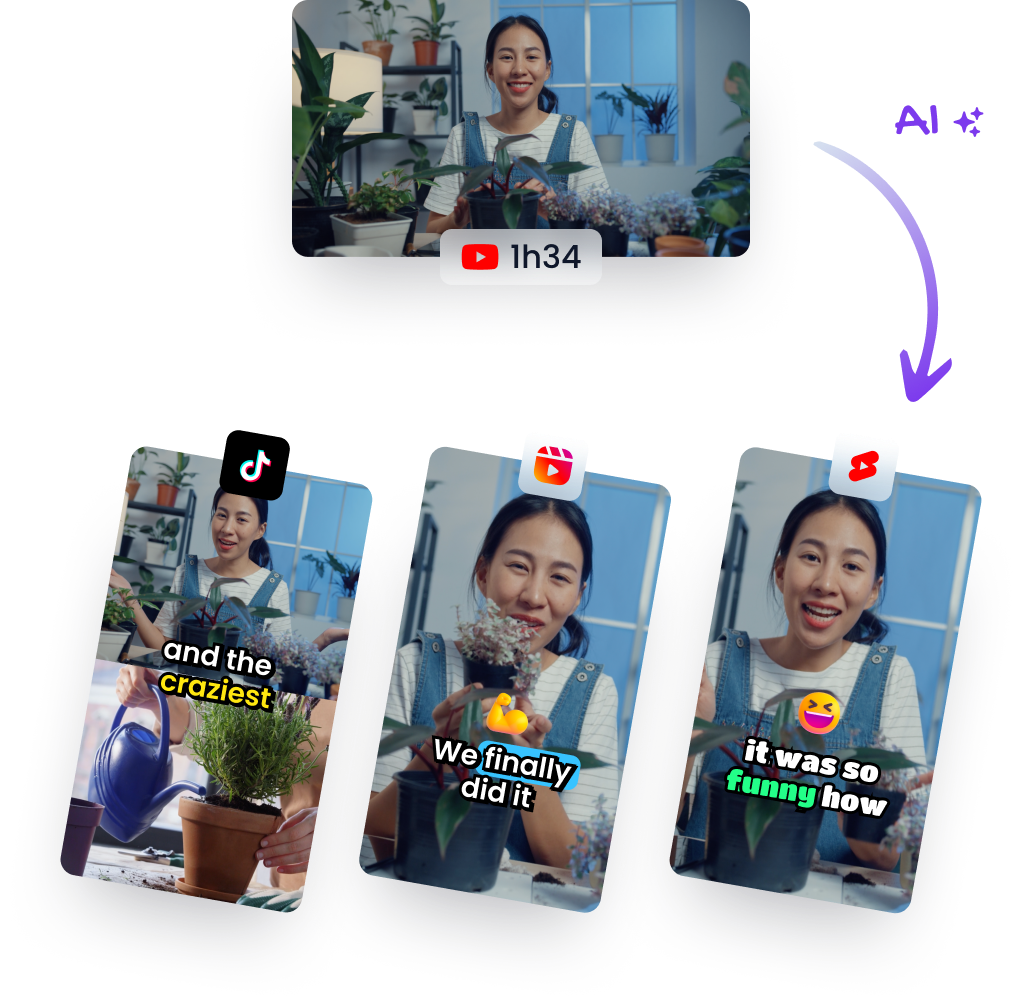
The core idea is simple: let artificial intelligence do the tedious work. Platforms like Klap were built for exactly this. You just provide a link to your YouTube video or upload the file, and the AI takes over.
It scans the entire video, listening for interesting topics, flagging potential hooks, and identifying the most shareable segments. The technology is designed to recognize the parts of your content that have the highest chance of performing well as short-form videos.
This completely flips your role from editor to curator. Instead of scrubbing through an hour of footage to find one 30-second gem, the AI presents you with a curated list of high-potential clips. The amount of manual effort this saves is staggering.
There's a reason the adoption of these tools is exploding. By 2025, 51% of video marketers are expected to be using AI for creation or editing. That's a huge leap from just 18% in 2023—a 128% increase in only two years. AI is leveling the playing field for creators everywhere.
From Long-Form to Viral Short in Minutes
Once the AI has pinpointed the best clips, the workflow becomes incredibly efficient.
- Intelligent Clip Selection: The AI doesn't just make random cuts. It uses topic detection and virality scores to find powerful, standalone moments.
- Automatic Reframing: It takes your horizontal video and instantly reframes it for the vertical 9:16 format, smartly keeping the speaker centered.
- Dynamic Captions: The tool transcribes everything and adds animated, easy-to-read captions—an absolute must for sound-off viewing.
This simple flowchart shows the core editing phases that AI helps automate.

As you can see, AI handles the heavy lifting of cutting, adding text, and managing audio to churn out social-ready clips in a fraction of the time.
You can learn more about how to find the perfect https://klap.app/tools/ai-short-video-generator for this workflow. These tools give you a massive head start, letting you review, make a few tweaks, and export dozens of clips in the time it used to take to manually edit just one. For busy business owners looking to save time and grow their presence, exploring a range of AI content creation tools can open up even more advantages for scaling your video production.
Got Questions About Social Media Videos? We've Got Answers.
As you get into the rhythm of creating videos, practical questions always come up. Here are straight-up answers to the questions we hear creators ask all the time.
What’s the Magic Number for Video Length?
The short answer? It depends on the platform, but shorter is almost always better. Even though platforms are allowing longer videos, human attention spans aren't getting any longer. Your job is to deliver value, fast.
Here’s a practical breakdown based on what works right now:
- TikTok: The sweet spot is usually 21-34 seconds. It's long enough for a quick story but short enough that people might watch it again—a huge signal to the algorithm.
- Instagram Reels: Aim for under 60 seconds. We’ve seen that Reels in the 30 to 60-second range perform well, especially for tutorials or storytelling.
- YouTube Shorts: You have up to 60 seconds, but the Shorts that go viral are often much shorter, landing in the 15-30 second range. They typically focus on a single, powerful idea or punchline.
The real "ideal length" is however long it takes to tell your story without a single wasted second. If you can make your point in 15 seconds, don't stretch it to 30. Edit ruthlessly.
How Often Should I Actually Be Posting?
This one's simple: consistency trumps frequency.
Posting three great videos a week, every single week, is far more effective than posting twice a day for a week and then disappearing for two weeks. Burnout doesn't help you, your audience, or the algorithm.
Find a schedule you can realistically stick to. For most people, that's somewhere around 3-5 times per week. Once you've established a sustainable workflow, then you can consider increasing your output. The algorithm rewards steady, reliable activity over short, chaotic bursts.
What Do I Do About Negative Comments?
First off, take a breath. It happens to everyone. The key is to have a plan so you're not caught off guard. Most of the time, your response will fall into one of three buckets:
- Ignore and Delete: If a comment is just spam, hate speech, or completely off-topic, don't engage. Just delete it, block the user, and move on. Never feed the trolls.
- Respond with Grace: Is the feedback critical but fair? A calm, professional reply can turn a negative interaction into a positive one. Thank them for their input, clarify your point if necessary, and leave it at that.
- Turn It Into Content: Sometimes, a negative comment is a content goldmine. If someone misunderstands a concept, you can bet others do too. Make a follow-up video clarifying it for everyone. This shows you're listening and adds value for your entire community.
How you handle criticism sets the tone for your community. When you handle it with class, you build a stronger, more positive brand.
Ready to stop spending hours editing and start scaling your content effortlessly? Klap uses AI to find the best moments from your long-form videos and turns them into dozens of viral-ready short clips in minutes. Try it now and see how easy it can be to grow your social media presence.