Master Summarize Video AI for Engaging Shorts
Other
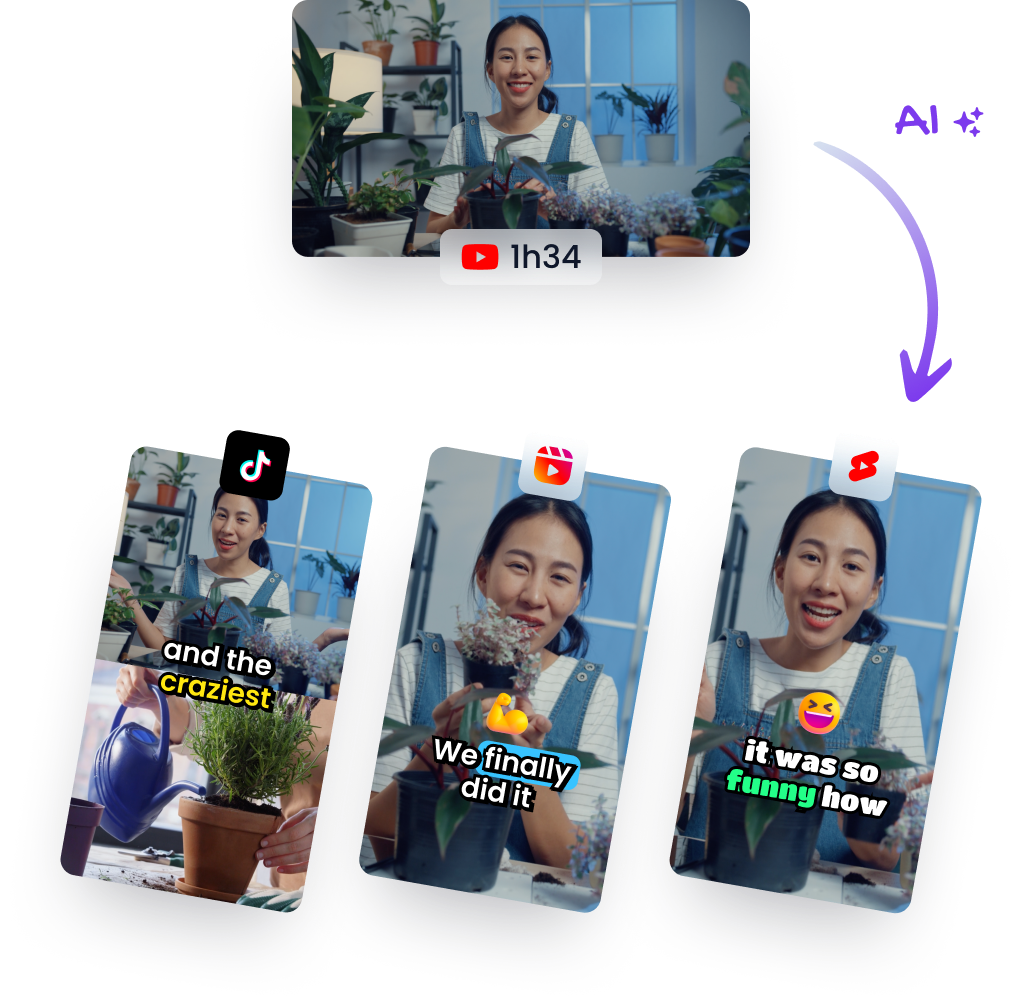
You've already done the hard part. You recorded the webinar, edited the interview, or published the podcast episode. The problem starts after that, when the long-form video sits there full of usable moments and you still need clips for TikTok, Reels, and Shorts.
Manual repurposing is where many operations lose momentum. Scrubbing through an hour of footage, marking timestamps, resizing for vertical, fixing captions, and exporting multiple versions turns one video into a full afternoon of post-production. That's why so many creators search for ways to summarize video AI can use, not just to produce a text recap, but to extract clips worth publishing.
The practical value of AI summarization isn't the summary itself. It's the shortcut from a long recording to a short-form asset library that can be shipped.
Why AI Video Summarization Is a Creator's Secret Weapon
A lot of creators still think video summarization means a paragraph of notes under a YouTube video. That's too narrow. In practice, the useful version of summarize video AI is a repurposing workflow. The tool watches the content, maps the transcript, detects key moments, and turns a long recording into shortlist candidates for social clips.
That matters because short-form publishing rewards consistency, not heroic editing sessions. If every podcast episode or webinar can produce several usable vertical clips, your content library gets a second life instead of dying after one upload.
It solves the worst part of repurposing
The hardest task isn't cutting video. It's finding what to cut.
Most long-form videos contain strong moments, but they're buried between intros, transitions, context-setting, and side tangents. Human editors can find them, but the process is slow. AI tools reduce that search time by combining transcript analysis with visual and audio signals, then surfacing likely highlights.
Industry coverage of AI video summarization workflows describes this shift clearly. The workflow now combines automatic speech recognition, computer vision, and NLP to turn long videos into condensed summaries with timestamps and highlight clips. That move from research to mainstream creator tools by the mid-2020s is why automated extraction now fits real publishing routines instead of living as a lab demo.
Why this changes content economics
When you can pull shorts from existing footage, you stop treating every platform as a separate production job.
A single source video can support:
- Discovery clips for short-form feeds
- Quote-driven snippets for thought leadership
- Topic-specific cuts for niche audience segments
- Captioned versions for silent autoplay environments
Practical rule: If a long video has one clear takeaway every few minutes, it probably has multiple short clips hidden inside it.
The win isn't automation for its own sake. The win is that creators can keep publishing without doubling editing hours. For a solo creator, that means less backlog. For a team, it means the same recording session can feed multiple channels with less manual review.
Used well, AI summarization becomes less of a convenience feature and more of a distribution lever.
How AI Actually Finds the Best Video Moments
A useful clip usually reveals itself before the flashy part. It starts when a speaker makes a clear claim, builds just enough context, and lands on a sentence that can stand on its own in a feed.
That is the core job of summarize video AI. It is not searching for random “exciting” frames. It is scoring segments for reuse. In practice, that means the system looks for moments with a clean start, a complete idea, and enough visual continuity that the clip will still make sense after it is cut out of a longer recording.

The transcript is usually the first filter
Speech-to-text gives the model a workable map of the video. From there, it can spot topic changes, question-and-answer patterns, repeated keywords, and lines that sound complete enough to survive as short clips. That is why interviews, podcasts, webinars, and talking-head explainers often summarize well. The structure is already present in the speech.
A recent survey of video summarization architectures and pipelines describes the same pattern. Systems ingest the video, extract text, audio, and visual features, score candidate segments, and select key shots. The practical takeaway for creators is simple. Transcript quality affects everything downstream, but transcript quality alone is not enough.
Watchability comes from timing and visuals
A transcript can tell a tool what the speaker meant. It cannot tell the tool whether the extracted moment feels clean on screen.
Models handle that by looking at temporal and visual signals such as scene changes, speaker visibility, framing stability, pace, and whether a segment starts or ends in the middle of motion or speech. Those details are what separate a usable short from a clip that feels clipped too early, drifts too long, or drops the viewer into a point with no setup.
Research reported in a 2024 Scientific Reports study on AI video summarization found measurable benchmark performance across standard datasets, including precision of 79.2%, recall of 86.5%, and F-score of 83%. The same paper also reported a personalized system with 89% precision, 78% recall, and an 83% F-score. Those benchmarks matter because they show clip selection is evaluated against shared datasets, not treated as a vague product claim.
Why some tools pick stronger clips than others
The difference shows up in the output. Basic summarizers condense the transcript. Better ones propose timestamped highlights. Creator-focused tools go one step further and rank moments based on whether they can become publishable shorts with minimal cleanup.
Klap is a good example of how that matters in a repurposing workflow. The tool is not only looking for the “important” section of a long video. It is trying to surface moments that can become short-form assets after reframing, captions, and light editing. This guide on how AI can find highlights in video shows the same idea from the editing side.
The best-performing clip is often the one that makes sense fastest.
That is the trade-off many creators miss. The most insightful moment in a 45-minute episode may need too much setup for TikTok, Reels, or Shorts. A slightly smaller point with a sharper opening often wins because it survives the full repurposing path, from long-form source to social post, with less editing.
Preparing and Importing Your Video for AI Analysis
A 50-minute interview can produce five strong shorts or none at all, and that outcome is often decided before the file hits the uploader. AI summarization works best when the source gives it clear speech, clean transitions, and framing that can survive a vertical crop.

What to fix before you upload
Start with the transcript. If the spoken words are hard to hear, every later step gets weaker. Topic shifts become harder to detect, captions need more cleanup, and clip boundaries get sloppy because the model is working from a damaged input.
Three checks catch most problems fast. Listen through the first minute with headphones. Scrub to the middle and confirm the pacing stays tight. Then look at a few moments where you may want a vertical crop later. If the speaker drifts out of frame or multiple people talk over each other, expect more manual repair after analysis.
Before import, check these basics:
- Audio intelligibility: Reduce hum, echo, and crosstalk if you can.
- Visible speaker framing: Keep faces and upper torso reasonably centered for later reframing.
- Clean topic transitions: Clear shifts between ideas help the tool isolate clips that stand on their own.
- Usable pacing: Long intros, dead air, and side tangents create more weak candidates to sort through.
If you export before uploading, this guide to best video format settings for editing workflows is a useful reference.
What happens after import
Import is where the repurposing workflow starts to speed up. You upload a file or paste a YouTube link, and the tool begins turning one long asset into a set of possible short-form outputs.
In Klap, that means analyzing the source, proposing clip candidates, and preparing them for the next stage with captions and social framing options. That matters in practice because it removes the slowest part of repurposing. You are no longer scrubbing through an hour-long recording hunting for a usable 40-second moment. You are reviewing options the system has already narrowed down.
For webinars, podcasts, interviews, and talking-head YouTube videos, the trade-off is straightforward. Cleaner source material gives you fewer false positives and less trimming later. Messy source material can still produce a winner, but the time savings shrink because you spend more of the process fixing the clip instead of publishing it.
What usually works and what doesn't
Here is the pattern I see most often:
Source video conditionLikely AI result
Clear solo speaker with strong pacing
Better transcript and stronger candidate clips
Interview with clean mic separation
More reliable segment boundaries
Noisy room audio with interruptions
Weaker captions and less usable suggestions
Long intro before the main point
Clips often need manual trimming at the start
Clean audio improves clip selection, not just captions.
If the transcript is off, the tool can miss the point of the segment. That is why preparation is part of summarization, not a separate production chore.
From Raw Highlights to Polished Social-Ready Shorts
Once the AI returns its suggestions, the job changes. You're no longer searching a whole video. You're evaluating options. That's a much faster editorial problem.
The fastest workflow is to review for opening strength, payoff clarity, and visual stability. A candidate clip can be technically correct and still weak on social if it opens too slowly or depends too much on earlier context.

Start by judging the first few seconds
The first cut is simple. Ask one question: would someone who never saw the full video keep watching?
If the answer is no, trim harder. Many AI-selected highlights improve immediately when you remove the throat-clearing at the front. A strong social clip often starts one sentence later than the source conversation did.
A good review pass usually looks like this:
- Watch without editing first. Don't touch the timeline yet. Just decide whether the clip has a real hook.
- Trim the entry point. Cut intros, repeated words, and setup that only matters in the full-length version.
- Check the ending. A short should stop after the payoff, not drift into the next idea.
- Review caption accuracy. Auto-captions are useful, but names, jargon, and acronyms still need a human pass.
- Pick the right aspect ratio. Vertical is usually the default for Shorts, Reels, and TikTok.
For a closer look at this workflow, this guide on turning long video into shorts with AI shows the same editorial logic in a repurposing context.
Reframing matters more than creators think
A horizontal talking-head clip can become unusable in vertical format if the speaker drifts or two people sit too far apart. AI reframing helps, but it still depends on decent source composition.
The practical goal is simple: keep attention on the person speaking or the object being demonstrated. If the crop keeps missing the speaker's face, the clip feels cheap even if the words are strong.
Here's a useful reference for how the refinement phase tends to work in practice:
Captions, pacing, and brand fit
Captions aren't decoration. They're part of the edit. They shape pace, improve comprehension, and keep the clip usable in silent autoplay feeds.
What works:
- Short caption lines: Easier to read on a phone
- Clean timing: Captions should land with the speech, not lag behind
- Consistent styling: Enough personality to feel branded, not so much that it distracts
What usually hurts:
- Overdesigned text treatments: They pull focus from the speaker
- Leaving transcription mistakes untouched: One bad keyword can undercut authority
- Publishing the first AI output unchanged: Even good automation benefits from a brief human pass
A useful clip isn't finished when the AI finds it. It's finished when a viewer can understand it instantly in a vertical feed.
That's the true handoff between machine speed and editorial judgment.
Tips to Improve Your AI Summarization Results
Better summarize video AI results usually come from better source decisions, not from clicking around the editor longer. If you want stronger clips, shape the long-form recording with repurposing in mind before you ever hit record.

Record in segments people can actually clip
Some videos are naturally easier to repurpose. Others fight the editor the whole way.
These habits help:
- Ask cleaner questions: In interviews, direct questions often produce cleaner standalone answers.
- Signal topic changes: A simple phrase like “the second mistake” gives the model a clearer boundary.
- State the point early: Don't bury the takeaway deep inside the answer.
- Pause between ideas: Small pauses make clip boundaries easier to detect and cleaner to trim.
Use performance feedback as training data
Once you publish a batch of clips, watch what your audience responds to. Not with invented benchmark certainty, but with your actual content outcomes.
Maybe your audience prefers:
- contrarian one-liners
- tactical step-by-step answers
- quick stories
- clips built around a direct question
When you notice a pattern, feed it back into the next recording. Structure future episodes so those moments happen more often and land more cleanly.
One advanced move: Treat clip performance as editorial feedback for the next long-form shoot, not just as a report card for the last one.
Think beyond English-only, transcript-only output
One important development in this space is the shift toward multilingual, cross-platform repurposing. Coverage of video summarizer product trends points to a gap many creators run into in practice: a summary alone isn't enough. Real repurposing needs hook detection, aspect-ratio reframing, and caption timing that fit platforms like TikTok and Reels, while still handling non-English content and speaker-heavy formats reasonably well.
That matters if you publish interviews, webinars, educational content, or podcasts. In those formats, meaning often lives in both the spoken words and the visual framing. If your workflow ignores either one, summary quality drops.
A short checklist keeps things grounded:
If you want better clipsChange this first
More accurate hooks
Improve transcript clarity
Better vertical exports
Record with centered framing
Cleaner social pacing
Shorten setup before the main point
More usable international variants
Review captions and language output manually
Common Questions on AI Video Summarization
Is AI video summarization accurate enough to trust on its own
It's accurate enough to be useful, but not accurate enough to skip review. The reliable approach is to let AI do the heavy scanning, then make fast editorial decisions yourself. That hybrid workflow saves time without giving up quality control.
What kinds of videos work best
Interviews, podcasts, webinars, educational explainers, talking-head YouTube videos, and recorded presentations usually work well. They have clear spoken structure, recognizable topic shifts, and repeatable visual patterns. Highly chaotic footage or videos with poor audio tend to produce weaker summaries and weaker clips.
Can AI replace a human editor
Not fully. It replaces the slowest part of the process, which is finding and rough-cutting candidate moments. Human judgment still matters for pacing, context, caption cleanup, and deciding whether a clip fits the platform you're publishing to.
Why do some AI clips feel flat even when the insight is good
Because a strong idea in long form isn't automatically a strong short. Many clips fail because the setup is too long, the opening sentence lacks tension, or the extract depends on context from earlier in the conversation. Usually the fix is tighter trimming, not discarding the whole clip.
Should you use AI summaries for publishing or for planning
Both. The same workflow can help you repurpose old content and also improve future recordings. Once you see which clips the system keeps surfacing, and which ones your audience watches, you can shape future episodes to generate better short-form moments from the start.
If you want a faster path from long videos to social-ready clips, Klap is built for that workflow. You can import a video or YouTube link, generate candidate shorts, review captions and framing, then export clips formatted for short-form platforms without doing the full process by hand.