Find highlights in video ai: How AI Auto-Clips Your Most Engaging Moments
Other
If you’ve ever spent an afternoon scrubbing through a two-hour podcast just to find one decent 30-second clip, you understand the grind. Manually hunting for highlights is a massive bottleneck for creators. It's slow, frustrating, and turns a creative passion into a tedious chore.
Let's be honest: in today's fast-paced content world, the old way of editing just doesn't work.
Why Manual Highlight Hunting Is a Creative Dead End
Manually chopping up long-form videos into short clips isn't just inefficient—it’s a dead-end strategy. For every long podcast or webinar, you can easily sink a full day just searching for a handful of shareable moments. That time directly limits your ability to grow your audience.
The demand for a steady stream of content on TikTok, Reels, and YouTube Shorts is relentless. When you're bogged down in a timeline, you simply can't keep up. You miss opportunities, your posting schedule becomes inconsistent, and your audience engagement inevitably drops off. You need a better system.
The True Cost of Manual Editing
The problem is much bigger than just wasted hours. Relying on manual highlight detection puts a serious drag on your channel's growth and even your bottom line.
Here’s what you’re really losing:
- Creative Burnout: When over 50% of your time is spent on tedious editing, there’s little energy left for what actually matters—coming up with new ideas and creating great primary content.
- Subjective Choices: What you find engaging might be a total dud for your audience. Manual selection is full of personal bias and guesswork, which means you could be ignoring clips that had the potential to go viral.
- Scalability Issues: You can't just add more hours to the day. As your content library grows, the task of repurposing it all manually becomes an impossible, unsustainable grind.
The real issue with manual highlight hunting is that it treats content repurposing as a simple time-for-clips trade. That model is completely broken in a world that rewards high-volume, high-quality output.
Ultimately, this old-school method forces a terrible choice: either create new long-form content or market the videos you’ve already made. It’s a frustrating cycle that holds so many creators back.
The shift to an AI-powered workflow breaks that cycle. Instead of being a content archaeologist, you get to be a strategist. You can use tools that find highlights in video ai to work smarter, not harder. This move is crucial for reclaiming your time and focusing on growth, which is exactly why we've put together guides on topics like how to create YouTube Shorts from existing video to help you maximize your output.
How AI Actually Finds The Best Moments In Your Videos
It’s easy to think of AI video editing as some kind of magic, but what’s happening under the hood is a lot more practical. To find highlights in video ai doesn't just guess; it systematically breaks down your footage, thinking like a human editor—only thousands of times faster. It’s trained to hunt for the same signals that our brains naturally pick up on as interesting, exciting, or important.

This whole process relies on analyzing multiple streams of data at once: what the AI sees, what it hears, and what it understands. By combining these different signals, it builds a complete picture of your video’s most engaging moments.
To really get how it works, let’s look at the different types of signals an AI is trained to detect.
AI Signal Types for Highlight Detection
The table below breaks down the core signals AI models use to identify compelling clips, along with some real-world examples you'd find in a typical podcast video.
Signal TypeWhat AI Looks ForExample in a Podcast Video
Visual
Changes in on-screen energy, movement, and emotion.
A guest suddenly leans forward to make a point, or starts using animated hand gestures to explain a concept.
Audio
Shifts in vocal tone, pace, and volume; audience reactions.
The host's voice rises with excitement, or they pause for dramatic effect before a big reveal. Laughter from the co-hosts is another huge flag.
Semantic
The meaning behind the words: key insights, questions, lists, and strong statements.
A speaker says, "The single most important lesson I learned was..." or asks a thought-provoking question that changes the direction of the conversation.
Each of these signals provides a different clue about a moment's potential to be a highlight. When multiple signals appear at the same time—like a speaker getting visually excited while delivering a key insight—the AI knows it's found gold.
What the AI is “Watching” For
First up, the AI analyzes the visual stream frame by frame. It’s not just passively watching; it’s actively looking for changes in energy and body language that signal something important is happening.
It’s trained to catch things like:
- Expressive Gestures: Someone pointing for emphasis, leaning in, or using their hands to illustrate a point. These are classic tells that accompany a key insight.
- Facial Expressions: The AI can spot the moment a guest’s face lights up with a smile, shows surprise, or narrows in concentration. These emotional shifts almost always mark a memorable moment.
- Sudden Action: This could be anything from a product being unboxed in a demo to a guest having a strong, visible reaction to a question. It’s the visual equivalent of an exclamation point.
This is the same core technology behind things like intelligent AI camera systems, but instead of security, it's being used to pinpoint the visual energy that makes a clip compelling and shareable.
Listening for the Emotional Highs and Lows
Next, the AI listens. A transcript tells you what was said, but the audio tells you how it was said. The soundwave is packed with emotional data, and the AI is trained to pick up on the subtle cues that signal a shift in the room's energy.
It’s listening for things like:
- Vocal Tone Shifts: A speaker’s voice getting higher with excitement or dropping to a near-whisper to build suspense.
- Changes in Pace: A sudden burst of rapid-fire speaking often signals passion, while a deliberate, well-placed pause can make the next words land with more impact.
- Audience Reactions: Obvious cues like laughter, applause, or even a gasp are dead giveaways that you’ve hit on an engaging moment.
These audio markers provide vital context, allowing the AI to map the emotional journey of your content and flag the peaks as potential highlights.
Reading Between the Lines
Finally, the AI reads. After transcribing the audio, it performs semantic analysis, which is just a fancy way of saying it figures out the meaning behind the words. This is where it isolates the actual substance of your conversation—the juicy, valuable bits.
An AI is constantly scanning for "informational density." It’s looking for those tight, self-contained segments where a question gets a direct answer, a powerful insight is shared, or a controversial opinion is stated. These are the moments that stop the scroll.
The system is trained to recognize specific linguistic patterns that signal value, like questions, numbered lists ("My top 3 tips are..."), or bold, definitive statements. It also flags topic changes, identifying when a new and important idea is being introduced.
It’s this deep understanding of the text that helps an AI reel generator pull out the most valuable, self-contained ideas from a long conversation. By weaving together the visual, audio, and semantic layers, the AI builds a ridiculously detailed map of your content’s highlight potential.
The Real Reason AI Video Tools Are Everywhere
The explosion of tools designed to find highlights in video with AI isn't some happy accident. It’s a direct response to a massive, long-standing headache for creators. For years, chopping up long videos into shareable clips was a grind, and the tech to automate it was either clunky, wildly expensive, or both. That's all changed.
This isn't just a few new startups popping up; it's a full-blown market shift driven by what creators actually need. The numbers don't lie—they paint a crystal-clear picture of where things are headed.
The global AI video market was valued at USD 11.2 billion and is on track to hit a staggering USD 246.03 billion by 2034. That’s a compound annual growth rate (CAGR) of 36.2%. This growth is fueled by the demand for automated video editing—the exact tech platforms like Klap use to find viral moments in a YouTube video and spit out a dozen TikToks. You can dig into the AI video market's exponential growth to see just how big this trend is.
From Corporate Labs to Your Laptop
What’s truly important here is that this technology has been democratized. Not long ago, AI video analysis was something only massive companies with deep pockets and a team of data scientists could touch. Now, that same power is in the hands of solo creators, small businesses, and marketing agencies through simple, web-based tools.
This shift has completely changed the game. You no longer need a computer science degree or a huge budget to put sophisticated AI to work. The whole ecosystem has moved away from complex, soul-crushing enterprise software toward user-friendly tools built for a real-world workflow.
Adopting these tools isn't just about saving a few hours anymore. It’s a strategic move to stay competitive and relevant in a world drowning in content. You're tapping directly into a massive market shift to get an edge.
Why This Matters for Your Content
This isn't just some abstract industry trend; it directly impacts your ability to grow an audience. The boom in the AI video market gives you a few key advantages:
- Better Tools, Better Prices: With more companies jumping in, they have to compete. That means better features, more accurate AI, and more aggressive pricing. The tools just keep getting better for you.
- No More Gatekeeping: You can access powerful video editing and analysis for the price of a few coffees a month. It’s a no-brainer, even if you're just starting out.
- It Actually Works: The market’s insane growth is proof that these tools deliver real results. People are investing in them because they see a clear return in saved time, higher engagement, and bigger audiences.
Ultimately, the market’s direction confirms that using AI to find video highlights isn't a fad—it's becoming a core part of the modern content workflow. It’s the next logical step for anyone serious about getting the most out of their video content.
A Practical Workflow to Generate Social Clips with AI
Theory is great, but let’s walk through a real-world workflow for turning a long-form interview into a fresh batch of social clips, ready to post. Think of this less as a list of steps and more as a look over my shoulder as I actually do it.
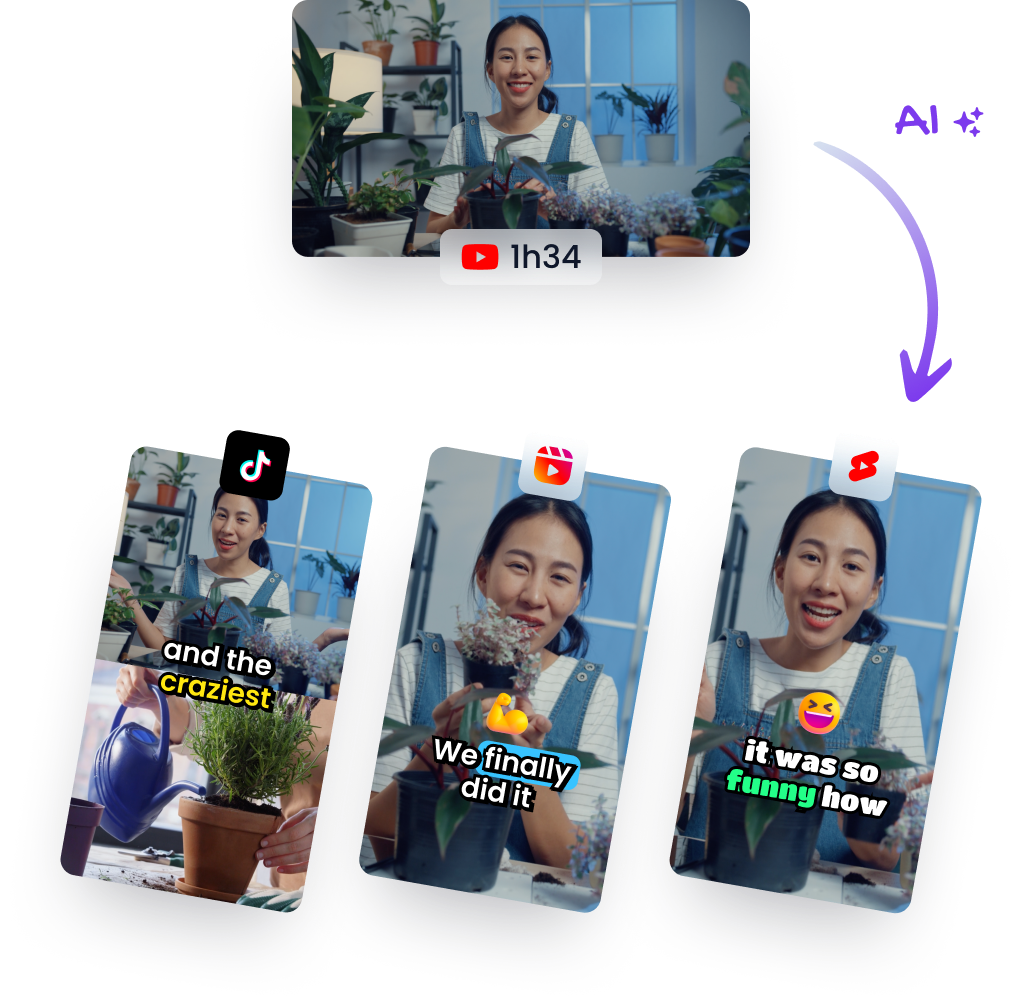
It all starts with getting your content into the system. Most modern AI clipping tools, like Klap, let you either upload a video file straight from your computer or just drop in a YouTube link. They’ve made this part as simple as possible so you can get to the good stuff quickly.
Sourcing and Analyzing Your Video
Once your video is uploaded, the AI gets to work. This is the magic part where the platform scans every single second of your footage. It’s hunting for those multimodal signals we covered earlier—spikes in visual energy, emotional shifts in someone's voice, and powerful, quotable phrases—to pinpoint the moments with the most potential.
For a typical hour-long podcast, you’re looking at just a few minutes of analysis. When it’s done, you get a dashboard full of suggested highlights. Each one comes with a pre-generated title and a full transcript. This isn't your final product; it's your raw material, a curated list of moments the AI thinks could go viral.

Reviewing and Refining the AI Suggestions
Now it's your turn. The AI is designed to get you 80-90% of the way there, but that last bit of human polish is what makes the clips truly shine. The goal here isn't to start from scratch. It’s about making quick, strategic refinements to what the AI has already built.
You can fly through the suggested clips, giving each one a quick watch to see if it has the right vibe. Most of the time, the AI nails it. But you'll probably want to make a few small tweaks:
- Trim the Ends: A clip can often feel punchier if you shave off a half-second from the start or finish. Good tools let you do this with simple drag-and-drop handles—no complicated timeline needed.
- Perfect the Captions: AI captions are shockingly accurate these days, but it’s always smart to give them a quick proofread. Fix any weirdly spelled names or industry jargon, and maybe rewrite a line or two to better match your brand's voice.
- Check the Reframing: AI speaker detection is a lifesaver, automatically keeping the person talking in the center of the frame. Just give it a once-over to make sure the focus is exactly where you want it.
This whole review process is built for speed. You’re not getting lost in a traditional editing suite; you’re making fast, high-impact decisions. For longer videos, using a dedicated long-to-short video converter is a game-changer, as these tools are specifically built for this kind of efficient workflow.
Preparing for Export and Maximum Virality
The final stretch is all about prepping your clips for the platforms where they’ll live. This is more than just hitting "download." It's about optimizing each clip to grab as much attention as possible.
Before you export, lock in the right aspect ratio—that’s almost always 9:16 for TikTok, Reels, and Shorts.
This simple workflow is the engine behind the massive growth we're seeing in video AI tools. The global market, valued at USD 131 million, is projected to hit a staggering USD 1,166 million by 2032. It's the cloud-based solutions, which make up 62% of this market, that put this powerful workflow directly into the hands of creators like us.
You’ll also want to apply your branding elements, like custom fonts and color palettes, to make sure every clip feels uniquely yours. Once you're happy with how everything looks, you’re ready to export.
What used to be a full day of tedious manual editing can now be wrapped up in less than an hour. The result? A consistent stream of high-quality content ready to fuel all your social channels.
How to Know If Your AI-Generated Content Is Actually Working
So, you've used an AI to slice up your long-form video into a bunch of shareable clips. You hit publish. Job done, right? Not even close.
Honestly, the most important work is just getting started. This is where you graduate from chasing likes and views and start digging into what actually connects with your audience.
The whole point is to stop guessing and start making decisions backed by real data. When you analyze how your short-form clips perform, you create an incredibly powerful feedback loop. This data won't just tell you what your next TikTok should be; it will guide your entire content strategy, right back to your next full-length video.
Metrics That Actually Tell You Something
Let’s be real: vanity metrics like view count can fool you. You need to focus on the KPIs that expose true audience engagement and retention. These are the numbers that prove whether your AI-selected highlights are genuinely hitting the mark.
Here’s what you should be tracking:
- Watch-Through Rate (WTR): This is the gold standard. It's the percentage of people who watch your entire video. If you're getting a high WTR on a 30-second clip, that’s a massive signal that the AI nailed it and found a truly compelling, self-contained moment.
- Engagement Density: Don't just look at the total likes and comments; look at when they happen. Did a specific line or visual in your clip trigger a flood of comments? This metric helps you pinpoint the exact hooks that grab people.
- Shares and Saves: These are worth far more than a simple like. When someone shares or saves your clip, they're signaling to the platform's algorithm that your content is valuable. That’s what gets you more reach.
Think of your short clips as tiny experiments. Each one is a test run for topics, formats, and emotional tones. The data you get back is pure gold for refining what you create next.
Creating a Data-Driven Feedback Loop
This is where the magic happens and your strategy comes full circle. The performance data from your shorts should directly influence your next long-form video.
If you notice that clips about a specific sub-topic consistently crush it with high watch-through rates and shares, that's your audience screaming at you to make a full-length video on that exact topic. A podcaster might see that clips with a certain guest always go viral, which is a clear sign to book them for a follow-up interview.
This approach transforms content creation from a shot in the dark into a calculated system for growth. The insights you gather from your AI-generated shorts literally become the blueprint for your next big video.
This strategic workflow is fueling a massive shift in how content gets made. AI video generators are quickly becoming non-negotiable, with the global market projected to hit USD 2.34 billion by 2030. This growth is a direct response to the demand for tools like Klap that automate turning long videos into viral-ready shorts, especially as platforms like YouTube Shorts now pull in 70 billion daily views. By analyzing performance, you're not just making content; you're tapping into this trend with intelligence. You can read more about the AI video generator market growth here.
Got Questions About AI Highlight Finders? We Have Answers.
Jumping into any new tech always brings up a few questions. It’s smart to get them out of the way before you commit your time and, more importantly, your content. So let's run through the big ones people usually have about using AI to find the best parts of their videos.
Just How Accurate Is This Thing?
This is usually the first question on everyone's mind. Can an AI really spot a genuinely great moment?
Honestly, it’s remarkably good, but it isn’t a mind reader. Most modern AI highlight finders can hit 80-90% accuracy right out of the box, flagging moments with clear engagement signals like emotional peaks, sharp insights, or audience reactions.
The final 10-20% is where you come in. Think of the AI as your super-fast assistant editor. It does the heavy lifting, sifting through hours of footage to hand you a shortlist of potential winners. You're still the director who makes the final call on what truly fits your brand and message.
But Can AI Understand My Niche?
This one’s crucial, especially if you’ve built a community around inside jokes and specific topics. Will an AI get the running gag that only your subscribers understand?
Right now, no. Most AI models are trained on massive, general datasets to spot universal patterns—laughter, energetic speech, key questions. They don't have personal context for your channel's unique history or your audience's in-jokes.
The workaround is pretty straightforward, though. You let the AI flag moments with high energy, and then you apply your expert knowledge during the review. If the AI flags a clip with a huge spike in laughter, you’ll know instantly if it's because of that hilarious inside joke your audience loves. It's a true partnership: automation handles the grunt work, and you provide the irreplaceable context.
The goal isn’t to replace your creative intuition but to amplify it. AI finds the potential hot spots, and you apply the context that makes the content resonate deeply with your audience.
Seriously, How Much Time Will I Save?
Okay, let's get down to the real value. The exact time savings will vary based on your video's length and how packed it is with good stuff, but a typical scenario makes it crystal clear.
Imagine you have a 60-minute podcast. Manually scrubbing through it to find and cut five solid clips can easily chew up two or three hours of your day.
Now, let's look at the AI-assisted version. The initial analysis takes just a few minutes. From there, reviewing the AI’s suggestions and polishing up those same five clips might take you 20-30 minutes.
Let's put those numbers side-by-side:
- Manual Workflow: Around 3 hours
- AI-Assisted Workflow: Around 30 minutes
That's a 6x increase in efficiency. If you’re putting out long-form content every week, that adds up to saving an entire workday each month. That reclaimed time is the core benefit—it’s more time you can spend creating, engaging with your community, and actually growing your channel.
Ready to stop wasting time and start creating more content? Klap uses AI to turn your long-form videos into viral-ready short clips in minutes. Try Klap for free and see how it works.