A Practical Guide on How to Go Viral in 2026
Other
Going viral isn't about luck anymore. It's a science. The formula is surprisingly straightforward: combine a scroll-stopping hook with content that hits an emotional chord, package it for short-form video, and distribute it effectively.
The New Rules for Going Viral on Social Media
The idea of "going viral" used to feel like catching lightning in a bottle—a total shot in the dark. But the game has completely changed. Today, getting your content seen by millions isn't about chance; it's about mastering a specific playbook, especially in the world of short-form video.
Forget huge budgets and fancy production. The new currency is authenticity, speed, and your ability to deliver value almost instantly.
This whole shift is powered by one simple truth: people's attention is the most valuable resource online, and the algorithms are built to reward whatever captures and holds it. The modern blueprint for going viral is built on a few key pillars:
- Emotional Connection: Content that makes people feel something—joy, surprise, curiosity, or even just seen—is content they can't help but share.
- Irresistible Hooks: You have less than three seconds. A powerful opening isn't just important; it's everything. If you don't grab them immediately, they're gone.
- Smart Repurposing: The top creators aren't starting from scratch every single day. They're masters at turning one long-form video into a dozen viral-ready clips.
Why Short-Form Video Is the King of Virality
Short-form video has completely taken over as the engine of virality on social media, changing how creators get massive reach. In fact, video content now makes up over 60% of all time users spend on platforms like Instagram, and Reels alone account for 50% of the time spent on the app.
The numbers don't lie. TikTok still leads with a base organic engagement rate of 2.5% per post, but that number skyrockets to an actionable 7.5% for accounts with under 100k followers. Meanwhile, YouTube Shorts isn't far behind, with an impressive average engagement rate of 5.91%. It’s clear: bite-sized clips deliver explosive results.
Short-Form Video Platform Engagement Rates (2026 Data)
This table breaks down the organic engagement rates across the major short-form video platforms. Use this data to decide where your content has the best odds of taking off organically.
PlatformAverage Organic Engagement RateKey Audience Characteristic
TikTok
9.3%
Gen Z-dominant, trend-driven, high virality potential
Instagram Reels
7.8%
Millennial-heavy, visually polished, strong e-commerce integration
YouTube Shorts
6.1%
Broad demographics, educational and evergreen content performs well
These figures show that platforms built from the ground up for short, snappy video are where you'll find the most organic discovery and the clearest path to going viral.

This just hammers home the point: if you want to go viral, short-form video isn't just an option—it's the main event.
The secret to going viral isn’t really about reaching everyone. It's about deeply connecting with the right people. Niche virality—where your content explodes within a specific community—often drives more powerful results like leads and sales than a broad, flash-in-the-pan moment.
To keep up with the latest tactics and get deeper insights into making your content pop, we always recommend checking out resources like the vidcloner's blog. Staying on top of trends is how you keep your strategy sharp and your content ahead of the curve. This guide will give you the playbook to do just that.
Crafting a Hook That Stops the Scroll
You’ve got less than three seconds to stop someone from swiping past your video. That’s it. In the world of short-form video, your hook isn't just important—it's everything. If the first few seconds don't land, the rest of your masterpiece might as well not exist.
The secret to going viral is creating an immediate sense of curiosity or an emotional spark. You need to open an information gap that the viewer feels compelled to close. Content that triggers strong feelings—surprise, validation, or even a little bit of shock—is what gets watched and shared. Your job is to hit that nerve right away.
The Power of Proven Hook Formulas
Forget starting with, "Hey guys, in this video..." It's a guaranteed way to kill your watch time. You need to drop the viewer directly into the action, the conflict, or the most valuable piece of information.
Here are a few actionable hook formulas that work like a charm:
- The Contrarian Take: Go against a popular belief in your niche. A fitness coach might start with, "Stretching before a workout is a waste of time. In fact, it might be killing your gains." This challenges what people think they know and makes them stop and listen.
- The Problem-Agitation Hook: Hit a nerve by calling out a specific pain point. Imagine a marketing expert opening with, "You're burning cash on ads that don't convert. Here's the one mistake you're making." It connects with a real struggle and offers an immediate solution.
- The Transformation Promise: Show the end result first. A food creator could show a perfect, gooey brownie with the text, "The fudgiest brownie you'll ever make, and it only takes 3 ingredients." People see the delicious outcome and instantly want the recipe.
The best hooks create an "information gap." By posing a question, making a shocking statement, or teasing a secret, you make the viewer’s brain crave the answer. They have to keep watching to close that loop.
It's not about politely asking for attention. It's about earning it by promising instant value and making it impossible for them to scroll away.
Deconstructing Real Viral Hooks
Let’s look at why some hooks are just magnetic. It’s always a mix of smart visuals and a killer opening line.
Take the classic "story time" format. These videos often start with the creator looking right into the camera and saying something like, "I'm never going to a public pool again, and here's why." The direct eye contact feels personal, and the statement is a total mystery. You can't help but wonder, "Okay, what on earth happened at the pool?"
Another great example is the "unboxing" video. A creator holds up a mysterious package with text that reads, "I waited six months for this." The visual curiosity combined with the implied high stakes makes it incredibly hard to swipe past without seeing what's inside.
Find Your Hook Moments
The good news? You don't have to invent these hooks from thin air. If you already create long-form content like podcasts or YouTube videos, you're probably sitting on a goldmine of viral moments. You just need to know how to spot them.
Listen for moments where you:
- Make a bold or controversial statement.
- Ask a rhetorical question that gets the audience thinking.
- Start telling a really compelling story or case study.
- Share a surprising statistic or fact.
These are your golden nuggets. For example, a 30-minute podcast might have a 15-second soundbite where your guest says, "The single biggest mistake most startups make is hiring too quickly." That one sentence is a perfect, ready-made hook for a short clip. It's direct, challenges a common practice, and speaks directly to a specific audience's fears. Learning to spot these moments is the key to repurposing content that actually performs.
Editing Techniques That Boost Watch Time
A great hook gets them in the door, but it's your editing that convinces them to stay. Once you’ve earned that initial three-second window, your next job is to hold their attention for as long as possible. This is where your editing choices become your secret weapon, telling the algorithms that your content is worth watching.
Every single cut, zoom, or sound effect needs to serve one purpose: keeping their eyes on the screen. In the blink-and-you'll-miss-it world of short-form video, even a few seconds of a static shot can send a viewer swiping.

Use Pattern Interrupts to Reset Attention
The human brain is hardwired to notice change. A pattern interrupt is any small, sudden tweak you make in the video to break a repetitive visual or sound. These tiny jolts work by constantly resetting a viewer's attention span, stopping them from zoning out.
Think of it this way: a static shot of you talking is predictable. The viewer’s brain adapts and starts to wander. But if you introduce small, frequent changes, you keep their focus sharp and engaged.
Some of the most effective pattern interrupts are simple:
- Quick Zooms: A slight punch-in on your face when you land a key point.
- Fast Cuts: Cutting to a different angle or B-roll for just a second or two.
- Sound Effects: Adding a simple "swoosh," "pop," or "ding" to emphasize an action or a word.
- On-Screen Text: Flashing keywords on the screen that sync up with what you're saying.
The goal isn't to be jarring. It's to create a dynamic experience that feels alive. A good rule of thumb is to introduce some kind of change every 2-3 seconds. For more tips, check out our guide on the best TikTok editing apps that make these effects a breeze to apply.
Make Your Captions a Visual Anchor
Dynamic captions are easily one of the most powerful tools you have for boosting watch time. They do a lot more than just make your video accessible for silent viewers—they become a visual anchor, guiding the viewer's eyes and reinforcing your message.
When captions are engaging and animated, they become part of the content itself. This can significantly increase watch time because viewers are not just listening; they are also reading along, which deepens their engagement.
Forget plain, static subtitles. You want captions that highlight words as you say them, change color, or pop onto the screen with a subtle animation. This technique keeps the viewer locked in, making your content feel far more polished and professional.
This is more important than ever. Instagram now reports that Reels account for 50% of all time spent on the platform. YouTube has reached 2.53 billion monthly ad users, thanks in large part to Shorts' 5.91% engagement rate. And on TikTok, engagement is growing 49% year-over-year. Getting your editing right is non-negotiable, and tools like Klap help you nail it by identifying the best hooks and adding dynamic captions that skyrocket watch time.
Create a Seamless Narrative Flow
Beyond quick cuts and flashy text, the underlying structure of your edit is what separates the pros from the amateurs. Professional editors use techniques like J-cuts and L-cuts to create a smoother, more cinematic flow.
- J-Cut: The audio from the next clip starts playing before the video cuts to it. This builds anticipation and pulls the viewer into the next scene. For instance, you might hear a car honking just before you cut to a street scene.
- L-Cut: The audio from the previous clip continues playing after the video has already cut to the next shot. This is perfect for showing someone's reaction to what was just said or for maintaining a continuous audio experience.
These techniques are subtle, but they make your videos feel less choppy and more like a cohesive story. By mastering these editing principles, you turn a simple clip into a compelling piece of content that viewers will actually finish, dramatically increasing your odds of going viral.
Using Trends and Distribution to Your Advantage
Making a killer video is only half the job. If no one sees it, it can't go viral. The difference between content that pops off and content that fades into obscurity is a smart distribution plan. It’s all about getting your video in front of the right eyeballs, on the right platform, at the perfect time.

But here’s where a lot of creators stumble: they chase the wrong things. You have to know the difference between a fleeting trend and a durable format. Understanding which one to use—and when—is how you make the algorithm work for you, not against you.
Trends vs. Formats: The Key to Sustainable Growth
Not all popular video styles are built the same. If you want a long-term strategy for going viral, you absolutely must distinguish between temporary trends and evergreen formats.
- Fleeting Trends: Think of these as quick hits. A specific dance, a soundbite from a new TV show, or a viral challenge. They explode in popularity and then die out, sometimes in just a few days. Jumping on one can give you a quick visibility boost, but they offer zero long-term value.
- Durable Formats: These are the repeatable video structures that stay relevant. You see them all the time: "A Day in the Life," "Get Ready With Me," "My Top 3 Mistakes," or "Unboxing" videos. These are essentially templates you can adapt to your own niche over and over, delivering consistent value.
Hopping on a hot trend can feel like a shortcut, but it's a huge gamble. Some creators try to get ahead by diving deep into data from platforms like Google Trends to spot what's next. Power users even explore methods like Scraping Google Trends to automate that process.
But be warned: trend-chasing can backfire. Research shows 33% of consumers find it embarrassing when brands try to hop on trends, while only 40% think it's cool. For YouTubers and podcasters, a much safer bet is to mine your own content for authentic, emotional hooks. Virality today isn't about mass appeal; it’s about niche-scale influence where you build trust within a dedicated community.
Finding and Adapting Trends Authentically
Okay, so you’ve decided to jump on a trend. The only way to do it right is with authenticity. Don't just mimic what everyone else is doing. Ask yourself, "How can I twist this to make it genuinely relevant to my audience?"
Here's a real-world example: say there's a trending audio of someone having a funny cooking fail. A personal finance expert could use that sound but show a chart of a stock dropping, with the caption, "When you thought you bought the dip, but the dip keeps dipping." It connects the trend to their niche in a clever, relatable way.
Use the platforms themselves to see what's hot:
- TikTok: Your "For You" page is your crystal ball. Look for recurring sounds, effects, and video structures. The "Add sound" button in the editor will also show you a list of what's currently trending.
- Instagram Reels: Head to the Reels tab and look for the little arrow icon next to a song's name. That arrow is Instagram's signal that the audio is trending.
- YouTube Shorts: The Shorts feed will quickly clue you into what's popular. You can also tap the "Remix" button on any Short to instantly use its audio in your own video.
The goal isn't just to use a trending sound; it's to join a cultural conversation. Your unique take on the trend is what makes people stop scrolling and hit that share button.
Your Multi-Platform Posting Cadence
To give your content the best shot at taking off, you need a smart posting schedule. Different platforms have different peak times based on when their users are most active. While this can vary by niche, here’s a solid starting point for your posting strategy.
PlatformOptimal Posting Times (Local Time)Key Considerations
TikTok
6-10 AM, 7-11 PM
The algorithm loves consistency. Aim for 1-3 posts per day to stay relevant.
Instagram Reels
9 AM, 12 PM, 3 PM
Engagement spikes around lunch breaks and commutes. Post 4-7 times per week.
YouTube Shorts
12-4 PM, 6-9 PM
Viewing times often peak later in the afternoon and on weekends.
Finally, don’t sleep on your descriptions and hashtags. Forget stuffing your caption with 30 generic tags like #fyp. That just doesn't work anymore.
Instead, focus on a tight mix of 3-5 highly relevant tags. Pick tags that accurately describe your content, your niche, and maybe one broader trending topic. This gives the algorithm clear signals on exactly who to show your video to. You can learn more about these platform differences by diving into TikTok vs YouTube Shorts.
Your Smart Repurposing Workflow
If you want to go viral, the secret isn't working harder—it's working smarter. Stop trying to create every single piece of content from scratch. Your existing long-form content, like YouTube videos, podcast episodes, and webinars, is a goldmine of viral potential just waiting to be tapped.
This is where a smart repurposing workflow changes everything. Instead of burning out on the content treadmill, you can use a system to turn one piece of long-form content into a dozen or more high-quality, platform-optimized short clips. It’s a strategy that dramatically increases your output and your chances of a video taking off, all while saving you hours of tedious work.
Automate the Heavy Lifting with AI
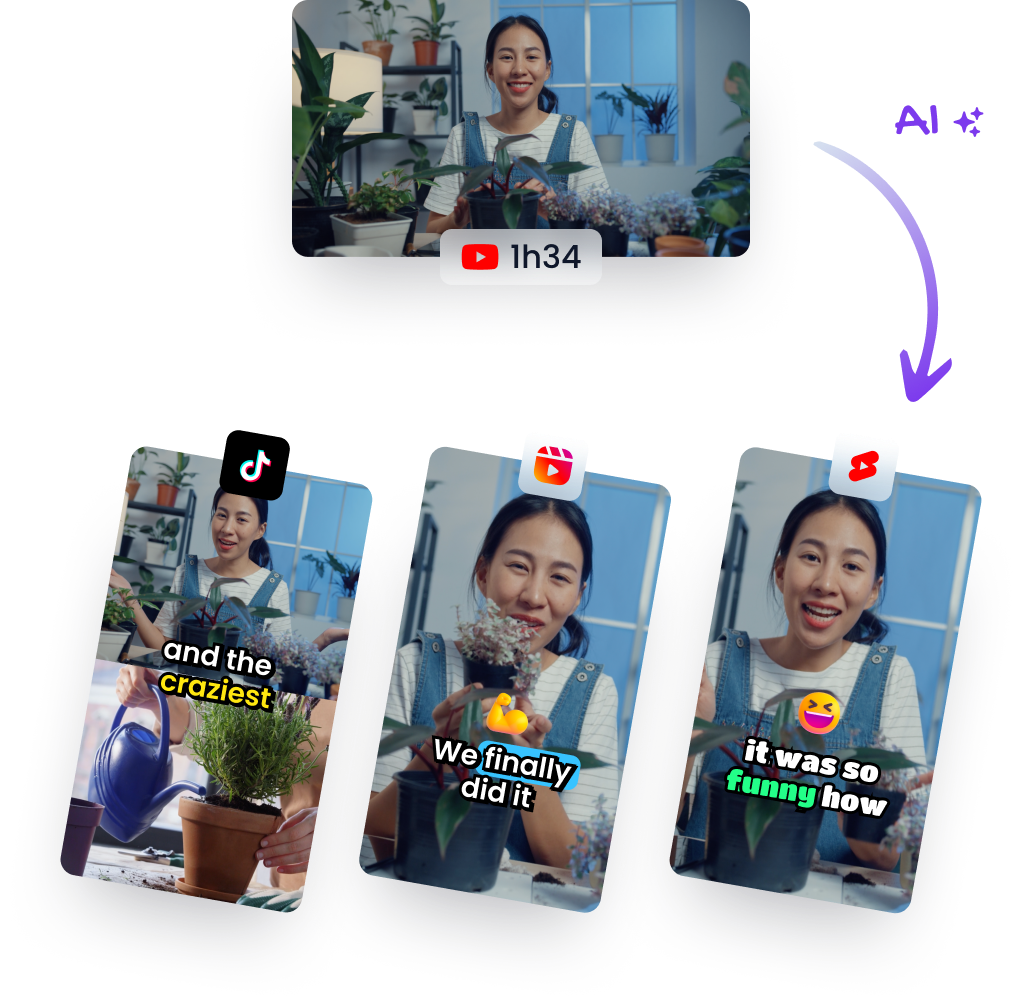
Let’s be honest, the most time-consuming part of repurposing is manually scrubbing through hours of footage to find those "hook moments." It's a slow, draining process that absolutely kills creativity. But today, AI-powered tools like Klap are built to do this heavy lifting for you, completely changing the game for creators.
The idea is simple but incredibly effective. You upload your long-form video, and the AI gets to work. It analyzes the entire transcript, identifies the most engaging and hook-worthy segments, and automatically generates ready-to-post short clips. This is how you scale your content production without scaling your workload.
Below is a look at how a tool like Klap transforms a single video into a collection of viral-ready shorts, automating the most difficult parts of the process.
This interface shows the real power of AI in content creation. The AI has not only identified multiple potential clips but has also assigned a "virality score" to each one, helping you prioritize which clips to focus on first.
A Simple Workflow for Maximum Output
Adopting an AI-driven workflow is more straightforward than you might think. By following a few simple steps, you can build a sustainable content engine that fuels your social media growth.
- Upload Your Core Content: Start by uploading your video file or just pasting a YouTube link. The system will pull in your video and its transcript to begin the analysis.
- Let the AI Find the Gold: The AI scans the video, looking for the most compelling hooks, questions, and powerful statements. It understands conversational nuances and pinpoints the parts of your video most likely to resonate with a short-form audience.
- Review and Refine Your Clips: Within minutes, you'll get a selection of auto-generated vertical clips. Each one comes complete with dynamic captions, smart reframing that keeps the speaker in focus, and a title. Your job is to simply review them, make any minor tweaks to the start or end points, or adjust a caption.
The goal isn't to create dozens of perfect clips from the start. It's to generate a high volume of good clips quickly, then use data to see what works. A single one-hour podcast can easily become 10-15 high-quality shorts—that's two weeks of content from one recording session.
This system removes the creative guesswork and the technical hurdles. You no longer need to be a professional video editor to produce a steady stream of engaging shorts. For a deeper dive into this process, our guide on how to create YouTube Shorts from existing video provides more specific tips.
By embracing this workflow, you shift your role from a manual editor to a content strategist. You spend less time in the weeds and more time focusing on the bigger picture—analyzing what performs best and creating more of what your audience loves. This is the most efficient and sustainable path to increasing your odds of going viral.
How to Analyze Data and Replicate Success
A viral video isn't just a lucky break; it’s a goldmine of data telling you exactly what your audience craves. If you want to go viral more than once, you have to stop chasing views and start digging into your analytics. This is how you build a repeatable system for creating hits.
Think of your analytics dashboard as a roadmap. It shows you what worked, what flopped, and where you can make your next video even better. Stop guessing and start making data-informed decisions that actually move the needle.
Look Beyond the Views
Views feel good, but they don't tell the whole story. The real insights are in the metrics that measure what people do after they click. These are the signals that tell the algorithm your content is worth pushing to a bigger audience, not just getting quick, empty clicks.
To really understand your performance, focus on these key metrics:
- Average Watch Time: This is a huge one. It shows, on average, how long people stick around. A high average watch time on platforms like TikTok or YouTube is a massive signal to the algorithm that your content is valuable and should be shown to more people.
- Audience Retention: This graph is your most honest feedback. It shows the exact percentage of viewers still watching at every single second of your video. Any sharp drop is a red flag showing you precisely where you lost their attention.
- Shares and Saves: These are high-intent actions. When someone shares your video, they're putting their own reputation on the line to recommend it. A save means your content is so good they want to come back to it later. These are powerful endorsements.
Deconstruct Your Audience Retention Graph
Your retention graph is the most important diagnostic tool you have. See a steep nosedive in the first 3-5 seconds? Your hook failed. It’s that simple. If there's a slow, gradual decline or a noticeable dip in the middle, you know that section was dragging or wasn't clear enough.
Your retention graph is like a video replay of your audience's attention span. A flat, high line means you’ve captivated them. A steep, downward slope is a clear sign they got bored and swiped away.
Use this data to create a feedback loop. If the hook was weak, you know to rework your first few seconds. If the middle sagged, you need to focus on tighter editing or add more pattern interrupts in your next video. Analyzing exactly where viewers bail tells you what to fix.
This turns a one-time hit into a reliable strategy—and that’s the secret to going viral consistently. Every video becomes a lesson that makes the next one stronger.

Common Questions About Going Viral
The idea of "going viral" brings up a lot of questions. Everyone wants the secret formula, but it often comes down to a few core principles. Let's get straight into the most common questions creators ask on their journey to viral success.
How Much Content Do I Need to Post?
There’s no magic number, but there is a magic rhythm: consistency. For platforms like TikTok and YouTube Shorts, aiming for 1-3 high-quality clips a day is a solid strategy to get the algorithm's attention. It rewards creators who show up consistently with valuable content.
But don't confuse consistency with just posting for the sake of it. Every single clip needs a purpose and a strong hook. It's always better to post one fantastic video than three that are just okay.
What If My First Videos Don't Go Viral?
First off, welcome to the club. Almost nobody strikes gold on their first, second, or even tenth try. The trick is to stop seeing your early videos as failures and start treating them as data.
Dive into your analytics and start asking the right questions:
- Did my hook actually work in the first three seconds?
- At what exact point did people swipe away?
- Which video, even with low views, got the most shares or saves? That's a sign of a passionate micro-audience.
Viral success isn't a single lottery ticket win; it's the result of countless small, informed tweaks. Think of your first ten videos as your training ground. They’re teaching you exactly what your audience wants, setting the stage for that video that finally takes off.
Will One Viral Video Change Everything?
A single viral hit is a massive opportunity. It can flood your account with new followers and get your brand in front of thousands, or even millions, of new people. But it's not the finish line.
Sustained growth comes from figuring out why that video went viral and immediately leaning into it. Was it the format? The topic? The way you edited it? Analyze what worked and create more content that captures that same magic.
One viral moment gives you attention. The real work is turning that attention into a loyal community that shows up for whatever you post next.
Ready to turn your best content into a stream of viral-ready clips without the burnout? Klap uses AI to find the most engaging moments in your videos and automatically creates polished, shareable shorts. Start repurposing smarter and increase your chances of going viral today.