Search by Video: A Creator's Guide to Finding Gold
Other
You probably already have the raw material.
A podcast episode with three sharp opinions. A webinar with two clean product explanations. A customer interview with one line that would make a perfect ad. The problem isn't making more video. The problem is finding the exact moment worth reusing before your team gives up and records something new.
That's where search by video stops being a novelty and starts becoming a powerful asset. Used well, it turns a bloated archive into a working content library. Instead of scrubbing through timelines, you query your footage the way you'd query documents. Instead of hunting manually for hooks, you pull moments on demand.
The Hidden Gold in Your Video Library
Most creators don't suffer from a content shortage. They suffer from content retrieval failure.
A long-form channel can rack up years of useful material. Sales demos, livestreams, interviews, workshops, Q and As, founder videos. Buried inside that pile are dozens of clips that could become Shorts, Reels, landing page assets, sales follow-ups, or proof points for ads. But if finding them takes half a day, they may as well not exist.
That's why discoverability matters twice. First, for public visibility in search. Second, for your internal ability to mine what you already made.
Video has a real advantage in search performance. One industry compilation reports that video search results have a 41% higher click-through rate and that pages with video are 53 times more likely to reach Google's first page according to Linearity's roundup of video marketing statistics. For creators and marketers, that changes the math. Better discoverability doesn't just help distribution. It increases the payoff of every good clip you can extract from long-form content.
Practical rule: A video archive becomes an asset only when you can search it faster than you can reshoot it.
A lot of teams still treat old footage like cold storage. They keep it, but they don't use it. That's usually because the retrieval layer is weak. Search by video fixes that by making moments addressable. A topic mention, a quote, a visual demonstration, a slide headline, a product objection. All of it becomes easier to surface and reuse.
If your current workflow is “open Premiere, drag the playhead around, hope something jumps out,” you're not editing. You're excavating. A dedicated video finder workflow for clip discovery is a much better starting point when your goal is growth, not just organization.
What Search by Video Really Means for Creators
Often, 'search by video' brings to mind a single concept. Upload a frame, run reverse search, and try to find where the clip came from.
That's valid, but it's only one branch of the category.
For creators, there are really two different jobs hiding under the same phrase. One is source-finding. The other is moment-finding.

Public search finds the video
Public reverse video search is mostly about tracing origin. You have a screenshot, a thumbnail, or a reposted clip and want to identify the source. That helps with verification, rights checks, and content research.
The catch is that this method is more fragile than many guides admit. Independent explainers note that current search engines usually don't scan whole video files directly. They lean on reverse image search, thumbnails, keyframes, and visual matches instead, as discussed in this reverse video search explainer from Opus. If the clip has been cropped, compressed, watermarked, or heavily edited for social, results often get worse.
That's why source-finding feels inconsistent in practice. The system isn't really understanding the whole clip. It's trying to match visual clues.
Internal search finds the usable moment
Internal semantic search is the more important capability for most creators. It answers questions like:
- Which clip explains our pricing clearly
- Where did the guest tell the strongest personal story
- Which webinar section mentions integrations
- What's the cleanest 15-second answer to a common objection
Imagine a library. Reverse search helps you find the right book. Internal search helps you find the line on page 87 worth highlighting in your newsletter.
That distinction matters because modern content teams don't just need to identify videos. They need to mine them. If you work with recurring formats like podcasts, demos, coaching calls, and educational videos, the bottleneck usually isn't production volume. It's retrieval.
For a good conceptual frame, this guide to information retrieval for creators is useful because it explains the broader logic behind how searchable systems move from simple matching to meaning. That's the shift creators care about. Not “can I find this file,” but “can I find the exact moment that deserves distribution.”
Searching your own video library should feel less like scrubbing a timeline and more like searching inside a transcript, a slide deck, and a shot list at the same time.
How AI Makes Your Videos Searchable
The tech sounds mysterious until you break it into jobs. Search by video usually works because several systems index different parts of the same footage, then combine the results.
The simplest way to think about it is this. One system listens, one watches, one reads, and one interprets.

Automatic Speech Recognition hears the words
Automatic Speech Recognition, or ASR, turns spoken audio into text. If your founder says “Our churn dropped after onboarding changes,” ASR gives the system searchable text tied to timestamps.
This is the backbone for dialogue-heavy content like podcasts, interviews, webinars, and tutorials. It's also why clean audio matters more than many video teams think. A bad camera can be survivable. Muddy audio damages searchability.
If you're building a recording stack from scratch, this roundup of tools for remote podcasting workflows is helpful because input quality affects everything that happens later, including transcripts and clip extraction.
Visual recognition watches the frames
Speech is only part of the story. Many useful moments aren't spoken clearly at all. They're shown.
Visual systems look for objects, scenes, people, and frame-level cues. A search might surface the section where someone is holding a product, where a whiteboard appears, or where a particular scene change happens. This is what makes video different from plain transcript search.
A transcript might miss “demo starts here.” The visuals won't.
OCR reads what appears on screen
Optical Character Recognition, or OCR, extracts text visible in the video itself. Slide titles, lower thirds, charts, UI labels, captions, and whiteboard notes all become indexable.
That matters a lot for education, B2B marketing, and product content. In many webinars, the best summary of a segment sits on the slide, not in the spoken sentence. Search that ignores on-screen text misses a huge share of useful material.
Panopto describes this as a library-wide retrieval problem solved by combining ASR and OCR so users can search across spoken audio and on-screen text in the same library, which you can see on Panopto's video search page.
Semantic understanding connects the signals
This is the layer people usually mean when they say “AI.” It doesn't just index words and frames. It tries to understand context.
A semantic system can connect a query like “best onboarding advice” to a clip where nobody uses those exact words but the speaker talks about reducing confusion for new users. That's what makes internal video search so useful for repurposing. It can surface moments by topic, intent, and relevance, not just exact phrasing.
Here's the operational takeaway:
Search signalWhat it catches bestWhat it misses alone
ASR
Spoken explanations, interviews, Q and As
Silent demos, slide text
Visual analysis
Objects, scenes, actions
Nuanced spoken meaning
OCR
Slide titles, labels, on-screen copy
Unwritten commentary
Semantic layer
Related concepts and intent
Can still need human review
If you want the simplest version of this stack for everyday use, start with strong transcripts. A clean video to text workflow gives you the base layer that many clip-finding systems build on.
From Search to Social Four Powerful Use Cases
Once a library is searchable, video production starts behaving more like editorial ops. You stop asking “what should we film this week?” and start asking “what do we already have that deserves a new format?”
That shift saves time, but its impact on quality is even greater. You're choosing from proven material instead of forcing fresh output on a deadline.

Repurpose long-form content without manual scrubbing
Google's help documentation around video search features reflects a bigger shift toward finding specific moments, not just whole videos. That matters because the business value of video search is moving toward semantic search for specific moments, especially when creators need the best 15-second clip from hours of footage without manual scrubbing, as reflected in Google's video search guidance.
That's the daily use case for podcasters, educators, agencies, and in-house teams. Search “strong contrarian take on pricing” across your backlog and pull every promising segment into a shortlist. Instead of reviewing two hours linearly, you review five candidate clips.
Pull testimonial gold from customer content
Customer interviews are packed with reusable proof, but they're painful to mine manually.
Search lets you look for phrases and themes like:
- Before and after statements that show transformation
- Language of relief that reveals the emotional payoff
- Unexpected use cases you didn't know customers valued
A transcript search can find the raw quote. A better multimodal system can also surface the exact visual section where the customer is animated, smiling, or showing the product in use. That makes the clip more persuasive on social and on landing pages.
The best testimonial usually isn't the longest answer. It's the shortest believable moment with clear emotion.
Mine UGC and research footage faster
If your brand collects creator submissions, interviews, demo calls, or feedback videos, search becomes a research tool.
You can track repeated objections, identify phrases customers use naturally, and spot visual patterns worth copying in future ads. This is especially helpful for social teams trying to brief editors with actual examples instead of vague instructions like “make it feel more native.”
Build educational content from repeated questions
Creators in education, consulting, SaaS, and coaching often answer the same question dozens of times across webinars and calls.
Search your library for that question, then compare answers. One version might be clearer. Another might be punchier. A third might have the strongest opening hook. Instead of recording from scratch, you can assemble a cleaner content package from moments you've already delivered well.
A simple way to prioritize use cases is this:
Use caseBest forOutput
Clip extraction
Podcasts, webinars, interviews
Shorts and reels
Testimonial mining
Customer marketing
Ads, landing page embeds
UGC review
Social teams, e-commerce brands
Messaging insights
FAQ retrieval
Educators, coaches, SaaS
Explainers and help content
Your Workflow for Finding Viral Moments Fast
The fastest teams don't treat search by video as a one-off trick. They make it part of publishing.
That starts with a simple workflow.

Step 1 Centralize your long-form footage
If your source material is split across YouTube, cloud folders, hard drives, and editor timelines, search will always be messy.
Create one master archive by show, format, or campaign. Keep filenames consistent. Store final exports, not just project files. Good search starts with content that's accessible.
Step 2 Make every asset timestamp-aware
A key historical milestone here was Google's rollout of Key Moments in 2018. Google said Search could surface timestamped links to relevant sections of a video, first in English for YouTube videos when creators provided timestamps in descriptions, as described in Google's Key Moments announcement. For creators, the lesson is simple. A searchable video library works better when moments are tied to clear time references.
That principle now shows up everywhere. Chapters, transcript timestamps, clip markers, comment notes, and editor selects all improve retrieval later.
Step 3 Search like an editor, not a file manager
Weak query:
- pricing
Better queries:
- moment where guest explains why annual plans reduce churn
- funny cold open from the webinar
- clear answer to who this product is not for
Natural language usually beats single keywords when you're trying to find clips worth posting. Search with intent, emotion, audience objection, or format in mind.
Workflow note: Good clip queries often combine topic plus usefulness. “AI editing” finds mentions. “Best explanation of AI editing for beginners” finds assets.
Step 4 Move from timestamp to publishable clip
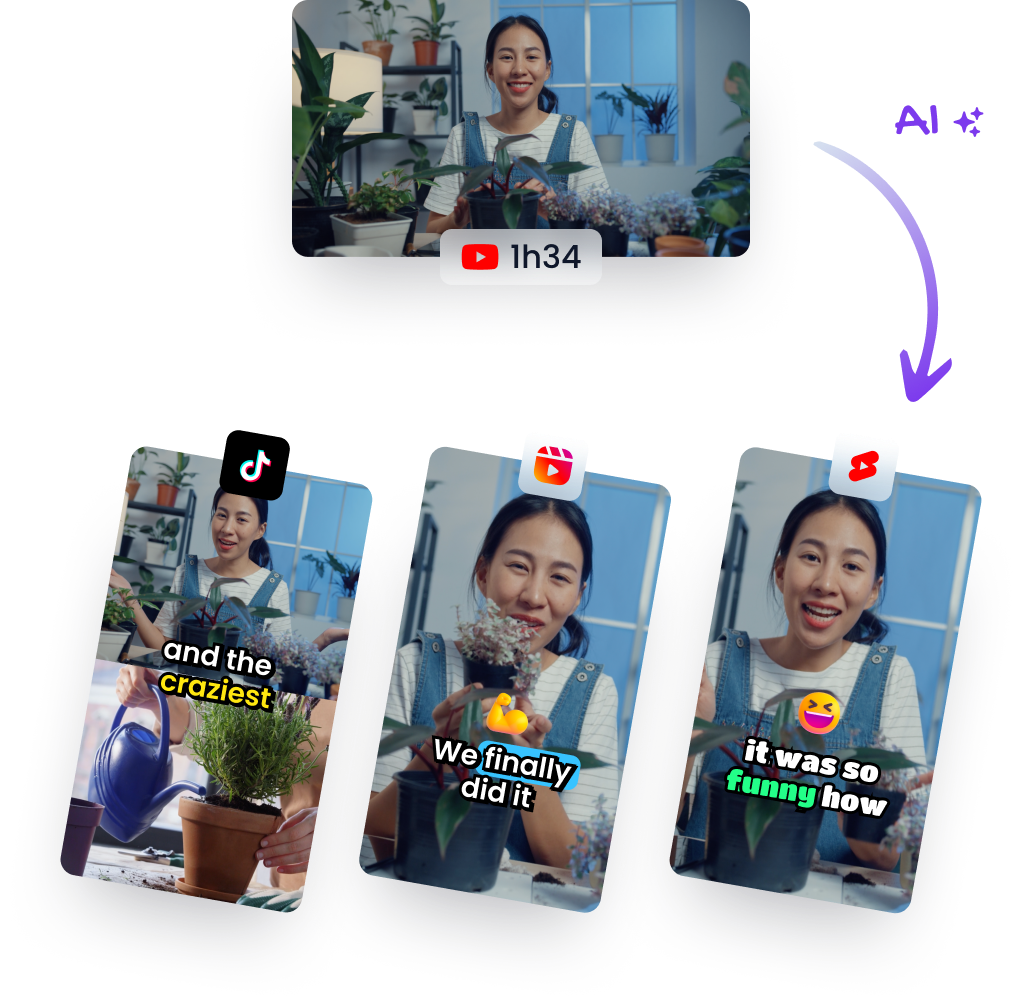
Once you've found the moment, don't drop into a slow manual edit unless you have to. The handoff should be immediate: mark the time range, extract the segment, tighten the in and out points, add captions, and format it for vertical platforms.
Here's a look at what that conversion step can look like in practice:
That's a key payoff of search by video. It doesn't end at retrieval. It shortens the path from buried moment to posted asset.
The Future Accuracy Privacy and What's Next
Search by video is useful now, but it still needs supervision.
ASR can stumble on accents, poor microphones, jargon, and overlapping speakers. Visual systems can misread scenes when footage is dark, fast-moving, or cluttered. Semantic matching can return a relevant-looking segment that still isn't the strongest clip for social. That's why human review still matters, especially for anything customer-facing.
Privacy is the second practical issue. Once a library becomes searchable, more people can pull moments from it quickly. That's productive, but it also means teams need clear rules around access, approval, sensitive recordings, and consent. A searchable archive is powerful. It should also be governed.
The weakest area remains public source-finding from degraded clips. As noted earlier, many systems rely on clear keyframes, and success drops when a video has been cropped, compressed, or edited for social. If your main need is tracing reposted content, it helps to understand the limitations covered in this reverse video search guide for creators.
What improves next is the depth of retrieval. Better multimodal indexing will keep reducing the gap between “I know this moment exists” and “I can find it instantly.” That's a big deal for small teams. Capabilities that once belonged to enterprise media libraries are becoming practical for individual creators, agencies, and lean marketing teams.
The creators who benefit most won't be the ones with the biggest archives. They'll be the ones who can search their footage like a strategist and publish from it like an operator.
If you already have long-form content sitting on YouTube, in webinar archives, or inside podcast folders, Klap helps turn those buried moments into social-ready short clips. Upload a video, let the AI identify strong segments, then review, edit, caption, and export vertical clips without rebuilding everything by hand.