Long Video to Short Video: The 2026 Creator's Guide
Other
You probably have the same backlog most creators do. A podcast episode that took real effort to record. A webinar with strong answers buried in the middle. A YouTube video that did fine long-form, but never got a second life on Shorts, Reels, or TikTok.
The usual advice is simple: cut it into clips. In practice, that's where things break.
Turning a long video to short video isn't an editing task first. It's a selection task. If the moment doesn't stand on its own, no crop, caption preset, or export setting will save it. The creators who get steady results from repurposing aren't just trimming footage. They're choosing moments with built-in tension, rewriting the opening seconds, and shaping each clip for the way people watch on mobile.
Why Most Repurposed Videos Fail
Most repurposed videos fail for one reason. The clip made sense inside the original video, but it doesn't make sense alone.
A strong long-form segment often depends on setup. The audience has already heard the question, seen the context, or spent several minutes with the speaker. When you pull out a random 45-second answer, that support disappears. What's left is usually a clip that starts too slowly, explains itself too late, and asks a cold audience to care before giving them a reason.
That gap shows up in a lot of creator workflows. The problem isn't how to split a file. It's how to choose clips that retain viewers across platforms, because platform guidance points to the first seconds as critical while many creators still rely on generic “best moments” extraction without testing hook, pacing, and context, as noted in CapCut's guide to choosing clips that retain viewers across platforms.
The clip isn't the moment you liked most
The moment you enjoyed while editing isn't always the moment a stranger will stop for.
In long-form, a thoughtful buildup can work. In short-form, the viewer decides almost immediately whether to stay. If your clip begins with “So, to answer that…” or “The interesting thing is…”, you've already lost the advantage. Those are continuation phrases. They signal missing context.
Practical rule: If the clip needs a sentence before it to make sense, it isn't ready yet.
A lot of repurposing advice stays too shallow. It focuses on extraction, not adaptation. If you're still thinking of short clips as leftovers from the main piece, it's worth reviewing what content repurposing actually means in practice. The job isn't to shrink the original. It's to rebuild it for a different viewing environment.
What actually works
Clips tend to survive on their own when they contain at least two of these elements:
- A clear premise: The viewer understands the topic almost immediately.
- A built-in question: The clip creates tension that demands resolution.
- A strong opinion: The speaker takes a stance instead of circling one.
- A visual shift: Something changes on screen early enough to reset attention.
- A self-contained payoff: The ending delivers a takeaway, not just a transition back to the full episode.
What doesn't work is treating the timeline like a highlight reel and exporting whatever sounds smart. A “good quote” is not automatically a good short. Good shorts feel complete, even when they came from something much longer.
Find Viral Moments with AI in Minutes
Manual clipping is where repurposing burns time. You sit with a long timeline, scrub for peaks, second-guess every cut, and end up with one or two clips after a lot of effort. That's hard to sustain if you're publishing consistently.
Creator workflow data points to the efficiency gap clearly. A long-form video can take about 12 hours end-to-end versus about 2 hours for a short clip, which is why the most effective repurposing work involves fast identification of hook segments, vertical reframing, and captioning, according to this creator workflow breakdown on YouTube.

What AI should handle first
AI is most useful at the start of the workflow, when the problem is volume.
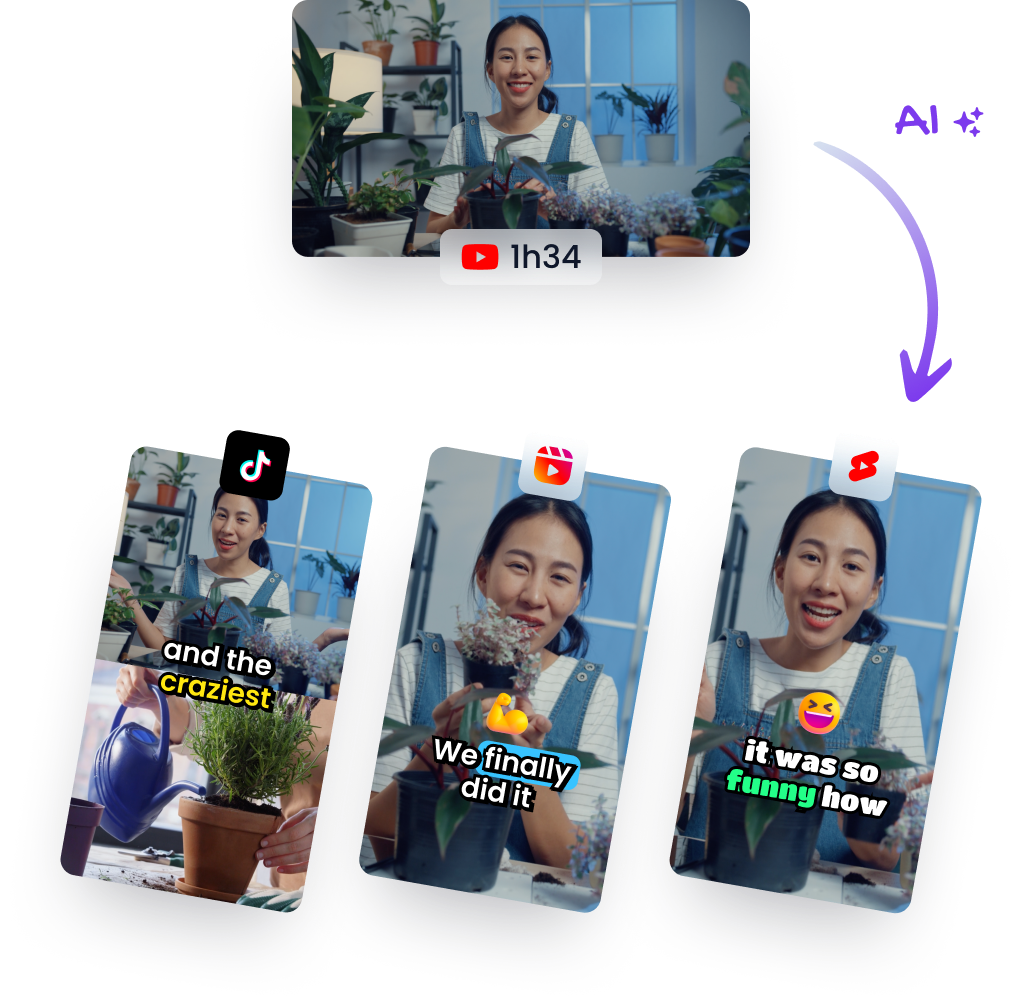
If you upload a long video file or paste a YouTube link into a tool such as Klap, the useful part isn't just that it cuts the video. It's that the system can scan transcript patterns, detect moments that begin with a question or strong claim, and surface candidate segments quickly. That's a better starting point than dragging through an hour of footage by hand. If you want a deeper look at that process, Klap has a practical post on finding highlights in video with AI.
The same logic applies before editing starts. If your source material is messy because you brainstormed ideas verbally, it's often faster to transform rambling notes into clear text first, then use that cleaned-up thinking to decide what kinds of clips you're hunting for. Better inputs usually lead to better clip selection.
A fast review process that saves time
AI suggestions still need a human pass. The trick is reviewing them with a specific filter instead of asking, “Is this interesting?”
Use questions like these:
- Does the first line create instant context?
If not, rewrite the opening or discard the clip. - Can a stranger understand it without the original conversation?
Internal references kill short-form performance fast. - Is there a payoff within the clip itself?
A short should resolve something, even if lightly. - Would you stop for this if you didn't know the creator?
Familiarity hides weak openings. - Can the idea be made stronger by starting later?
Many good clips begin several seconds after the obvious in-point.
AI is good at finding candidates. Editors still have to decide which candidates deserve attention.
What to look for in suggested clips
The best AI-curated moments usually fall into a few repeatable categories:
- Direct answers to specific questions because they arrive with built-in structure.
- Strong disagreements because they create tension immediately.
- Counterintuitive advice because the hook writes itself.
- Personal stakes or consequences because viewers understand why the point matters.
- Short stories with a turn because they hold attention better than abstract commentary.
What usually underperforms is generic motivation, context-heavy discussion, and any segment where the speaker warms up for too long before making the point. AI can reduce the search time dramatically. It can't remove the need for judgment.
Reframe and Edit for Vertical Viewing
Most long-form footage wasn't composed for a phone screen. That's why a direct crop almost always looks wrong. Heads get cut off, slides become unreadable, and the visual energy disappears.
With 92% of Instagram users and 98.5% of Facebook users accessing those platforms on mobile, a vertical-first approach isn't optional. Adobe's overview of long-to-short conversion makes the case for mobile-first reframing and captioning for silent viewing.

Reframing is a composition choice
A vertical short needs a focal point. Sometimes that's a face. Sometimes it's a product demo, a gesture, or a slide with one important line. What matters is that the eye knows where to go instantly.
If you're converting 16:9 footage, don't ask only whether the subject fits inside 9:16. Ask whether the subject still commands attention in 9:16. Those are different questions. A clip can be technically visible and still feel dead.
A solid manual pass usually includes these checks:
- Face position: Keep the speaker's eyes high enough in frame that captions won't crowd them.
- Negative space: Remove empty background that doesn't add meaning.
- Visual hierarchy: Decide what should dominate the frame. Don't let the crop make the viewer choose.
- Cut points: Trim breaths, restarts, and throat-clearing at both ends.
Tight edits beat faithful edits
A repurposed clip doesn't owe loyalty to the original timeline.
That means you can cut into the answer earlier, remove polite setup, and tighten pauses much more aggressively than you would in the full-length version. In many cases, the strongest short starts with the conclusion, then lets the rest of the clip justify it.
Start where the viewer gets curious, not where the speaker started talking.
If you're dealing with interviews, panels, or webinars, split-screen and punch-in edits can help restore energy after the crop. A subtle zoom, a cut to a visual example, or a text overlay can carry attention through a section that would feel static otherwise.
Here's a useful example of the kind of editing mindset that works for aspect ratio changes and visual adaptation:
For creators who do this often, aspect ratio conversion gets easier once you stop treating it as a resize setting and start treating it as a re-edit. This walkthrough on how to convert video aspect ratio is useful for that shift in thinking.
Small visual decisions change retention
A few adjustments usually make a bigger difference than people expect:
- Open on motion: Even a minor gesture or frame change helps the first seconds feel alive.
- Use on-screen text early: Not as decoration. As orientation.
- Keep text out of interface zones: Platform UI can cover key words near the bottom and edges.
- Show the speaker when emotion matters: Stay wide only when the environment adds meaning.
The point of editing a long video to short video isn't to preserve every detail. It's to preserve the idea while rebuilding the presentation for a vertical screen.
Craft Captions That Stop the Scroll
Captions do more than translate speech. In short-form, they often carry the hook, the structure, and the pacing.
That matters because many views happen in silent or low-sound situations. If the viewer can understand the clip without audio, you've removed friction. If the captions also create rhythm and emphasis, you've added a second layer of engagement.
Captions are part of the edit
A plain transcript dumped onto the screen rarely helps. It tends to be too dense, too slow, and too visually flat.
Good captions behave like design. They direct attention. They tell the viewer what matters now, not just what was said. Sometimes that means word-by-word emphasis for a punchy, high-energy clip. Other times it means larger phrase-based captions that make an educational point easier to absorb.

What strong captions do
The most effective caption styles usually share a few traits:
- They front-load meaning: The first caption screen should help explain why the clip matters.
- They break at natural beats: Viewers read faster when each chunk feels intentional.
- They emphasize only a few words: If everything is highlighted, nothing stands out.
- They match the creator's tone: Clean and restrained for some brands, louder and more animated for others.
Style choices that help instead of distract
Word-by-word animated captions can work well when the speaker has momentum and the delivery is the point. They tend to fit advice, contrarian takes, and story-driven clips. Static block captions often work better for dense information, interviews, and clips with visual complexity already on screen.
Use emojis carefully. They can add tone or help scanning, but too many make the screen feel noisy. The same goes for color. One accent color is usually enough to guide emphasis without turning the video into a motion graphic.
The best captions feel like they were written for the screen, not copied from the transcript.
If a sentence is long, split it into shorter reading units. If a phrase only works when heard in context, rewrite it. Captions don't need to be literal to be effective. They need to make the clip land.
Optimize Each Clip for Its Platform
A clip that feels native on TikTok can feel slightly off on YouTube Shorts. The same idea may still work, but the packaging usually needs adjustment.
One benchmark worth keeping in mind is that Shorts and long-form should be treated as separate optimization problems. YouTube guidance emphasizes average view duration and subscriber gain for Shorts, while long-form leans more on click-through rate and total watch time. The common mistake is chasing raw views instead of retention, which can backfire in distribution, as explained in this guide to YouTube Shorts and long-form optimization.
Platform expectations aren't identical
TikTok usually rewards clips that feel immediate and socially native. That often means a faster open, looser polish, and a hook that sounds like a person talking rather than a scripted voiceover.
Instagram Reels tends to respond well when the clip looks clean, easy to share, and visually deliberate. The content can still be direct, but the packaging usually benefits from stronger visual consistency.
YouTube Shorts often gives educational, explanatory, and value-dense clips more room to work, especially when the payoff arrives quickly and the structure is tight.
Platform optimization checklist
PlatformIdeal LengthAudio StrategyPrimary Goal
TikTok
Short enough to land fast
Native-feeling audio, creator voice, or trend-aligned sound when it fits
Stop the scroll and earn completion
Instagram Reels
As long as the pacing stays clean
Clear original audio with polished presentation
Shares, saves, and brand recall
YouTube Shorts
Long enough to deliver a compact takeaway
Original audio that makes the value clear immediately
Retention and subscriber interest
What to change before posting
Don't just duplicate the same export three times. Adjust the packaging.
- For TikTok: Rewrite the opening text so it sounds conversational, not formal.
- On Reels: Clean up caption styling and thumbnail framing because visual polish matters more.
- For Shorts: Make the premise explicit early so the viewer knows what they'll learn or get.
A long video to short video workflow gets stronger when the source clip stays the same but the final wrapper changes by platform.
Build a Sustainable Publishing Workflow
One good clip is useful. A repeatable system is what compounds.
The simplest durable workflow is batch-based. Pull multiple candidate clips from one long video, review them in one sitting, edit them in another, then publish on a schedule you can maintain. That approach lowers decision fatigue and makes your standards more consistent from clip to clip.

A workflow that doesn't collapse after a week
A practical system usually looks like this:
- Clip selection session: Review one long recording and shortlist only moments that can stand alone.
- Edit session: Reframe, tighten pacing, add captions, and customize hooks.
- Publishing session: Match each clip to its platform and queue the posts.
- Review session: Look at which openings, structures, and topics held attention best.
The key is that each session has one job. When creators try to search, edit, caption, publish, and analyze in one stretch, quality drops.
What to measure
You don't need a complicated dashboard to improve your clipping instincts. Focus on signals that tell you whether the idea held attention and whether the clip created momentum after the view.
Track things like:
- View duration trends to spot weak openings
- Shares and saves to identify clips with utility or resonance
- Follower or subscriber movement per clip to see what earns ongoing interest
- Repeating themes among your strongest performers
After a few cycles, patterns start to show up. Certain hooks work. Certain speakers clip better. Certain topics need more context than short-form can support. That's how repurposing gets smarter over time.
If you already have strong long-form content sitting unused, Klap is one practical way to turn it into social-ready clips. You can upload a file or paste a YouTube link, let the AI surface candidate moments, then review, edit, and export vertical shorts with captions and reframing built in.