How to Repurpose YouTube Videos for TikTok
Other
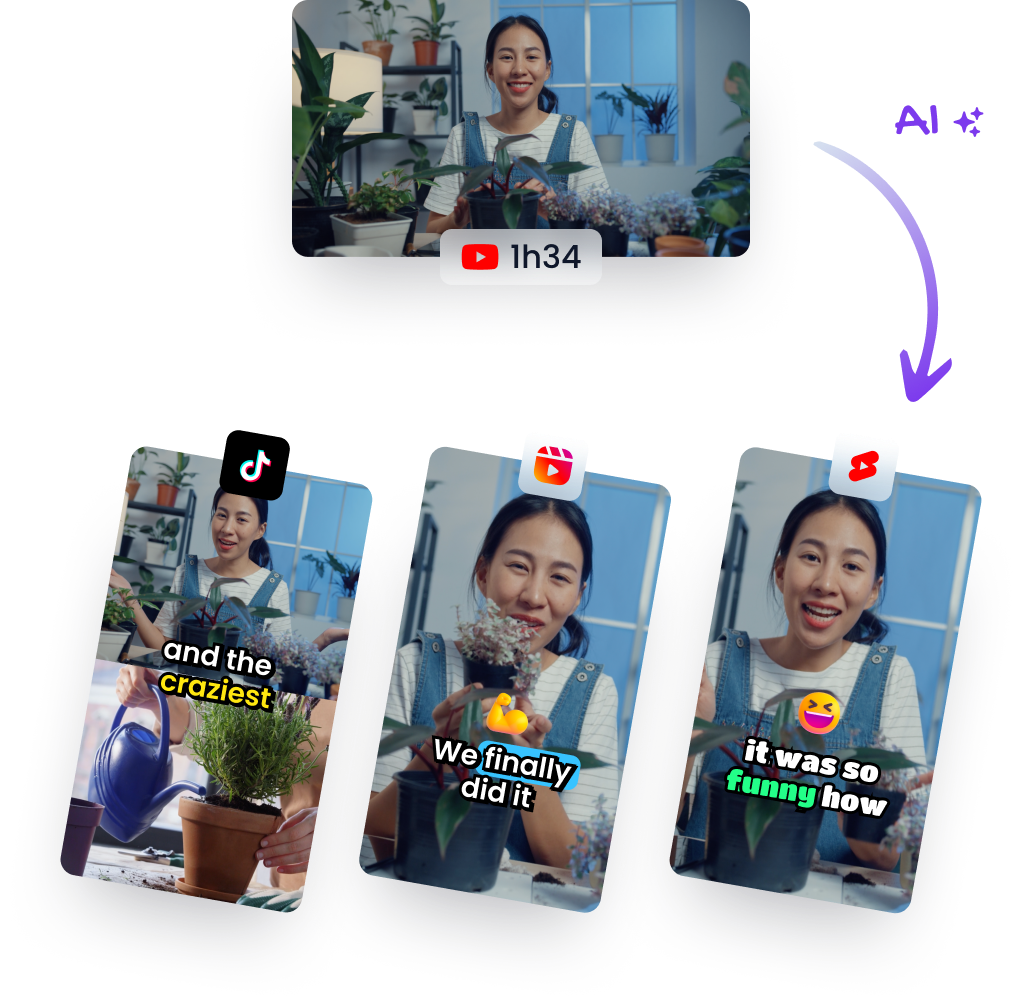
You've just finished a polished 40-minute YouTube deep dive. The script is tight, the lighting looks good, and the edit holds together. Now you're staring at the timeline, wondering which 30 or 60 seconds could make sense to someone who has never seen your channel.
That decision matters more than the crop, captions, or export settings. Successful YouTube-to-TikTok repurposing starts with selecting a moment that works independently, then reshaping it for a viewer who may decide whether to stay within the first few seconds.
Why Most YouTube Videos Fail on TikTok
The most common mistake is treating repurposing as a trimming task. A creator opens the YouTube timeline, grabs an interesting passage, removes a few pauses, and exports it vertically. The result may be perfectly clear to someone who watched the original video, but confusing to a TikTok viewer encountering it cold.
YouTube and TikTok create different viewing conditions. Long-form viewers accept setup because they've chosen to spend time with the video. TikTok viewers need an immediate reason to continue. A segment that feels energetic at the 12-minute mark may depend on an earlier explanation, an inside joke, or a visual detail that disappears in a center crop.
Context collapse is the real problem
Three failure patterns appear repeatedly:
- Context-dependent humor: The punchline arrives without the situation that makes it funny. A reaction to an earlier story becomes an unexplained facial expression.
- Slow-burn narrative: The clip spends its opening seconds building toward a payoff. On TikTok, that delay often costs the view before the payoff arrives.
- Passive horizontal framing: A 16:9 shot cropped into a vertical frame can leave the speaker small, cut off a second person, or hide the product being discussed.
The fix isn't just to cut faster. It's to ask whether the selected moment contains its own premise, tension, and payoff. A strong clip might open with the conclusion, show the surprising result first, or place a short context card before the speaker continues.
Practical rule: If a stranger needs your YouTube intro, previous episode, or pinned comment to understand the clip, the segment isn't ready for TikTok.
A useful test is to watch the export with no channel knowledge and no sound. If the subject, topic, and emotional direction aren't obvious almost immediately, select a different moment or rebuild the opening. Editing quality can polish a strong idea, but it can't rescue a clip whose meaning lives somewhere else in the original video.
The Scale and Engagement Case for Repurposing
Short-form distribution is now a mass channel. In 2026, YouTube Shorts was reported at more than 200 billion daily views globally, compared with about 70 billion in March 2024. The same summary places YouTube Shorts at about 2 billion monthly active users, TikTok at around 1.59 billion, and Instagram Reels at about 1.8 billion.
That scale changes the economics of an existing video library. Your long-form recording has already absorbed the planning, filming, and primary edit. Repurposing turns that finished asset into several opportunities for discovery, provided each clip is selected and edited as native short-form content rather than treated as a miniature YouTube upload.
Short-form engagement also gives the workflow a practical rationale. One 2026 industry compilation reports average short-form engagement around 5.5%, compared with about 1.7% for long-form video and 0.8% for static image posts. A separate benchmark places TikTok's average engagement at 2.80% in 2024 and 3.15% in 2025, while YouTube Shorts measured 5.91% in Q1 2024 in that comparison. These figures aren't promises for every clip, but they explain why a strong long-form moment deserves a second life in a short-form feed.
YouTube and TikTok serve different jobs
MetricYouTube, long-formTikTok, short-form
Primary role
Depth, search, and sustained viewing
Discovery, rapid testing, and sharing
Viewer expectation
More context and narrative development
Immediate value or curiosity
Editing priority
Structure across the full episode
Hook, retention, and payoff
Repurposing opportunity
Source library
New distribution surface
TikTok also captures substantial attention. One 2026 summary reports that Android users spend about 1 hour 37 minutes per day on TikTok, roughly 14% longer than on YouTube on the same measure, as documented by short-form video benchmark coverage.
Repurposing isn't a shortcut around creative work. It relocates the work from filming to selection, reframing, captioning, and scheduling. For a broader overview of ways to transform content with MyKaraoke Video, think beyond a single upload: one long-form source can support a sequence of distinct clips, each with a different hook and audience entry point.
Finding Clips That Survive Without Context
The best candidate isn't necessarily the shortest passage. It's the moment that gives a new viewer enough information to understand the subject, enough tension to care, and enough payoff to finish.

Start with evidence, then apply judgment
Open YouTube Studio and inspect the audience-retention graph for the source video. Peaks can reveal moments where viewers rewatched or slowed their viewing, making them useful places to investigate. They aren't automatic winners, though. A retention spike might come from a visual reveal that makes no sense outside the episode, or from a moment that depends on several minutes of setup.
Use this selection sequence:
- Mark retention peaks and meaningful transitions. Note the timestamp, topic, and what changes in the scene. Include moments where the speaker makes a clear claim, demonstrates a result, or reacts strongly.
- Pull the transcript around each timestamp. Read enough surrounding dialogue to understand the premise and payoff. Transcript scanning is faster than scrubbing every second of a long timeline, and it exposes references that won't survive extraction.
- Apply the stranger test. Ask whether someone with no knowledge of your channel can identify the topic and reason to care within the opening moments.
- Rank by hook strength. Put a direct claim, surprising result, visual reveal, or useful instruction above a generic highlight, even if both are similar in length.
- Cut the explanation that the clip doesn't need. Preserve the minimum context required for comprehension, then remove greetings, repeated points, and references to earlier material.
A practical workflow described in Klap's guide to clipping a video combines transcript review with automated candidate discovery. Tools can reduce the initial search, but an editor still needs to reject clips that are technically engaging yet context-dependent.
Score the survivors, not every timestamp
Give each candidate a simple editorial score for four questions:
- Does the opening state a problem, claim, or question?
- Can the viewer understand the subject without the full YouTube episode?
- Is there a visible or verbal payoff?
- Would a viewer plausibly share, save, or discuss it?
The last question matters because clip length alone isn't a selection model. A short but incomplete remark may earn a view and lose the audience immediately afterward. A slightly longer explanation can work when it resolves a real question and keeps its context compact.
Don't use a view target as proof of quality. The useful comparison is between candidates from the same channel, with attention to average watch time, completion rate, comments, shares, and profile visits. Those signals tell you whether the moment created sustained interest rather than merely attracting an initial stop.
Editing for Vertical Viewing and Sound-Off Audiences
A YouTube clip doesn't become TikTok-native when you change its file dimensions. The edit needs a new visual hierarchy, a faster opening, and enough on-screen information to work while the viewer's audio is off.
TikTok's native full-screen format is 9:16 at 1080×1920 pixels, while 16:9 and 1:1 uploads can display with black bars rather than filling the screen, according to TikTok video size guidance. Set the vertical canvas before you begin reframing so every decision reflects the phone screen.

Rebuild the first seconds
The source video's original introduction may be useful on YouTube and expendable on TikTok. Lead with the strongest statement, result, or visual moment, then add only the context needed to make that opening honest and understandable.
For a talking head, use center tracking but check every movement manually. A fixed center crop can cut off gestures or drift away when the speaker turns. Interviews often benefit from a split-screen treatment, while product demonstrations and B-roll-heavy clips need keyframed crops that follow the relevant object instead of the speaker's face.
Captions deserve editorial attention, not just automatic transcription. A peer-reviewed review identified 36 social-media video caption studies published from 2015 to 2025, supporting captions as both an accessibility feature and an engagement and comprehension mechanic, as summarized in the caption research review.
Use large, high-contrast text, keep important words away from interface overlays, and synchronize emphasis with the spoken rhythm. Word-by-word animation can create visual momentum, but excessive movement makes the screen harder to read. Correct transcription errors before export, especially names, technical terms, and negations.
Sound-off design needs more than subtitles. Add a short context card where the premise isn't obvious, use a cutaway or zoom to interrupt a static shot, and let a reaction or visual demonstration carry meaning without relying on music. Guidance from vertical-video editing techniques recommends opening within 1 to 3 seconds, adding captions from the first frame, and treating sound-off viewing as a primary condition. That source also cites 85% of social videos initially watched without sound and a 40% retention improvement associated with captions, so those figures should guide testing rather than serve as a guarantee.
Use this structure when the original clip is slow:
- Open with the payoff or strongest claim.
- Add one sentence of context.
- Deliver the explanation or demonstration.
- End on the answer, reaction, or a loop-friendly visual.
A tool such as Klap can handle mechanical tasks like automatic reframing and caption generation, while the editor decides whether the hook is truthful, whether the crop protects the subject, and whether the pacing feels intentional. More detail on the manual decisions appears in this guide to vertical video editing.
Choosing the Right Length and Platform Cut
Cutting every source segment to the same duration is convenient, but it ignores the shape of the idea. A strong opinion may need only a compact statement and a reaction. A tutorial needs enough time to show the action and confirm the result.
TikTok permits standard uploads up to 10 minutes, but practical guidance still commonly favors shorter edits. One 2026 platform-specification guide identifies 30 to 90 seconds as a practical range for completion and retention, while the strategic choice depends on the subject and payoff, as outlined in TikTok platform specifications.
Content typeIdeal lengthBest platformEditing priority
Single opinion or answer
15 to 30 seconds
TikTok
State the claim immediately
Compact explanation
30 to 60 seconds
TikTok or Shorts
Remove setup that doesn't change the answer
Story with a clear payoff
45 to 90 seconds
TikTok or Reels
Preserve the turn, cut dead air
Tutorial demonstration
45 to 90 seconds
TikTok, Reels, or Shorts
Show the action and result
Long-form teaser
As short as the idea allows
YouTube Shorts
Create curiosity for the full video
These ranges are editorial starting points, not rules. If a 20-second cut removes the reason the viewer should care, keep the longer version. If a 60-second explanation repeats its premise, shorten it even when the source segment appears complete.
Make separate exports when the platform's job differs. TikTok can prioritize completion and discussion, Instagram Reels can receive a more polished version, and YouTube Shorts can tease the full YouTube episode. Don't assume one master file serves discovery, conversion, and watch-time goals equally well.
A scoring tool can suggest boundaries based on speech patterns and engagement signals, but the final cut should follow meaning. Choose the shortest version that preserves the promise and payoff, then test a longer cut when removing context makes the explanation feel rushed.
Publishing and Tracking Performance Over Time
Treat repurposed clips as a publishing system, not a pile of exports. A practical workflow starts by selecting 1 to 3 long videos, extracting 5 to 8 candidate clips per source, and staggering publication across 7 to 10 days, as recommended in this YouTube-to-TikTok repurposing workflow. That spacing gives each clip room to generate its own performance data.
Write the first caption line as a second hook rather than a transcript label. Use a small set of niche-relevant hashtags, identify the topic plainly, and direct interested viewers toward the related YouTube video when the longer version adds meaningful depth. Avoid stuffing every caption with generic tags.

Track the signals that improve selection
Record the following for every post:
- Views: Useful for distribution, but weak as a standalone quality measure.
- Average watch time: Shows whether the body holds attention after the hook.
- Completion rate: Indicates whether the clip delivers its promise efficiently.
- Profile visits: Connects the clip to broader channel interest.
- Comment quality and shares: Reveal whether the idea created a response worth carrying forward.
Review results weekly and compare like with like. If clips with direct claims consistently hold attention better than reaction excerpts, select more direct claims from the next source. If a topic receives views but no profile interest, the clip may be entertaining without establishing why the viewer should follow the creator.
The video content distribution workflow is useful as a planning reference, but the core practice is simple: publish, measure, revise the selection criteria, and preserve the formats that repeatedly earn meaningful attention. Don't let one weak upload convince you that the source video has no usable material. Often, the problem is the opening, crop, or missing context, not the underlying idea.
Klap can scan a YouTube video for promising moments, create vertical clips, reframe the subject, and generate captions so you can spend more time judging hooks and payoffs. Visit Klap to turn your existing long-form library into reviewable TikTok-ready clips and build a repeatable repurposing workflow.