Video Content Distribution: Channels, Workflows
Other
The popular advice is simple: publish more video, distribute it everywhere, and let volume do the work. That advice made sense when short-form feeds were still expanding. It's weaker now. Online video reached 92% of the global digital population by the end of 2023, and Statista reported that 92% of the global internet audience watched video content online in the third quarter of 2024, with weekly reach at 99.6% in Nigeria and 99% in Ghana (Statista's online video audience data). Video content distribution has become nearly universal. The scarce resource is no longer access to a channel. It's attention.
Why Distribution Is No Longer the Bottleneck
A video can be published on every relevant platform and still fail before the viewer understands what it offers. In a crowded feed, distribution is less about moving a file from one server to another and more about engineering the first impression, the opening visual, the promise, and the reason to keep watching.
Short-form supply has accelerated sharply. Independent reporting on Metricool's 2025 short-form analysis says short-form publishing volume rose 71%, the number of accounts using the format rose 51% year over year, and TikTok posts increased 156% (MarketingTechNews' coverage of Metricool's short-form analysis). Those figures describe a publishing environment where another competent clip is easy to produce and easy to ignore.
The historical shift is clear. Live video was publicly demonstrated over the Internet at Xerox PARC during a Severe Tire Damage concert in 1993, and YouTube was founded in 2005 as an internet-only video distribution service (The Streaming Book's history of streaming video). What began as a distribution breakthrough has become an attention-allocation problem.
Practical rule: More output only helps when each additional asset gives the audience a stronger reason to stop, watch, share, save, or act.
The volume versus attention gap
MetricStatistic
Global digital population reached by online video by the end of 2023
92% (Statista)
Global internet audience watching online video in Q3 2024
92% (Statista)
Weekly online video reach in Nigeria
99.6% (Statista)
Weekly online video reach in Ghana
99% (Statista)
Year-over-year increase in short-form publishing volume
71% (MarketingTechNews)
The implication for marketers is uncomfortable but useful: distribution now behaves like an optimization problem for human cognition. Publishing frequency matters, but only after the clip earns an initial pause. Hook quality, packaging, audience selection, format adaptation, and feedback loops determine whether distribution creates reach or merely creates a larger archive.
A practical workflow therefore starts before export. Ask which audience problem the clip addresses, what the viewer should understand in the opening moment, and whether the title, cover, captions, and first visual make the same promise. Tools can reduce the labor involved, as the broader workflow discussed in AI video content marketing demonstrates, but automation can't rescue an indistinct idea.
What Video Content Distribution Actually Means
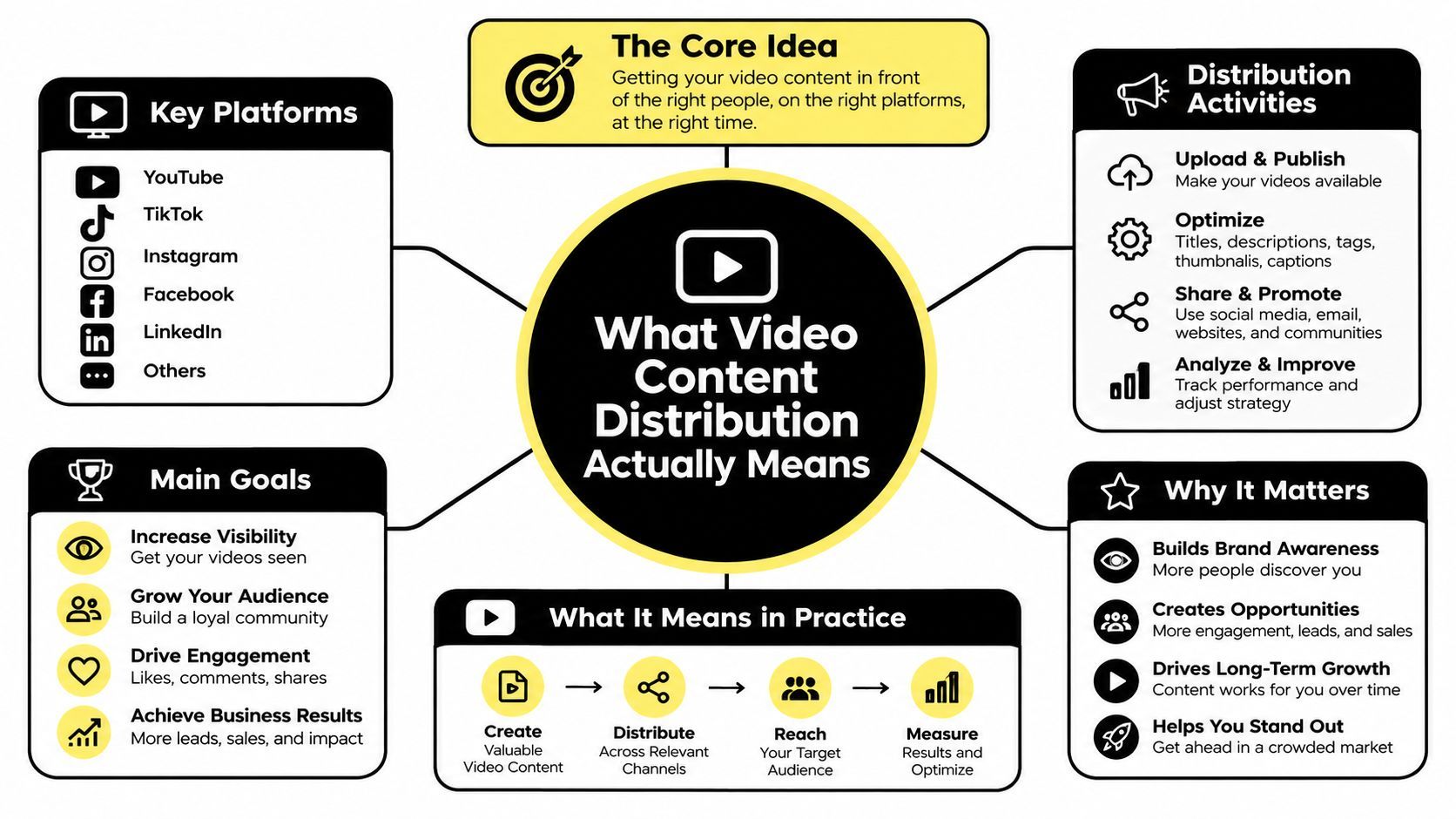
Video content distribution is the systematic placement of adapted video assets across channels, not a single upload action. The same source recording may support a searchable YouTube episode, a vertical discovery clip, an email embed, a website resource, a paid retargeting asset, and a sales follow-up. Each placement has a different job, audience expectation, and measurement model.
A useful operating model has four quadrants:
- Owned distribution uses properties your team controls, such as a website, email newsletter, resource hub, or embedded player. It gives you control over context, calls to action, and the path to conversion, but it depends on an audience you've already reached or can bring to the property.
- Earned distribution comes from organic sharing, editorial attention, backlinks, community recommendations, and algorithmic promotion. It can create credibility and additional reach, although you can't fully control timing, framing, or volume.
- Shared distribution covers direct forwarding and community circulation, including employees sharing a clip, customers posting it in a group, or a niche community discussing it. Relevance and participation matter more here than polished production alone.
- Paid distribution uses advertising, sponsorships, creator partnerships, or promoted placements to buy targeted exposure. It's useful for controlled acquisition and testing, but it introduces media cost and can expose weak creative quickly.
Assign each quadrant a job
Owned channels are strongest when the viewer already has some relationship with the brand and needs depth, proof, or a next step. Earned and shared channels expand discovery through trust and relevance. Paid media helps you reach a defined audience or accelerate a message that already shows signs of creative fit.
That distinction prevents a common mistake: judging every clip by views. A discovery cut may succeed by generating qualified profile visits or a relevant conversation. A conversion cut may produce modest reach but send the right viewers to a product page. Teams that need a concise vocabulary for these mechanics can use Grou's guide to content distribution terms for B2B sales.
The distribution plan should also specify the asset's canonical destination, tracking parameters, caption standards, approval owner, and reuse rights. Without those decisions, syndication becomes duplication. Multiple posts may appear active while nobody knows which version drove the meaningful action.
A strong video content marketing strategy treats distribution as part of the creative brief. The team decides the intended audience, channel role, format, and conversion path before it cuts the footage.
Matching Channels to Intent and Format
A video asset isn't universal. A viewer searching YouTube for a detailed answer has a different mindset from someone swiping through TikTok, and a professional scrolling LinkedIn expects a different opening from a viewer browsing Instagram Reels. Distribution works when format matches intent.
YouTube Search can support long-form explainers, interviews, demonstrations, and tutorials where the viewer has a defined information need. The opening still matters, but the video can earn attention through structure, depth, chapters, examples, and sustained usefulness. YouTube Shorts and TikTok operate closer to rapid discovery. They need a clear premise, immediate movement, readable captions, and a payoff that doesn't depend on lengthy setup.
Instagram Reels often rewards a combination of visual polish, recognizable identity, and social relevance. LinkedIn can work well for concise professional insights, strong opinions, lessons from execution, and practical commentary. The same sentence may belong in all four ecosystems, but it shouldn't be edited identically.
Channel intent and format matrix
PlatformIdeal format or lengthPrimary audience intent
YouTube Search
Long-form tutorials, interviews, and explainers
Research, learning, evaluation, and depth
YouTube Shorts
Vertical short-form clips
Discovery, quick education, and entertainment
TikTok
Fast, vertical clips
Entertainment, cultural relevance, and rapid discovery
Instagram Reels
Polished vertical clips
Discovery, inspiration, identity, and sharing
Short professional insights
Learning, credibility, and business discussion
Owned website or email
Embedded video with supporting context
Trust, conversion, onboarding, and retention
Retention is a useful anchor because short clips don't win by being short. One 2026 guide reports that videos under 90 seconds retain about 50% of viewers on average, identifies 21 to 34 seconds as an optimal engagement window, and reports 5.8% average engagement for Reels in the 15 to 30 second range (Kapwing's 2026 short-form video benchmarks). Those figures are benchmarks, not publishing laws. A complex idea may need more time, while a visual demonstration may work in a much tighter edit.
A short clip is a discovery instrument. A long-form video is a depth instrument. Treating them as interchangeable usually weakens both.
Use the long-form version to answer the complete question and the short-form version to create a compelling entry point. The short should not summarize every point. It should resolve one useful tension and give interested viewers a logical reason to continue.
The Long-Form to Short-Form Repurposing Workflow
A dependable repurposing pipeline protects the source material from random cutting. The objective isn't to turn every sentence into a post. It's to identify moments that stand on their own, then package them for a specific audience and channel.

Start with source selection
Review the long-form recording for quotability, visual dynamism, and standalone context. A sharp claim with a clean beginning and ending is usually more useful than a technically impressive exchange that requires several minutes of setup. Mark moments where the speaker changes direction, reveals a consequence, demonstrates a process, or answers a question in a complete unit.
Clean the transcript next. Remove obvious filler where appropriate, correct names and terminology, and align subtitle timing with the actual speech. AI transcription is valuable here because it turns a long recording into a searchable editorial surface, but a human should verify meaning, speaker changes, and specialized vocabulary.
Cut, package, and reframe
Generate candidate clips around natural breakpoints rather than arbitrary silences. Klap, Opus Clip, and Descript can help identify highlights, but selection scores are starting points, not editorial judgment. Keep clips that preserve narrative coherence and remove candidates that begin with context the viewer can't see.
Then separate the hook pass from the caption pass. Write the opening promise first. After that, create subtitles and on-screen text that support comprehension without covering the speaker's face or key product detail.
- Reframe for the destination. Choose the appropriate aspect ratio, safe zones, crop, and subject position. A face-centered crop may fail when the important action occurs at the edge of the frame.
- Adjust pacing. Remove pauses that add no meaning, but leave enough breathing room for comprehension. Speed is not a substitute for clarity.
- Review voice and claims. Human review should protect brand voice, accuracy, cultural context, and legal requirements.
- Package the metadata. Titles, descriptions, cover frames, hashtags where relevant, and calls to action should reinforce the first two seconds rather than introduce a separate idea.
- Export by platform. Keep clean masters and channel-specific versions, with filenames that identify topic, hook, audience, language, and revision.
AI adds real value in transcription, highlight detection, caption timing, and reframing. It doesn't reliably decide whether a clip makes a defensible point, whether the tone fits the brand, or whether the payoff arrives too late. Those decisions still need editorial ownership.
Engineering Hooks That Win the First Three Seconds
The opening seconds carry disproportionate weight because viewers make a rapid keep-or-swipe decision before they've built context. In a saturated short-form market, posting another clip doesn't solve a weak opening. The clip must identify its value quickly enough for the right viewer to recognize it.
Retention benchmarks reinforce the point. Videos under 90 seconds retain about 50% of viewers on average, while the cited guide places the strongest engagement window around 21 to 34 seconds (Kapwing's short-form statistics guide). Meanwhile, Metricool's analysis shows that supply is rising, with short-form publishing volume up 71% (MarketingTechNews' report). That combination makes the first beat a creative control point, not a decorative intro.
Four repeatable hook patterns
- Contrarian claim: “Posting every day won't fix a clip nobody understands.” The claim creates tension and specifies the problem. “Video marketing is important for every business” fails because it gives the viewer no new angle.
- Open loop: “The strongest moment in this interview arrived after the answer everyone expected.” The viewer wants the missing resolution. “You won't believe what happened next” makes a promise without substance.
- Visual demonstration before context: Show the before-and-after crop, the failed edit, or the product action immediately, then explain it. A slow zoom toward a talking head delays the evidence.
- Stakes-setting statement: “If your buyers misunderstand this step, the rest of the campaign becomes expensive.” It gives the information a consequence. Leading with a logo and asking viewers to follow before delivering value spends the most valuable moment on the brand instead of the audience.
Test the opening, not your entire production system
Create distinct hook variants while keeping the core body stable. Compare three-second view-through, average percentage watched, completion behavior, shares, saves, and qualified comments. Don't call a winner from a single viral outlier. Look for the opening pattern that repeatedly attracts the intended audience and holds them into the payoff.
A strong hook isn't clickbait. It's a precise contract. The clip should deliver what the opening implies, or the initial retention may turn into distrust and weak downstream action.
Localization and Format Variants at Scale
One 9:16 export rarely serves every audience. Platforms differ in caption density, visual safe zones, pacing, cover treatment, and viewer intent. A version that works for an English-speaking audience on TikTok may need a different opening, subtitle rhythm, or example before it makes sense in another market.
Localization starts with language, but it shouldn't end there. Caption translation tools such as Captions and Rask can accelerate first drafts. HeyGen and ElevenLabs can support dubbed or voiced versions. Human reviewers still need to check pronunciation, idioms, humor, cultural references, imagery, and claims that may carry a different meaning in another region.
Industry coverage of 2026 video trends treats personalization and localization as scaling requirements, while one report projects that around 75% of marketing videos in 2026 will be AI-generated or AI-assisted (Designforce's 2026 video marketing trends). That projection points to an operational shift. The advantage won't come from producing one clip slightly faster. It will come from making useful variants practical without allowing quality control to disappear.
Variant matrix for one source clip
VariantLanguageAspect ratioHook styleTarget platform
A
English
9:16
Contrarian claim
TikTok
B
English
9:16
Visual demonstration
Instagram Reels
C
English
9:16
Open loop
YouTube Shorts
D
Localized language
9:16
Stakes-setting statement
TikTok in the target market
E
English
1:1
Proof-led introduction
F
Localized language
16:9
Search-led explanation
Owned website or YouTube
The matrix makes the trade-off visible. More variants can improve audience fit, but they also create more review time, storage requirements, naming decisions, approvals, and opportunities for subtitle or brand errors. Don't translate every clip by default. Start with markets where the source topic, audience demand, distribution access, and conversion path justify the work.
The right question is not “How many posts can we publish?” It's “Which variations make a previously marginal audience reachable?” Scale comes from systematic variation, not from dumping more raw footage into the feed.
Scheduling, Syndication, and the KPIs That Matter
Scheduling should function as a feedback system, not as the last administrative step before publishing. Begin with one long-form anchor on YouTube or an owned hub. Release platform-native cuts on TikTok, Instagram Reels, and YouTube Shorts within a deliberate window, then use a later derivative for LinkedIn, email, or a sales conversation when the topic is relevant.
The exact cadence should follow audience behavior and production capacity. Avoid building a strategy around one exceptional post. Use median performance across comparable concepts, because a single outlier can hide a weak process.
Build a usable content ledger
Tag every cut by topic, hook, format, length, audience, platform, campaign, language, and destination. Preserve the canonical URL and use consistent UTMs so a discovery clip, an email click, and a sales-assisted visit don't collapse into one unattributed traffic bucket.
Teams that need help comparing publishing systems can use a practical guide to best social media scheduling tools, but software won't decide which creative deserves another test.
ObjectivePrimary metricsWhat the signal means
Discovery
Three-second view-through, average watch time, completion rate, rewatch rate
Whether the opening earns attention and the edit sustains it
Conversation
Shares, saves, qualified comments, profile visits
Whether the idea has relevance beyond passive viewing
Conversion
Landing-page views, click-through rate, leads, assisted conversions, cost per result
Whether the clip moves an audience toward a business outcome
Audience growth
Follower conversion and returning viewers
Whether distribution creates an ongoing relationship
Creative diagnosis
Thumb-stop rate, play-through rate, retention curve
Where the viewer accepts or rejects the package
For discovery clips, prioritize retention, watch time, completion behavior, rewatches, and qualified comments. For conversion clips, add landing-page views, click-through rate, leads, assisted conversions, and cost per result. Audit weekly, keep the winning opening patterns, and archive concepts that consume production time without advancing an audience or business goal.
Syndication also needs quality control. Remove platform-specific watermarks where appropriate, verify captions, check the crop on a real phone, maintain consistent identity, and avoid posting an identical cut everywhere when a small adaptation would make the message feel native.
Your Distribution Playbook for the Next 30 Days
A month of distribution should test attention, not reward publishing volume. In week one, audit the long-form library, name three audience problems, and choose one topic with a clear job. For a SaaS trial, the destination is the signup page. For an educator, it is the course landing page. Write that path down before cutting clips.
Week two turns the source into testable creative. Choose one topic, such as reducing customer churn, and mark five self-contained moments. Build each around a different hook pattern, including a contrarian claim, a mistake, or a before-and-after result. Give every version its own opening, cover, captions, crop, and call to action. Track the source timestamp, audience, platform, version, owner, status, and KPI in one sheet.
Week three publishes the anchor and stages its strongest cuts. Test one variable at a time. A useful first benchmark is whether the opening holds viewers through the first three seconds, then whether the retention curve stays healthy through the core explanation. If one clip opens with “Your onboarding is losing trials before users see value,” keep the topic fixed while testing the wording, cover frame, or caption treatment. Changing hook, crop, topic, and call to action together hides the cause.
Week four is for pruning. Compare qualified watch time, retention, clicks, conversions, shares, saves, and meaningful comments by concept, not follower count. Keep the top two repeatable patterns, document the winning promise and edit choice, and retire clips that create activity without useful movement.

A strong social media and content strategy creates a repeatable loop: select a meaningful source, engineer the opening, adapt the format, localize where justified, publish with tracking, and feed results into the next edit. The goal is a system that turns each core video into measurable, platform-specific opportunities.
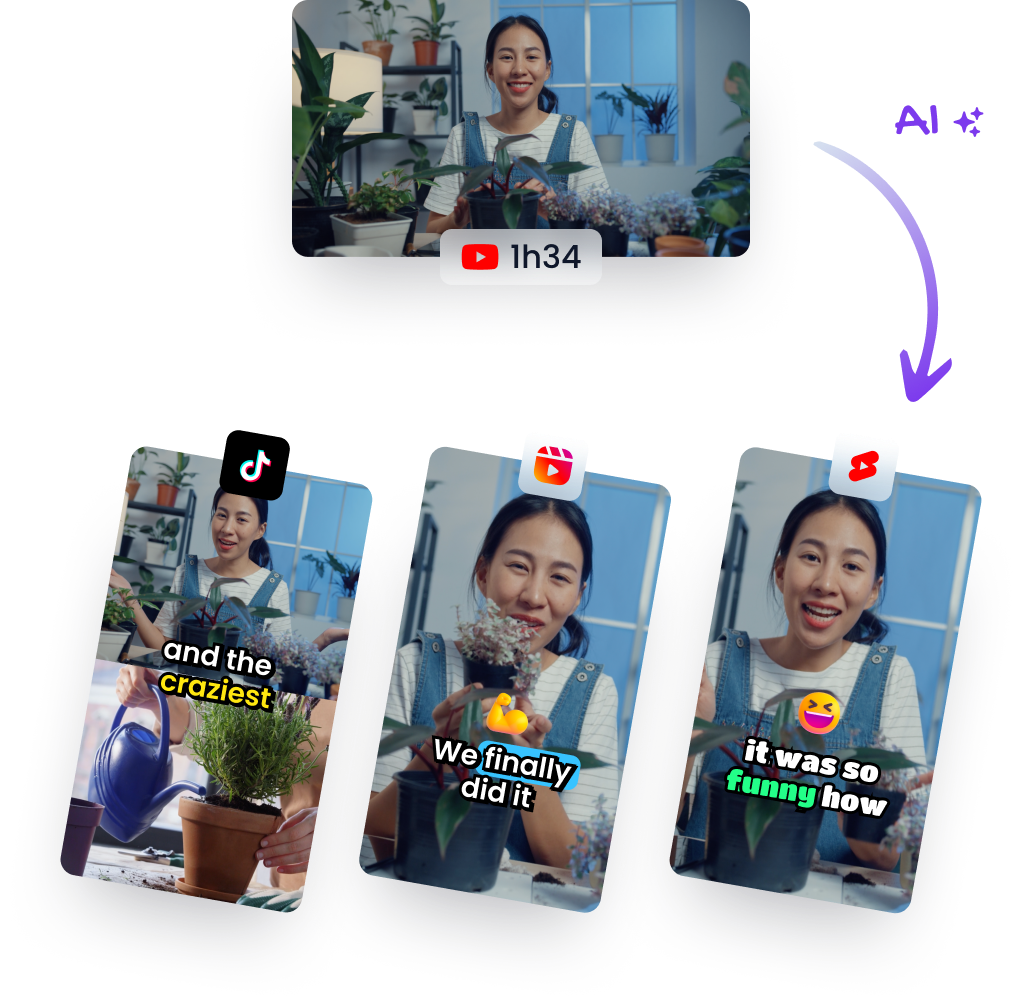
Klap turns long-form videos, podcasts, webinars, and YouTube uploads into short clips with AI-assisted highlight selection, captions, reframing, resizing, and social-ready exports. Visit Klap to build a faster video content distribution workflow around stronger hooks and useful platform variants.