How to Clip Videos: A 2026 Guide to Viral Shorts
Other
You already have more short-form content than you think. If you publish podcasts, webinars, interviews, tutorials, sales calls, or YouTube videos, the raw material is sitting there. The problem usually isn't lack of content. It's that clipping feels like extra work piled on top of everything else.
That mindset is expensive.
When you learn how to clip properly, long-form stops being a one-and-done asset and starts acting like a content library. One recording can feed multiple platforms, test multiple hooks, and give you far more surface area for discovery without forcing you to film from scratch every day.
The shift that matters in 2026 isn't "make more videos." It's extract more value from the videos you've already made.
Why Clipping Is Your Biggest Growth Lever in 2026
Most creators know the feeling. You spend hours scripting, recording, editing, and publishing a strong long-form video. It gets some traction, maybe even solid watch time, but the reach stalls. Meanwhile, a rough-looking short from someone else floods feeds for days.
That gap is why clipping matters.
By 2026, clipping had become a core visibility mechanism, with short clips producing engagement that was often 5 to 10 times higher than long-form content, and a single viral clip could drive over a million views even without a large following, according to this 2026 clipping analysis. If you publish long-form and ignore clipping, you're leaving reach on the table.
Long-form creates depth and clips create distribution
Long-form still does important work. It builds trust, carries nuance, and gives you enough room to teach, sell, or tell a real story. But clips are what push that value into discovery surfaces where people find you.
That changes the economics of content production.
Instead of asking, "Was this one video worth the effort?" the better question is, "How many useful distribution assets can I extract from this recording?" Once you think that way, clipping stops feeling like post-production admin and starts looking like content ROI.
A practical clipping workflow usually does three things at once:
- Extends shelf life by giving one source video multiple chances to perform on different platforms
- Improves testing because different hooks reveal what your audience reacts to fastest
- Supports monetization since clipping platforms now pay per views on short content and creators use clips to drive traffic, leads, and client attention
Practical rule: If a long video has one strong point, it deserves one clip. If it has multiple emotional turns, objections, reveals, or punchy explanations, it probably deserves a batch.
Why this works right now
Short-form fits how people browse. Feeds reward immediate clarity, not patient context. That's why clippers warm accounts, post consistently, and repurpose podcasts, interviews, and YouTube videos into tighter edits designed for mobile viewing.
If you're still unsure whether clips are worth the extra step, study the patterns behind what makes a video go viral. The common thread isn't complexity. It's efficient packaging. Good clipping gives strong ideas a better chance to get seen.
Finding the Viral Moment How to Identify Perfect Hooks
The hard part of clipping isn't cutting video. It's recognizing the few seconds worth cutting.
A weak clip usually isn't weak because the editor missed a transition or chose the wrong font. It's weak because the source moment never had enough stopping power. You can't polish a flat idea into a great hook.
According to Whop's guide to content clipping, the first 3 seconds determine whether a short-form clip keeps the viewer or loses them to the next scroll. That's the decision window. Your job is to find moments that earn those first seconds instantly.

What a real hook sounds like
When I review long-form footage, I don't look for "interesting." That's too vague. I look for moments that create immediate tension.
Good hooks often begin with one of these patterns:
- A bold claim that makes someone think, "Wait, what do you mean?"
- A clean problem statement that sounds exactly like what the viewer is dealing with
- A moment of friction such as disagreement, pushback, surprise, or correction
- An emotional peak where the speaker's tone changes and the energy jumps
- A promised payoff where the viewer expects a reveal, answer, or shortcut
A clip works when the first line opens a loop and the rest of the clip closes it quickly.
How to hunt hooks inside a long video
Most long-form videos hide their best clips in predictable places. Start with these sections before scanning the whole file:
- The first minutes of the recording
Speakers tend to front-load their clearest opinions early. - Transitions between topics
People often summarize sharply before moving on. Those summaries clip well. - Stories with a turn
If someone says, "I thought this would work, but..." you're probably near a usable segment. - Audience reaction moments
In interviews or livestreams, laughter, interruption, or a visible reaction is a strong clue. - Answer-first responses
When the speaker says the conclusion before the explanation, that's clipping gold.
The easiest way to miss a viral moment is to listen for information and ignore energy.
What to skip even if it sounds smart
Some parts of a long video are useful in context but weak as shorts. I cut these aggressively:
Segment typeWhy it usually fails as a clip
Long setup
It asks the viewer for patience they won't give
Inside jokes
It depends on context the feed doesn't provide
Slow explanations
It may teach well in long-form but doesn't stop a scroll
Generic advice
It sounds interchangeable with every other creator
Rambly anecdotes
It buries the payoff too late
A simple filter before you cut
Before you turn any moment into a short, ask:
- Would this make sense if the viewer knows nothing about the full video?
- Does the first sentence create tension or curiosity right away?
- Can the payoff land cleanly without extra explanation?
If the answer is no, keep scanning. The fastest way to improve your clips is to reject more source moments.
The Core Workflow Trimming and Reframing
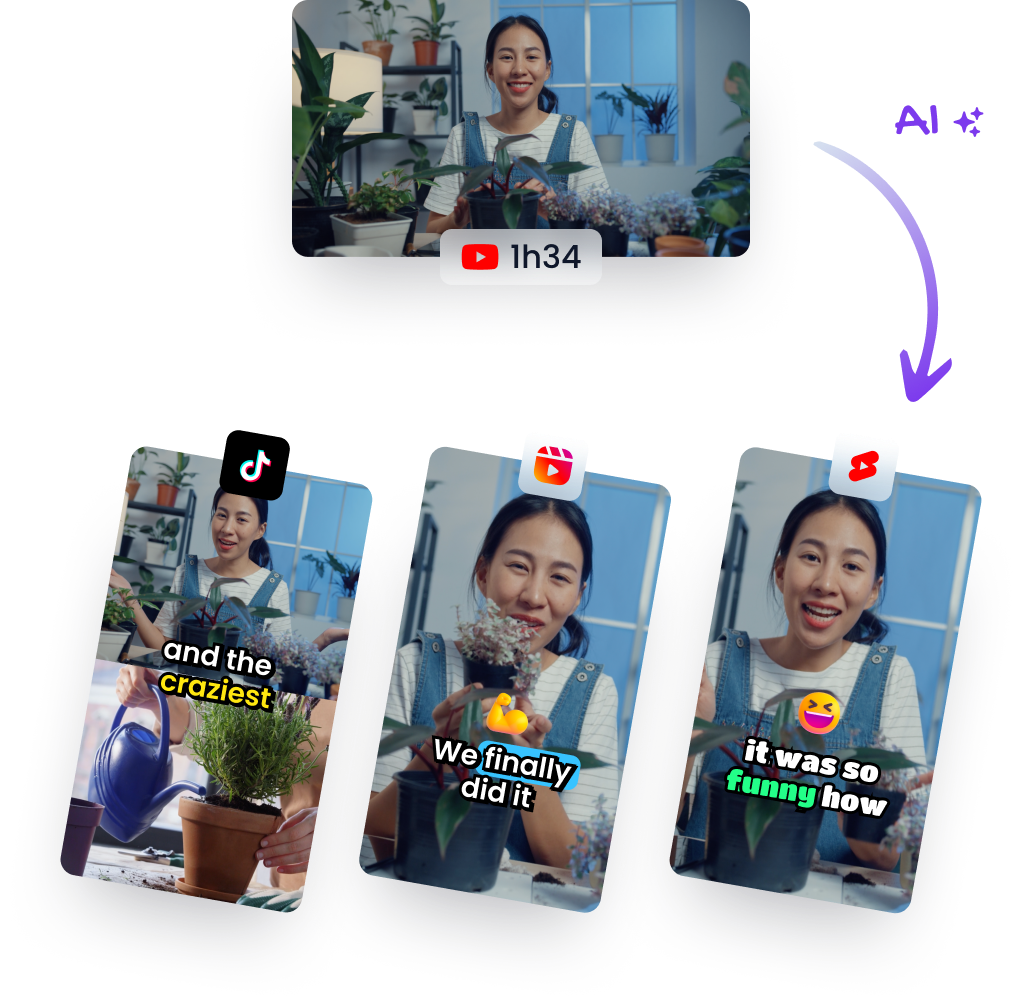
Once you've found a promising moment, the workflow splits into two paths. You can clip manually, or you can let AI handle the repetitive parts and then refine. Both can work. They don't cost the same amount of time, and they don't produce the same consistency.

The manual path
Manual clipping usually starts in Premiere Pro, Final Cut Pro, CapCut, or Descript. You drop the long video into a timeline, mark in and out points, duplicate sequences, resize for vertical, and then start fixing framing shot by shot.
That sounds manageable until volume enters the picture.
A single talking-head clip might need:
- Tighter trimming so dead air disappears before the hook
- Vertical reframing for 9:16 so the face stays central on mobile
- Speaker tracking if the person leans, gestures, or shifts position
- Caption cleanup because auto-transcription always needs checks
- Visual adjustments for split screen, punch-ins, or background handling
That manual route gives you control, but it also creates friction. If you're clipping one short per week, it's workable. If you're clipping from a podcast, webinar series, or multi-camera interview library, it turns into production drag fast.
What AI changes
AI-assisted tools don't replace judgment. They reduce the repetitive editing that slows judgment down.
One example is Klap, which analyzes long-form video, identifies engaging segments, reframes for vertical formats, adds captions, and lets you adjust the results before export. If you need a quick walkthrough on the mechanical side of cuts, this guide on how to trim an MP4 video is useful because the trimming principles are the same whether you're clipping manually or reviewing AI suggestions.
The reason AI matters isn't only speed. According to the verified data, AI-driven clip segmentation can produce 2.5 to 3.5 times higher view-to-completion rates than manually trimmed segments when it identifies hooks in the first 1 to 2 seconds and trims clips to an optimal 7 to 9 seconds, where 60 to 68 percent of viewers complete the clip, based on this referenced segmentation analysis.
Here's the practical takeaway. AI is often better at pattern spotting across lots of footage. Humans are usually better at nuance, brand fit, and final taste. The strongest workflow uses both.
A good hybrid process looks like this:
- Feed in strong source footage
Podcasts, interviews, webinars, and educational videos tend to clip well. - Generate candidate clips automatically
Let the system surface likely hooks and build first-pass cuts. - Review for narrative sense Remove clips that sound dramatic but fail to resolve.
- Adjust framing and endpoints
A tiny trim at the start or end often improves momentum.
For teams doing client work, this same principle shows up in brand systems too. If you're handling shorts video editing for brands, the bottleneck usually isn't access to footage. It's maintaining speed without letting quality slip across dozens of assets.
A quick visual breakdown helps if you're comparing process styles:
Editing rule: Trim later than feels safe at the end, but earlier than feels comfortable at the start. Most weak clips begin a beat too soon.
Reframing is not a cosmetic step
A lot of people still treat reframing like resizing. It isn't. It's composition for a different behavior pattern.
A horizontal shot that looks fine on YouTube can feel distant and sloppy on a phone. If the face is too small, the eye line is off, or multiple speakers compete for space, retention drops. Reframing should make the clip feel native to vertical feeds, not recycled from another format.
Adding Polish with Captions and Branding
A clean cut gets attention. Polish helps the clip travel.
The biggest finishing layer is captions. Not because captions are trendy, but because they carry the clip when the environment is noisy, the phone is muted, or the speaker's delivery is fast. If the words are hard to follow, people leave.

Captions that help instead of distract
Good captions do three jobs. They improve clarity, reinforce rhythm, and guide the viewer's eye.
Bad captions do the opposite. They flood the screen, animate every word for no reason, or use styling that fights the footage.
When you're deciding how to clip and finish a short, focus on readability first:
- Keep line breaks clean so phrases feel natural when read quickly
- Use contrast so text stays visible over changing backgrounds
- Highlight selectively because emphasis only works when it isn't everywhere
- Match pacing to speech instead of forcing captions to race ahead
If you're building a repeatable process, a practical reference on managing video ad captions can help clarify the operational side of caption editing, especially when multiple people touch the same assets.
Branding should be present, not loud
Most creators either ignore branding or overdo it. Both are mistakes.
You want enough identity that people start recognizing your content in-feed. That can be a logo watermark, a brand color on caption highlights, a recurring frame style, or a consistent title card approach. You don't want giant corner bugs, heavy intros, or animated clutter that steals attention from the hook.
A solid branding pass usually includes:
ElementGood useCommon mistake
Logo
Small and unobtrusive
Oversized watermark
Color
Used in highlights or frames
Multiple competing colors
Font
Consistent across clips
Decorative font that hurts readability
Intro styling
Minimal or skipped
Long branded opener before the hook
Keep branding subordinate to comprehension. If viewers notice your brand treatment before they understand the clip, the edit is backwards.
Build a template and stop redoing everything
Time often disappears for many teams. They treat every short like a fresh design project. That's unnecessary unless the content format changes.
Create a repeatable package:
- one caption preset
- one or two brand color treatments
- one safe watermark placement
- one headline style for covers
- one export-ready aspect ratio setup
If you're refining subtitle workflows, this walkthrough on how to add captions to videos is useful because it focuses on the editing decisions that affect usability, not just turning captions on.
Exporting and Publishing for Maximum Reach
A strong clip can still underperform if you publish it carelessly. Export problems, weak cover frames, vague captions, and random posting habits waste good edits.
Publishing needs a checklist.

Export for the platform you're feeding
The safest default is a vertical file that looks native on TikTok, Reels, and Shorts. Keep your footage visually clean, your text inside safe areas, and your framing centered for mobile.
Before exporting, check:
- Aspect ratio so the clip is built for vertical feeds, not adapted after export
- Caption placement so on-screen UI doesn't cover key words
- Cover frame with a readable focal point and a face or phrase worth clicking
- Audio consistency so speech stays clear from start to finish
I avoid overcomplicating export settings unless a platform is compressing badly. In practice, publishing discipline matters more than endless codec tweaking for most creators.
The publishing layer most people rush
The written caption matters, but not in the same way subtitles do. Its job is to frame the clip, give context if needed, and invite the right kind of engagement. The best ones usually stay tight.
A simple publishing routine works well:
- Pick the strongest cover frame
Choose the frame that sells the tension fastest. - Write a caption that supports the clip
Don't repeat the whole transcript. - Use focused hashtags
Relevance beats stuffing. - Post consistently enough to learn
The point is to collect pattern data, not just publish and hope.
One good clip posted well teaches more than five rushed uploads with no review process.
Adjust by platform, not by guesswork
TikTok, Instagram Reels, and YouTube Shorts overlap, but they don't always reward the exact same creative choices. Some hooks travel across all three. Others need different framing, cover choices, or supporting text.
If you're planning distribution across channels, this comparison of how to evaluate TikTok and Reels for marketers is a helpful operational reference. It gives you a cleaner way to think about format fit instead of posting identical assets everywhere without review.
A key habit that improves reach is simple. Publish, study retention and response patterns, then feed that learning back into the next round of clips. The clipping workflow isn't done at export. It gets sharper every time you review what held attention and what lost it.
Frequently Asked Questions About Video Clipping
How many clips should I pull from one long video
Enough to capture the distinct strong moments, but not so many that you flood your feed with near-duplicates. If several clips make the same point with minor wording changes, pick the clearest one. More clips isn't always better. Oversampling weakens your standards.
What's the ideal clip length
Use the source moment to decide, but keep it tight. If a clip needs too much setup, it usually isn't a good short. Strong clips tend to land fast, resolve fast, and leave cleanly. If you're trimming and still waiting for the point, keep cutting or discard it.
Should every clip have captions
For most creators, yes. Captions improve usability, clarity, and feed-native feel. They're especially important for interviews, education, commentary, and any clip where a precise phrase carries the hook.
Can I use trending music
You can, but be careful. If the spoken audio is the point, don't bury it under music. And if you're publishing for brands or clients, copyright and licensing rules matter more than trend chasing. A clean spoken clip usually ages better than a trend-dependent edit.
What kind of long-form videos clip best
Videos with clear opinions, strong stories, teachable moments, or energetic exchanges. Podcasts, interviews, webinars, coaching calls, tutorials, and product explainers are all workable if the speaker gets to the point.
If you already have long-form content, you don't need to start over. You need a workflow that turns existing footage into usable shorts without eating your week. Klap is built for that process. You upload or link a video, the platform analyzes it, generates short vertical clips with reframing and captions, and gives you edits you can review before export.