Find This Video: Your 2026 Guide to Tracking Clips
Other

You saw it once. Maybe it was a podcast clip, a tutorial moment, a weirdly specific rant, or a scene you only remember by color and cadence. Now you need it, and every search feels one word off.
That's the core issue behind “find this video.” It is frequently approached as a search problem. Often, it's a retrieval problem. You're not just looking for a title. You're trying to recover a fragment of meaning from a giant video archive, whether that archive belongs to YouTube or your own channel.
That Video You Can't Stop Thinking About
Sometimes the memory is sharp but useless. You remember a red hoodie, a line about pricing, and a cut to a whiteboard. You don't remember the channel name, the upload date, or the exact wording. That's why basic search fails so often.

The scale of the problem is obvious when you look at platform volume. YouTube alone has more than 2 billion monthly logged-in users, and users watch more than 1 billion hours of video on the platform every day, according to Cross River Therapy's YouTube statistics roundup. If you've ever felt like one half-remembered clip vanished into a continent-sized pile of content, that feeling is accurate.
Why vague memory beats exact metadata
Creators run into this in two different ways.
First, there's external search. You're trying to recover a clip somebody else published. You have scraps: a phrase, a thumbnail style, a guest name, maybe a topic. You need a better process than typing random words into YouTube and hoping.
Second, there's internal search. This is the one more creators underestimate. You already recorded the webinar, podcast, livestream, interview, or course. The good stuff is in your own archive. You just can't get to it fast enough.
The hardest videos to find are usually the ones you remember by feeling, not by filename.
That's why I don't separate discovery from repurposing anymore. The same habits that help you find an obscure public clip also help you surface your own strongest moments. If you make long-form content, your archive is usually more valuable than your memory of it.
The shift that changes the workflow
The useful mindset shift is simple. Stop asking only, “How do I find that video?” Start asking, “How do I search video like a library instead of a feed?”
Once you do that, the workflow gets more practical. You search titles and metadata first. Then you use transcripts. Then visual and audio clues. Then, if the video is yours, you stop hunting manually and start extracting systematically.
Mastering Search Platform Fundamentals
Most “find this video” attempts fail because the query is too loose. People remember one phrase, type it in raw, and get whatever the algorithm thinks is adjacent. Search works better when you tell it what to include, what to ignore, and where to look.

A stronger workflow starts with candidate queries, not one perfect query. The GESIS guide to YouTube data collection supports this approach: query candidate titles with keyword variants, enrich them with metadata and subtitles, then use semantic similarity on transcript segments to rank likely matches. In plain English, don't bet everything on exact keyword matching. Build a short list, then narrow with better evidence.
The search operators I use first
Here's the practical cheat sheet I come back to:
- Use quotation marks for exact phrases
Search"nobody buys the first offer"when you remember exact wording from the clip. This cuts out loose matches. - Use
site:when Google is better than platform search
Searchsite:youtube.com "cold email teardown"if YouTube search is noisy. This is especially useful when Google has indexed the title better than YouTube surfaces it. - Use minus terms to remove junk
Searchproduct review 2024 -shorts -reactionif the phrase keeps pulling compilations or reposts. - Use multiple query variants
If you remember “pricing psychology” but the creator may have said “price anchoring,” search both. Don't trust your recall of terminology.
A simple query ladder
When I'm stuck, I work down a ladder like this:
- Phrase memory
Exact quote if I have it. - Topic plus platform
Broad idea plussite:youtube.comor Vimeo-specific searches. - Topic plus likely context
Add guest name, year, format, product, or event. - Exclusion cleanup
Remove unrelated creators, clips, and repost formats.
Practical rule: Start broad enough to find candidates, then narrow fast. Starting ultra-specific too early often hides the result.
If you also search across social platforms, Sup Growth's 2026 Instagram search guide is worth reading because the same logic applies: better input beats more scrolling.
For deeper video-specific methods, I'd also keep this guide on search by video nearby. It's useful when standard text search stops returning the right candidates and you need a more content-first approach.
What works and what doesn't
A few hard truths from doing this repeatedly:
ApproachWorks whenFails when
Raw YouTube keyword search
You remember the title structure
Your memory is fuzzy or the title is generic
Exact phrase search
You recall a distinctive quote
The quote in your head is paraphrased
Metadata filtering
The uploader labeled things well
The video is poorly titled or clipped by others
Transcript-aware search
The useful moment is spoken clearly
The key clue is visual, musical, or nonverbal
If your first pass doesn't work, that doesn't mean the video is gone. It usually means you're still searching metadata when you should be searching content.
Beyond Keywords With Visual and Audio Clues
Sometimes you don't remember what the video was called. You remember the shot. A blue neon set. A split-screen layout. A guest laughing right before the key line. That's where keyword search starts to break.
The more reliable mental model is this: titles help with discovery, but content clues solve recovery.
Search the scene, not the title
If you have a screenshot, use it. A frame grab can outperform ten guessed keywords.
My basic phone-first workflow looks like this:
- Take the cleanest screenshot possible
Grab a frame with a face, prop, logo, subtitle style, or distinct background. - Crop aggressively
Remove the player chrome, captions, and unrelated UI. You want the scene, not your browser tabs. - Run a reverse image search
Start with the screenshot, then try alternate crops if the first result set is noisy. - Compare thumbnails and channel branding
Even if the exact video doesn't show up, visual identity often leads you back to the creator.
Many people often conclude their search too soon. If the full screenshot doesn't work, crop to the speaker, then the set, then any visible product or slide. Different crops reveal different matches.
When the clue is audio
Audio-led search is messier, but still useful. If the remembered clue is a song, intro sting, catchphrase, or spoken line, isolate that clue from memory as best you can.
Try these in order:
- Search the lyric or spoken phrase in quotes
- Search the phrase with likely platform names
- Add context words like podcast, interview, ad, livestream, or remix
- Check transcript-rich surfaces before purely visual ones
A better technical way to think about this comes from long-video retrieval research. An effective system uses a three-level retrieval stack: global summaries for coarse filtering, clip-level caption embeddings for semantic ranking, and frame-level inspection for precise verification, as described in the agentic video-understanding paper on arXiv. You don't need to build that system yourself to benefit from the idea. The practical lesson is simple: don't rely on one signal.
If title search fails, switch inputs. Use frames, captions, transcript fragments, and sound cues together.
That's also why reverse search is more useful than it sounds. It pushes you away from metadata-only thinking. If you want a deeper walkthrough of that process, this guide to reverse video search is a solid next step.
The trade-off nobody mentions
Visual and audio clues are powerful, but slower. They're best when the video is obscure, mislabeled, reuploaded, or clipped out of context.
Keyword search is still the fastest first pass. Multimodal clues become the rescue plan when text search stalls. Treat them like forensic tools, not your default for every lookup.
Finding Key Moments Inside a Video
Finding the right video isn't the same as finding the right moment inside it. In this process, creators lose time.
You finally locate the full webinar, interview, or podcast episode. Then you scrub a 45-minute timeline looking for one sentence you know is in there somewhere. If the video has chapters, you get closer. If it has a transcript, you hit Ctrl+F and hope the speaker used the exact word you remember. If neither is available, you drag the playhead and guess.

Manual methods still matter
The old-school methods aren't useless. I still use them.
- Transcript search works when the key moment is verbal and the transcript is clean.
- Chapter markers help when the uploader named sections clearly.
- Timeline scrubbing helps when the moment is visual, not spoken.
- Comments and descriptions sometimes reveal timestamps from viewers.
But each method has a catch. Transcript search misses paraphrased ideas. Chapters are often broad. Scrubbing is slow. Comment timestamps are unreliable and incomplete.
Where the workflow breaks
The problem isn't that these methods never work. It's that they don't scale once you have a library.
If you publish occasionally, manual retrieval is annoying. If you publish long-form every week, it becomes operational debt. Valuable moments stay buried because nobody has time to rewatch everything.
Your archive doesn't fail because it lacks value. It fails because the retrieval cost stays manual.
That's why creators eventually need a clip-finding workflow, not just a video-finding workflow. If you're trying to turn long recordings into reusable assets, this guide on finding highlights in video with AI gets closer to the actual bottleneck than another list of scrubbing tips.
The practical takeaway is blunt. Manual review is fine for one urgent clip. It's a weak system for a content library.
Let AI Find the Best Clips for You with Klap
Once you shift from “find this video” to “find the moments worth publishing,” the workflow changes completely. You stop acting like a viewer trying to remember a clip and start acting like a creator mining an archive.
That's where automation earns its keep.

What I want the tool to do
For long-form repurposing, I'm not looking for a generic editor. I want a system that does four things reliably:
NeedWhy it matters
Identify candidate moments
Saves the rewatching pass
Create vertical framing
Makes clips usable on Shorts, Reels, and TikTok
Add readable captions
Helps in sound-off environments
Let me adjust quickly
Keeps human review in the loop
One practical reason captions matter so much is platform behavior. TechSmith reports that 74% of Facebook videos are watched without sound, which makes captions essential for mobile viewing, as noted in its 2026 video statistics article. If a repurposing workflow doesn't treat sound-off viewing as standard, it's not built for how people consume social video.
The workflow that makes more sense
A content-first AI workflow is straightforward:
- Start with a long-form asset
A YouTube upload, webinar, interview, podcast recording, or training video. - Let the system analyze the full video
Instead of manually hunting timestamps, you surface likely highlight moments first. - Review clips, not raw footage This is the main efficiency gain. You're judging candidates, not searching blind.
- Polish only the clips worth posting
Tighten starts and ends, fix captions, and export in platform-friendly formats.
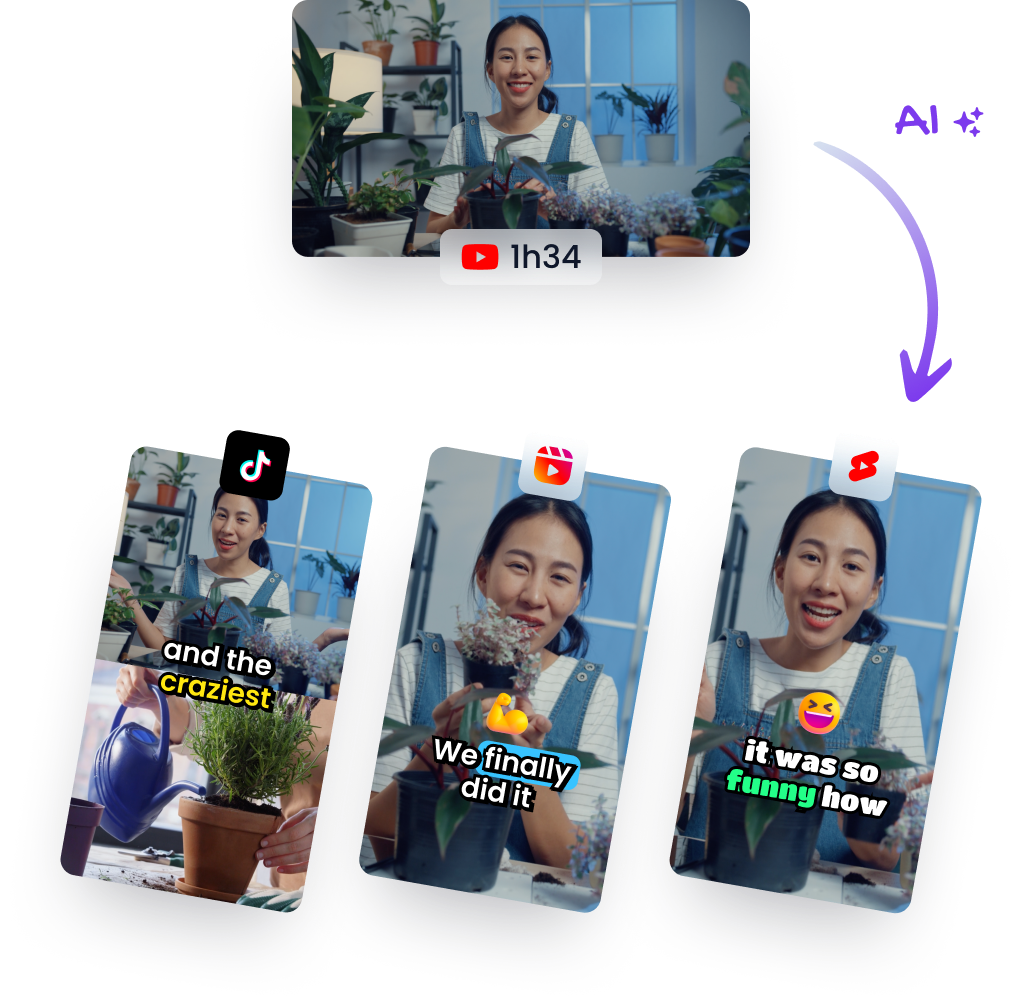
This is the specific use case where Klap fits. It takes a YouTube link or uploaded file, analyzes the long video, extracts short clips, reframes them for vertical formats, and adds captions. That makes it useful when your bigger problem isn't discovering public videos, but surfacing the strongest pieces of your own library.
What works better than manual clipping
The win isn't “AI replaces taste.” It doesn't. You still need editorial judgment.
The win is that the system handles the expensive first pass. Instead of watching from minute one to minute sixty searching for social-ready moments, you review a tighter set of candidates and make decisions faster. That's the right division of labor.
If you compare tools as part of a broader workflow, Flaex.ai's listing for Klap App for AI stacks is a useful reference point because it places the product in the context of other AI creation tools rather than treating it as a standalone editor.
Good automation doesn't remove the human. It removes the repetitive hunt.
What I'd still review by hand
Even with a strong AI pass, I still manually check:
- The opening second
The clip needs a clear start, not a breath-in or stumble. - Caption accuracy on names and jargon
Auto-captions are useful, but proper nouns often need cleanup. - Reframing on motion-heavy shots
Talking-head clips are easier than wide scenes with multiple subjects. - Whether the clip stands alone
Some “good moments” only work with prior context.
That last one matters most. A memorable line inside a podcast isn't automatically a shareable short. The clip has to make sense to someone who never watched the full episode.
Your New Video Discovery Workflow
The old version of “find this video” was passive. Search, scroll, guess, repeat.
The better version is layered. Use search operators to find candidates. Use transcripts, subtitles, and metadata to narrow them. Use visual and audio clues when words fail. Then apply the same retrieval mindset to your own archive, where the most useful clips are usually hiding in plain sight.
For outside videos, the goal is recovery. For your own videos, the goal is to maximize potential.
That distinction changes how you work. You don't just locate a forgotten clip. You build a repeatable way to surface moments, turn them into assets, and stop wasting hours on timeline scrubbing.
If you publish long-form content, your backlog is already a searchable library. Treat it like one. The creators who get the most from video in the next few years probably won't be the ones who record the most. They'll be the ones who can retrieve, reshape, and reuse what they already made.
If you want a faster way to turn long interviews, podcasts, webinars, and YouTube uploads into short, social-ready clips, Klap is built for that workflow. Paste a link or upload a file, review the moments it surfaces, clean up what you want, and publish without doing the whole hunt by hand.