How to Find a Video: Pro Methods for Any Platform
Other
You know the clip exists.
It's probably from that webinar you ran six months ago, or a podcast episode with a guest who dropped one perfect line, or a product demo someone on the team recorded and uploaded with a filename like final_v2_REAL.mp4. You can remember the moment. You can't find the file.
That's where most content workflows break. Not at editing. Not at publishing. At retrieval. If you can't find a video quickly, you can't reuse it, test it, or turn it into something that earns attention on social.
Why Finding the Right Video Is Half the Battle
The biggest waste in content teams isn't always bad creative. It's lost inventory. Brands already have webinars, interviews, customer calls, demos, launch videos, livestreams, and talking-head recordings sitting in drives, cloud folders, YouTube back catalogs, and Slack threads. The problem is access. Teams remember the asset, but not where it lives, what it's called, or whether the original version is still usable.
That matters more now because short-form has become the default battleground for reach. Short-form video is the dominant format, with 21.02% of marketers citing it as the most effective for results. The global market is projected to reach USD 59.09 billion in 2026, and 93% of marketers report landing new customers through short video ads, according to HubSpot's short-form video psychology analysis.
So when a team can't find a video, the cost isn't just annoyance. It's missed output.
What usually goes wrong
Most video libraries fail for simple reasons:
- Bad file naming: clips get saved as export-final-new or webinar-cut-2.
- No searchable transcript: nobody can search by what was said.
- Platform sprawl: the source could be on YouTube, Google Drive, Dropbox, Vimeo, Loom, Zoom, or an old landing page.
- No repurposing mindset: people archive by campaign, not by reusable moment.
Practical rule: If a clip can't be found in under five minutes, it doesn't really exist in your working library.
The fix starts with search, but not the typical approach. Typing a vague keyword into YouTube or Drive is rarely enough. You need a retrieval system that thinks like an editor: topic, speaker, phrase, timeframe, visual cue, and intended reuse.
If you're trying to identify an unknown clip before you even track down the source file, Klap's guide on what video is this is a useful companion read. It helps when the problem isn't storage, but recognition.
Think like a repurposer, not an archivist
Archivists preserve. Repurposers surface.
That shift changes what you're looking for. You're not just trying to locate the master file. You're trying to find the best reusable segment inside it. That means the search starts earlier than editing. It starts the moment you decide what kind of social clip you want: a contrarian take, a product explanation, a customer objection, a clean soundbite, or a reaction moment.
Once you search with the end use in mind, video discovery gets much faster.
Beyond the Search Bar Mastering Platform Search
Most creators search like viewers. They type a broad phrase and hope the platform figures it out. That works if the video is recent and well titled. It fails when you're looking for a buried upload, a guest appearance, or an old clip with weak metadata.

Use operators that narrow intent
A few simple search patterns save a lot of scrolling:
- Exact phrase searches: Put a phrase in quotation marks when you remember the wording. Search
"customer acquisition is getting harder"instead of customer acquisition harder. - Exclusions: Add a minus sign to cut noise. Search
product demo -shortsif short clips are cluttering results. - Channel or brand pairing: Search
founder interview site:youtube.com BrandNamein Google when platform search is weak. - Date language: Search phrases like
marketing podcast episode before:2025-01-01in search engines that support operators, then cross-check on the platform.
These work because titles and descriptions are often incomplete, but exact phrases, guest names, and topic combinations tend to survive.
Use the platform's filters before you scroll
Every major platform gives you ways to tighten the results. These options are often overlooked.
PlatformFilter worth usingBest use case
YouTube
Upload date, duration, channel
Finding an old webinar, interview, or stream
Accounts, audio, Reels tabs
Tracing reposted clips and creator originals
TikTok
Sounds, users, recent relevance
Locating trend variations and source clips
If you're on YouTube, filter by long duration when you're hunting for source material and by short duration when you're checking whether a moment was already repurposed. On Instagram and TikTok, start with the account if you know the creator. Hashtag results are often too messy unless the topic is niche.
Search for the container first, not the clip. Find the full interview, webinar, or episode. Then pull the moment from inside it.
Search with production clues
When keywords fail, use clues that creators forget they have:
- Guest name plus topic
- Series title plus month
- Launch period plus product name
- Visual identifier, like “orange background” or “black hoodie intro”
A real example: if you need a founder quote from an old show, don't search only the quote. Search the likely packaging: Founder Name podcast growth mistakes April. Packaging is often easier to recover than the line itself.
Follow adjacent signals
This is the part that separates casual searching from reliable retrieval.
- Check related channels: guest appearances often live on someone else's channel.
- Check playlist pages: webinars and event recordings are commonly grouped there.
- Check hashtags and captions: reposted clips often preserve the original creator's topic language.
- Check comments: viewers sometimes reference the exact segment or timestamp.
When I need to find a video fast, I stop thinking like a librarian and start thinking like the person who uploaded it in a rush. That usually means imperfect metadata, but predictable habits.
Digging Deeper with Reverse Search and Web Archives
Some videos won't surface through text search at all. Maybe the title changed. Maybe the upload was removed. Maybe a meme account reposted a clip without credit, and now the original is buried under copies.
That's when screenshots beat keywords.

Reverse search the frame, not the title
Grab the cleanest still you can. Good candidates include:
- A frame with a face
- A frame showing text on screen
- A distinctive background or logo
- A subtitle frame with an unusual phrase
Then run that image through reverse image search tools and compare results across Google Images, Bing Visual Search, and platform-specific searches when available. You're not looking for a perfect match every time. You're looking for clues: a reposting account, an embedded article, a thumbnail variant, or a creator page.
If the clip is widely reposted, your first win may be finding an older repost that still credits the source. That's enough to keep tracing backward.
For more detailed methods, Klap's guide to reverse video search is useful when you have only a screenshot, a repost, or a vague clip fragment.
Use web archives when the page is gone
A surprising number of useful videos were never uploaded as platform-first content. They lived on event pages, product pages, old blog posts, investor pages, course sites, or landing pages that changed later.
When that happens, use the Wayback Machine on the original page URL if you can recover it. Search for:
- old blog posts that embedded the video
- event agendas with speaker sessions
- campaign landing pages
- resource libraries that have since been redesigned
If the platform search says the video never existed, check whether it existed on a website first.
Archived pages won't always preserve playable video, but they often preserve titles, thumbnails, embed sources, surrounding copy, and timestamps. That's enough to identify the asset and hunt for a surviving upload elsewhere.
Match context, not just content
Digital detective work gets easier when you connect the frame to context:
- Was it tied to a launch?
- Did the speaker wear the same outfit in multiple recordings?
- Was the clip quoted in a newsletter or article?
- Did the company syndicate the same talk across YouTube, LinkedIn, and a blog embed?
This is slower than search-bar work, but it's often the fastest way to recover “lost” media. A screenshot plus context usually beats guessing file names in a cluttered drive.
How to Pinpoint Specific Moments and Timestamps
Finding the file is only step one. The harder and more valuable job is finding the moment worth clipping.
A two-hour webinar can contain five strong social cuts or none at all. The difference usually comes down to hooks, self-contained answers, and whether the audience can understand the point without the full setup.
Start with the transcript
If a platform provides captions or auto-transcripts, search the transcript before you scrub the timeline. Look for phrases that signal a usable clip:
- “the mistake teams often make”
- “our approach evolved”
- “the cause of this setback”
- “if a fresh start were possible”
- “a straightforward way to consider this”
Those phrases often mark complete thoughts. Complete thoughts make cleaner short clips.
If there's no transcript, generate one first. It doesn't need to be perfect. It just needs to be searchable so you can move from broad topic to exact timestamp.
Look for moments that open strong
Not every good sentence becomes a good short. Social clips need an opening that earns the next few seconds.
The moments I flag first usually have one of these shapes:
- A sharp claim “Often, teams are measuring the wrong thing.”
- A direct question
“Why do some videos stall even when the advice is good?” - A clean contrast
“Long-form explains. Short-form hooks.” - A useful mini-framework
“Three things tell you whether this clip will work.”
That matters because format changes performance. Vertical short-form videos on platforms like TikTok and YouTube Shorts achieve 15–30% higher view-through rates than horizontal content, and including auto-captions can lead to up to 45% more shares, according to this YouTube video on short-form optimization.
Scan by visual rhythm
When transcripts aren't enough, visual changes help you move faster.
Visual cueWhy it matters
Slide changes
Often signal a new point or summary
Guest handoff
Can mark a clean answer segment
Camera punch-in or layout shift
Usually coincides with emphasis
Laughter or audience reaction
Signals emotional energy
These cues help when the transcript is long and flat. A strong clip usually has not just a good sentence, but a clear shape and energy change.
The best short clips feel complete on their own. If the viewer needs the previous two minutes to understand it, keep looking.
Mark wider than you think you need
When you find a promising timestamp, don't cut too tightly at first. Mark a wider in and out point so you preserve lead-in and reaction. Editors often lose a good clip by trimming away the breath before the punchline or the sentence after the insight.
A practical workflow is simple: shortlist five candidate moments, rank them by opening strength, then test whether each one still makes sense with captions and no surrounding context. If it doesn't survive that test, it's not ready for social.
Turn Your Found Video into Viral Shorts with Klap
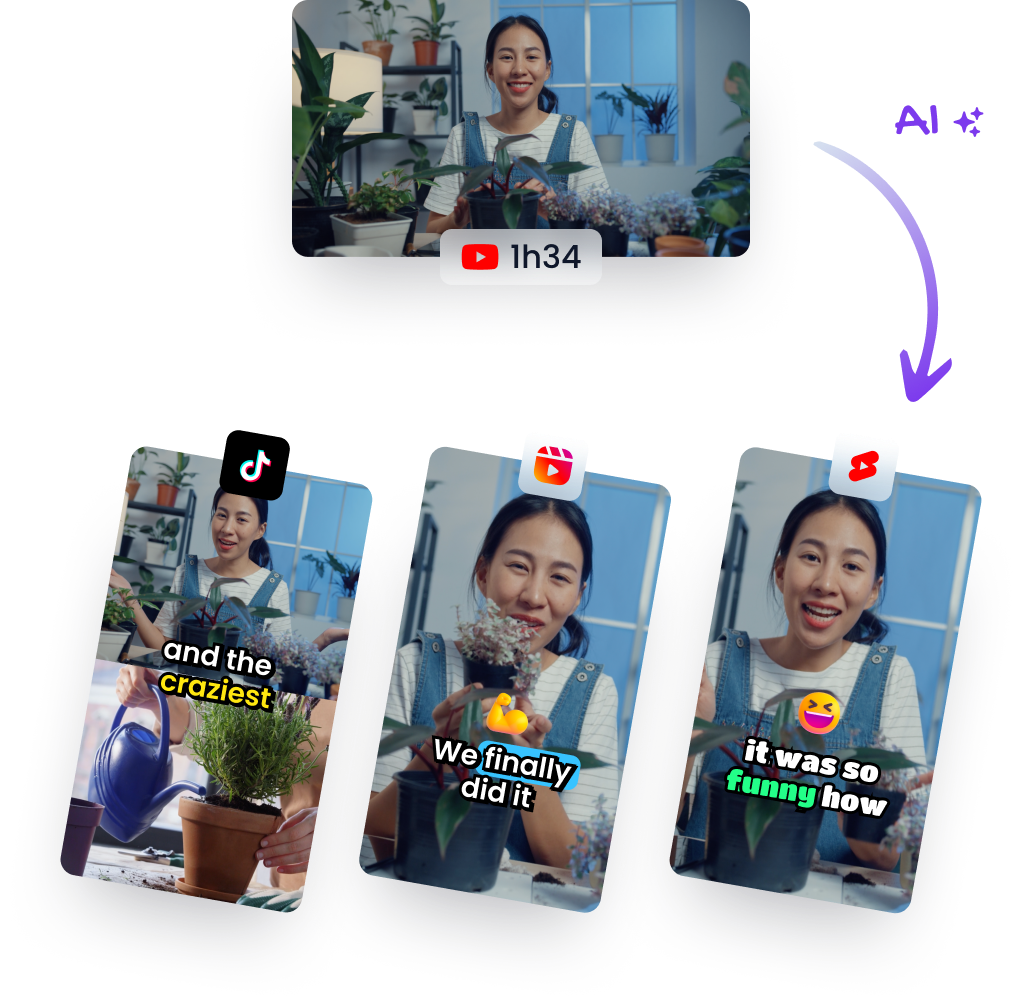
You finally recover the webinar, interview, or podcast episode you forgot you had. You mark three moments that could work on Shorts, Reels, or TikTok. Then the true time sink shows up. Cropping, captioning, reframing, exports, and review can turn one good find into an afternoon of production work.

That production step is where repurposing projects stall. The search is done. The value is identified. But the team still has to package each moment for social in a format people will choose to watch on a phone.
Where manual clipping breaks down
Manual clipping works for a few assets a month. It breaks once you start treating your archive like a content library.
One long-form video can contain several usable short segments, but every clip needs the same repetitive work. Find the start frame. Trim dead air. Reframe the speaker. Add readable captions. Check whether the quote still makes sense out of context. None of those tasks are hard on their own. Together, they create a queue.
There is also a quality issue. AI can speed up selection and editing, but it still needs review. Analysts at AdMonsters found that in practical AI video automation, usable yield can land around 4% to 5%, with creators often needing multiple takes and review passes to get publishable output, according to AdMonsters' breakdown of AI video yield. That matches what I see in repurposing workflows. The gain comes from reducing manual editing time, not from skipping editorial judgment.
Why clip generation is useful after the search phase
Once you already know the source video is strong, a repurposing tool earns its keep fast. Upload the file or paste the YouTube link. Let the tool surface likely highlights, convert the frame for vertical viewing, and draft captions. Then review the outputs instead of building every cut by hand.
That changes the workflow in a practical way. You spend time choosing the right moments and polishing the winners, not doing the same formatting steps over and over.
The biggest time savings usually come from:
- spotting candidate hooks from a longer recording
- converting horizontal footage into vertical layouts
- generating and cleaning up captions
- preparing review-ready cuts for multiple social platforms
Here's a look at that workflow in motion:
What a smart review process looks like
Good teams still review every clip before publishing. They check for:
- factual accuracy
- hook strength in the first seconds
- caption cleanup
- framing on speakers and products
- whether the clip stands alone without explanation
If you want a closer look at that part of the process, this guide to an AI video clipping tool walks through the workflow well.
The primary advantage is not automation by itself. It is turning a hard-to-find source video into a repeatable stream of short-form content without burning hours on formatting work.
Your New Workflow for Limitless Content Creation
The reliable system is simple. Find the source. Pinpoint the moment. Repurpose at scale. Many teams do the third part first and wonder why output feels chaotic. The advantage is in the order.

The workflow that saves time
A practical weekly rhythm looks like this:
- Identify one strong long-form asset
Start with a webinar, interview, podcast, customer story, or demo that already contains clear expertise. - Use advanced search to recover it fast
Search by phrase, guest, timeframe, channel, screenshot, or archived page. - Mark the best standalone moments
Use transcript search, visual cues, and opening strength to shortlist clips. - Generate social-ready versions
Turn selected moments into vertical, captioned shorts for TikTok, Reels, and Shorts. - Track what deserves a second life
Keep a simple vault of your best themes, quotes, and timestamped source videos.
Why this compounds
This system works because it treats your old content like an asset library instead of a graveyard. The more organized your retrieval gets, the more often you can reuse a strong insight in a fresh format.
That has a direct operational upside. Content creators who use AI-driven repurposing save an average of 3.5 hours per week on manual editing while increasing their posting frequency by 40%, according to this Filmora review covering Klap-style repurposing workflows.
A searchable video library is a production system. Every recovered clip lowers the cost of your next post.
Most advice on how to find a video stops at discovery. The better play is to build a repeatable path from discovery to distribution. Once that's in place, every old upload becomes raw material.
If you've got a webinar, podcast, interview, or YouTube video sitting in your archive, try running it through Klap. It's built to turn long-form footage into social-ready shorts fast, with AI-assisted clip selection, vertical reframing, and captions so you can spend less time digging through timelines and more time publishing.