AI Caption Generator: A Guide to Faster Video Content
Other
You've got a strong video, a clean edit, and a publishing deadline. Then the caption work starts. Manual transcription drags, subtitle timing gets fussy, and the final pass turns into a hunt for misspelled names, awkward line breaks, and captions that land half a beat too late.
That's why the AI caption generator has moved from nice-to-have tool to standard part of a modern video workflow. But speed alone isn't the sole concern. Generating captions rapidly is now commonplace. The bigger question is whether the captions hold up when your content includes interviews, podcasts, webinars, accents, jargon, or overlapping speakers.
That's where a lot of buying decisions go wrong. People compare caption styles and export buttons, then discover the hard part later in editing. If you want captions that save time, you need to understand how the tools work, what breaks accuracy, and how to fit captioning into a repeatable publishing system.
What Is an AI Caption Generator and How Does It Work
Manual captioning is one of those tasks that looks simple until you do it by hand. You listen, transcribe, pause, rewind, set timestamps, fix punctuation, then adjust everything again when one subtitle block stays on screen too long.
An AI caption generator automates that process. It functions as a fast transcription assistant paired with a timeline editor. It listens to the audio, turns speech into text, aligns that text to specific moments in the video, and exports subtitles in formats your editing stack can readily use.

The core pipeline
Most caption tools follow the same technical path:
- Speech recognition turns spoken audio into text.
- Time alignment matches each word or caption segment to the video timeline.
- Editing and export lets you correct text and deliver files such as SRT, VTT, TXT, DOCX, PDF, or JSON, as described by ElevenLabs' caption generator overview.
The part many buyers overlook is the timing layer. Tools with word-level or character-level timing are much easier to edit because you can fix a single wrong word without rebuilding an entire caption block.
Practical rule: If a caption tool only lets you edit chunk by chunk, cleanup gets slow fast.
Why modern tools got much better
The jump in caption quality didn't happen by accident. It came from much larger speech models and better workflow integration. One useful benchmark comes from OpenAI's Whisper model, which was released in 2022 and trained on 680,000 hours of multilingual audio, according to this summary of historical facts about AI captioning.
That scale matters in practice. Better training usually means stronger handling of varied accents, speaking styles, and recording conditions. It doesn't mean captions are perfect. It does mean today's tools are much more usable than the first generation of auto-subtitle features.
If you want a broader foundation for where these systems fit into content work, this expert guide to generative AI is a useful companion read.
What the output should give you
A good AI caption generator shouldn't just create text. It should give you a working asset inside your production flow.
Look for output that supports:
- Platform publishing: Burned-in captions for Shorts, Reels, and TikTok.
- Subtitle reuse: Separate files for YouTube, training videos, or client delivery.
- Precise correction: Word-level edits when names, product terms, or industry language get misheard.
If the tool saves time on generation but forces clumsy cleanup later, it's not really saving time.
Why Captions Are Essential for Modern Video
A creator clips a strong interview moment for Reels. The guest name is misspelled, one quote is wrong, and the opening line makes no sense with the sound off. The clip still gets published because the deadline is close. That is usually where captions stop being a formatting task and become a content quality issue.
Captions still matter for accessibility first. They give deaf and hard-of-hearing viewers access to the content, and that should be the baseline. They also help in the very common viewing conditions that shape performance now, like muted autoplay, noisy commutes, open offices, and quick social scrolling.

Accessibility sets the baseline
Good captions make video usable, not just available.
That distinction matters. A file with auto-generated subtitles attached technically checks a box. A file with clear phrasing, correct names, readable timing, and sensible line breaks helps people follow the message. For creators and marketing teams, that gap shows up fast in audience retention and in the number of edits required before publishing.
Silent viewing changed what counts as watchable
A large share of social video is consumed with the sound off, so the first few caption lines often carry the hook. If those lines are clean, viewers can follow the setup immediately. If they are clumsy or inaccurate, the clip feels low quality before the speaker has made the point.
This is especially important for interviews, podcasts, webinars, and customer conversations. In those formats, the wording carries the value. A missed product term, misheard statistic, or wrong attribution does more than look sloppy. It changes meaning.
Accuracy matters as much as visibility
A lot of articles stop at "captions help engagement." That is true, but it misses the harder part of real production work. Captions only help if they are accurate enough to trust.
In controlled recordings, many tools can produce decent results. In real audio, quality drops fast. Podcast mics clip. Remote guests talk over each other. Interview subjects use brand names, acronyms, and industry terms that generic caption tools often get wrong. If your workflow depends on publishing short clips from long conversations, caption accuracy becomes part of editorial accuracy.
That is why I treat captions as part of the asset, not decoration. If the subtitles misquote the speaker, the clip is wrong even if the visuals look polished.
Captions also make distribution easier
Captions create usable text around the video. That helps with review, repurposing, approvals, and platform-specific edits.
In practice, strong captions support three jobs:
- Faster clip selection: Teams can scan transcript text to find usable moments before cutting.
- Cleaner repurposing: One interview can be adapted into Shorts, Reels, TikToks, and longer-form uploads without rebuilding context from scratch.
- Better comprehension in imperfect conditions: Viewers can still follow the point when audio is muted, noisy, accented, or less than studio clean.
Teams that treat captions as an afterthought usually pay for it later. They either publish muted clips that lose viewers early, or they push auto-captions live and spend time correcting public mistakes after comments point them out.
Key Factors That Determine Caption Accuracy
Most product pages sell speed. Real users buy based on cleanup time.
That's the critical difference. If you're captioning talking-head videos recorded in a quiet room with one speaker, many tools will look similar. If you're working with podcasts, interviews, webinars, or panel recordings, accuracy starts to separate the lightweight tools from the serious ones.
Multi-speaker audio is where weak tools break
The hard cases are predictable. One speaker interrupts another. Two hosts talk over each other. A guest has a strong accent. Someone references a person, product, or acronym the model hasn't seen clearly in context.
These are normal recording conditions, not edge cases. That's why one of the most useful evaluation criteria is whether a tool handles speaker changes, names, jargon, and crosstalk well. Choppity's tool page highlights those pain points directly and points to multi-speaker detection as a meaningful differentiator in real-world captioning, as described in its video caption generator overview.
Timing precision matters more than people expect
Accuracy isn't only about whether the words are right. It's also about whether the captions land at the right moment.
If the software groups speech into rough blocks, editing becomes annoying. Fixing one phrase can throw off the entire subtitle segment. With word-level timing, you can tighten the text without rebuilding the timeline from scratch.
A practical way to judge this is to ask what happens when you need to correct:
- A speaker name that appears once but matters a lot
- An industry term that was transcribed phonetically
- A sentence collision where one person cuts in before another finishes
If the answer is “you'll need to manually retime the section,” expect friction.
The best caption tools don't eliminate editing. They reduce the pain of editing.
Audio quality still sets the ceiling
No model can fully rescue bad source material. If the mic is distant, the room is echoey, and the conversation overlaps constantly, the caption generator is starting from weak input.
That doesn't mean AI captions fail. It means your workflow should reflect reality. For clean solo narration, you can trust the first pass much more. For long interviews, plan for review.
A useful mental model is this short table:
Content typeWhat usually matters most
Solo tutorial
Fast transcription and clean formatting
Podcast interview
Speaker separation and jargon handling
Webinar
Long-form consistency and export flexibility
Street or event clip
Noise tolerance and readable burned-in captions
When people say one tool is “accurate,” that claim is incomplete unless you know for what kind of audio.
Choosing the Right AI Caption Generator for You
The wrong way to choose a caption tool is to start with templates and text animations. Those features matter later. Start with your actual workload.
If you mostly publish polished tutorials with one speaker, your checklist will be different from a team repurposing long podcast episodes into a stream of short clips. The tool has to fit the content you make every week, not the demo video on the homepage.
Match the tool to the job
I usually evaluate an AI caption generator against four questions.
- How well does it transcribe your kind of audio
Don't ask whether it supports captions. Every tool says yes. Ask how it handles accents, names, interruptions, and topic-specific vocabulary. - How easy is cleanup after the first pass
Editing controls matter. Word-level timing, speaker labels, and intuitive correction tools save more time than flashy preset styles. - Does it fit the rest of your workflow
Some teams need a caption utility. Others need a broader repurposing flow. If you work from long-form video, a platform like Klap can sit closer to the full short-form pipeline by taking a source video, finding clip-worthy segments, adding captions, and preparing social-ready outputs. - Can it export what your stack needs
SRT and VTT are table stakes. Text and structured exports can also help if your team reuses transcripts for blogs, summaries, approvals, or translation.
Compare workflow, not just features
A simple comparison sheet helps more than a trial-and-error spree.
Decision areaWhat to check
Accuracy
Test with your messiest real file, not a clean sample
Editing
Look for precise timing and fast correction
Styling
Confirm brand fonts, colors, and subtitle layouts
Output
Make sure subtitle and video exports match your channels
If you're weighing dedicated subtitle apps against broader repurposing tools, this guide to closed captions software options is a practical place to compare approaches.
A fast test that reveals a lot
Before committing, run one difficult file through each option. Not your best audio. Your most annoying audio.
Use a clip with:
- Two speakers
- At least a few proper names
- Some natural interruption
- A section you'd publish on social
That test reveals far more than a polished marketing demo. The actual cost of a caption generator isn't the first render. It's how long your editor spends fixing what comes next.
The Modern Workflow From Long Video to Captioned Shorts
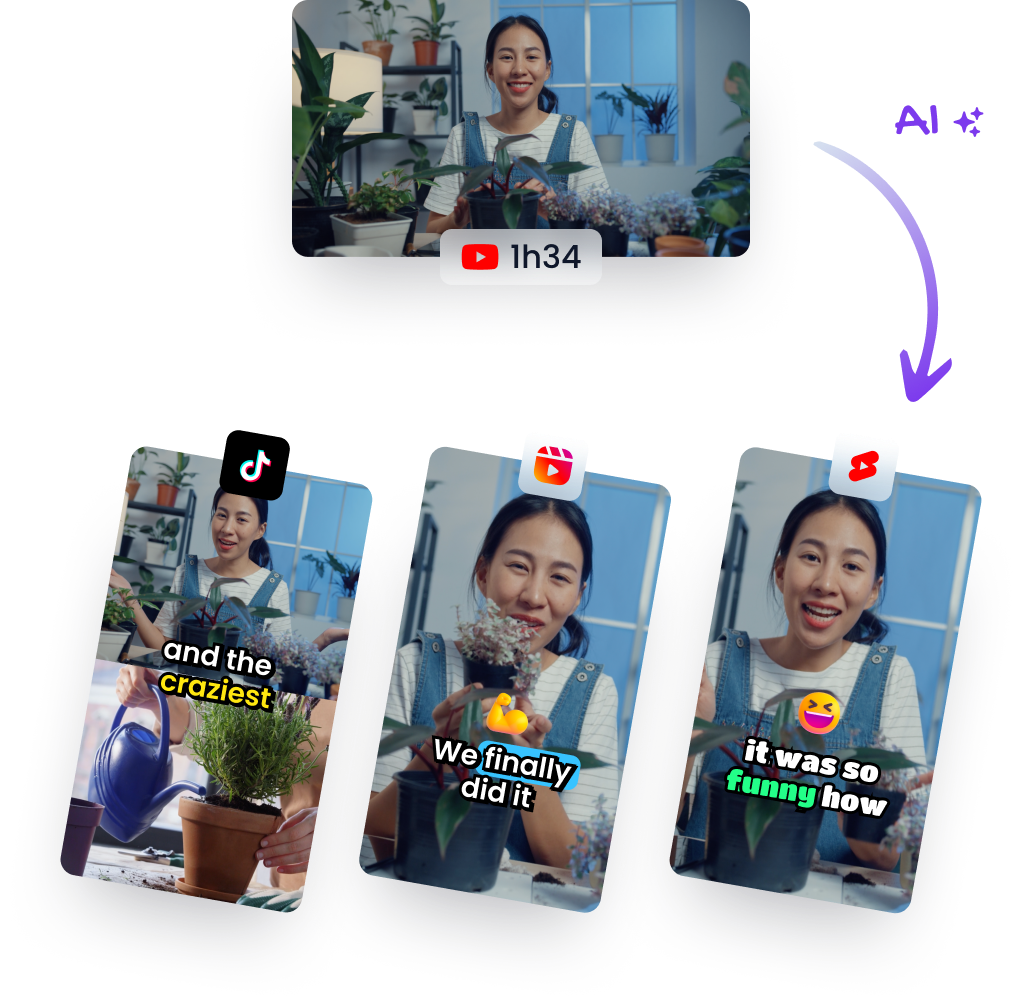
The old workflow treated captioning as the final checkbox after editing. The newer workflow starts earlier. Teams take one long source asset, break it into short-form pieces, caption those clips as part of the same process, and publish multiple platform-ready versions without rebuilding everything by hand.
That shift matters because most creators don't need “captions” in isolation. They need usable clips.

What an efficient flow looks like
A typical modern workflow starts with a long video source. That could be a podcast episode, a webinar replay, a YouTube interview, or a recorded training session.
From there, the process usually looks like this:
- Import the source video by upload or link.
- Run AI analysis to identify potentially strong segments.
- Generate captions while the platform processes the transcript and timing.
- Review the proposed clips for hook strength, framing, and subtitle clarity.
- Adjust and export versions for vertical social formats.
The key gain comes from combining these steps instead of treating each one as a separate production task.
Where captioning fits inside repurposing
In a repurposing workflow, captions do more than display dialogue. They help shape the clip.
A good subtitle layer can make a short video easier to follow on mute, clarify quick cuts, and keep the core phrase visible during the most important seconds. If the captions are hard to edit, that bottleneck slows everything else down.
For teams converting long videos into snippets, text extraction is also useful beyond subtitles. A transcript helps with clip review, hook selection, and content approval. If you're interested in that side of the workflow, this guide on turning video to text shows how transcript-driven editing supports faster reuse.
A strong short-form process doesn't ask editors to rebuild context from scratch. It keeps the transcript, captions, crop, and clip selection connected.
Here's an example of the broader workflow in motion:
What still needs a human pass
Even with a smooth system, human review still matters in three places:
- Hook selection: AI can identify engaging sections, but a marketer still needs to judge relevance and audience fit.
- Caption cleanup: Proper nouns, product language, and abrupt speaker switches deserve a quick check.
- Final packaging: Thumbnail choice, opening frame, and platform-specific edits still affect whether the clip feels native.
That's the practical balance. Let the software compress the heavy labor. Keep humans focused on judgment calls.
Best Practices for Optimizing AI Generated Captions
Auto-generated captions are a draft, not a finish line. The tools can handle the first pass. The professional polish still comes from review, formatting choices, and a clear sense of what the viewer needs on a small screen.
A lot of creators leave performance on the table. They generate captions, accept every default, and publish. A small amount of intentional editing usually makes the video easier to follow and more aligned with the brand.
Edit for clarity first
Start with correctness, then improve readability. If the AI missed a product name, guest name, or industry phrase, fix that before touching style.
Then tighten the caption flow:
- Break long thoughts cleanly: Don't force viewers to read dense subtitle blocks while the speaker keeps moving.
- Remove filler when needed: Spoken language often includes repetitions that don't help on-screen readability.
- Check punctuation for meaning: A missing comma or question mark can change tone fast.

Format for mobile viewing
Social captions aren't transcript dumps. They're visual copy layered on moving footage.
A few practical adjustments help a lot:
- Keep lines visually scannable: Shorter lines are easier to process on vertical video.
- Highlight sparingly: Emphasize key words, but don't turn every sentence into a motion-graphics poster.
- Respect the frame: Avoid placing captions where platform UI or profile overlays will compete with them.
If you need a walkthrough for the implementation side, this guide on how to add captions to videos covers the practical setup.
Short-form captions work best when they read like speech but scan like copy.
Keep captions in brand voice
This part gets overlooked because captions feel “technical.” They're still writing.
If your brand is direct and clean, your captions should reflect that. If your content is playful, your caption styling and wording can carry some of that energy without becoming distracting.
A useful review pass checks for:
Review areaWhat to look for
Vocabulary
Terms that match how your brand actually speaks
Tone
Formal, casual, sharp, or conversational consistency
Speaker labels
Clear distinctions in interviews or podcasts
Context cues
Helpful notes such as [Music] or [Laughter] when they aid comprehension
The best AI caption generator helps you get to a solid first draft fast. The best publishing habit is knowing exactly what to refine before the clip goes live.
If you're already sitting on long podcasts, interviews, webinars, or YouTube videos, Klap is worth a look for turning that existing footage into captioned short-form clips without handling every step manually.