Summarize YouTube Video AI: A Complete How-To Guide
Other
You've probably done this recently. You open a YouTube video because the title promises exactly what you need, then notice it's half an hour long. You don't have half an hour. You need the key points, the quotable insight, or the one segment worth turning into a short clip.
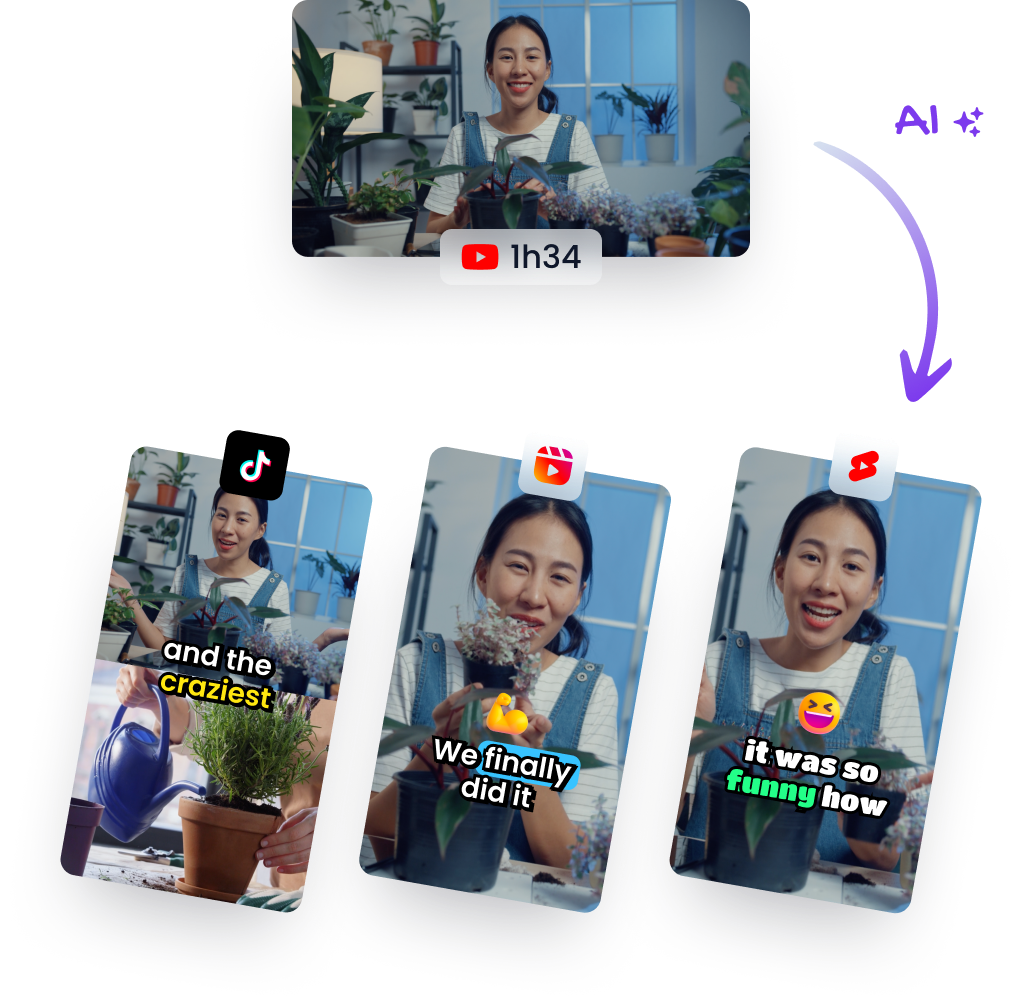
That's where AI summarization stops being a novelty and becomes workflow infrastructure. Used well, it helps in two different ways. First, it turns long videos into usable text notes for research, writing, and learning. Second, it helps identify the moments worth repurposing into short-form content for TikTok, Reels, and Shorts.
Most guides blur those together. That's a mistake. The workflow for extracting notes is different from the workflow for finding audience-worthy highlights. If you treat both jobs as the same task, you usually end up with weak summaries and forgettable clips.
Why Summarizing YouTube Videos with AI is a Game-Changer
The pressure point is simple. There's more video than anyone can reasonably process, and most of it is longer than your schedule allows.
As of 2024, YouTube has over 2.7 billion monthly users, the average video length is 12 minutes, and reports from 2025 show over 65% of mobile users will skip videos longer than 10 minutes if a summary isn't available, according to Heuristi's YouTube summarizer analysis. That changes how people learn from video and how marketers need to package it.

A practical summarize YouTube video AI workflow helps in two situations that come up constantly.
When you need the ideas, not the footage
A strategist watching a founder interview doesn't need every pause, tangent, or anecdote. They need the thesis, supporting points, objections, and maybe two lines worth citing in a draft. AI can compress that into a research-friendly format quickly, especially when the transcript is clean.
That's why text summarization works so well for:
- Research notes that pull out arguments and examples
- Content briefs built from webinar or interview transcripts
- Learning workflows where you want retention without rewatching
When you need distribution, not just understanding
The second use case is more commercial. A podcast episode, webinar, or interview often contains multiple short segments with strong hooks. Those moments are buried inside long-form content. AI can help surface them faster than manual scrubbing.
Practical rule: Use one workflow to understand the full video, and a different workflow to package the strongest moments for reach.
That shift matters for anyone publishing consistently. A long video can become notes, article inputs, social copy, and short clips if you build around extraction instead of passive viewing. Teams already exploring AI video workflows for repurposing usually get the most value when they treat the original upload as raw material, not finished distribution.
How AI Actually Summarizes a YouTube Video
AI summarizers are often treated like a black box. In practice, the output quality depends on a few visible steps, and once you understand them, it gets easier to judge which summaries to trust.
Production-grade AI summarization uses a three-step method: Automatic Speech Recognition (ASR) for transcripts, Computer Vision for analyzing frames, and Natural Language Processing (NLP) to synthesize both into a coherent summary. This process can improve a team's efficiency by up to 25%, according to Enterprise Tube's breakdown of AI video summarization workflows.

It starts with the transcript
If the transcript is bad, the summary usually follows it off course. ASR converts spoken audio into text, and that text becomes the foundation for almost everything the model does next.
Many weak summaries fail because technical terms get mistranscribed. Names get mangled. Sentence breaks land in the wrong place. If you're summarizing a lecture, interview, or tutorial, those errors can change the meaning of the takeaway.
There are two summary styles
A useful way to think about summarizers is this:
MethodWhat it doesWhen it works best
Extractive
Pulls key sentences directly from the transcript
Research notes, meeting-style recaps, factual content
Abstractive
Rewrites the material into a new, shorter summary
Executive summaries, cleaner blog inputs, simplified explanations
Extractive summaries stay closer to the source. They're usually safer when accuracy matters. Abstractive summaries read better, but they can smooth over nuance or overstate certainty if the transcript is weak.
If a summary sounds cleaner than the speaker actually was, check whether the model rewrote the meaning or just improved the phrasing.
Visual context fills in what audio misses
A good summarizer doesn't only listen. It also checks the screen. Computer vision can catch slide titles, diagrams, product labels, code snippets, and scene changes. That matters in tutorials and demos where the most important information may appear on screen rather than in the spoken narration.
For anyone evaluating tools, that's the key distinction. Basic tools mostly summarize text. Stronger systems combine transcript understanding with on-screen context and then package the result into bullet points, timestamps, or Q&A outputs. If you want a deeper look at tools built specifically for this job, this guide on AI to summarize videos is a useful starting point.
Workflow for Generating Text Summaries and Notes
If your goal is learning, research, or writing, don't start with a flashy summarizer extension. Start with the transcript. That gives you more control, fewer formatting surprises, and a much better chance of catching mistakes before they show up in your notes.
A 2025 Pew Research Center study found 78% of U.S. adults using YouTube for learning use an AI tool to summarize videos, 52% cite time savings as the main reason, and Google's native Summarize button was processing 15 million summaries per month by early 2025, according to Wayin's review of video summarizer adoption. The behavior is mainstream now. The advantage comes from using it better than everyone else.
A clean workflow that holds up in practice
Here's the process that works reliably for long interviews, webinars, and educational videos.
- Open the transcript first
On YouTube, pull up the transcript if it's available. Scan the first part before doing anything else. If the speaker names, terms, or topic phrases are already wrong, expect the summary to need heavier editing. - Decide the output format before prompting
“Summarize this video” is too vague. Ask for one specific output:- Bullet summary for quick review
- Detailed notes for research
- Executive summary for stakeholders
- Topic clusters if the video jumps around
- Paste the transcript into ChatGPT, Gemini, or a similar model
If the transcript is long, split it into chunks and ask the model to summarize each section first. Then ask for a final synthesis from those chunk summaries. - Ask for timestamps only if they exist in the source text
Don't let the model invent structure. If timestamps aren't in the transcript you pasted, request “section references based on transcript order” instead.
Prompt templates worth reusing
Use prompts that tell the model what to preserve.
Use this for research notes:
“Summarize this transcript into 7 to 10 bullet points. Keep the speaker's main arguments, objections, examples, and any specific tools mentioned. Do not add information that isn't in the transcript.”
Use this for a blog draft input:
“Turn this transcript into an editorial summary with a short intro, 5 key takeaways, and a list of phrases or ideas worth expanding into article sections.”
Use this for study notes:
“Create structured notes from this transcript. Group ideas by topic, define important terms in plain English, and end with 5 review questions based only on the source material.”
Where manual handling still wins
For nuanced content, transcript-first workflows are often safer than one-click extensions. That's especially true for interviews with layered arguments, technical terminology, or messy pacing.
A simple comparison helps:
GoalFaster optionSafer option
Quick gist
Native summary button or extension
Transcript plus short prompt
Citable notes
AI summary tool
Manual transcript review plus model
Deep research
Auto-summary
Section-by-section transcript synthesis
If you're building a repeatable editorial pipeline, it also helps to pair summaries with clean source text. A practical foundation is a transcript workflow like the one covered in transcribe video to text, then use AI on top of that instead of treating AI as the first and only step.
Turning Summaries into Engaging Short-Form Videos
Text summaries help you understand a video. They don't automatically help you distribute it. That's where the second workflow starts.
For short-form repurposing, “summary” really means highlight detection. You're not asking AI to explain the whole video. You're asking it to find the moments that can survive outside the original context and still hold attention.

AI video repurposing tools can cut editing time by up to 90%, enabling creators to generate 5 to 10 short clips from a single long-form video in under 10 minutes, according to Eduonix's analysis of AI repurposing workflows. That's the part that matters to marketers. The bottleneck shifts from editing every clip by hand to choosing what deserves publishing.
Good clips aren't just short segments
A weak repurposing workflow chops video by length. A strong one selects clips by audience value. Those are different.
The segments worth turning into shorts usually have at least one of these traits:
- A sharp opening line that works as a hook without setup
- A clear claim that people can agree or argue with quickly
- A practical answer to a common question
- A visible emotional shift in tone, pace, or emphasis
- A standalone payoff that doesn't depend on five minutes of previous context
That's why long-form summarization and clip generation shouldn't be treated as identical tasks. A perfect textual summary might emphasize the most important argument. A perfect short clip might emphasize the most watchable delivery of one argument.
What the repurposing workflow should do
When you use a tool for highlight extraction, look for these functions together:
NeedWhat the tool should handle
Moment selection
Find segments with strong hooks or clear takeaways
Reframing
Convert horizontal footage into vertical composition
Captions
Add readable subtitles that fit short-form viewing
Trim control
Let you adjust openings and endings manually
Export readiness
Produce clips usable on Shorts, Reels, and TikTok
One option in this category is Klap, which takes long-form videos or YouTube links, analyzes the content, identifies engaging segments, reframes them for vertical formats, and adds captions for social-ready clips.
A walkthrough helps make the difference clearer:
- Start with a long-form source
Use a webinar, podcast, interview, tutorial, or creator upload with several distinct talking points. - Let AI identify candidate moments
This narrows the field. Instead of reviewing the full video line by line, you review possible clips. - Evaluate clips by feed context
Ask one question: would this make sense to a viewer who has never seen the original video? If not, trim harder or skip it. - Edit the first second aggressively
Short-form performance often depends on the opening beat. Remove throat-clearing intros and get to the statement.
Here's a visual example of that workflow in action:
Short-form repurposing works best when you treat each clip like a native post, not a miniature archive of the original video.
The practical payoff is scale. One long video can serve research, article production, and clip distribution, but only if you separate the note-taking job from the audience-attention job.
Refining AI Output for Accuracy and Impact
AI output is a draft. Sometimes it's a strong draft. It's still a draft.
That matters even more when the source video has weak captions, non-English auto-generated subtitles, or poor audio. A critical challenge is the lack of reliable AI summarization for videos with auto-generated captions in non-English languages, which have 40% lower accuracy, and 75% of users will abandon a tool if the timestamps are inaccurate, according to Nearity's analysis of YouTube AI summary limitations.

Check the source before you polish the wording
If the transcript is flawed, editing the summary for style won't fix the underlying problem. Review the parts most likely to break:
- Names and terminology that ASR often mishears
- Numbers and dates spoken quickly in the original video
- On-screen text that may not appear in the transcript
- Timestamp alignment if you plan to use the summary for reference
Use a review pass with a specific checklist
Don't just read the summary and ask whether it “looks right.” Check it against the original with a narrow lens.
- Verify key claims against the actual transcript or video segment
- Restore nuance when the AI compresses disagreement into false certainty
- Cut filler if the summary sounds polished but vague
- Rewrite captions for readability when spoken phrasing doesn't work on screen
- Adjust clip boundaries so the segment starts on the hook and ends on the payoff
Editorial check: If a point is important enough to publish, it's important enough to verify against the source.
Tailor output to the destination
Text summaries need clarity and fidelity. Short-form clips need clarity and momentum. Those are different editing jobs.
For notes, preserve meaning even if the wording stays rough. For shorts, improve readability and pacing even if you need to trim repeated words or tighten pauses. The mistake is assuming AI's first output already matches the audience format.
A quick review table helps:
Output typeWhat to fix first
Research notes
Accuracy, missing context, mislabeled ideas
Blog input
Structure, redundancy, topic grouping
Short clips
Hook timing, caption clarity, start and end points
Putting AI Video Summarization to Work
The strongest summarize YouTube video AI workflow isn't one tool. It's a decision.
If you need to learn faster, use AI on transcripts to produce notes, topic breakdowns, and article inputs. If you need to publish more efficiently, use AI to find highlight-worthy moments and turn them into short-form assets people will watch.
That split keeps the process clean. Text summarization is about comprehension and recall. Clip summarization is about selection and packaging. Treat them differently, and both get better.
There's also a practical mindset shift behind all this. Stop thinking of YouTube as a stream you either watch or ignore. Treat each video as material you can mine. Some videos deserve a bullet summary. Some deserve a set of research notes. Some deserve three vertical clips and a caption draft. Many deserve all of the above.
The teams that get the most value from AI aren't the ones pressing the summarize button fastest. They're the ones building a repeatable workflow around review, refinement, and repurposing.
If you want a faster way to turn long videos into social-ready clips, Klap is built for that repurposing workflow. You can upload a video or paste a YouTube link, let the AI identify strong segments, review the suggested clips, edit captions and cut points, then export vertical shorts for platforms like TikTok, Reels, and YouTube Shorts.