How to Convert YouTube Videos to Shorts: A Practical Guide
Other
Turning your long-form videos into Shorts isn't just a clever trick; it's a powerful growth strategy. Instead of letting your best content collect dust, you can find the highlight moments and give them a second life as snappy, vertical clips. The data is clear: channels that actively repurpose long-form content see a measurable lift in subscribers and overall watch time.
Frankly, it's one of the highest ROI activities for creators today.
Why Converting Videos Into Shorts Is a Growth Superpower
The magic here is that YouTube Shorts run on a totally different discovery algorithm than your regular videos. This gives you a fresh shot at getting in front of millions of new viewers—people who might never have stumbled upon your channel otherwise. A single 20-minute deep dive could realistically become 5-10 high-impact Shorts. Each one acts like a targeted ad for your channel, pulling in a new audience segment and boosting your visibility with minimal extra effort.
Unlocking a New Audience
The sheer scale of the Shorts audience is staggering. YouTube's short-form content now pulls in over 70 billion daily views. That's a massive, engaged audience actively looking for quick, compelling videos. By not converting your existing content, you're essentially leaving a huge potential audience on the table.
This explosion in viewership has led to an incredible volume of content, with millions of Shorts being uploaded daily. The best part? The average engagement rate for Shorts often surpasses that of long-form videos for many channels, giving you a real chance to connect with viewers in a fast, impactful way. Your repurposed clips land right in the endless scroll of the YouTube Shorts feed—a prime discovery engine for any creator.
Your best long-form content deserves more than one chance to be seen. Converting it into Shorts is like creating multiple doorways for new viewers to find their way back to your channel.
To help you see the distinct advantages, here's a quick comparison of what each format brings to the table.
Long-Form vs. Short-Form Content Potential
AttributeLong-Form VideoYouTube Shorts
Primary Goal
Deep engagement, building authority
Discovery, audience growth
Audience
Existing subscribers, niche viewers
Broad, new audiences
Discovery
Search, suggested videos, browse
Shorts feed algorithm, trends
Watch Time
Builds channel authority, monetization
High volume, quick views
Content Style
In-depth, educational, narrative
Quick hooks, high-impact moments
Repurposing allows you to tap into the best of both worlds, using the broad reach of Shorts to funnel new, interested viewers back to your in-depth long-form content.
Expanding Your Content Ecosystem
And this strategy isn't just limited to YouTube. Once you have a smooth workflow for creating Shorts, you can apply the exact same principles to other vertical video platforms like TikTok and Instagram Reels.
This is all about creating a connected ecosystem where every piece of content you make supports the others, building a powerful engine for your channel's growth and visibility.
The Smart Way: Using AI Tools Like Klap
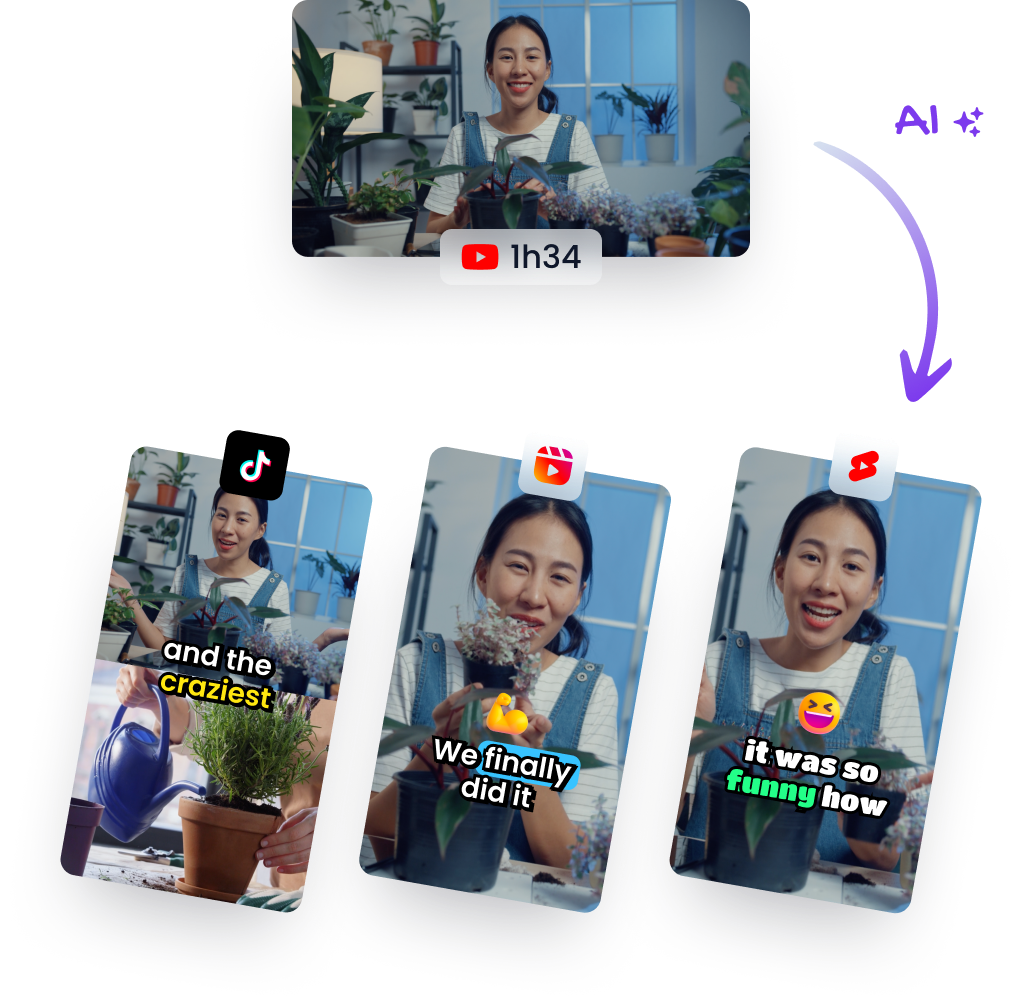
Let’s be honest, manually scrubbing through hours of footage just to find a few golden seconds for a Short is a massive time sink. For creators who'd rather be creating than editing, this is a huge bottleneck. This is exactly where AI-powered tools come in. They completely change the game, turning the tedious job to convert YouTube video to Shorts into a fast, automated process. Instead of spending a day editing, you can generate a week's worth of content in minutes.
Platforms like Klap were built for this exact problem. The concept is simple but incredibly powerful: you give it a link to your long-form video, and the AI does all the heavy lifting. It scans the transcript, pinpoints the most engaging moments based on topical relevance and speech patterns, and automatically creates short, vertical clips ready for social media.
This approach is especially effective for certain types of content:
- Interviews and Podcasts: The AI can easily isolate impactful questions, insightful answers, or funny interactions.
- Tutorials and How-To Guides: Each step or tip in your guide can become a standalone, high-value Short.
- Listicles or "Top 5" Videos: The AI can effortlessly break down each numbered point into its own clip.
- Product Demos: Highlighting specific features or benefits becomes a simple, automated task.
This workflow shows how repurposing your long videos into Shorts creates a direct pipeline for audience growth.

The big takeaway here is that you're not just recycling content. You're creating tons of new entry points for people to discover you and your channel.
How AI Finds Your Best Moments
The real intelligence behind a dedicated long to short video converter is its ability to understand your content in context. The AI isn't just randomly slicing up your video; it’s actively looking for signals that indicate a "potential viral moment."
What kind of signals? It's looking for things like:
- Topical Relevance: It figures out the main subjects you're discussing to ensure each clip is focused.
- Engagement Cues: The AI analyzes speech patterns—like a change in tone, a burst of laughter, or moments of emphasis—that usually correlate with high audience engagement.
- Virality Score: Some tools even provide a score for each suggested clip, predicting how well it might perform on Shorts, Reels, or TikTok.
The real power of using AI is its ability to find compelling moments you might have overlooked. It provides an objective analysis of your content, pinpointing segments that have the highest potential to stand on their own and capture a new audience's attention.
Even after the AI makes its first pass, you're still in full control. You can guide it by selecting a specific topic from your video, and the tool will narrow its suggestions to clips focused only on that theme. It's the perfect blend of automation and creative direction.
Plus, the AI automatically handles two of the biggest manual editing headaches: vertical reframing and dynamic captions. The tool intelligently keeps the main speaker in the center of the 9:16 frame and adds eye-catching captions. This is crucial for mobile viewing, since studies show over 85% of social media videos are watched with the sound off.
If you're curious about other ways AI can level up your entire workflow, it's worth checking out some of the best AI tools for content creators available today.
Adding the Human Touch to AI-Generated Clips
Let's be real: AI tools are incredible for doing the heavy lifting. They can get your clips about 90% of the way there, saving you hours of tedious work. But that last 10%? That’s where you, the creator, come in. This is your chance to inject your brand's unique voice and creative instincts, turning a decent clip into something people actually want to watch and share.
AI is smart, but it doesn't always understand the vibe. It's great at spotting potentially viral moments, but it can miss the subtle art of storytelling. Your job is to take what the AI gives you and polish it until it shines, making sure every Short feels authentic and not like it was chopped up by a robot.

Nail the Hook, Narrative, and Payoff
Every great Short, no matter how simple, follows a basic story structure. When you're reviewing the clips your AI created, run them through this simple but powerful framework.
- The Hook (First 3 Seconds): Does the video grab attention immediately? An AI might pick a good starting point, but you can often make it better. Try trimming the first half-second to start right on an impactful word or a surprising visual. No slow lead-ins.
- The Narrative (The Core Idea): Does the clip stick to one, easy-to-follow idea? If the AI included a tangent or a second point, be ruthless and cut it out. A Short needs to be laser-focused.
- The Payoff (The Conclusion): Does it end with a satisfying punchline, a key takeaway, or a cliffhanger that leaves them wanting more? A weak ending is a scroll-stopper—and not in a good way.
If a clip feels weak on any of these points, it either needs a quick edit or it's destined for the digital trash can. Don't get attached to every clip the AI generates. Quality over quantity, always.
Refine Captions and Visuals
AI-powered captions are a lifesaver, but they're rarely perfect. Think of them as a first draft. This is your opportunity to inject personality and make sure the text matches your channel’s tone. Is your style witty? Educational? Straight to the point?
Go beyond just fixing typos. Add emojis for emphasis. Use capitalization to make key phrases pop. The captions should be part of the entertainment, not just a word-for-word transcript. For even more control over the look and feel, a dedicated subtitle generator can give you more creative freedom.
AI gets the words on the screen, but you make them compelling. Think of captions as a secondary visual layer for storytelling. Adjusting the timing, adding a pop of color, or breaking a long sentence into shorter, punchier phrases can dramatically improve viewer retention.
You’ll also want to double-check the AI’s auto-reframing. For the most part, it does a great job of keeping the speaker centered. But sometimes, the real focus should be on a specific facial expression or a detail in a product demo. A quick manual adjustment of the frame can make all the difference, ensuring the visual story is crystal clear on a vertical screen.
Your Final Polish Checklist
Before you hit "publish" on any AI-assisted Short, do a quick mental run-through. This little checklist helps determine if a clip is truly ready to go or if it needs one last tweak.
- Clarity: Can someone who has never seen my content understand this instantly?
- Pacing: Does the clip feel energetic? Are there any awkward pauses or dead air?
- Brand Voice: Do the captions and overall vibe feel like me?
- Value: Does the viewer leave with a laugh, a new idea, or a feeling of curiosity?
Taking a few extra minutes for this final review is what separates creators who just convert YouTube video to Shorts from those who actually build a loyal community with them.
The Manual Method for Total Creative Control
While AI tools are incredibly fast, sometimes you want—or need—to get your hands dirty. For creators on a tight budget or those who want absolute command over every single frame, going manual is the way to go. This approach is all about precision, letting you craft a Short that perfectly matches your vision.
And don't worry, "manual" doesn't have to mean "slow and complicated." There are some fantastic free tools that make the process feel surprisingly smooth. Let's walk through two powerful options that let you convert a YouTube video to Shorts without spending a penny.
Using YouTube's Built-In Editor
One of the most direct ways to create a Short is right inside the YouTube app on your phone. It's a quick and simple solution that’s perfect for grabbing clips on the fly.
The "Edit into a Short" feature is YouTube's own tool built for exactly this. You just navigate to one of your published long-form videos, tap the "Remix" button, and choose "Edit into a Short." From there, you can grab up to 60 seconds of your video, slap on some text, add a filter, and hit publish.
This is a great option for:
- Quick Turnarounds: Instantly pulling a highlight from a video you just published.
- Simple Clips: When you don't need fancy transitions or complicated edits.
- Mobile-First Workflow: If you manage most of your content from your phone.
But that simplicity is also its biggest weakness. For anything more advanced, you'll want a dedicated video editor.
A More Powerful Workflow with CapCut
When you need more firepower, a free tool like CapCut is a game-changer. It offers desktop and mobile apps packed with features that easily rival paid software, giving you everything you need for a professional-looking Short.
One of its killer features for this process is Auto Reframe. This function intelligently analyzes your horizontal (16:9) video and automatically tracks the main subject, keeping it perfectly centered in the vertical 9:16 format. It saves a massive amount of time you'd otherwise spend manually dragging the frame around.
Trying to manually reframe a 15-minute video to find the perfect 30-second vertical clip can be a nightmare. CapCut's Auto Reframe does the heavy lifting, letting you focus your energy on the fun stuff, like timing, text animations, and cool transitions.
Once your clip is reframed, you can really make it pop. Add dynamic, animated captions to hook viewers watching with the sound off. Use high-energy transitions like a quick zoom or a glitch effect to keep the pace snappy and exciting.
AI vs. Manual Conversion Methods
So, which path is right for you? It really comes down to your goals and resources. Here's a quick look at how the AI and manual methods stack up against each other.
FeatureAI Method (Klap)Manual Method (CapCut)
Speed
Extremely fast; minutes for multiple clips.
Slower; requires manual selection and editing.
Control
Good, with post-generation edits.
Complete creative and frame-by-frame control.
Cost
Typically subscription-based.
Free to use.
Best For
Efficiency, high-volume content repurposing.
Detailed editing, brand consistency, budget-conscious creators.
Learning Curve
Minimal; mostly automated.
Moderate; requires basic editing knowledge.
Ultimately, it’s all about your priorities. If your goal is to efficiently slice up your entire back catalog of videos, an AI tool is your best friend. But if you're crafting a single, highly-polished "hero" Short from your latest upload, the precision of a manual editor like CapCut gives you the creative control to make it absolutely perfect.
How to Publish Your Shorts for Maximum Reach
Okay, so you’ve got a killer Short ready to go. That’s a huge win, but making a great clip is only half the battle. Now you’ve got to get it in front of people.
Your publishing strategy can be the difference between a Short that gets a few hundred views and one that lands on millions of feeds. Let's walk through the actionable steps to give your content the best possible chance to succeed.
It all starts with the title. You don't have much space, so every character counts. You need something that's both intriguing and packed with keywords. For instance, instead of a flat title like "Cool Marketing Tip," try something with more punch: "This Marketing Hack Got Me 10k Views." It sparks curiosity and hits a specific search term.

Link Your Short to the Original Video
This is the single most important step for turning casual viewers into actual subscribers, and so many creators forget it. YouTube’s "Related Video" feature is a direct funnel from your Short to your long-form content. Ignoring this is like making a movie trailer and forgetting to tell anyone the title of the movie.
When you upload your Short on a desktop, look for the option in the "Details" screen to link a related video. Always link back to the full-length video you clipped the Short from. This gives anyone who’s genuinely interested an immediate next step, which boosts your original video's watch time and signals to YouTube that your content is valuable.
The Related Video link is non-negotiable. It’s the primary engine that makes this whole content repurposing strategy work, turning passive Shorts scrollers into engaged fans of your main channel.
Craft a Smart Hashtag Strategy
Hashtags are your secret weapon for discovery. A classic rookie mistake is just tossing #Shorts on the video and moving on. A much smarter approach is using a mix of tags to hit different discovery angles.
Your hashtag strategy should look something like this:
- The Essentials: You have to start with
#Shortsand#YouTubeShorts. These are table stakes for even getting into the Shorts feed. - Niche-Specific Tags: Get specific. If it’s a cooking clip, use tags like
#cookinghacksor#easyrecipes. This helps the algorithm find the right audience for your content. - Your Own Brand Tag: Think about creating a unique tag for your channel, like
#KlapTips. It’s a great way to group all your Shorts together and encourage people to binge-watch your stuff.
And remember, the captions themselves are just as crucial for grabbing attention in that split second before someone scrolls away. To get the most out of them, check out our guide on how to add captions to YouTube Shorts for maximum impact.
Time Your Post for Early Engagement
Finally, let's talk about when you post. The YouTube algorithm loves to see a flood of likes, comments, and shares within the first few hours of a video going live. This early velocity is a massive signal that your content is high-quality and deserves a push to a wider audience.
Dive into your YouTube Analytics and find out when your audience is most active. Schedule your Shorts to go live right in that sweet spot. Posting when your community is ready and waiting gives your content the initial momentum it needs to take off.
Common Questions About Turning Videos into Shorts
Jumping into the world of Shorts can bring up a few questions, especially when you're repurposing your existing videos. Let's clear up some of the usual concerns with some straight answers.
Think of this as a strategic advantage, not just another task on your to-do list.
Will This Hurt My Original Video’s Performance?
Absolutely not—in fact, it's usually the other way around. A Short acts as a high-energy trailer for your main video. By using the "Related Video" feature, you create a direct pipeline for curious viewers to jump straight to the full-length version. This strategy can significantly boost the long-term views and watch time of your original videos, breathing new life into your back catalog. I've seen channels increase their long-form views by 10-15% just by implementing a consistent Shorts strategy.
What’s the Perfect Length for a Repurposed Short?
While you can go up to 60 seconds, data suggests the sweet spot for repurposed clips is between 20 and 40 seconds. This is just enough time to deliver a single, powerful idea or a compelling highlight without viewers getting impatient and swiping away.
The goal is to deliver a quick, satisfying punch that makes someone think, "I need to see the rest of that." Don't try to cram a ten-minute video into a one-minute clip. Just focus on one core message.
Can I Monetize Shorts Made from My Existing Videos?
Yes, you absolutely can. As long as your channel is in the YouTube Partner Program, any eligible views your Shorts get will contribute to the Shorts ad revenue sharing pool. This means repurposing your content library doesn't just get you more eyeballs; it also opens up a new, scalable income stream for your channel with very little extra work.
Should the Captions Be the Same as My Video's Subtitles?
Definitely not. They serve completely different purposes. Standard subtitles are about accessibility. Shorts captions, on the other hand, are a core part of the viewing experience, designed to grab and hold attention.
To make your captions pop, try these techniques:
- Emphasize key words using bigger fonts, different colors, or simple animations.
- Sprinkle in emojis to add personality and visual interest.
- Keep the text dynamic to keep the viewer’s eyes moving, which is crucial for the majority who watch with the sound off.
Tools like Klap and CapCut are designed specifically for creating these kinds of eye-catching, dynamic captions that are practically essential for performing well in the Shorts feed.
Ready to stop spending hours on manual edits and start creating viral clips in minutes? With Klap, you can turn any long video into a dozen social-ready shorts with a single click. Our AI finds your best moments so you can get back to growing your channel.