Video Editor for Instagram Stories: A How-To Guide (2026)
Other
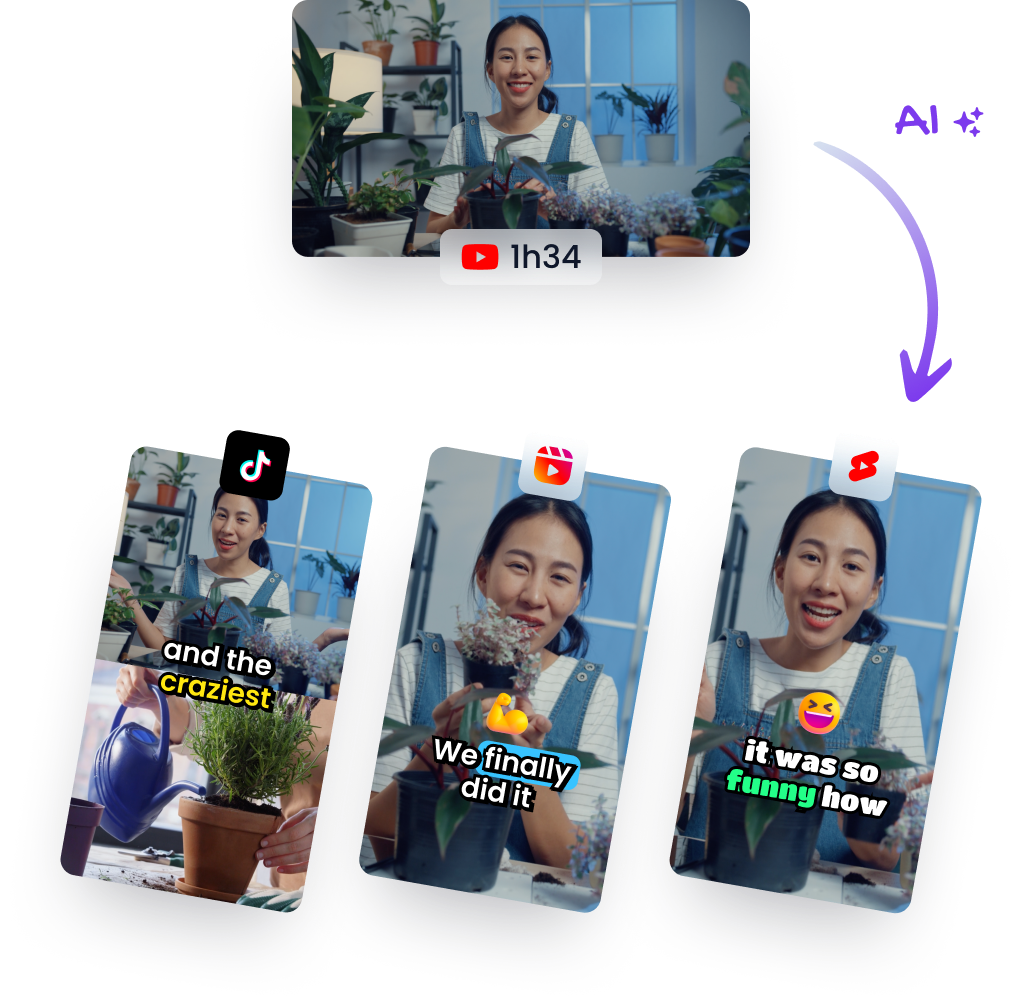
You already have the raw material.
The YouTube video, podcast interview, webinar recording, or talking-head training is sitting in a folder somewhere, and the hardest part is not making more content. It is turning that long-form asset into Instagram Stories that feel native, sharp, and worth tapping through.
That is where most creators get stuck. They open a general editor, drag in a horizontal file, crop it badly, spend too long fixing captions, and end up with a Story that looks like a clipped-down afterthought.
A good video editor for instagram stories is not just an app with trim and text tools. It is a workflow for extracting the right moments, reframing them for vertical viewing, and packaging them fast enough that repurposing happens consistently.
Why Repurposing Video Is Your Instagram Story Superpower
Many people approach Stories backwards. They think they need to create something brand new every day, even when they already recorded something useful, funny, insightful, or persuasive in a longer format.
That mindset burns time and usually lowers quality.

The key shift is workflow, not software
By 2025, short-form videos are projected to comprise 80% of all online content, with mobile devices accounting for over 75% of video views according to Socialinsider’s video statistics. If your editing process is still built around desktop-first, horizontal-first production, you are working against the way people watch.
Stories reward speed, relevance, and frequency. Long-form gives you depth. Repurposing connects the two.
A single episode or presentation can produce:
- A strong opinion clip for a quick Story sequence
- A practical takeaway with captions for viewers watching muted
- A teaser segment that sends people to your Reel, full video, or offer
- A behind-the-scenes moment that feels less polished and more human
This is why smart teams treat long-form as a content bank, not a one-time post.
If you want a broader system for deciding what to atomize and where to distribute it, TimeSkip’s guide to smart content repurposing strategies is useful because it frames repurposing as an editorial process, not just an editing task.
Why Stories matter even when Reels get more discovery
Stories are where audience familiarity builds. They are quick, informal, and ideal for moving someone from passive follower to active responder.
What works here is different from what works in a polished long-form upload. You are not asking for a full attention session. You are earning the next tap.
Tip: If a long-form video has one clear insight and one strong emotional moment, you usually have enough material for multiple Story clips without recording anything new.
The creators who publish Stories consistently are not always filming more. They are getting better at turning one finished asset into several vertical moments.
Finding the Gold in Your Long-Form Content
The editing starts before you open an editor.
The fastest way to waste time is to dump a full video into software and start cutting at random. The better approach is to review your source material like a producer. You are hunting for moments that can survive on their own.
What a Story hook looks like
The best Story clips usually start with tension, novelty, or specificity.
That could be:
- A sharp claim someone would want explained
- A surprising admission from an interview guest
- A mistake your audience keeps making
- A concise answer to one expensive problem
- A moment of reaction that feels human and unscripted
The reason this matters is simple. Google Trends data shows queries for “repurpose video to Instagram Stories” spiked 45% in the last 12 months, yet only 12% of top search results address AI-driven hook detection, as cited in this research roundup. People are looking for a repeatable method, not just another list of editing apps.
Review your footage in categories
When I audit a webinar, podcast, or YouTube upload for Story candidates, I sort moments into a few buckets.
The instant opener
This is the clip that can stand as the first frame in a Story sequence.
Examples:
- “Most creators are editing the wrong part first.”
- “We tested this and the ugly version performed better.”
- “If your clip only works with context, it is not a Story clip yet.”
These openings buy attention fast.
The payoff moment
This is the part that answers the question raised by the opener.
It might be a simple teaching point, a product demo insight, or a clean before-and-after explanation. In Stories, payoff matters more than buildup. Viewers do not owe you patience.
The personality moment
A dry educational clip becomes more watchable when there is some natural personality in it.
Look for:
- a laugh
- a raised eyebrow
- a candid correction
- a short disagreement
- a sentence that sounds spoken, not written
Those beats often outperform technically perfect edits because they feel native to Stories.
Pre-select before you edit
Do not send a full hour of footage into your workflow without notes.
Create a rough shortlist with timestamps and labels such as:
Clip typeWhat to look for
Hook
A line that creates curiosity in the first seconds
Proof
A concrete explanation or demonstration
Reaction
A candid or emotional beat
CTA bridge
A natural segue to a Reel, link, or DM prompt
Then move only those candidates into the editor.
If you want to speed up the first pass, a dedicated long to short video converter can help surface candidate moments before you do your final judgment call. The key is still editorial taste. AI can shortlist. You decide what belongs in your Story sequence.
Key takeaway: Good Story editing is mostly selection. If the source moment is weak, no font, sticker, or transition will save it.
The Smart Workflow From Horizontal to Vertical
Most manual Story editing fails in three places. The crop is awkward, the clip starts too late, and the captions take too long to finish.
That is why the old workflow feels slow even when you know your software.

The manual workflow that drains your week
The traditional process looks something like this:
- Export the full video from your main editor.
- Duplicate it for vertical use and create a 9:16 sequence.
- Manually crop each section so the speaker stays in frame.
- Trim clips by hand into Story-friendly lengths.
- Add captions manually or clean up poor auto-captions.
- Export every segment and upload them one at a time.
It works. It is also the reason repurposing gets pushed to “later.”
The biggest pain point is reframing. A horizontal interview or webinar was not composed for a phone screen. If you center the whole frame, the subject looks tiny. If you punch in too hard, you lose gestures, slides, or a second speaker.
The AI workflow that fixes the bottlenecks
A better video editor for instagram stories handles three jobs early.
Reframing
AI reframing tracks the active speaker or point of action and rebuilds the composition for vertical viewing. That removes the need to keyframe every crop yourself.
For creators working from interviews, screen recordings, podcasts, and YouTube footage, this is the feature that saves the most frustration. A plain crop tool is not enough. You need the frame to follow the important subject.
If you want to test this specific step, a focused crop video tool is a practical place to start.
Trimming
The next bottleneck is selection. You can spend more time deciding where a clip should start than exporting it.
That is where AI segmentation helps. CutStory reports that 92% of its users see a 20-50% uplift in engagement because its AI auto-slices long videos into 15-second clips and detects engaging hooks via waveform analysis, according to this Movavi roundup.
The important lesson is not that every auto-cut is perfect. It is that the first draft of the cut no longer has to be manual.
Captioning
Captions are not an optional layer on Stories. They are part of the edit.
If the text is late, too dense, or placed over a face, watchability drops. AI captioning gives you timed subtitles quickly, then you spend your time on cleanup and styling instead of raw transcription.
A simple production sequence
Use this order. It reduces revision loops.
StepWhat to doWhy it comes first
Source import
Upload your long-form video or paste the link
Keeps the full asset intact
Clip detection
Identify likely hooks and segments
Prevents random cutting
Vertical reframing
Convert to mobile composition
Affects text placement and visual balance
Caption pass
Generate and clean subtitles
Easier once framing is locked
Final trim
Tighten starts and endings
Makes pacing cleaner
Export batch
Download multiple Story-ready files
Faster posting workflow
A platform like Klap fits into this process as one option for turning long-form video into social-ready vertical clips with AI hook detection, reframing, captions, and review tools. The practical benefit is not magic editing. It is reducing the amount of manual assembly work between source video and publishable Story clips.
Here is a walkthrough worth watching before you set up your own system.
Tip: Let AI create the first draft of the crop, cuts, and subtitles. Then use your judgment on pacing, brand voice, and what should go live.
What still needs a human eye
AI is fast. It is not your audience strategist.
You still need to decide:
- whether the first line is strong enough
- whether the clip needs context text
- whether a pause should stay for comedic timing
- whether a sequence should run as one Story arc or separate fragments
That is the trade-off. AI removes repetitive labor. You keep editorial control.
Enhancing Stories for Maximum Engagement
A clean crop and readable captions get you to “watchable.” They do not automatically get you to “interactive.”
Stories perform better when the video leaves room for participation. People should feel like they can tap, reply, vote, or move to the next related clip.

Edit with stickers in mind
This is one of the most common mistakes I see. The video uses the full canvas, then the creator opens Instagram and realizes the poll, quiz, or question sticker blocks a face or covers the captions.
Leave intentional dead space.
That can mean:
- placing the speaker slightly higher in frame
- keeping captions lower but not at the bottom edge
- avoiding heavy graphics in the corners
- designing a first frame with room for a poll
For context, Reels account for 38.5% of all content in the Instagram feed and have a 37.87% higher reach rate, based on reporting in Business Insider. Stories often act as the bridge that sends viewers toward those higher-reach assets.
Make captions part of the design
Captions should feel built in, not pasted on.
Three practical rules:
- Keep lines short. Dense subtitle blocks feel like homework.
- Use contrast. If your footage is visually busy, add a subtle background or high-contrast text style.
- Match your brand lightly. Use your colors and type treatments, but do not sacrifice readability.
If you need to speed this step up, an AI subtitle generator helps create a clean caption draft that you can then style for Stories.
Practical rule: If the viewer can understand the clip with sound off and still see where to tap, the edit is structurally sound.
Build Story arcs, not isolated clips
One strong clip is useful. A short sequence is better.
Think in mini-arcs:
Arc one: problem
A speaker identifies the pain point.
Arc two: insight
The next Story answers it or reframes it.
Arc three: action
The final Story asks for a reply, points to a Reel, or sets up the next post.
This structure works especially well when repurposing webinars, interviews, and podcast conversations because those formats already contain setup and payoff.
What usually hurts engagement
A few edits tend to underperform:
MistakeWhy it hurts
Over-decorated text
Pulls attention away from the speaker
Full-screen clutter
Leaves no room for native Instagram stickers
Slow first line
Loses taps before the point arrives
Standalone clips with no context
Feels random in the Story tray
The goal is not to make every Story look highly produced. It is to make each one easy to watch and easy to act on.
Exporting and Posting for the Algorithm
A strong edit can still look bad after upload if the export is off.
Instagram compresses aggressively. If your file starts soft, the final Story gets softer.
Export settings that hold up
Use this baseline. It is reliable and simple.
For professional results, export an H.264 MP4 at 1080x1920 pixels and 30-60fps, with a bitrate between 5-10Mbps, based on this guidance from OBSBOT’s Instagram editor walkthrough.
SettingRecommendation
Format
H.264 MP4
Resolution
1080x1920
Frame rate
30-60fps
Bitrate
5-10Mbps
Posting cadence matters more than people think
There is no universal rule for spacing Story clips from one long-form source. The right call depends on the strength of the sequence.
Use this framework:
- Post back-to-back when the clips clearly form one narrative and each one creates momentum for the next.
- Space them out when each clip covers a separate idea and you want multiple check-ins across the day.
- Hold weaker clips instead of posting everything you exported.
A lot of creators over-publish because they worked hard on the edit. Viewers do not care how long it took. They care whether the next tap is worth it.
Protect the first frame
Your first frame acts like packaging.
Before exporting, check:
- is the speaker visible immediately?
- is the opening line readable at a glance?
- is there visual contrast?
- does the frame still work if Instagram overlays its own interface?
Also think beyond the first 24 hours. The clips that explain your offer, process, or point of view often belong in Highlights. That gives your repurposed Stories a second life.
If you want a practical framework for reviewing performance after publishing, Replymer’s guide on how to measure social media engagement is worth using as a companion. It helps separate vanity reactions from signals that your Story edits are moving people to watch, tap, and respond.
Tip: Export slightly fewer clips than you think you need. Posting your strongest sequence beats posting every usable segment.
Frequently Asked Questions
Should I edit Stories the same way I edit Reels
No.
Reels are usually built for discovery. Stories are built for relationship and response. A Reel can survive with a broader setup if the payoff is good. A Story needs to feel immediate and personal.
That usually means Stories can be looser, quicker, and more conversational.
How many Story clips should come from one long-form video
There is no fixed number that works for every account.
The better rule is to stop when the sequence stops feeling connected. If your webinar gives you one strong arc and two standalone moments, publish that. Do not force every usable sentence into a Story just because the software surfaced it.
What is the biggest mistake when turning horizontal video vertical
Bad cropping.
More specifically, treating vertical editing like a simple center crop. Horizontal footage often has multiple points of interest. If the face is tiny, the Story feels distant. If the crop cuts off gestures, slides, or reactions, the clip feels amateur.
The frame has to be rebuilt for the phone screen, not just resized.
Should I edit inside Instagram or use a separate tool first
Use both, but for different jobs.
A dedicated editor is better for the heavy lifting. That includes clipping, reframing, subtitles, and export consistency. Instagram is better for final native touches like polls, quizzes, question stickers, mentions, and links.
That combination usually produces stronger results than trying to do everything in one place.
Do I need polished Stories for them to work
Not always.
Some of the strongest Story sequences look intentionally lightweight. Clear framing, readable subtitles, a strong first line, and one interactive element usually beat over-designed edits.
Polish helps when it improves clarity. It hurts when it slows production or makes the Story feel stiff.
Can AI replace my editing judgment
No. It can remove repetitive labor.
That is the distinction that matters. AI can surface hooks, generate captions, and create a usable first crop. You still decide whether the moment is on-brand, whether the sequence is coherent, and whether the clip deserves a place in your Story flow.
If you already have long-form video sitting on YouTube, in your podcast archive, or inside webinar recordings, Klap is a practical way to turn that existing footage into vertical, captioned short clips without rebuilding every Story by hand. It is built for the exact bottleneck most creators run into. Finding the right moments, reframing them for mobile, and getting to a publishable draft fast.