The Ultimate Guide to Social Media Video Editor Tools
Other
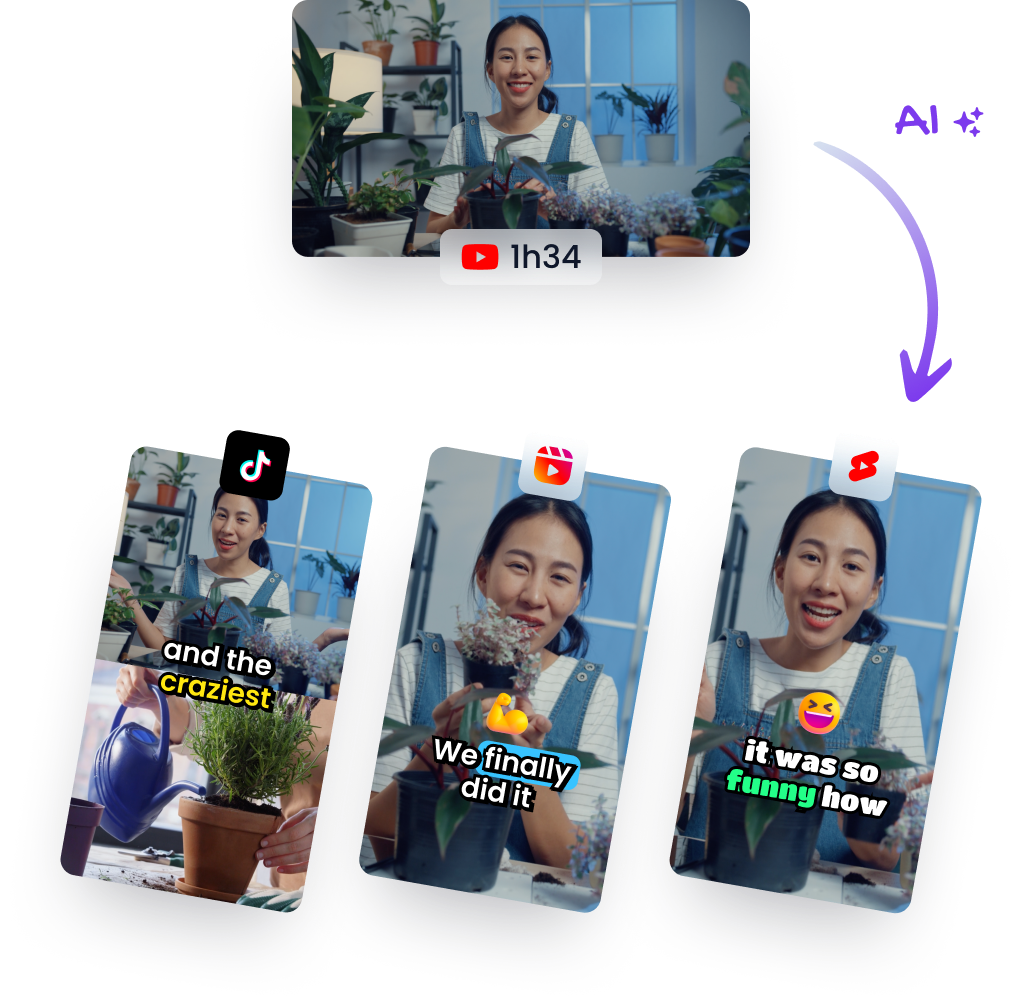
A social media video editor is a creator's secret weapon. Think of it as a specialized, AI-powered tool built to do one thing really well: slice up long videos (like podcasts or webinars) into short, addictive clips for TikTok, Reels, and Shorts. It automates the grunt work—like finding viral moments, reframing for vertical screens, and adding captions—slashing your manual editing time by up to 90%.
The Age of Short-Form Video Content

Let's face it, we're living in the era of short-form video. Platforms like TikTok, Instagram Reels, and YouTube Shorts aren't just a trend; they're the new standard for content consumption. For creators and marketers, grabbing and holding user attention in a sea of endless scrolling has become the primary challenge.
This shift has created a massive appetite for a constant stream of bite-sized videos. Viewers now spend an average of nearly 24 hours per month on TikTok alone. The problem? Traditional video editing workflows were never designed to keep up with this kind of speed and volume.
The Problem with Traditional Workflows
Imagine you just finished recording a one-hour podcast. Using traditional software like Premiere Pro to turn that into a week's worth of social clips is a mountain of work. You'd have to manually scrub through the entire timeline to find a few good moments, painstakingly crop and reframe every single clip for the 9:16 vertical format, and then type out captions word-for-word.
This is slow, repetitive, and expensive work. It’s a huge bottleneck that stops creators from posting consistently and meeting audience demand. For many, the hours spent editing actually exceed the time it took to create the original video. That's not a scalable workflow.
The Actionable Insight: The core issue is clear: The demand for daily short-form content has outpaced the supply capacity of traditional editing methods. To stay relevant, you need a faster, more efficient way to repurpose long-form assets without sacrificing quality or burning out.
This is where a new class of tool comes in. The social media video editor isn't just another program; it's a strategic partner built to solve this exact problem. It’s like having an intelligent assistant that automates the most time-consuming parts of the repurposing process.
The Shift to Automated Content Creation
Instead of spending hours hunting for a 30-second gem inside a long video, AI-powered tools do the heavy lifting. They analyze your content, pinpoint potential "viral" moments based on topics and audience engagement patterns, and then automatically prepare them for social media. This changes everything about your content strategy:
- From Hours to Minutes: What used to take hours of manual labor now takes just a few minutes of review and a couple of clicks. This means you can repurpose a one-hour video in the time it takes to drink your morning coffee.
- From One to Many: Effortlessly multiply your output, turning one long video into a dozen ready-to-post clips. You get significantly more mileage out of every piece of content you create.
- From Manual to Automatic: Key tasks like reframing to keep the speaker in the shot and generating dynamic captions are done for you. This is crucial, since up to 92% of mobile viewers watch videos with the sound off.
To win on these platforms, you can't just create clips; you have to optimize them. You need to understand the unique nuances of each one, from the differences between TikTok vs YouTube Shorts to knowing the optimal TikTok ad lengths. A good social media video editor is built with these best practices baked in, giving you a serious competitive advantage.
What a Social Media Video Editor Actually Does
Let's cut through the noise. A modern social media video editor isn't just another program on your computer—it’s a purpose-built content machine. Its entire reason for being is to solve the single biggest headache for creators and marketers today: turning one long video into a ton of engaging short clips.
Think of a traditional video editor, like Premiere Pro or Final Cut, as a massive, professional woodshop. It’s packed with powerful tools that can build anything you can imagine, but you have to measure, cut, and assemble every single piece by hand. It’s powerful, but it's slow.
An AI-powered social media video editor is more like a specialized, automated assembly line. It’s engineered to do one thing exceptionally well: churn out attention-grabbing vertical videos for social media, minus all the tedious manual work that eats up your day.
Solving the Biggest Creator Pain Points
The main job of these tools is to break down the walls that are holding your content back. They’re designed to fix the specific, frustrating bottlenecks that stop you from posting consistently and reaching a wider audience. For marketers, this speed is a game-changer. With 96% of marketers now calling video a vital part of their strategy, creating content at scale is no longer a "nice to have"—it's a must.
The meteoric rise of short-form video has completely flipped the script on editing. In 2022, videos on social media drove a wild 1200% more shares than text and images put together. That's why platforms like TikTok and Instagram Reels are engagement goldmines. This shift is pushing the entire video editing software market, valued at $1.94 billion in 2022, toward smart, AI-driven tools that can actually keep up. You can discover more about these market shifts and other video editing industry statistics for a deeper dive.
The Shift from Manual Labor to Intelligent Automation
A social media video editor isn’t just about working faster; it's about working smarter. It shifts you away from the painful, clip-by-clip process of manually hunting for good moments and into an intelligent, automated workflow. Instead of you finding the best parts, the AI does it for you.
The Actionable Insight: This isn't about slapping a turbocharger on your old, clunky process. It's about trading it in for a whole new engine. The goal is to let technology handle the repetitive stuff so you can get back to focusing on creative ideas and engaging with your audience.
Here’s what that change looks like with real metrics:
- Slashing Editing Time: The biggest win is getting your time back. AI can scan an hour-long podcast and pull out the 10 most viral-worthy clips in minutes. When freelance editors charge anywhere from $30-$150 per hour, the savings are immediate. In fact, 54% of editors say AI dramatically speeds up the initial rough cut process.
- Automating Mobile Optimization: Over 58% of all web traffic comes from mobile phones. A key feature of these editors is automatically reframing your horizontal (16:9) footage into a vertical (9:16) format. The AI ensures the speaker or the main action is always perfectly centered, so you don't have to.
- Generating Essential Captions: Let's be real—most people scroll with the sound off. Since 92% of users watch mobile videos on mute, captions are non-negotiable. These tools automatically transcribe your audio and bake in dynamic, easy-to-read captions, making every clip instantly more accessible and engaging.
What These Tools Actually Do For You
A modern social media video editor isn't just a slightly faster version of your old software—it’s a completely new way of thinking about content. The features aren't just small perks; they fundamentally change how you create and share your videos. Once you understand them, you’ll see why they're such a big deal for creators and marketers.
Think of these tools as an intelligent partner that handles all the repetitive, soul-crushing tasks. This frees you up to focus on your message and creativity instead of getting bogged down in tedious technical edits. Let's break down the core features that make this all possible.
AI-Powered Clip Selection
You just wrapped up a one-hour podcast. You know there are at least ten incredible, 30-second moments buried in there that could blow up on TikTok or Reels. The old way meant manually scrubbing through the entire recording, a process that could easily eat up your afternoon. A true social media video editor kills this problem with AI-powered clip selection.
This feature is like having a super-producer who’s watched thousands of hours of viral content and knows exactly what makes people stop scrolling. The AI scans your video's transcript, audio, and even visual cues to pinpoint the most compelling segments. It’s hunting for "hooks"—the questions, bold statements, emotional shifts, or topic changes that grab a viewer's attention.
Instead of you digging for gold, the AI serves up a dozen high-potential clips on a platter, often in just a few minutes. This one feature alone can turn a full day of editing into a quick 15-minute review session.
Automatic Video Reframing
Once you have your viral-worthy clips, you hit the next wall: formatting them for mobile. Most of your source content, like YouTube videos or webinars, is shot horizontally (16:9). But short-form platforms like TikTok and Instagram live and breathe in a vertical (9:16) world. Manually reframing every single clip is a nightmare—you have to constantly create keyframes to keep the speaker from getting chopped out of the frame as they move.
This is where automatic video reframing feels like magic. The AI intelligently identifies the main subject—usually the speaker—and automatically keeps them perfectly centered in the new vertical frame.
The Actionable Insight: Think of it as a smart camera operator who is constantly adjusting the shot for you. No matter where the speaker moves in the original horizontal video, the reframed vertical clip keeps them perfectly in focus, ensuring a professional and polished look without any manual keyframing.
This ensures your content is perfectly optimized for mobile viewing, which is non-negotiable when the vast majority of social media is consumed on phones.
Automated Dynamic Captions
Did you know that up to 92% of users watch videos on their mobile devices with the sound off? That single stat makes one thing painfully clear: if you don’t have captions, most of your audience will completely miss your message. But let's be real, typing out subtitles for every clip is another slow, mind-numbing task.
A top-tier social media video editor handles this with automated dynamic captions. The tool not only transcribes your audio with surprising accuracy but also styles the captions to be engaging and easy to read. It will often highlight important words in real-time to keep viewers locked in. If you want to learn more, check out our guide on how to add engaging subtitles to your videos.
This feature makes your content more accessible to everyone and gives your engagement a serious boost. People can understand your video whether they're in a quiet library or on a noisy subway, making sure your message always gets through.
Brand Kit Integration
Consistency is everything when you're trying to build a recognizable brand. You want your audience to know a clip is yours before they even see your name. Brand kit integration makes this dead simple.
Instead of manually slapping your logo, brand colors, and specific fonts onto every single video, you set up your brand kit once. From then on, the editor automatically applies your branding to every clip it generates. This means your logo is always in the right place, your captions use your brand font, and the color scheme matches your aesthetic—across dozens or even hundreds of clips. This is how you achieve brand consistency at scale, something that’s nearly impossible to manage by hand.
To see just how much of a difference this makes, let's compare the old way of doing things to the new, AI-powered workflow.
Traditional Editing vs AI-Powered Social Media Editing
The table below breaks down the time and effort you save when repurposing a single long-form video. The difference is night and day.
TaskTraditional Workflow (Manual)AI-Powered Workflow (e.g., Klap)
Finding Clips
1-2 hours of manual scrubbing and notation.
5-10 minutes for AI to analyze and suggest clips.
Trimming Clips
30-60 minutes using a traditional editor like Premiere Pro.
Clips are pre-trimmed by the AI. Minor adjustments take minutes.
Reframing
1-2 hours of tedious manual keyframing for 10 clips.
Instant. AI reframes all clips automatically.
Adding Captions
1-2 hours of transcribing and timing subtitles.
5-10 minutes for AI to generate and style dynamic captions.
Branding
30-45 minutes to add logos, colors, and specific fonts.
Instant. The brand kit is applied to all clips automatically.
Total Time
4-6 hours per long-form video.
20-30 minutes per long-form video.
As you can see, the time savings are massive. What used to be a full day's work for a skilled editor can now be accomplished in less time than it takes to drink a cup of coffee. This isn't just about speed; it's about reclaiming your time to focus on creating more great content.
Your Modern Video Repurposing Workflow With Klap
Knowing the theory behind a great social media video editor is one thing, but seeing it in action is where it all clicks. Let's walk through the modern content repurposing workflow, using Klap as a real-world example.
You’ll see just how quickly you can turn one long video into a dozen or more engaging short clips, shifting the heavy lifting from you to the AI. This frees you up to focus on the big picture, not the tedious technical stuff.
Step 1: Getting Your Content In
The old way of editing starts with a headache: downloading huge video files, transferring them to your computer, and waiting for them to import. It’s a slow, clunky process that kills momentum before you even start.
A modern workflow flips that on its head. With a tool like Klap, you have two simple options:
- Paste a YouTube Link: This is the path of least resistance. Just copy your video's YouTube URL and paste it into Klap. The platform pulls the video right in, so you never have to download a thing.
- Upload Your Video File: If your content isn't on YouTube—like a podcast recording or webinar—you can upload the file directly from your computer.
This gets you from "I have a video" to "I'm ready to edit" in seconds, not hours. It completely removes the friction that slows so many creators down.
Step 2: The AI Does the Heavy Lifting
Once your video is uploaded, the AI gets to work. This is the magic behind the scenes. Think of it as having an entire team of expert editors and social media strategists analyzing your content all at once.
The Actionable Insight: The AI isn’t just listening for keywords; it’s understanding your content. It tracks topic changes, identifies who is speaking, and even predicts which moments have the best shot at going viral based on what’s currently working on social media.
This deep analysis is what allows the AI to automatically pick out a batch of high-potential clips for you. It’s not just making random cuts—it’s making smart, data-backed suggestions to give you the strongest possible starting point. For a deeper dive, check out our guide on how to turn long videos into shorts.
This infographic shows you exactly how the AI takes your raw video and turns it into polished clips. It’s a clear visual of how AI selection, auto-reframing, and captions come together to create ready-to-post content with minimal effort from you.
Step 3: Review and Refine
No AI is perfect, and that’s why a human touch is still essential. The AI is designed to get you 90% of the way there, serving up a list of clips that are almost ready to go. Your job is to add that final 10% of polish.
In this stage, you can quickly:
- Tweak the Timing: If a clip starts a second too early or ends too late, just drag the start and end points to nail the timing.
- Polish the Captions: The AI transcription is incredibly accurate, but you might want to fix a name or adjust the phrasing. You can edit the text right on the screen.
- Apply Your Brand: With a brand kit, you can make sure every clip automatically features your logo, brand colors, and fonts for a consistent look.
This part of the process is built for speed. You’re not building anything from scratch; you're just making final approvals. What used to be an hours-long task now takes maybe 15 minutes.
Step 4: Export and Post
Once you're happy with the clips, the last step is to get them out into the world. A good social media video editor makes this completely seamless.
You can download your finished clips, already perfectly formatted with the 9:16 aspect ratio for platforms like TikTok, Instagram Reels, and YouTube Shorts.
The files are ready to upload immediately. No more worrying about conversion steps or complicated export settings. Just download, post, and keep your social media feeds full of high-quality content.
How to Choose the Right Social Media Video Editor
With so many tools promising to turn your videos into viral shorts, picking the right social media video editor can feel overwhelming. The truth is, not all platforms are built the same. What works for a solo creator might be a terrible fit for a marketing agency, and vice versa.
The secret isn't just about ticking off features on a list. It’s about finding a tool that fits into your entire content workflow. Your choice comes down to four key factors: ease of use, the quality of its AI, creative control, and what you get for your money. Let's break down how to evaluate each one so you can find a tool that helps you grow long-term.
Workflow and Ease of Use
Your editor should speed you up, not slow you down. If a tool is clunky or confusing, you’ll stop using it—no matter how many cool features it has. The first question you should ask is: how easily does this slot into my current process?
For most creators, everything starts with a long-form video, usually on YouTube. A great editor lets you simply paste a YouTube link to get started. This small detail saves you the massive headache of downloading and re-uploading huge files. The whole experience should feel fast and intuitive, guiding you from your original video to a finished clip in just a few clicks.
AI Quality and Accuracy
The "AI" in an AI video editor is its brain. The smarter the AI, the better your clips will be and the more time you’ll save. A truly great AI doesn't just cut your video into random pieces; it understands what makes a moment worth watching.
Here’s what to look for when judging an AI’s performance:
- Clip Selection: Does the AI find the genuinely good parts? It should be able to spot the hooks, questions, and emotional high points that make people stop scrolling.
- Speaker Detection: If you have a podcast or interview with multiple people, the AI needs to tell them apart and create focused clips for each speaker.
- Caption Accuracy: Nothing kills a video faster than bad captions. The AI needs to deliver transcripts that are at least 95% accurate so you're not stuck fixing typos for hours.
The Actionable Insight: A powerful AI acts as your creative partner. It should deliver clips that are so well-chosen and well-framed that your main job becomes simple review and approval, rather than creation from scratch.
Customization and Brand Control
Automation is great, but not if it makes your content look generic. The best social media video editors give you the speed of AI without forcing you to give up your brand's unique look and feel. The AI should do the heavy lifting, but you need the final say.
Look for tools with a solid brand kit feature. You should be able to upload your logo, lock in your brand colors, and set your specific fonts one time. From then on, the platform should automatically apply that branding to every single clip, giving you perfect consistency with zero extra work. This ensures that every video feels like it came from you.
Evaluating Cost vs. Return on Investment
Finally, let's talk about money. It’s easy to get fixated on the monthly price, but that’s only half the picture. The real value of a social media video editor is its return on investment (ROI), measured in both time saved and audience growth.
Here's a simple calculation: how many hours do you spend repurposing just one long video? If a tool costs $50 per month but saves you 10 hours of editing (and let’s say your time is worth a conservative $25/hour), you’re already getting a $200 net benefit. That doesn't even count the growth you'll see from posting more consistently—more reach, more engagement, and more traffic.
When you look at the price, think of it as an investment in your own efficiency and growth, not just another subscription.
Feature Checklist for Different User Types
To make your decision even easier, we've broken down which features matter most for different types of users. Whether you're a solo creator just starting out or part of a large marketing team, this table will help you focus on what's truly important for your needs.
User TypeMust-Have FeaturesNice-to-Have Features
Solo Creator / YouTuber
- YouTube link import
- High-quality auto-captioning
- Simple brand kit (logo, colors)
- Ease of use
- Speaker detection
- Advanced caption styles
- Team collaboration tools
Marketing Agency
- Team collaboration & workspaces
- Robust brand kit features
- High export limits
- API access
- Direct social media scheduling
- Performance analytics
- Multi-language support
Small Business Owner
- Brand consistency tools
- Time-saving automation
- Affordable pricing
- Ease of use
- A/B testing variations
- Advanced analytics
- Integration with other marketing tools
Podcast Host
- Excellent speaker detection
- Audio-focused clip finding
- High caption accuracy
- Multiple aspect ratios
- Audiogram creation
- Custom sound wave styles
- Full episode transcription
This checklist should give you a clear starting point. By matching your primary role to the "must-have" features, you can quickly narrow down your options and avoid paying for features you'll never use.
Measuring the ROI of Your Video Strategy

Churning out a steady flow of short-form clips with a social media video editor feels productive, but it's just the first step. The real win isn’t just making content; it's seeing that content make a real difference for your brand. To know if any new strategy is actually working, you have to measure its return on investment (ROI).
That means getting past the vanity metrics. Sure, a video hitting 100,000 views looks great on paper, but if it didn't bring in a single new follower, website click, or sale, did it really move the needle? The goal is to connect your video efforts to actual business results.
Tracking Audience Growth and Reach
One of the first things you'll notice with a consistent short-form video strategy is a boost in reach. When your clips hit the mark, algorithms push them to new audiences, which is the most direct way to grow your follower count.
Actionable Insight: Track your follower count on TikTok, Instagram, and YouTube Shorts. At the end of each month, compare your growth rate to the period before you started using an AI editor. Also, monitor total impressions—this shows you how many more eyeballs are seeing your content. An increase of 10-15% in monthly follower growth after implementing a consistent strategy is a solid benchmark.
Analyzing True Engagement
Engagement is so much more than likes. The metrics that really matter are the ones that signal your content genuinely connected with someone and made them act. This is what tells the algorithms your videos are worth sharing even more.
Pay close attention to these three signals:
- Shares: This is the highest form of praise. It means someone found your video so good they had to pass it along to their own audience.
- Saves: When someone saves a clip, they're bookmarking it as a resource to come back to. This is a massive indicator that you're providing real value.
- Comments: Real conversations in your comment section show you’ve sparked a reaction and are building a community, not just a following.
The Actionable Insight: A high number of saves and shares often carries more weight than likes. It demonstrates that your audience finds your content genuinely useful or entertaining, which is a far better measure of content quality than a passive double-tap.
Calculating Time and Cost Savings
The ROI of a social media video editor isn’t just about the audience you gain; it's also about the time you get back. And we all know time is money. Automating the grunt work of editing adds up to huge savings. Repurposing a single long-form video used to take 4-6 hours of tedious manual work. With an AI tool, that same task can be done in under 30 minutes.
Want to put a number on it? Let’s say your time is worth a conservative $30/hour. If you save 20 hours of editing in one month, you’ve just reclaimed $600 worth of your time. For many creators, this metric alone easily covers the cost of a subscription.
Measuring Traffic and Conversions
At the end of the day, your social media activity should fuel your business. Your short-form clips are the perfect way to guide viewers from social platforms over to your website, podcast, or product page. Use trackable links in your bio to see exactly how many people are clicking through from your profiles.
By keeping tabs on these key areas, you'll have a clear, data-backed picture of the value your new video strategy is delivering. It proves that a good social media video editor isn't just a cost—it's an investment that pays for itself over and over again.
Frequently Asked Questions
Jumping into AI-driven content creation can feel like a big leap. It's natural to have questions before you change up your workflow, so let's walk through some of the most common ones.
How Much Technical Skill Do I Need?
Honestly? Almost none. Modern AI video editors are built for creators and marketers, not professional video engineers. If you can copy and paste a YouTube link and click a few buttons, you have all the skill you need.
These tools do the heavy lifting—like finding the best clips and reframing them for mobile—all on their own. Your job shifts from being a technical editor to more of a creative director, where you simply approve the AI's suggestions or make a few small tweaks. It’s about strategy, not software know-how.
Can AI Really Understand What Makes a Video Interesting?
This is a totally fair question. An AI doesn’t "feel" what's exciting, but it’s incredibly good at spotting the signals of an interesting moment. It scans transcripts for questions, powerful statements, and shifts in conversation.
The Actionable Insight: An AI video editor is trained on millions of data points from viral content. It learns to identify the characteristics of clips that capture and hold audience attention, like fast-paced dialogue, emotional spikes, or clear "hook" sentences that make viewers want to see what happens next.
While it's not a perfect replacement for human intuition, it gets you 90% of the way there in seconds. That saves you from manually scrubbing through hours of footage just to find those golden nuggets.
Is It Better to Hire a Freelance Editor or Use an AI Tool?
This really comes down to your goals and budget. Hiring a freelance editor, who can charge anywhere from $30-$150 per hour, is a great move for big, one-off projects that demand a completely unique creative touch.
But for the relentless, high-volume demand of daily social media clips, an AI tool is almost always the smarter play. An AI tool like Klap gives you speed and scale a human simply can't match. It can turn a one-hour podcast into ten ready-to-post clips in under 30 minutes—a task that would take a freelancer hours. For consistent content repurposing, the cost-effectiveness and sheer efficiency of a social media video editor deliver a much higher return on investment.
Ready to stop wasting hours on manual editing and start creating more content? Klap uses AI to turn your long videos into viral-ready shorts in minutes. Give it a try and see how easy it can be.