How to Monetize YouTube Shorts A Creator's Guide to Earnings
Other
So, you want to make money from your YouTube Shorts? Good news: you absolutely can. The main way to get paid is by joining the YouTube Partner Program (YPP), which shares ad revenue with creators who hit specific milestones. To get in, you'll need 1,000 subscribers and either 10 million public Shorts views in the last 90 days or 4,000 watch hours on your long-form videos. This gives Shorts-first creators a direct path to earning from their content.
The New Frontier of Creator Earnings on YouTube Shorts

The entire content creation world has been turned on its head by short-form video, and YouTube Shorts is leading the charge. Gone are the days when making money was just for creators producing long, polished videos. Today, a 60-second clip has the potential to not only go viral but also build a real, sustainable income.
This shift has unlocked massive opportunities for every type of creator. Established YouTubers can breathe new life into their archives by clipping highlights, while podcasters can pull out compelling moments to find a completely new audience. For those just starting out, Shorts is a direct route to building a community and an income without the pressure of producing 20-minute epics.
Your Two Paths to Monetization
To get into the YouTube Partner Program, you now have two distinct options. This flexibility is YouTube’s way of acknowledging that creators grow their channels differently. Figuring out which path fits your style is the first step toward getting paid.
You can qualify through the classic route or the newer, Shorts-focused one:
- The Shorts-First Path: This is for creators who live and breathe short-form content. You need 1,000 subscribers and 10 million valid public Shorts views within the last 90 days.
- The Long-Form Path: This is the traditional way in. You'll need 1,000 subscribers and 4,000 valid public watch hours on your long-form videos over the past 12 months.
Here's a quick side-by-side look at how they compare.
YPP Monetization Paths Compared
RequirementShorts-First PathLong-Form Path
Subscribers
1,000
1,000
Views / Watch Time
10 million public Shorts views in the last 90 days
4,000 public watch hours in the last 12 months
Best For
Creators focused on high-volume, viral short-form content.
Creators who produce in-depth, longer-form videos.
Timeframe
A short, intense 3-month window to hit the view count.
A full year to accumulate watch hours on evergreen content.
The introduction of the Shorts milestone was a huge deal—it officially validated short-form video as a legitimate, primary content format on the platform. It means you can build a successful, monetized channel entirely on Shorts if that's what you want to do. Understanding this is just one piece of the puzzle; it's also worth getting familiar with broader digital marketing and social media marketing strategies to truly maximize your channel's potential.
Actionable Insight: You don't have to do both. If your genius is in crafting addictive 30-second clips, you have a clear, direct path to earning revenue without ever needing to post a 10-minute vlog.
Why This Opportunity Is Massive
What makes this so significant is the sheer scale of YouTube Shorts. The platform’s popularity has absolutely exploded, boasting over 70 billion daily views. This creates a goldmine of attention for creators. With a massive global audience, even smaller channels can catch fire and gain traction if they find a way to connect with viewers.
This isn't just about YouTube trying to compete with other platforms; it’s about integrating short-form content into a mature, powerful monetization system that’s been built over years. If you’re still weighing where to focus your energy, our breakdown of TikTok vs. YouTube Shorts offers deeper insights into what makes each platform tick. Ultimately, YouTube's approach provides a solid framework for turning your creativity into a real career.
So, you’ve hit the magic numbers.
Whether you grinded your way to 1,000 subscribers and 10 million Shorts views or took the traditional long-form route, the next step is getting into the YouTube Partner Program (YPP). This part can feel a little intimidating, but it's actually a straightforward, guided process right inside your YouTube Studio.
Think of the "Earn" tab in your Studio as mission control for all things money. It’s where YouTube shows you a handy tracker of your progress toward the YPP requirements, so you always know exactly how close you are.
Once you’re eligible, a big "Apply Now" button will pop up. This is your ticket to turning all those views into actual income.
The Application Steps Inside YouTube Studio
The application itself isn't some crazy, long-winded form. It's really just a series of modules you need to review and accept. YouTube breaks it down this way to make sure you understand the terms for all the different kinds of content you might be making.
Here’s what you can expect:
- Review Base Terms: This is the big one—the foundational agreement for the entire YPP. It covers the general rules of the program, how you get paid, and YouTube’s content policies. It's basically the main contract for your partnership with YouTube.
- Sign Up for Google AdSense: If you don't already have an AdSense account, you’ll be prompted to set one up. This is the financial engine behind your monetization; it's how Google actually gets money into your bank account. You have to link an active AdSense account to your channel before they can pay you.
- Get Reviewed: After you accept the terms and connect AdSense, your channel officially enters the review queue. A real person on the YouTube team will manually go through your channel to make sure it follows all their rules, from the Community Guidelines to AdSense program policies. This process typically takes about a month, so be prepared to wait.
Actionable Insight: The review stage is all about patience. YouTube is literally checking to see if your content is original, advertiser-friendly, and actually provides value to viewers. This human review is what keeps the platform from turning into a total free-for-all.
Activating Your Shorts Monetization
Once you get that glorious acceptance email, there's one last, crucial step to start earning from Shorts. You have to specifically turn on the monetization for short-form content.
Back in the “Earn” tab, you'll see different “Monetization Modules.” The one you're looking for is the Shorts Monetization Module.
By accepting its terms, you're officially opting in to get your slice of the ad revenue from the Shorts Feed. It’s a simple click, but it's the final switch that activates your Shorts income stream.
A Real-World Creator Journey
Let's imagine a gaming creator, "PixelPulse," who went all-in on Shorts. She posted daily clips of her "game-winning moments," and for three months, it was a slow and steady grind. Then, one of her clips showing a clutch victory in a popular shooter went completely viral, rocketing her past the 10 million view threshold in just a couple of weeks.
She immediately logged into YouTube Studio and hit "Apply." She breezed through the Base Terms and linked up a brand-new AdSense account. Then, the wait began.
For PixelPulse, the review took eight long days. She later said she was checking her email constantly, feeling that mix of jittery excitement and pure anxiety.
Finally, the approval email landed in her inbox. She logged back into the "Earn" tab, clicked to accept the Shorts Monetization Module, and just like that, her channel was officially monetized. The first few dollars started trickling in within 24 hours. Her journey shows that while the process takes a bit of a waiting game, the steps are clear and the payoff is absolutely worth it.
So, How Does Shorts Ad Revenue Actually Work?
If you're used to long-form YouTube monetization, the way Shorts make money can feel a bit weird at first. There are no pre-roll or mid-roll ads attached directly to your videos. So where does the cash come from?
Instead of a direct ad-to-video link, YouTube pools all the ad revenue generated within the Shorts feed. Think of it as one giant pot of money that gets distributed among all eligible creators every month. This means your earnings are tied to the collective performance of all monetized Shorts, not just your own.
It's a four-step process that happens behind the scenes, but understanding it is key to setting the right expectations.
The Four Steps of Revenue Sharing
YouTube set this system up to fairly compensate everyone contributing to the Shorts ecosystem. It starts with all the ad money and ends with a deposit into your AdSense account.
Here’s a simple breakdown of how that money finds its way to you:
- Ad Revenue Gets Pooled: First, YouTube collects all the money from ads that run between videos in the Shorts feed. This creates one massive monthly fund.
- The Creator Pool is Calculated: Before anyone gets paid, YouTube has to cover its music licensing costs. Since a huge number of Shorts use popular music, this step makes sure artists and labels get their cut. What's left over is called the "Creator Pool."
- Your Share is Allocated: Next, YouTube figures out your slice of the pie. This is based purely on your channel's share of total monetized Shorts views. If your Shorts got 1% of all eligible views that month, you're allocated 1% of the Creator Pool. Simple as that.
- You Get Your Cut: Finally, the money is divvied up. As a creator, you keep 45% of your allocated share. YouTube keeps the remaining 55%.
This flow chart gives you a good visual of how the YouTube Partner Program process for Shorts is structured, from hitting your eligibility numbers to actually flipping on the monetization switch.

The biggest thing to remember here is that even after you qualify, you have to go into your settings and actively accept the "Shorts Monetization Module" to start earning.
A Practical Earning Example
Let's make this real. Imagine the Creator Pool for September is a nice, round $1 million. During that same month, all monetized Shorts on the entire platform generated a combined 1 billion views.
Now, let's say your channel was on fire and you pulled in 5 million of those views.
Here’s how the math would shake out for you:
- Your Share of Views: (5 million your views / 1 billion total views) = 0.5%
- Your Revenue Allocation: 0.5% of the $1 million Creator Pool = $5,000
- Your Final Payout: You keep 45% of that, so $5,000 x 0.45 = $2,250
This example makes it crystal clear: volume is the name of the game with Shorts. Because each view is worth a tiny fraction of a cent, your success hinges on consistently generating a high view count.
Actionable Insight: Your earnings are directly proportional to your share of the total viewership pie. The more of that pie you can claim with your content, the larger your payout will be.
What Is a Good RPM for Shorts?
This brings us to a super important metric: Revenue Per Mille (RPM), or how much you earn per 1,000 views.
Honestly, the RPM for Shorts is low. We're talking anywhere from 1¢ to 6¢ per 1,000 views. It’s a far cry from the $1–$30 RPM you might see on long-form content.
So why bother? Scale.
Shorts boast an insane 70 billion daily views worldwide. While your per-view earning is tiny, the sheer volume of potential viewers is astronomical. For instance, as Shopify's blog points out in their guide to turning Shorts views into revenue, a Short with 1 million views at a much higher 13¢ RPM could net around $131.85. It's not life-changing money on its own, but it shows how the pennies can add up.
The strategy is simple: consistently create Shorts that capture a piece of that massive daily viewership. Let the small earnings from each view compound over time into a meaningful income stream.
Actionable Strategies to Maximize Your Shorts Earnings

Getting into the YouTube Partner Program is a huge win, but let's be real—it's just the starting line. Now the fun part begins: turning that green light into actual, consistent income.
Since Shorts revenue is all about view volume, your mission is simple: create videos the algorithm can't help but share and that viewers can't scroll past. This isn't about chasing one viral hit. It's about building a solid system for pumping out engaging content that keeps people watching.
Nail the First Three Seconds
In the world of infinite scrolling, you have a fraction of a moment to make an impression. The first one to three seconds of your Short are everything. If you don't give someone a reason to stop scrolling, they're gone. Just like that.
Here are a few tactics that work wonders for crafting irresistible hooks:
- Ask a provocative question. Start with something that piques immediate curiosity. A cooking channel might ask, "What if I told you the best steak of your life needs only three ingredients?" You'd stick around to find out, right?
- Present a problem you're about to solve. Hit on a common pain point. A DIY creator could start with, "That wobbly chair is one cheap hardware store trip away from being fixed forever."
- Show the "after" first. For any kind of transformation video, showing the stunning final result at the very beginning is a killer hook. It makes people stay to see how you did it.
A killer hook has a direct impact on your audience retention, a metric YouTube's algorithm is obsessed with. A high average view duration of over 100% (meaning people rewatch it) tells YouTube your content is engaging, prompting it to push your Short to a much wider audience.
Create Content That Loops Perfectly
One of the most powerful—and surprisingly simple—strategies for blowing up your view count is the "perfect loop." This is where the end of your Short transitions seamlessly back into the beginning, tricking people into watching it two or three times before they even realize it.
This technique can have a massive impact on your total watch time. Think about those "oddly satisfying" videos of a power washer cleaning a dirty patio. They can loop endlessly, and each time someone re-watches it, that's another view in your pocket. More views mean more ad impressions and, ultimately, more money.
Actionable Insight: Think of a perfect loop as a "free" way to multiply your view count. If a viewer watches a 15-second Short three times in a row, you've just turned one impression into three monetizable views.
Systematize Your Content with AI Repurposing
Let's be honest: figuring out how to monetize YouTube Shorts consistently boils down to one thing—volume. The algorithm loves channels that post regularly. But trying to come up with fresh, high-quality Shorts every single day is a one-way ticket to burnout.
This is where smart repurposing comes in.
If you already create long-form videos, podcasts, or webinars, you're sitting on a goldmine of potential Shorts. The big hurdle has always been the mind-numbing process of manually scrubbing through hours of footage, finding the best moments, re-editing them for vertical, and adding captions.
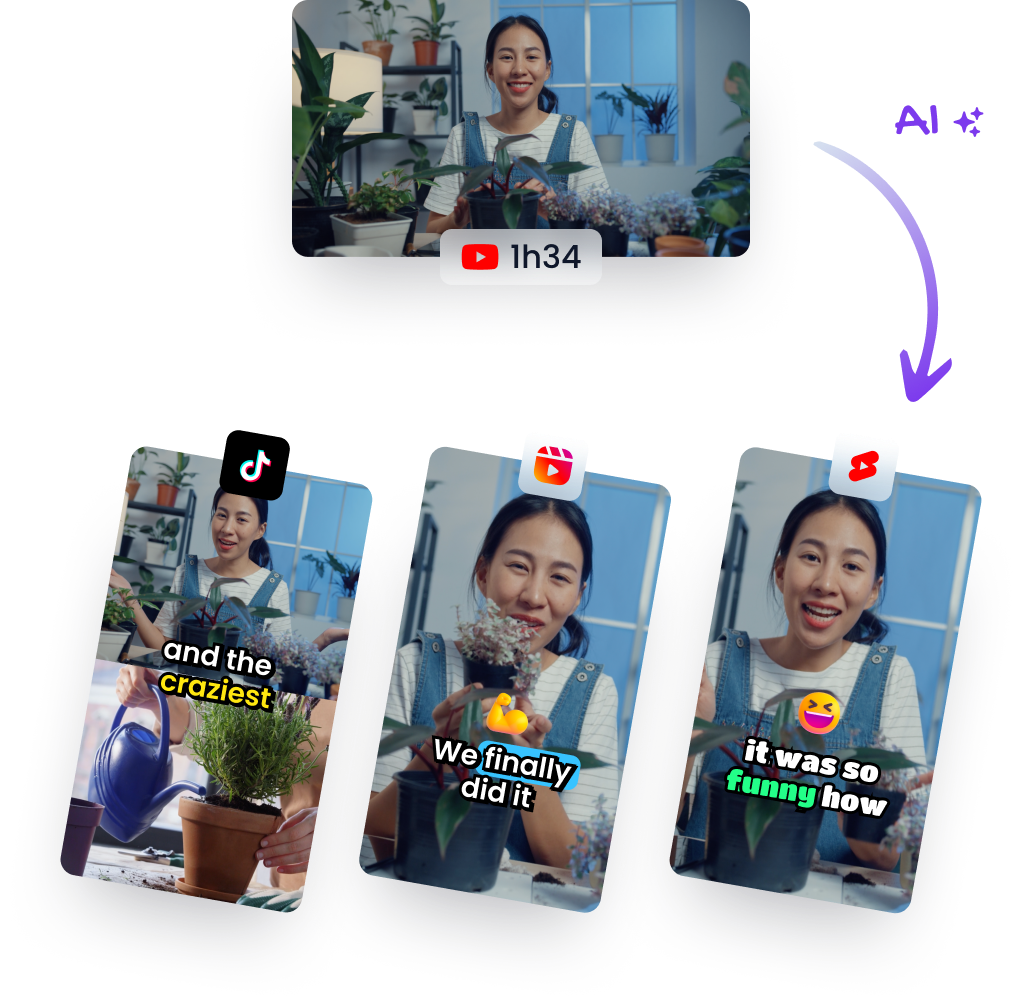
This is exactly the problem AI tools were built for. With a tool like Klap, for example, you just drop in a YouTube link or a video file. The AI does the heavy lifting, automatically identifying the most engaging segments and potential hooks from your existing content.
It doesn't just find the clips; it reframes them for a 9:16 view and adds dynamic, eye-catching captions that keep viewers locked in. A job that used to take hours of editing can now be done in minutes. You can learn more about how to turn a single YouTube video into dozens of Shorts and keep your content calendar packed without losing your sanity.
This kind of workflow is an absolute game-changer. It lets you build a massive library of Shorts fast, ensuring you maintain the posting velocity you need to maximize earnings. You stop treating content creation like a daily chore and start running it like a predictable, scalable system.
Thinking Beyond Ads with Alternative Monetization
Relying on the Shorts Creator Pool alone is like planting only one type of crop—a single bad season could wipe you out. While that ad revenue is a great start, the real financial power of Shorts comes from using them as a top-of-funnel marketing tool.
Think of your Shorts as attention magnets. They pull in new viewers who might never have found your channel otherwise. Each clip that takes off is a golden opportunity to guide that fresh audience toward more stable, profitable income streams you actually control.
Revive Old Videos to Boost AdSense
One of the smartest and simplest plays is using Shorts to breathe new life into your long-form video library. You've already done the hard work creating that content; now it's time to put it back to work.
Create a punchy Short that serves as a teaser or highlight reel for one of your older, high-performing videos. Then, drop a verbal call-to-action and a pinned comment pointing viewers to the full video. This sends a wave of new traffic to content that's already earning good AdSense, essentially giving you a second payday from your archives.
Drive Sales with Affiliate Marketing
Affiliate marketing and Shorts are a natural fit. It’s a way to earn commissions by recommending products you genuinely use and believe in, but the key is authenticity—it can't feel like a pushy sales pitch.
Instead of just holding up a product, create a Short that solves a real problem. A tech creator, for instance, could make a clip titled, "The one gadget that finally fixed my terrible WiFi." Then, they drop their affiliate link in a pinned comment.
Actionable Insight: This works because you're leading with value. You aren't just saying "buy this." You're showing people how it solves a problem, which makes them far more likely to trust the recommendation and make a purchase.
Attract High-Paying Brand Deals
Brands are constantly on the hunt for creators with an engaged, niche audience. When you consistently create high-quality Shorts in a focused topic, you position yourself as an authority, making your channel a magnet for sponsorships.
A brand trying to reach DIY enthusiasts would much rather partner with a woodworking channel getting 50,000 views per Short than a generic entertainment channel getting a million. Why? Because every single one of your viewers is in their target demographic.
Focus on building a loyal community around your niche. When brands see that engagement, they don't just see views—they see a valuable partner for their next campaign. These deals can often dwarf what you make from ad revenue. For a deeper dive into monetization tactics, check out our other articles on content monetization.
Sell Your Own Products and Merch
Selling your own stuff is one of the most profitable moves a creator can make because you keep the lion's share of the revenue. Your Shorts become the perfect, low-cost ad platform to show off what you've got.
- Digital Products: A fitness creator could share a quick, intense workout in a Short, then point viewers to their complete digital workout plan for sale.
- Physical Merch: A gaming creator could simply wear their own branded hoodie while recording a clip, making the merch an organic part of the content.
Many creators diversify by selling merch. It helps to explore how to choose effective promotional products that actually resonate with your audience and feel like a natural extension of your brand, not just a cash grab.
Use YouTube’s Native Creator Support Tools
Finally, don't sleep on the monetization tools YouTube has built right into the platform. These are designed to let your most dedicated fans support you directly.
Two key features you should enable immediately are:
- Super Thanks: This lets viewers buy a fun, one-time animation that pops up over your Short. It's essentially a virtual tip jar, giving fans a way to show appreciation for a clip they really loved.
- Channel Memberships: While memberships are often driven by long-form content, you can use Shorts to promote the program. Tease exclusive perks like custom emojis, badges, or behind-the-scenes footage to convince your Shorts viewers to become paying members.
By weaving these alternative strategies together with your ad revenue, you build a much more resilient and diversified income stream. You stop being completely dependent on the algorithm and start building a real, sustainable business around your content.
Common Questions About Monetizing YouTube Shorts
As you get into the swing of creating Shorts, you're bound to run into a few questions. The monetization side of things is a little different from what you might be used to with long-form videos, so it's totally normal to feel a bit unsure. Let's clear the air and give you some straight-up answers to the stuff creators ask about the most.
How Much Can I Realistically Expect to Earn at First?
Alright, this is the big one, and I'll be blunt: not a lot when you're just starting. The Revenue Per Mille (RPM) for Shorts is way lower than for your regular videos, typically landing somewhere between $0.01 and $0.06 for every thousand views.
Let's put that in perspective. A Short that pops off and hits a million views might only bring in $10 to $60. That's why with Shorts, it's all about volume. You're not trying to get rich off one viral hit. The real strategy is to build a steady flow of views across dozens or even hundreds of Shorts, letting all those tiny earnings add up over time.
Actionable Insight: Think of your initial Shorts ad revenue as a nice little bonus, not a full-time salary. Early on, the real magic is using those views to grow your subscriber base and funnel people toward more profitable things, like your affiliate links or long-form content.
Does Using Copyrighted Music Affect My Revenue?
Yes, it absolutely does, and it's a major factor. When you grab a popular track from YouTube's music library, the ad money from that Short often gets split between you and whoever owns the music rights. The money in the Creator Pool is calculated after YouTube has already paid out for all those music licenses.
This means if you use a trending song to get more views, a chunk of the revenue that would have gone to you is first paid out to the artists and record labels. While hopping on a trend is great for getting discovered, sticking to original audio or royalty-free music is the only way to guarantee you keep your full 45% share of the ad revenue.
How Do Shorts Earnings Compare to TikTok?
Even though they're both short-form video giants, their payment models are worlds apart. For a long time, TikTok's Creator Fund paid out from a fixed pool of money, which many creators found was pretty low and wasn't directly connected to how well their videos actually performed with ads.
YouTube, on the other hand, is built on a real ad-revenue sharing model. What you earn is directly tied to the ads people see while scrolling the Shorts feed and your slice of the total monetized views. While TikTok is definitely trying to improve its programs, YouTube's system is generally more transparent and scales directly with your channel's growth.
Can a Short Go Viral and Make Me No Money?
Unfortunately, yes, this can and does happen. Not every view is a monetized view. For a view to count toward your earnings, an ad has to be shown to that specific viewer during their watch session in the Shorts feed.
There are a few common reasons you might see a ton of views but zero dollars:
- Ineligible Content: If your Short gets flagged as not being advertiser-friendly, no ads will run against it, and you won't earn a dime.
- Copyright Claims: It's not just music. If you use other copyrighted clips or footage, the rights holder can claim all the revenue from your video.
- Ad-Free Viewing: People watching with YouTube Premium don't see ads. You still get a small piece of their subscription fee, but it's calculated differently than ad revenue.
The best way to protect your earnings is to focus on creating original, advertiser-safe content. That way, you can maximize the percentage of your views that actually put money in your pocket.
Ready to stop manually editing and start scaling your content? Klap uses AI to find the best moments in your long-form videos and turns them into viral-ready shorts in minutes. Try it for yourself and see how easy content repurposing can be at https://klap.app.