Your Guide to Content Marketing Videos in 2026
Other

Let's get one thing straight: content marketing videos aren't just ads disguised as content. They are valuable, educational, or entertaining videos designed to build a genuine connection with your audience. Think of them as the engine that attracts, engages, and guides viewers from just being curious to becoming loyal customers.
Why Content Marketing Videos Are Essential in 2026
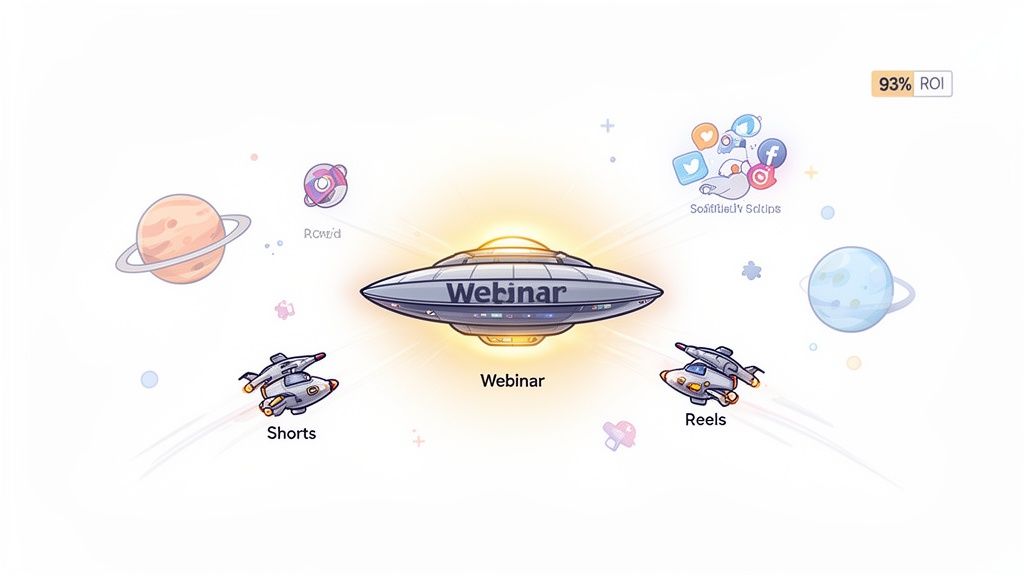
Picture your best piece of content—maybe a detailed webinar or an in-depth tutorial—as a "mothership" packed with knowledge. In the past, that mothership might have just been a long article sitting on your blog. Today, it’s a fleet of agile "scout ships" (your videos) launched across every social media platform to find and bring back an engaged audience.
This video-first approach isn't some passing fad; it's the core of any smart marketing strategy. Video simply grabs and holds attention better than anything else. By combining visuals, sound, and storytelling, it creates an immersive experience that forges a much deeper connection with your viewers.
The Power of Video in Building Trust
So, what makes video so effective? It’s all about humanizing your brand. When viewers can actually see and hear a real person explaining a tricky concept or showing how a product works, it builds a level of trust and authenticity that text alone can't touch.
This direct connection makes complex information easy to digest and remember. It's the difference between reading a dense instruction manual and having an expert personally walk you through each step. That’s exactly why video has become such a dominant force.
The data backs this up. Video marketing delivers a significant ROI, with research showing 92% of marketers report strong returns from their efforts. Digging deeper, 86% say video has helped them generate leads, and 90% credit it with increasing brand awareness. This translates to real business impact, as 88% of consumers say they’ve been convinced to buy a product or service by watching a brand’s video. You can dive into more of these powerful video marketing metrics to see the full picture.
The actionable insight here is to stop treating video as just another type of content. Instead, see it as the primary channel that powers your entire marketing ecosystem, turning passive browsers into active customers.
How Video Outperforms Static Content
To really grasp this shift, it helps to put video and text side-by-side. While articles and infographics definitely still have their place, video dominates in the areas that matter most for engagement and conversion. Think of text as the detailed blueprint and video as the immersive 3D walkthrough.
Here's a quick look at how they stack up.
Video vs. Text Content at a Glance
MetricContent Marketing VideosTraditional Text/Image Content
Attention & Retention
High; the mix of sight and sound holds attention for longer periods.
Moderate; users can easily skim, get distracted, or bounce.
Emotional Connection
Strong; seeing human faces and hearing stories builds empathy and trust.
Lower; it relies entirely on strong writing and images to create emotion.
Information Recall
Very high; viewers retain around 95% of a message from a video.
Low; people only remember about 10% of what they read.
Social Shares
High; videos are shared 1200% more than text and images combined.
Lower; requires exceptionally good copy or visuals to go viral.
Conversion Impact
Strong; adding a video to a landing page can boost conversions by 80%.
Moderate; it depends heavily on persuasive writing and clear calls-to-action.
Ultimately, a video-first mindset doesn't mean you have to abandon other content. It just means you should lead with your most powerful tool. Actionable insight: Every blog post can become a video script, every data point can be an animated short, and every customer story can be a compelling testimonial. In 2026, getting on camera isn't just a nice-to-have—it's the business case.
Matching Video Types to Your Marketing Goals
Throwing random videos out there and hoping something sticks? That’s not a strategy; it’s a lottery ticket. The smartest creators know that making "a video" is easy, but making the right video is what actually gets results.
Your videos need to meet viewers where they are. You wouldn't pitch a product demo to someone who's never even heard of your brand, right? It’s like proposing on a first date—it’s just too much, too soon.
Think of the customer journey as a path with three main stops: awareness, consideration, and decision. Each stop requires a totally different kind of conversation, and that means a different type of video. When you map your video formats to these stages, you create a natural flow that guides people from "Who are you?" to "Where do I sign up?"
Top of the Funnel Videos for Building Awareness
At the top of the funnel (ToFu), your job is to get noticed. You’re trying to attract a wide audience and introduce them to your brand or a problem they didn’t even realize they had. These folks aren't looking to buy anything yet; they're just scrolling and exploring.
Your videos here need to be quick, valuable, and super shareable. This is the domain of short-form clips and snappy explainer videos, built for discovery on platforms like TikTok, Instagram Reels, and YouTube Shorts where you have seconds to make an impression.
- Engaging Short-Form Videos: These are your 15-60 second attention-grabbers. Actionable insight: Think quick tips, funny skits about industry pain points, or jumping on a trend that relates to your niche. A software company, for example, could make a hilarious Reel about the chaos of spreadsheet management—subtly hinting at the problem their tool solves.
- Educational Explainer Videos: A little longer at 1-3 minutes, these videos break down a complex idea into something simple. They’re all about answering the "what" and "why" behind a problem, positioning you as a helpful expert without a hard sell. Imagine a fintech brand creating a short animation that finally makes blockchain make sense.
Middle of the Funnel Videos for Nurturing Consideration
Once people know you exist, they slide into the consideration stage (MoFu). Now, they're actively researching solutions and comparing you to others. Your goal shifts from getting attention to earning trust and showing off your expertise.
This is where you go from simply grabbing attention to holding it. These videos must deliver real substance and answer the specific, detailed questions your potential customers are asking.
For this stage, you need to go deeper. These formats prove you’re an authority and help you build a real connection with people who are serious about finding an answer.
- In-Depth Webinars & Expert Interviews: Hosting a 30-60 minute webinar on a hot industry topic or interviewing a respected voice in your field instantly elevates your brand. It’s a massive value-add for your audience, and by putting it behind a simple registration form, you can capture high-quality leads.
- Powerful Case Study Videos: Nothing sells like proof. Case studies tell the story of how a real customer triumphed over their problem using your product. They're incredibly persuasive because they show tangible results and move beyond just claiming you're the best to showing it.
Bottom of the Funnel Videos for Driving Decisions
Finally, at the bottom of the funnel (BoFu), your audience is on the verge of making a decision. They’ve done their homework and are likely weighing their final two or three options. Your videos now need to be direct, convincing, and eliminate any last-minute hesitation.
This is your chance to close the deal. The goal is to build confidence and make saying "yes" feel like the easiest, most obvious choice.
- Customer Testimonials: While case studies show the "how," testimonials are all about the "feeling." These are short, authentic clips of happy customers sharing their positive experiences. Seeing and hearing a real person vouch for your brand can be the final nudge a prospect needs to convert.
- Personalized Demo Videos: Forget generic product tours. Actionable insight: A personalized demo speaks directly to a prospect’s unique challenges and shows them exactly how your solution will work for their specific situation. This high-touch approach proves you’ve been listening and makes your value impossible to ignore.
Capitalizing On the Short-Form Video Revolution
Let's be honest: the content marketing game has changed. For years, we poured our energy into long blog posts and polished YouTube videos. But a new format has completely taken over the conversation: short-form video. This isn't just a passing fad—it's the new language of the internet, built for quick scrolls on a phone and our ever-shrinking attention spans.
The numbers are compelling. Short-form video has become the undisputed champ of content marketing, with 49% of marketers calling it their single best format for ROI. And it’s not just us pushing it; audiences are begging for it. A massive 81% of consumers say they want to see more short-form content from brands. With Instagram Reels now accounting for over 50% of time spent on the platform for many users, you know exactly where your audience is looking. Dive into the latest marketing statistics on HubSpot to see just how deep this trend goes.
The Anatomy of a Winning Short
Making short-form content marketing videos that actually stop the scroll on TikTok, Reels, and YouTube Shorts is both an art and a science. It all boils down to a few core elements you simply can't afford to get wrong.
It all starts with the hook. You have less than three seconds to give someone a reason to care. Actionable insight: Start with a bold claim ("This one tool replaced our entire sales team"), a shocking visual, a relatable problem ("You're wasting hours on this every week"), or the start of a story they need to see finished. If your hook is weak, your video is already dead on arrival.
Next, you have to deliver the value—fast. Your clip needs to offer a quick, satisfying payoff. Maybe it's one killer tip, a good laugh, or a "wow" moment. The goal is to be incredibly concise and impactful, leaving the viewer feeling like they got something genuinely useful out of their 15 seconds with you.
Finally, think about how they’re watching. A staggering 50% of viewers watch videos with the sound off. This makes dynamic on-screen captions an absolute must. They make sure your message hits home even in silence and open your content up to a much wider, more accessible audience.
Overcoming the Content Treadmill
Here’s the real challenge with short-form video: it’s not about making one amazing clip. It’s about the never-ending hunger of the algorithm. To stay relevant, you need to feed it a constant stream of high-quality shorts. For most creators and marketing teams, this feels like running on an impossible treadmill.
This is where your strategy needs to get smarter. Each platform has its own quirks, and knowing the key differences can make or break your performance. You can get a head start by reading our guide on TikTok vs YouTube Shorts.
The secret isn't to work harder by filming endless new videos. The secret is to work smarter by multiplying the value of the content you already have.
This constant pressure to create can lead to serious burnout, but it also creates a massive opportunity. Just think about all the incredible long-form content you’ve probably already made:
- In-depth webinars packed with expert knowledge.
- Podcast interviews with industry titans.
- Detailed YouTube tutorials that solve real-world problems.
Each of these is a goldmine. Tucked away in those hours of footage are dozens of perfect, bite-sized moments just waiting to be clipped and shared. The only thing that's been holding you back is the sheer time and effort it takes to find and edit them.
This very problem sets the stage for a powerful solution—a way to meet this demand without hiring a huge editing team or spending your life in Adobe Premiere. Instead of seeing the short-form revolution as a burden, you can reframe it as a chance to amplify your best ideas, turning one big piece of content into a dozen new ways to connect with your audience.
How to Repurpose Video Content with AI
You've poured hours, maybe even days, into creating a fantastic long-form video—a deep-dive webinar, a killer podcast episode, or a detailed product demo. The problem? It's just one piece of content sitting on one platform, like YouTube.
To get the most out of all that hard work, you need to chop it up into a bunch of short, social-ready clips. But doing that by hand is a soul-crushing grind. It’s the kind of bottleneck that burns out entire marketing teams and leaves creators feeling completely drained.
What if you could turn that one-hour "lead" of a podcast into social media "gold" in just a few minutes? This isn’t just a time-saver; it’s a strategic way to multiply your content's reach, and it’s all possible with AI.
The New AI-Powered Repurposing Workflow
AI tools have totally changed the game for how we create content marketing videos. Forget about an editor manually scrubbing through hours of footage. AI now does the heavy lifting, acting like a super-powered assistant that instantly finds the best moments for you.
The process boils down to three simple but critical parts: nailing the hook, adding dynamic captions, and closing with a clear call to action.
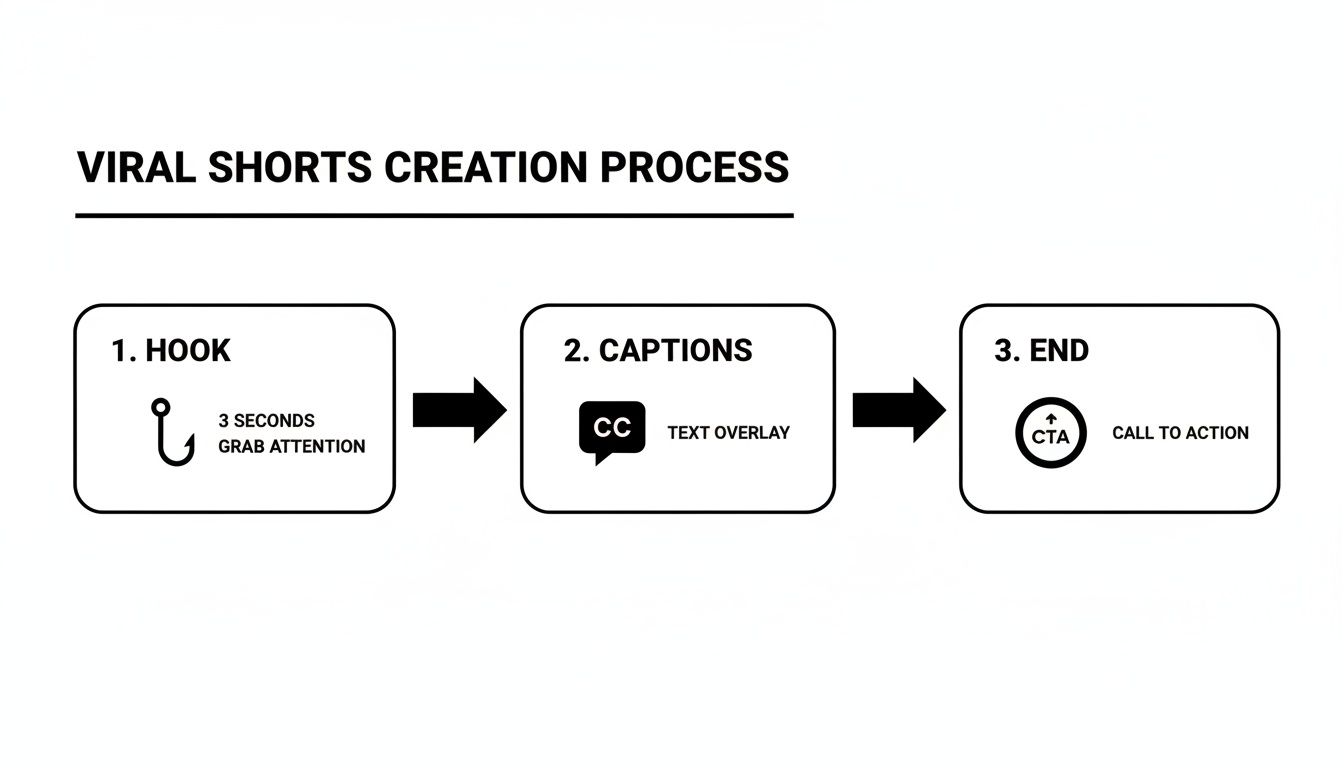
This simple structure is the secret sauce behind almost every successful short video. You start with something irresistible to stop the scroll, keep attention with captions, and then tell them what to do next. AI tools can now automate this entire sequence.
A Practical Walkthrough Using Klap
Let’s see what this actually looks like with a tool like Klap, which was built from the ground up for exactly this job. This is the exact method top creators are using to 10x their video output without hiring a massive editing team.
All you have to do is drop in a link to your original video. That’s it. There’s no need to download massive files or wrestle with complicated editing software.
Here's how the magic happens in a few automated steps:
- Upload Your Long-Form Video: Just paste a YouTube link or upload your video file directly. The AI gets to work right away.
- AI Finds the Best Moments: The AI scans your entire video—analyzing the transcript, faces, and tone—to pinpoint the most interesting questions, powerful statements, and hook-worthy moments. It then presents a series of suggested short clips.
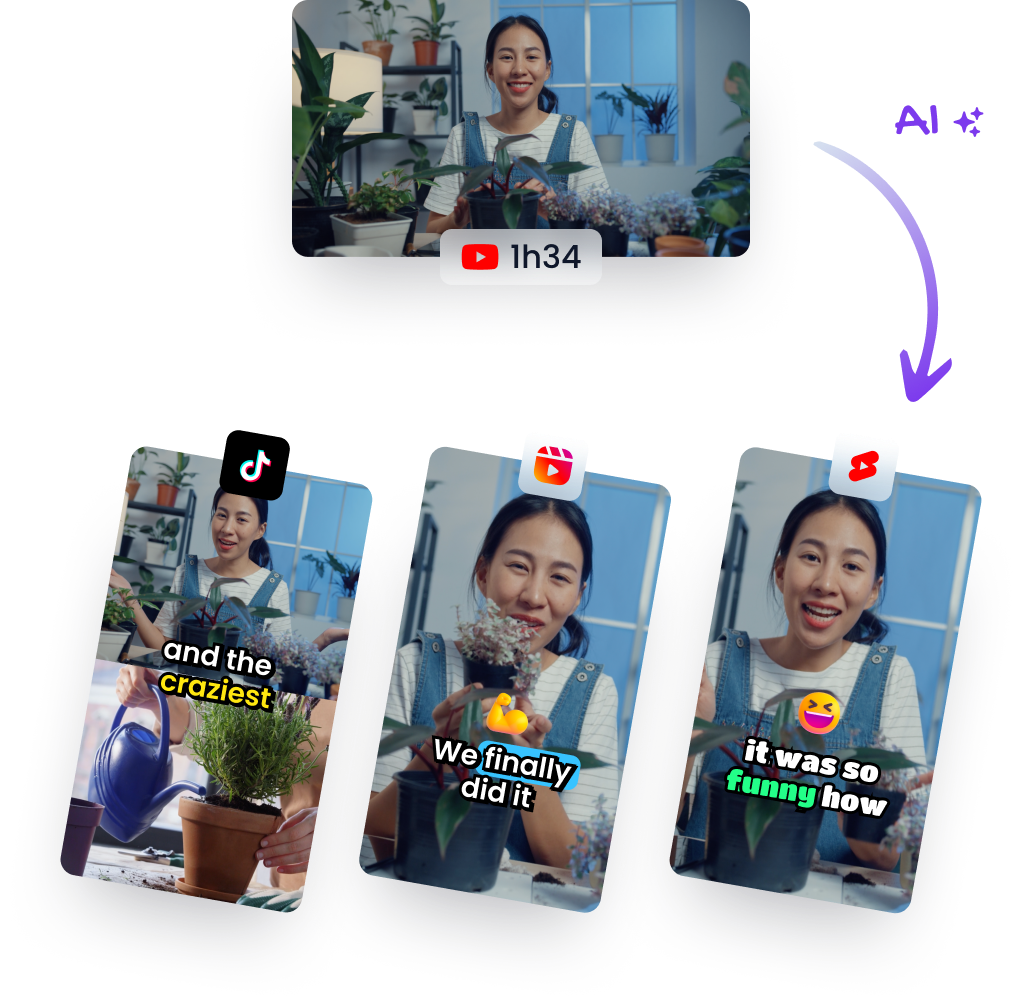
- It Edits for You: Klap doesn't just cut the video; it gets it ready for social media. It adds slick, animated captions (a must-have for silent viewers), automatically reframes the shot to keep the speaker centered, and formats it perfectly for TikTok, Reels, and Shorts. You can then quickly review the clips, tweak the captions, or trim the start and end points if you need to.
- Export and Share: With a couple of clicks, you have an entire library of social media clips ready to post. A task that used to take a full day can now be done in the time it takes to make a coffee.
Manual vs. AI-Powered Video Repurposing Workflow
To really understand the difference this makes, let's compare the old way of doing things with the new AI-powered workflow. The time and effort saved is staggering.
TaskManual Workflow (Time per Video)AI Workflow with Klap (Time per Video)
Review & Select Clips
60 - 120 minutes
5 minutes (AI does it automatically)
Clip & Trim Videos
30 - 60 minutes
10 minutes (for minor adjustments)
Transcribe & Caption
45 - 90 minutes
5 minutes (AI auto-generates)
Reframe for Vertical
20 - 45 minutes
2 minutes (AI auto-reframes)
Export Clips
15 - 30 minutes
5 minutes
Total Time
~4 - 6 hours
~20 - 30 minutes
As you can see, the AI workflow isn't just a minor improvement—it’s a complete transformation of the process, freeing up hours of your time for every single long-form video you produce.
By building this into your content strategy, you’re not just making more stuff; you're squeezing every last drop of value out of the hard work you’ve already done.
If you’re ready to stop the manual grind, see how a long-to-short video converter can transform your workflow. It's the key to making a powerful video marketing plan a reality, no matter the size of your team.
Promoting Your Videos for Maximum Reach and Impact
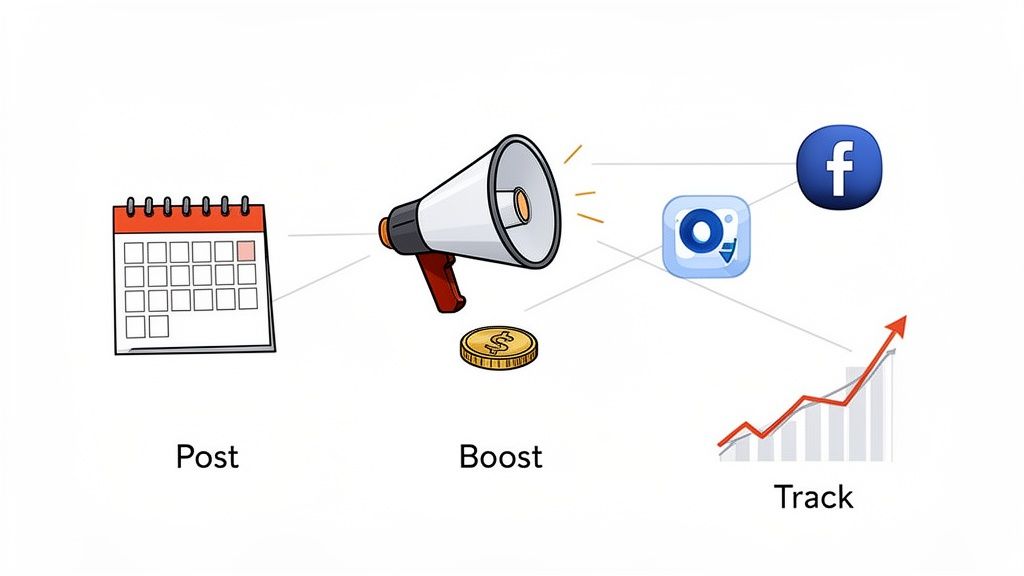
Creating great content marketing videos is only half the battle. After all the time you've spent scripting, filming, and editing, the worst thing that can happen is for your masterpiece to sit unseen, collecting digital dust.
To make sure that doesn't happen, you need to ditch the old "post and pray" approach. It's time to build a smart, strategic distribution plan.
Think of it like a movie premiere. Studios don’t just drop a film and hope people find it. They run trailers, do press junkets, and put up billboards. Your video promotion needs that same level of intention to get your content in front of the right eyeballs at the right time.
Tailoring Your Content for Each Platform
A one-size-fits-all strategy just doesn't cut it on social media. Every platform has its own algorithm, audience, and unspoken rules. To win, you have to play their game and adapt your content to feel native to each channel.
- YouTube: This is your home base for long-form video. Go all-in on SEO with keyword-rich titles and descriptions. Actionable insight: A compelling, custom thumbnail is non-negotiable—it can improve your click-through rate by over 50% in some cases.
- TikTok and Instagram Reels: These platforms are all about the hook. You have to grab attention within the first 3 seconds. Use trending audio, pop in relevant hashtags, and get straight to the point. Captions are also a must, since so many people scroll with the sound off. If you need a hand, check out our guide on how to add captions to YouTube Shorts; the same principles apply here.
- LinkedIn: As the go-to B2B network, LinkedIn is where you build professional authority. Share clips from webinars, expert interviews, or insightful case studies. The vibe should be more polished and geared toward solving real business problems.
- X (formerly Twitter): Video on X is perfect for quick updates, event highlights, and starting conversations. Keep your clips short and punchy, and use them to drive people back to your longer content on YouTube or your blog.
Amplifying Your Best Content with Paid Ads
Organic reach is great, but let's be real—sometimes your best work needs a little boost to break through the noise. This is where a small, targeted ad budget can work wonders. You don't need to spend a fortune; even $5 or $10 a day can seriously amplify your top-performing videos.
This isn't about "buying views." It's about strategically placing your best content in front of a hyper-specific audience that's most likely to care about your message. You're turning passive scrollers into genuinely interested viewers and potential leads.
Actionable insight: Find a video that's already getting good organic love—one with high watch time, lots of comments, or a good number of shares. Then, use that post's ID to run a targeted ad campaign. This preserves all the social proof (likes, comments) you've already earned, making the ad appear more authentic and trustworthy.
A Sample Weekly Distribution Schedule
Consistency is the engine of any good content strategy. A simple distribution schedule keeps you on track and builds momentum with your audience and the algorithms. Here’s a simple but powerful schedule for one long-form video and its repurposed shorts:
DayPlatformAction
Monday
YouTube & Blog
Publish the main long-form video. Embed it in a fresh blog post.
Tuesday
Post a 60-second clip from the main video with a professional insight.
Wednesday
Instagram/TikTok
Share Short #1 using trending audio and relevant hashtags.
Thursday
X (Twitter)
Post Short #2 as a quick tip and ask a question to spark engagement.
Friday
Instagram/TikTok
Share Short #3, maybe a behind-the-scenes moment or a fun blooper.
Weekend
All Platforms
Reshare the main YouTube link and ask for feedback in your Stories.
This structured approach makes sure you squeeze every drop of value out of each video, turning one big piece of content into a full week of engagement. By being strategic and consistent, you guarantee all your hard work pays off in views, engagement, and real business growth.
Measuring Video KPIs That Actually Drive Business
You’ve poured time and energy into creating and sharing your content marketing videos. That’s a huge win, but the job isn't done. The real question is: is any of it actually working?
It’s easy to get distracted by "vanity metrics" like view counts. A big number feels good, but it tells you almost nothing about your bottom line. To get the budget you deserve and prove your videos are more than just a creative exercise, you have to measure what matters.
Forget drowning in spreadsheets. It all boils down to tracking a few key numbers that connect your videos to real business goals. We can break these down into three simple categories: Engagement, Conversion, and ROI. Each one tells a different part of the story, from how captivating your content is to how much money it’s actually making.
Moving Beyond Views With Engagement Metrics
Engagement is your most honest feedback loop. These metrics tell you if people are actually watching and enjoying your videos. After all, a million views are worthless if everyone clicks away after three seconds.
These are the engagement KPIs you should be watching:
- Watch Time: This is the total time people have spent watching your video. Platforms like YouTube love high watch times because it means you're keeping users on their site, and their algorithm will reward you for it.
- Audience Retention: This is arguably the most important metric here. It shows you exactly what percentage of viewers are still watching at any given point. Actionable insight: Look for sharp drop-off points in your retention graph. These tell you exactly where your content became boring or confusing, giving you precise feedback for your next video.
- Average View Duration: On average, how long are people watching your videos? If you have a two-minute video but the average duration is only 15 seconds, you either have a weak hook or the content isn't delivering on its promise.
Connecting Video to Business Goals With Conversion Metrics
This is where your video strategy starts to hit the bottom line. Conversion metrics track the specific actions viewers take after watching your video. They're the bridge between eyeballs and actual impact.
Actionable insight: To track this stuff properly, you'll need to use tools like UTM parameters. These are little codes you add to your links (e.g., ?utm_source=youtube&utm_medium=video_description) that tell your analytics software exactly where your traffic and leads are coming from.
By measuring conversions, you’re no longer just a content creator; you're a growth driver. You can draw a direct line from a video view to a new lead or sale, which is the language that budget-holders understand.
Key conversion metrics include:
- Click-Through Rate (CTR): This measures how many people clicked a link in your video's description, cards, or on-screen call-to-action. A healthy CTR shows that your CTA is relevant and compelling enough for people to act on it.
- Leads Generated: Are viewers signing up for your newsletter, downloading your guide, or booking a demo? Tracking this is direct proof that your video is successfully moving people through your marketing funnel.
Proving the Bottom-Line Value With ROI Metrics
Ultimately, everything comes down to this. To truly prove your video strategy works, you have to measure marketing ROI. This is the KPI that answers the million-dollar question: "For every dollar we spend on video, how much are we getting back?"
Actionable insight: A simple way to calculate a basic ROI is: (Revenue from Video Leads - Video Costs) / Video Costs. Even if you can't track direct revenue, you can calculate Cost Per Lead by dividing your total video costs by the number of leads generated. This gives you a clear metric to benchmark and improve upon.
Calculating your ROI means connecting all your video production costs—tools, ad spend, and even your time—to the revenue generated from the leads your videos brought in. It might sound complicated, but it's the single most powerful way to justify and expand your video marketing budget.
Frequently Asked Questions About Content Marketing Videos
Getting into content marketing videos can feel like a huge leap, even when you have a solid plan. It’s natural to have a few nagging questions before you hit record.
Let's clear the air and tackle the most common hurdles that marketers and creators run into. Here are some quick, no-nonsense answers to get you started with confidence.
How Much Does It Really Cost to Get Started?
A lot of people think video production needs a Hollywood-sized budget. That’s a total myth.
The powerful 4K camera in your pocket—your smartphone—is more than enough to get going. Actionable insight: To instantly level up your audio, you can grab a simple lavalier microphone for less than $30. The difference in sound quality is dramatic and often more important than video quality.
Your biggest initial investment is your time. But even that can be managed. With AI repurposing tools, you can slice up a single long video into a month's worth of social clips, making that time incredibly well spent.
I'm Camera-Shy. How Can I Make Videos?
You don't have to be the star of the show. Seriously. Many of the most successful video formats don't require you to be on camera at all.
Give these a try:
- Screen Recordings: These are perfect for tutorials, software demos, or just walking through a slide deck.
- Animated Explainer Videos: You can use tools like Canva or Powtoon to build slick animations that break down complex ideas.
- Expert Interviews: Put the spotlight on your guest. This positions you as a skilled facilitator and thought leader without you having to be the main attraction.
Just start where you feel most comfortable. Even a simple voiceover on a presentation is a fantastic first step.
How Can I Measure ROI Without Complex Tools?
You don't need a complicated analytics dashboard to prove your videos are working. You can start by tracking a few powerful metrics right inside your social media accounts and website analytics.
The real key is connecting video views to tangible business results. You need to see if your audience is moving from passively watching to actively engaging.
Actionable insight: Use unique links with UTM parameters in your video descriptions. This lets you track exactly how many website visitors or sign-ups came from a specific video. Pay attention to your audience retention graphs—if people are sticking around, your message is landing. A high click-through rate on your video's call-to-action is another direct signal that your video is driving results. These simple data points are often all you need to show a clear return on your effort.
Ready to stop the manual grind and effortlessly turn your long-form videos into a library of viral shorts? With Klap, you can generate a dozen high-quality clips in minutes, complete with smart captions and perfect reframing. Start multiplying your content today at https://klap.app.