Why Are My TikTok Views So Low? A 2026 Diagnostic Guide
Other
You spent time scripting, filming, trimming, adding text, maybe even re-recording the first line three times. You hit post, wait for the first wave of traffic, and the video stalls. A few hundred views. Sometimes less. Meanwhile, an older post or a lower-effort clip seems to move faster.
That gap is why so many creators ask why are my TikTok views so low.
The frustrating part is that low views usually don’t come from one big mistake. They come from a mismatch between what TikTok wants to test, what your video signals in the opening seconds, and whether your account is healthy enough to get a fair shot at distribution. When you don’t separate those causes, you end up fixing the wrong thing.
I’ve seen creators blame hashtags when the actual issue was a weak opening. I’ve seen them blame the algorithm when their videos were getting held in review. I’ve seen good creators torch their reach by reposting near-identical clips and calling it “consistency.”
Low views are a diagnosis problem first.
That Sinking Feeling When Your TikTok Gets No Views
A flatlining TikTok feels personal, even when it isn’t.
You post something you believe should work. It’s on-topic. The edit is clean. Maybe your other platforms responded well to the same idea. Then TikTok barely moves it, and now you’re second-guessing everything from your niche to your account quality.
That reaction is normal. It’s also dangerous, because it pushes creators into random fixes. They post more often without improving the hook. They change niches too fast. They copy trends that don’t fit their audience. They delete videos too early. None of that solves the root issue.
What works is a clean troubleshooting process.
Practical rule: Don’t treat low views as a verdict on your talent. Treat them as a distribution problem with clues.
When views drop, I look at three layers:
- Algorithm fit: Did the video earn enough early watch behavior to keep getting pushed?
- Creative execution: Did the first seconds make people stop, understand, and keep watching?
- Account health: Is TikTok limiting distribution because of duplication, moderation flags, or erratic posting behavior?
That framework matters because different problems create similar symptoms. A bad hook and a review delay can both look like “TikTok killed my reach,” but the fix is completely different.
If you work through the problem in order, low views stop feeling random. You can tell whether the platform tested your content and rejected it, whether viewers bounced before the value landed, or whether your account never got a clean chance in the first place.
Understanding the 2026 TikTok Algorithm
Most creators still think TikTok mainly shows content to followers first and then expands from there. That’s outdated.
In early 2024, TikTok made a major shift toward distribution to non-followers, and many accounts saw follower-based views fall as a result. According to Media Mister’s analysis of falling TikTok views, creators saw an average 30-50% decrease in views from followers, while only about 20-30% of a creator’s content was pushed to existing subscribers after the change. The same analysis notes that the platform now weighs initial 3-second retention at 70% for promotion decisions, and creators who didn’t adapt saw average views drop from 10,000-50,000 to 2,000-10,000.
That means your follower count is no longer reliable insulation against weak performance. TikTok cares more about whether a video earns a strong response from fresh viewers.

Discovery now beats loyalty
This is the first trade-off creators need to accept. TikTok is less of a subscriber feed and more of a rolling audition.
If your old strategy was “my followers know me, so I can warm up slowly,” that strategy now fights the platform. New viewers don’t know you. They don’t care about your backstory yet. They judge the video fast, often internally, and they scroll even faster when the premise is vague.
That’s why many creators feel their audience “stopped seeing” their content. In practice, the platform shifted from loyalty distribution to discovery testing.
For local brands and service businesses trying to understand whether TikTok is still worth the effort under this discovery model, Adwave on TikTok for local business is a useful companion read because it frames the platform around practical business use rather than creator mythology.
TikTok is testing, not blessing
A lot of people talk about TikTok as if the algorithm randomly picks winners. It doesn’t feel random when you look at the mechanics.
TikTok behaves more like a testing engine. It gives a video an early shot, reads viewer behavior, and decides whether that clip deserves wider distribution. The first viewers aren’t just passive audience members. They’re the quality-control layer.
Here’s the key implication:
- The platform doesn’t owe your followers delivery
- It doesn’t reward effort by itself
- It rewards videos that create immediate proof of interest
This is why some “simple” videos outperform heavily edited ones. They communicate faster. They create curiosity faster. They earn those first few seconds faster.
The signals that matter most
At a practical level, TikTok is reading a cluster of signals, not one magic metric. The most important starting point is still the opening retention window.
When I audit low-view accounts, I usually find one of these problems:
SignalWhat TikTok is likely readingCommon failure
Opening retention
Did people stop scrolling and stay?
Intro takes too long
Completion behavior
Did viewers get to the end?
Middle drags or repeats
Rewatch potential
Did the structure create payoff?
Hook promises more than video delivers
Engagement depth
Did anyone comment, share, or react strongly?
Topic is clear but forgettable
The mistake is obsessing over likes while ignoring watch behavior. Likes are nice. Watch-through is survival.
If viewers leave before your point lands, TikTok treats the video as a bad bet, no matter how proud you are of the edit.
Why old TikTok advice stopped working
A lot of legacy advice still floats around. “Just post more.” “Use trending sounds.” “Followers will carry the video.” “The algorithm will find your audience eventually.”
Some of that advice still has a place. None of it works reliably without early retention.
What works now is tighter packaging:
- Faster context
- A clearer promise in the opening
- Immediate relevance for a cold viewer
- A payoff that matches the hook
The creators winning under the current model aren’t always making more content. They’re making more testable content. That’s the difference.
Diagnosing Your Content Are You Passing the 3-Second Test
If the algorithm section explains why your views are low, you find out whether your video gave itself a fair chance.
According to Made By Extreme’s breakdown of TikTok view issues, TikTok distributes a video to a seed audience of 300-500 users in the first 1-2 hours. To move further, the video typically needs a completion rate above 70-80%. That same analysis notes that poor hooks cause 60-70% of viewers to drop off in the first 3 seconds, and that adding auto-subtitles can boost completion rates by 25-40%, with videos using captions seeing 12% higher engagement on average.
That’s the primary battlefield. Not your full script. Not your niche manifesto. The first test.

What the first three seconds actually need to do
Creators usually think a hook means saying something loud or dramatic. That’s not enough.
A hook has one job. It must answer the viewer’s unspoken question: why should I keep watching this one?
Strong hooks usually do at least one of these immediately:
- Promise a result: “Here’s why your TikToks stall after posting.”
- Show a mistake: “This opening is killing your retention.”
- Create a gap: “My views dropped until I changed this one thing.”
- Start mid-action: Show the payoff, then explain it.
Weak hooks usually sound like this:
- “Hey guys, so today I wanted to talk about…”
- “A lot of people have been asking…”
- “I’m going to walk you through…”
Those aren’t hooks. They’re permission-seeking intros.
Audit your video without ego
When I troubleshoot a low-view TikTok, I mute it first and watch only the opening visuals. Then I play it with sound. Then I read the on-screen text separately.
That process reveals where the communication breaks.
Use this quick audit:
- Can a stranger understand the topic instantly?
If not, your setup is too slow. - Does the opening line create tension or curiosity?
If it only introduces the topic, it’s weak. - Is the value delayed by throat-clearing?
Cut the preamble. Start closer to the useful moment. - Would the clip still make sense with sound off?
If not, captions and text framing need work.
If you need editing support for this part of the workflow, it helps to review practical tooling options. This roundup of best TikTok editing apps is useful when you’re comparing captioning, trimming, reframing, and mobile-first editing setups.
Hooks that work versus hooks that don’t
The easiest way to improve retention is to stop writing intros and start writing openings.
Weak openingBetter opening
“Today I want to talk about low views on TikTok”
“If your TikTok stalls fast, check your first sentence”
“Here are some tips for creators”
“Most creators lose the viewer before the point starts”
“I made this video because people asked”
“This is the reason solid videos die at low views”
Notice what changes. The stronger version doesn’t announce content. It creates stakes.
Don’t waste the middle
A lot of TikToks have a decent first line and then collapse because the middle loses shape.
The structure should feel like motion. Each beat needs to earn the next one. If the clip repeats the same point in three ways, viewers sense there’s no new payoff coming. They leave.
A reliable structure looks like this:
- Hook
- Problem
- Specific example
- Fix
- Clean ending
That doesn’t mean every video needs to be educational. Entertainment clips still need progression. Even humor needs escalation or surprise.
Here’s a useful walkthrough on short-form pacing and editing craft:
Captions are not optional anymore
Many creators still treat subtitles as polish. On TikTok, they’re often part of comprehension.
Captions help in three ways:
- They clarify your point immediately
- They keep sound-off viewers in the video
- They reinforce the hook while the viewer is deciding whether to stay
A good caption track doesn’t decorate the video. It carries the message when the audio alone isn’t enough.
This is especially important if you speak quickly, use industry jargon, or rely on podcasts, interviews, and talking-head clips.
Quality still matters, but clarity matters more
Sharp video helps. Clean audio helps. Good lighting helps. But I’ve seen technically polished clips fail because they hid the point too long.
Prioritize in this order:
- Clear premise
- Fast hook
- Readable captions
- Tight structure
- Then polish
A raw clip with a strong opening can outperform a beautiful clip with a sleepy start. TikTok is ruthless that way.
Finding Hidden Technical and Account-Level Issues
Sometimes the content isn’t the main problem.
You can have a solid hook, decent pacing, and a clean edit, then still watch your views crater because the account itself is carrying friction. This situation often leads creators to lose weeks. They keep rewriting content when the actual issue is distribution suppression.
According to Skinned Car Tree’s analysis of declining TikTok views, shadowbans or content review flags can restrict FYP eligibility for 14-30 days, causing 70-90% view drops. The same analysis says TikTok’s AI scans for over 95% similarity to existing content to penalize reposts. It also notes that posting more than 3 videos a day can trigger review queues, while gaps longer than 72 hours can reduce an account’s momentum score by 40-60%.
That cluster of issues is why some creators feel like “nothing works anymore” even when individual videos look fine.

What a shadowban usually looks like in practice
Most creators use the word too loosely. Not every underperforming post is shadowbanned.
What I watch for is a pattern:
- Good videos suddenly stop reaching fresh viewers
- Multiple posts underperform in a similar way
- Visibility drops across the account, not just one topic
- Posts appear delayed, stuck, or oddly flat from the start
If that pattern appears after guideline-adjacent content, repost-heavy behavior, or spammy posting bursts, I stop blaming hooks and start looking at account health.
Low views on one video might be creative. Low views across many solid videos at once often means account friction.
Duplicate content is a bigger problem than most creators think
Reposting the same clip with tiny changes is one of the fastest ways to damage distribution trust.
TikTok is actively checking for near-identical content. If you’re cutting shorts from long-form video, that doesn’t mean you can dump multiple versions that feel effectively the same. Change the framing. Change the opening. Change the text treatment. Pull a different moment. Make the clip meaningfully distinct.
Creators run into issues when they repurpose content badly. Repurposing works. Lazy duplication doesn’t.
If you need cleaner subtitle workflows while varying clip packaging, a dedicated subtitle generator can help you produce more distinct versions without manually rebuilding every caption track from scratch.
Posting too much can hurt
Creators panic when views fall, so they often react by flooding the account.
That move backfires. More posting does not always create more opportunities if the platform starts treating the account as low-trust or spammy. I’d rather see a creator post with intention than dump a batch of mediocre or repetitive clips in a rush.
On the other side, long posting gaps hurt too. Accounts often lose rhythm when they disappear and return without any continuity.
A practical account-health reset
When I suspect technical or account-level suppression, I simplify everything for a stretch:
IssueWhat it often looks likeBetter move
Duplication
Similar clips posted repeatedly
Publish more distinct edits
Overposting
Burst posting in panic
Slow down and post deliberately
Inconsistency
Long gaps, then random uploads
Rebuild a steady schedule
Risky wording
Sensitive or spammy captions
Clean up language and metadata
I also review recent captions, overlays, and themes for anything that may have triggered review. Not because every account issue is moderation-related, but because creators often forget what they posted two weeks ago that may still be affecting reach.
Signs you should stop tweaking the same video
There’s a point where editing the same post idea becomes a waste.
If the account is unhealthy, changing fonts, trimming half a second, or swapping audio won’t solve the main issue. Step back and ask:
- Is this a single-video miss, or an account-wide slump?
- Did performance drop right after repetitive reposting?
- Have I been posting erratically?
- Have recent topics flirted with content-review risk?
Those questions save a lot of time.
Your Actionable TikTok Troubleshooting Checklist
When views drop, don’t guess. Run the checklist.
CategoryCheck PointHow to Fix
Algorithm
Is the opening immediately clear to a cold viewer?
Rewrite the first line and first visual so the topic is obvious at a glance.
Algorithm
Does the video create curiosity in the first seconds instead of introducing itself slowly?
Cut “hey guys,” setup lines, and warm-up context. Start with the strongest claim, moment, or result.
Algorithm
Does the video feel built for discovery, not just followers?
Remove insider language and assume the viewer has never seen you before.
Content
Is the hook stronger than the title in your head?
Turn the main idea into a tension-driven opening, not a topic statement.
Content
Can the clip work with sound off?
Add readable on-screen text and captions that carry the core message.
Content
Does the middle keep moving?
Cut repetition, compress explanation, and get to the payoff faster.
Content
Is the ending clean and earned?
End right after the value lands. Don’t tack on an unnecessary summary.
Content
Does the clip look and sound easy to consume?
Improve framing, lighting, and audio clarity. Keep edits readable on a phone screen.
Technical
Have recent posts been near-duplicates?
Change the angle, opening, and packaging of repurposed clips so they feel distinct.
Technical
Have you posted in a panic?
Stop flooding the feed. Return to a controlled posting rhythm.
Technical
Have you gone quiet and then returned randomly?
Re-establish consistency with a realistic publishing cadence you can maintain.
Technical
Could captions, overlays, or topics be triggering review friction?
Remove risky wording, avoid spammy formatting, and keep metadata clean.
A few creators like to overcomplicate this with spreadsheets, dashboards, and endless benchmark tracking. That’s fine if you manage a team. Most solo creators need something simpler.
Use the checklist after every low-view post. If two or three weak points show up in the same category, fix that category first. Don’t redesign your whole strategy because of one underperforming video.
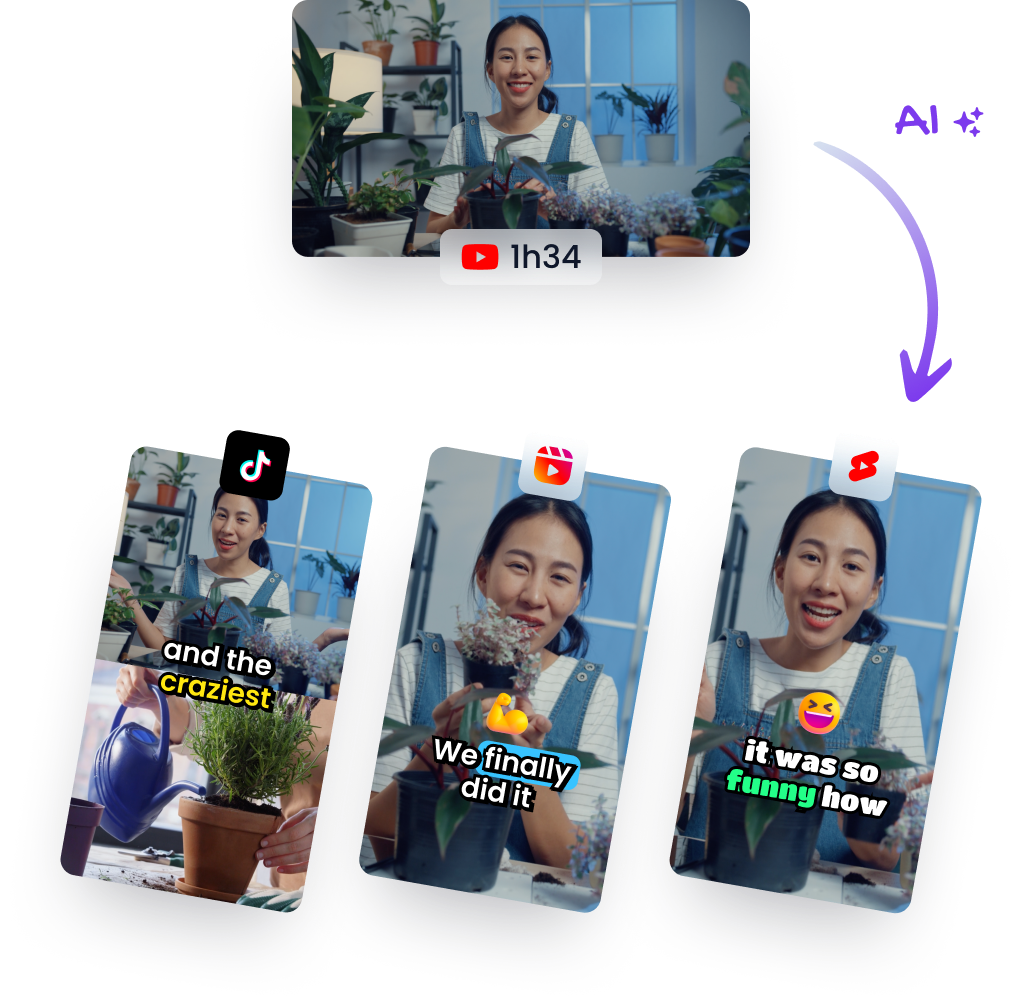
The Smartest Fix Repurposing Content for Endless TikToks
The hardest part of TikTok isn’t posting. It’s sustaining quality without burning out.
Creators hit a wall because the platform rewards speed, but strong short-form still demands hooks, structure, captions, pacing, and consistency. If you try to invent every TikTok from scratch, you eventually run into one of two problems. Either quality drops, or output drops.
That’s why repurposing long-form content is the smartest long-term fix.

Your best TikToks may already exist
If you have YouTube videos, podcasts, webinars, interviews, tutorials, livestreams, or client recordings, you probably already own more short-form material than you think.
Long-form content is useful because it naturally contains:
- Stronger raw opinions
- Real explanations
- Unexpected soundbites
- Natural story beats
- Authority that feels less forced
That matters because many weak TikToks are weak at the idea level. They were made just to fill the feed. Repurposed clips often feel sharper because they come from real conversations or complete thoughts.
Repurposing solves three low-view problems at once
This strategy works best because it attacks the root causes behind most view slumps.
First, it improves consistency. You’re no longer waiting for inspiration every day.
Second, it improves hook quality. Long-form content gives you more moments to choose from, so you can pull openings that already contain tension, clarity, or payoff.
Third, it reduces editing drag. You stop rebuilding every piece manually.
That’s especially important for creators who know they should post regularly but keep disappearing because the production load gets too heavy.
The goal isn’t more content for the sake of it. The goal is more good shots on goal without lowering your standard.
What good repurposing actually looks like
A bad repurposing workflow chops a random thirty seconds from a long video and posts it as-is.
A good workflow does this instead:
Bad repurposingBetter repurposing
Pulls a generic excerpt
Pulls a self-contained idea with tension
Keeps the original pacing
Tightens the opening for short-form attention
Uses one version everywhere
Adapts framing for TikTok specifically
Leaves captions as an afterthought
Builds captions into the viewing experience
This is why a proper long to short video converter matters in practice. The win isn’t just saving editing time. Its main advantage is giving yourself more chances to publish clips that are packaged for vertical, short-form viewing instead of recycled lazily.
Who benefits most from this approach
Repurposing is especially powerful if you’re one of these creators:
- YouTuber: You already have explainers, commentary, tutorials, or vlogs that contain multiple short-form moments.
- Podcaster: Your conversations are full of quotable clips, reactions, contrarian takes, and educational segments.
- Coach or educator: Your long-form teaching often contains compact answers that can become standalone TikToks.
- Brand or agency: You likely have webinars, demos, customer calls, and founder content that can be turned into repeatable short-form output.
The common thread is simple. You already have substance. You need better extraction and packaging.
Why this is more sustainable than trend chasing
Trend chasing can work. It can also wreck your consistency because trends have an expiry date and often don’t fit your voice.
Repurposing gives you a more durable system. Instead of asking, “What should I post today?” you ask, “What strong moment can I package from what I’ve already made?”
That shift changes everything. It lowers creative friction. It keeps your account active. It helps you test more hooks. It also leads to content that sounds more like you and less like a rushed imitation of whatever is moving this week.
For most serious creators, that’s the better long game.
Turning Low Views into a Consistent Growth Engine
Low views don’t mean your account is dead. They usually mean one part of the system is failing.
The creators who recover fastest are the ones who stop taking the slump personally and start treating it operationally. They understand how TikTok now distributes content. They audit the opening seconds with honesty. They check account health before pumping out more posts. Then they build a workflow they can sustain.
That’s the key shift.
The three habits that change everything
If you want views to become more stable, keep these habits:
- Read the platform correctly
TikTok is testing videos for discovery. Make content that earns cold-viewer attention fast. - Diagnose before reacting
Separate creative problems from account-level problems. They look similar from the outside and require different fixes. - Build a repeatable content engine
Sustainable output beats panic posting. Systems beat bursts.
Those same habits show up in adjacent performance channels too. If you’re thinking beyond organic social and want a broader view of paid distribution strategy, this guide to digital advertising for app businesses is a useful outside perspective on how structured testing beats random promotion.
What to do next
Pick your last five TikToks and review them in order.
Don’t ask whether they were “good.” Ask whether they were clear in the first seconds, distinct from one another, easy to consume without sound, and published from a healthy account rhythm. That audit will tell you more than your feelings about the content ever will.
Then make the next batch with intention. Better hooks. Cleaner packaging. More deliberate cadence. Less duplication. More benefit from content you already own.
That’s how low views stop being a recurring crisis and start becoming feedback you can use.
If you already create YouTube videos, podcasts, webinars, or interviews, Klap can make the whole process easier by turning long-form content into short, vertical clips with captions, reframing, and faster editing. Instead of starting from zero every time, you can build a steadier TikTok pipeline from content you’ve already made.