Short Form vs Long Form Video Content: A 2026 Guide
Other

Short form video keeps growing, but the smartest creators still don’t treat it as a replacement for long form. They treat it as distribution.
That shift matters because the old argument misses what drives results. According to Metricool reporting covered by Marketing Tech News, short form video publishing across major platforms grew 71% compared to 2024, while the number of accounts using it rose 51%. At the same time, long videos still hold the deepest attention and strongest monetization on platforms built for intentional viewing.
For creators, podcasters, educators, and marketers, the practical question isn’t short form vs long form video content. It’s how to make each format do the job it’s good at. Shorts win discovery. Long form builds trust, watch time, and revenue. A strong video portfolio uses both, with a workflow that turns one long asset into many short entry points.
The Great Video Debate Reimagined for 2026
The most useful way to think about video in 2026 is simple. Short form gets you found. Long form gives people a reason to stay.
That’s why creators who frame this as a fight usually end up underinvesting in one side of their funnel. If you only post shorts, you can build attention without building much depth. If you only publish long videos, you can create real value but struggle to keep discovery moving.

A better model is an ecosystem. Your long form content acts as the core asset. It holds the full lesson, interview, breakdown, story, or argument. Your short form content acts as the distribution layer. It surfaces the sharpest moments, strongest hooks, and most shareable takeaways in formats built for TikTok, Reels, and Shorts.
Early in strategy work, I usually map video formats by business role rather than by length. That keeps teams from chasing vanity metrics or dismissing a format because it feels less premium.
FormatBest useViewer mindsetMain payoffMain risk
Short form video
Discovery, reach, testing hooks
Browsing, low commitment
Shares, new viewers, fast feedback
Weak depth if used alone
Long form video
Education, trust, conversion
Intentional, active viewing
Authority, retention, revenue
Slower production and slower distribution
Hybrid strategy
Growth plus monetization
Mixed journey across platforms
Better portfolio balance
Requires workflow discipline
Core principle: The strongest creators don’t choose one lane. They build a system where short clips pull people into deeper assets.
That’s the essential reframe for short form vs long form video content. You don’t need to pick a winner. You need to assign each format a clear job and make them work together.
The Anatomy of Short-Form Video The Discovery Engine
Short-form video wins attention by asking for almost nothing upfront. In a feed built around speed, that low commitment gives creators a real distribution advantage.
Viewer behavior is different here. People are scrolling between messages, work, and entertainment. They decide in seconds whether a clip deserves more time, so the job of a short is narrower than many creators assume. It does not need to teach everything. It needs to earn the next action.
As noted earlier, short videos tend to perform best on completion and sharing when they stay tight and mobile-friendly. That pattern underscores the primary role of short form in a video portfolio. It is your discovery engine, your testing ground, and your fastest feedback loop.
That distinction is important because creators often judge shorts by the wrong standard. A 30-second clip should not be evaluated like a full tutorial, interview, or case study. It should be judged by whether it creates interest: a follow, a comment, a profile visit, a share, or a click into a longer asset.
Why short form earns reach
Strong short-form content usually does one clear job well:
- Create curiosity fast: Lead with a sharp opinion, surprising result, or audience pain point.
- Deliver one takeaway: One useful idea travels better than five rushed ones.
- Capture a real moment: Tension, contrast, reaction, and specificity outperform generic summaries.
- Point to something deeper: The best short often works as an entry point into a longer video, series, offer, or channel theme.
In practice, source material decides a lot of the outcome. Clips pulled from long-form videos with strong opinions, clean phrasing, and natural turning points usually outperform clips cut from rambling recordings. That is one reason a hybrid system works so well. Long form gives you richer raw material. Short form turns that material into repeatable distribution.
Short form is where you test hooks in public. The clips that earn rewatches and comments often reveal which topics deserve a full video, a follow-up, or a new series.
Execution still matters. Framing, on-screen text, and captions affect whether a clip survives the first two seconds, especially on mobile and in sound-off environments. If you want to tighten that part of the workflow, this guide on adding captions to YouTube Shorts covers the practical details.
Where short form breaks down
Shorts are weak at carrying nuance on their own. They can spark interest, but they rarely handle complexity, objection handling, or trust-building well without sending viewers somewhere else. That is the trade-off.
Creators who publish only shorts often run into the same ceiling. Reach goes up, but the content starts to feel disposable, repetitive, or detached from any larger body of work. The better approach is to assign shorts a clear role inside a broader system, then repurpose strategically. One long-form recording can become multiple clips, each aimed at a different hook, audience segment, or platform behavior.
If you want that top-of-funnel layer to feel more human and less interchangeable, it helps to boost audience connection with smarter content by building clips around real audience questions, common objections, and recognizable points of view.
The Power of Long-Form Video The Authority Builder
Long form asks more from the viewer, but it gives more back. When someone chooses to spend real time with your content, they’re not just browsing. They’re evaluating your thinking, your teaching, your taste, and whether you’re worth returning to.
That makes long form the format where authority is built. Not claimed. Built.
Why deeper viewing still matters
A long video gives you room to do what short clips can’t. You can explain context, show process, address objections, and let an idea breathe. That matters in categories where the audience needs confidence before they act, such as education, software, consulting, podcasts, interviews, and product-led content.
The platform economics also still favor depth. According to YouTube watch time and creator revenue data summarized here, long form videos over 10 minutes account for 64% of total YouTube watch time. Channels that prioritize long form also see 39% higher subscriber retention and 52% more revenue per viewer than short-form-only channels.
Those numbers line up with what many creators see in practice. Shorts often introduce you. Long form is where people decide whether to trust you.
What long form is best at
Long form is usually the right choice when the viewer needs more than a quick hit:
- Teaching complex topics: Tutorials, breakdowns, product education, and detailed walkthroughs need room.
- Building a repeat audience: Viewers return when they know they’ll get depth, not just flashes of insight.
- Creating monetizable assets: Sponsors, premium offers, services, and affiliate recommendations usually perform better when context is strong.
- Developing intellectual property: Long videos can become a searchable archive of your ideas.
One practical test helps here. Ask whether the topic loses value when compressed. If the answer is yes, make the long version first.
Operating rule: If your business depends on trust, don't build your entire content strategy on formats designed for interruption.
Long form also creates cleaner downstream assets. A thoughtful interview, webinar, or solo breakdown can produce multiple short clips, newsletter ideas, quote graphics, and sales collateral. The long asset becomes the source of truth.
What creators often get wrong
The common mistake is treating long form as if publishing alone is enough. It isn’t. A strong long video still needs a sharp premise, an intentional opening, and audience-aware structure. If the first minute wanders, viewers leave before the value arrives.
Another mistake is separating video strategy from monetization strategy. If you’re building around interviews, podcasts, or educational episodes, your money often comes from the deeper relationship that long content supports. This breakdown of how to monetize a podcast is useful because it maps monetization to audience trust, not just download volume.
Long form won’t usually win the fastest reach contest. That’s not its job. Its job is to make the audience you already reached care enough to stay, subscribe, buy, and come back.
A Head-to-Head Analysis by Performance and Purpose
The short form vs long form video content debate gets clearer when you compare formats by business function instead of personal preference. A creator who wants rapid distribution should judge formats differently than a creator selling expertise, memberships, or sponsorship inventory.

Reach versus retention
Short form is usually stronger when the goal is exposure. The format lowers the cost of trial for the viewer and gives platforms more chances to distribute your content to people who don’t know you yet. It’s ideal for first-touch attention.
Long form serves a different KPI set. It’s more useful for session depth, subscriber quality, repeat viewing, and direct monetization behavior. A smaller number of engaged viewers can be more valuable than a larger number of drive-by views.
Short form answers, "How do I get in front of more people?" Long form answers, "How do I become worth following?"
Use the first when your problem is discoverability. Use the second when your problem is conversion, authority, or loyalty.
Discovery versus deliberation
The viewer intent is completely different.
Someone watching a short clip is often in browsing mode. They may be entertained, intrigued, or lightly educated, but they usually haven’t committed to a topic yet. That makes short form excellent for hooks, snippets, reactions, and moments that spark interest.
Someone choosing a longer video is usually in deliberation mode. They want to understand, compare, learn, or spend time with a creator they already trust. For these reasons, interviews, tutorials, explainers, and stories outperform fragmented clips.
A useful way to frame it:
Decision areaShort formLong form
Audience intent
Casual discovery
Intentional learning or evaluation
Best content shape
One idea, one moment, one payoff
Full argument, process, or story
Typical next action
Follow, share, profile visit
Subscribe, binge, buy, inquire
Strategic role
Top of funnel
Mid and bottom of funnel
Speed versus depth in production
Short form looks cheaper, but that’s only partly true. A single clip is faster to make than a full episode. But a short-first strategy often demands relentless output, trend awareness, fast iteration, and constant packaging work. Many creators underestimate that operational burden.
Long form takes more planning, scripting, recording discipline, and editing judgment. But one strong asset can support a larger content system if you repurpose it well.
Practical reality: Short form rewards velocity. Long form rewards substance. Your workflow has to match the format you're betting on.
This is why teams with weak processes often stall. They either overproduce isolated shorts with no strategic destination, or they invest heavily in long videos and fail to distribute them.
Surface engagement versus deeper commercial value
Shorts often generate faster visible engagement. That feedback is useful. You can learn which hooks land, which topics spark reactions, and which framing styles increase shares.
Long videos tend to create stronger commercial outcomes because they allow more context. You can explain your offer, demonstrate expertise, or tell a persuasive story without forcing the audience to connect the dots themselves.
That distinction matters for creators selling services, software, education, communities, or sponsorships. If your offer requires trust, short clips can open the door, but they rarely close the loop alone.
What works and what does not
A lot of poor strategy comes from mismatched expectations. Here’s the clean version.
- What works with short form: bold openings, single-topic clips, visual clarity, strong spoken moments, and frequent testing.
- What fails with short form: dense explanations, soft intros, context-heavy edits, and clips with no obvious takeaway.
- What works with long form: clear positioning, strong first minute, narrative structure, topic depth, and meaningful payoff.
- What fails with long form: rambling openings, weak editing choices, generic topics, and publishing without a distribution plan.
Neither format is universally superior. Each one is unforgiving in a different way.
The Modern Workflow Turn Long-Form Assets into Viral Shorts
The highest-ROI workflow in video right now starts with a strong long-form asset and turns it into a set of shorts designed for different platforms and audience states.
That approach isn’t just more efficient. It also improves quality control, because your clips come from ideas you’ve already developed rather than from random attempts to fill a posting calendar.

Start with a pillar asset
The source content matters more than the clipping software.
A good pillar asset is usually a podcast episode, webinar, interview, tutorial, panel, founder update, or educational YouTube video with clear segments and natural spoken hooks. If the original recording has no tension, no clear structure, and no memorable lines, the shorts will feel forced.
Before recording, I’d define three things:
- The audience question the full video answers.
- The strongest moments likely to stand alone as clips.
- The desired path from clip viewer to long-form viewer or buyer.
That last piece is where many teams leave money on the table. Repurposing only works strategically when the shorts point somewhere.
Extract moments, not random excerpts
A usable clip usually falls into one of these buckets:
- A hard opinion: Something concise enough to trigger agreement or disagreement.
- A tactical lesson: One takeaway that can stand on its own without too much setup.
- A dramatic turn: A story beat, surprise, mistake, or insight shift.
- A proof moment: An answer that demonstrates expertise fast.
Don’t clip based only on timestamps where someone spoke clearly. Clip based on emotional and informational density.
The strongest short clips usually feel complete on their own, but incomplete enough to make the full version more attractive.
Format for mobile, then refine for platform context
Once you identify candidate moments, the next step is adaptation. Teams often lose time during this phase. Vertical reframing, speaker tracking, subtitle cleanup, and pace adjustments sound small until you need to do them for multiple clips every week.
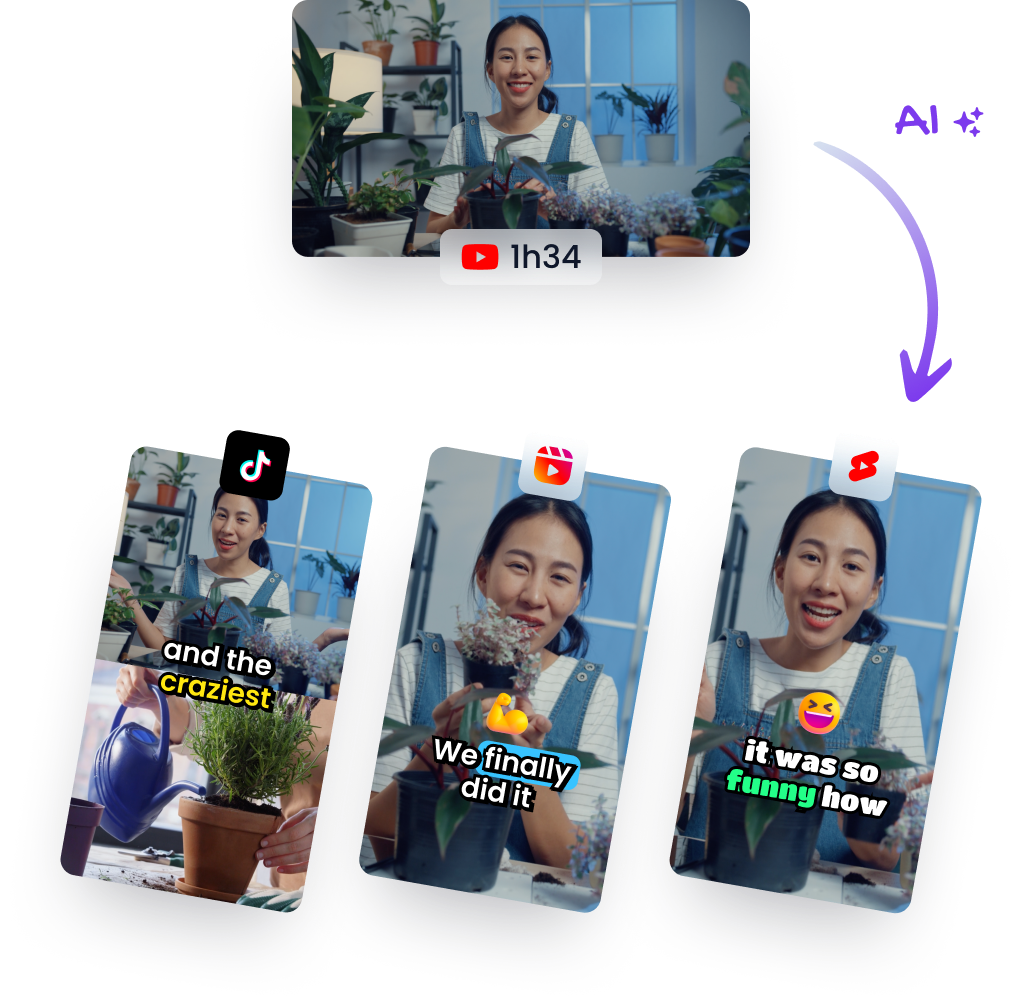
AI-driven repurposing tools can reduce editing time by up to 80%, turning a 4-hour manual job into a 30-minute task. Agencies using that efficiency report a 35% ROI uplift, and hybrid strategies using repurposed clips see 50% better engagement than pure short-form approaches, according to this analysis of AI video repurposing workflow gains.
One tool in that workflow is Klap’s long to short video converter, which analyzes longer videos, identifies clip-worthy segments, reframes them for vertical formats, and adds captions. That kind of tooling is useful when the bottleneck isn’t ideas. It’s editing throughput.
For creators who want to see how this workflow looks in practice, this walkthrough is helpful:
Build a repeatable publishing system
The workflow only becomes valuable when it’s operational, not occasional. A practical system looks like this:
- Record one substantive long-form piece: Make something with enough structure to yield multiple clips.
- Review for clip candidates in batches: Don’t decide clip-by-clip in isolation.
- Create different clip types: Some should drive reach, others should qualify viewers, and some should pull people to the full asset.
- Track by role, not just views: A clip that sends people to your channel can be more useful than one that only gets casual likes.
This is also where creators should stop expecting every clip to go viral. That mindset ruins good distribution. Some shorts are built to maximize reach. Others are built to attract the right viewer. Those are not always the same thing.
What makes this model sustainable
The biggest advantage of a hybrid workflow isn’t only output speed. It’s strategic coherence.
Your long form content becomes the primary asset where your best thinking lives. Your shorts become precision cuts from that asset, each designed for a different discovery moment. That gives you a portfolio with both breadth and depth instead of a feed full of disconnected fragments.
If you’re publishing video regularly, this model is usually more sustainable than trying to invent every short from scratch.
A Decision Framework When to Prioritize Each Format
Creators usually don’t struggle because they lack options. They struggle because they apply the wrong format to the wrong objective.
The easier way to decide is to start with the business goal, then choose the format that fits the job.

Prioritize short form when speed matters most
Short form should get priority when your main challenge is reach, feedback, or audience growth.
That’s usually true if you’re:
- Launching a new channel
- Testing audience interests
- Trying to increase top-of-funnel visibility
- Working with limited production time
- Building awareness around a larger content library
Shorts are also useful when you’re still finding your angle. They let you test hooks, themes, and positioning in public without committing to a full production cycle every time.
If you don't yet know which idea your audience cares about most, use short form to test demand before you build the full version.
Prioritize long form when trust is the bottleneck
Long form should lead when the audience needs depth before they subscribe, inquire, or buy.
That usually applies when you:
- Sell expertise or complex products
- Need stronger conversion from existing attention
- Want to build a searchable content library
- Rely on sponsorships, partnerships, or deeper loyalty
- Operate in educational or story-driven categories
If a viewer has to understand your process, hear your reasoning, or spend time with your perspective before taking action, short clips alone won’t carry enough weight.
Use a hybrid sequence when you want durable growth
This is the model I’d recommend for most established creators and brand teams.
Start with a strong long-form asset. Pull short clips from the best moments. Publish those clips where discovery happens. Then direct interested viewers toward the full episode, channel, offer, or series.
That sequence works because it respects audience behavior. People often discover in fragments and commit in depth.
A simple planning checklist helps:
If your main goal is...Lead with...Support with...
Rapid awareness
Short form
Selected long form for conversion
Trust and authority
Long form
Short clips for distribution
Testing new topics
Short form
Long form after signals are clear
Monetization and retention
Long form
Short form to widen entry points
Balanced portfolio growth
Hybrid
Repurposing workflow
Questions to ask before you publish
When deciding between formats for a specific topic, ask:
- Does this idea need context to be useful?
- Can one moment from the full piece stand alone cleanly?
- Am I trying to get discovered, or am I trying to persuade?
- Do I need more breadth right now, or more depth?
- Can this long asset fuel multiple shorts afterward?
Those questions force better trade-offs than generic advice ever will.
Short form vs long form video content isn’t a philosophical question. It’s a portfolio decision. Pick the format that fits the audience’s stage, then build a system where one format feeds the other.
Conclusion Building Your Sustainable Video Ecosystem
The creators getting the most from video in 2026 aren’t betting everything on one format. They’re building a portfolio where each format has a clear role.
Short form creates entry points. It helps new viewers discover your ideas, tests what resonates, and expands reach across fast-moving platforms.
Long form creates value density. It builds authority, strengthens retention, and supports the kind of trust that leads to subscriptions, sponsorships, and sales.
That’s why the opportunity isn’t choosing sides in the short form vs long form video content debate. It’s designing a workflow where the two formats reinforce each other. The long video gives you substance. The short clips give you distribution. Together, they create a video ecosystem that’s far more durable than either format alone.
The practical skill that matters most now is repurposing with intent. Not chopping videos into random snippets, but turning one strong piece of source content into multiple assets matched to different stages of audience attention.
Creators who learn that workflow won’t have to keep starting from zero. They’ll build momentum from assets they already own.
If you already publish podcasts, YouTube videos, webinars, or interviews, Klap can help you turn those long-form assets into social-ready short clips with AI-assisted reframing and captions, so your video strategy reaches beyond a single upload.