How to Add Text to Video and Boost Engagement
Other
Adding text to your video might seem simple on the surface: open an editor, type some words, pick a font, and place it on the timeline. But the real strategy isn't just about adding words; it's about making your content more engaging and accessible, especially for the 85% of Facebook users who watch videos with the sound off.
Why Text on Video Is Non-Negotiable for Engagement
In a world of silent autoplays and shrinking attention spans, adding text to your videos isn't just a creative choice—it's a strategic necessity. This goes beyond aesthetics; text overlays deliver real, measurable results that directly impact your video's performance.
Let's face it: a huge portion of social media video is consumed on mute. When users are scrolling through Instagram or TikTok, text provides instant context, often becoming the single factor that stops them from swiping away. A study by Verizon Media found that 69% of people view videos without sound in public places. By adding text, you cater to this massive audience, which can significantly boost your watch time and engagement rates.
Boosting Reach and Accessibility
Beyond grabbing attention, text makes your content accessible to a much broader audience. Captions are essential for viewers who are deaf or hard-of-hearing, making your message more inclusive. According to the World Health Organization, over 5% of the world's population has disabling hearing loss, so you're opening the door to a significant viewer base.
This isn't just about good practice; it's also a smart SEO move. Search engine crawlers can index the text within your video's captions, making your content more discoverable through search.
This aligns perfectly with current digital trends. In 2023, video content accounted for over 82% of all internet traffic, and it’s the primary tool for businesses connecting with users. Data shows that video content with captions can increase view time by 12%. You can explore more video marketing trends and statistics at Wyzowl.
The Strategic Advantage of Text
Ultimately, text transforms a passive viewing experience into an active one. It prompts viewers to engage more deeply with your message. Here’s the strategic edge this gives you:
- Improved Comprehension: Text reinforces key points, ensuring your audience understands and retains important information. Studies show that captions can improve brand recall and message comprehension.
- Enhanced Storytelling: Use text to add emotional context, emphasize a punchline, or introduce a speaker. It gives you another layer of creative control over your narrative.
- Stronger Calls to Action: A clear, text-based CTA on the screen is far more effective than a spoken one that could be missed without audio. Viewers are more likely to take action when they can both see and hear the instruction.
By treating text as a core component of your video strategy, you make every piece of content work harder for you. For more tips on leveling up your videos, check out our other articles on content creation.
The Hands-On Approach to Manual Text Overlays
Sometimes, you need to be in the driver's seat. For those moments when you want complete creative control, adding text to a video yourself is the only way to go.
This manual method is all about fine-tuning every little detail, from the exact timing of a title card to the subtle animation of a lower-third graphic. It’s definitely a more hands-on process, but the payoff is a polished, professional look that perfectly nails your brand and message.
You don't need a Hollywood budget for this, either. Tools like CapCut and Adobe Premiere Rush, or even the native editors in TikTok and Instagram, give you all the power you need. These platforms let you place text layers right onto a timeline, giving you pinpoint control over when they appear and disappear. This is perfect for creating those impactful moments, like revealing a key piece of information right as you say it.
Choosing Your Tools and Getting Started
First things first, you need to pick your editing environment. For quick, on-the-go edits, the built-in tools within social media apps are surprisingly capable. They're designed for speed and simplicity, making it a breeze to add text to video clips directly from your phone.
But for more complex projects, a dedicated desktop or mobile app like Adobe Premiere Rush offers much more flexibility. These applications open up advanced options for text styling, animation, and layering—all of which are essential for creating a more sophisticated look.
Here’s a quick peek at what the interface of a tool like Premiere Rush looks like.
This clear, timeline-based layout is pretty standard for video editors. It lets you drag and drop text elements and adjust their duration with ease, making the whole process of syncing your text with the video's audio and visuals much more intuitive.
Key Design Principles for Manual Text
Look, simply slapping words on the screen isn’t going to cut it. They need to be readable, engaging, and easy on the eyes. Ignoring basic design principles is one of the most common mistakes I see, and it can instantly make your video look amateurish and hard to watch.
The goal of manual text isn't just to inform—it's to enhance the viewing experience. Every font, color, and placement choice should have a purpose that supports your video's message.
To make sure your text always looks great, let's break down the core elements.
- Font Selection: Stick with fonts that are clean and easy to read, especially on tiny mobile screens. A sans-serif font like Montserrat or Roboto is always a safe bet for body text. You can get a bit more creative with headlines, but legibility is still king. The font's tone should also match the video's mood—is it playful, serious, or inspirational?
- Color and Contrast: Your text has to pop against the video background. A simple but effective trick is to use white text with a subtle black drop shadow or outline. This one little tweak ensures readability whether the background is light, dark, or a chaotic mix of both. Using your brand's color palette is also a great way to create a consistent, recognizable look across all your content.
- Sizing and Placement: Text needs to be large enough to be read comfortably on a phone without overpowering the visuals. A classic rookie mistake is placing crucial text too close to the edges of the frame, where it can easily get cut off by the app's interface (like usernames, captions, and like buttons). If you want to dive deeper, this step-by-step guide on adding subtitles is a fantastic resource that covers more manual options.
Let's be honest: manually transcribing a video and timing every single word to the audio is a soul-crushing task. It's the kind of tedious grind that kills your creative momentum and brings your entire content workflow to a screeching halt. This is precisely where AI tools have completely changed the game for adding text to video.
Instead of burning hours syncing text, you can now hand off the entire captioning process to AI. These platforms can generate remarkably accurate, time-synced captions in minutes, freeing you up to focus on what actually matters—coming up with great ideas and engaging with your audience.
More Than Just Transcription
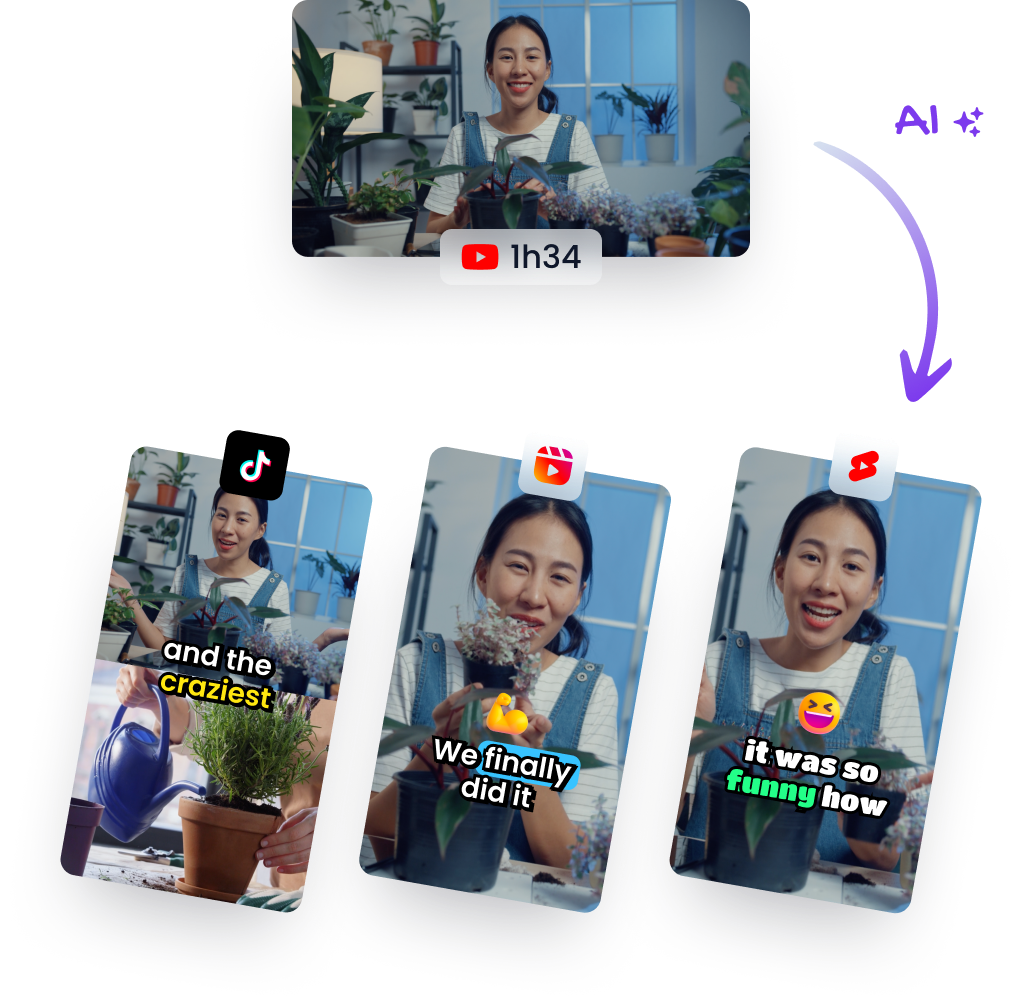
The real magic of today's AI isn't just turning your voice into text. The smarter tools are built to actually understand your content. A platform like Klap, for example, doesn't just give you a transcript. It actively scans your long-form videos to pinpoint the most compelling, viral-worthy moments.
This means the AI can intelligently snip out a powerful hook, a key insight, or a memorable quote and instantly package it into a short clip ready for social media. It takes care of the reframing for vertical video and, most importantly, slaps on perfectly styled, dynamic captions automatically.
This leap from manual drudgery to AI-assisted creation is a massive win for creators. A task that used to eat up an entire afternoon can now be knocked out in the time it takes to make a coffee.
This kind of automation is becoming essential as the demand for video continues to explode. The Text-to-Video AI market is projected to reach $1.18 billion by 2029, a significant jump from its $0.4 billion valuation in 2025. This rapid expansion, confirmed by market research, highlights the growing reliance on AI for efficient content creation.
How to Pick the Right AI Captioning Tool
Of course, not all AI tools are built the same. When you're looking for a platform to automate your captioning, here are a few things I always tell people to look for.
- Accuracy: How good is the transcription, really? Look for tools with a high accuracy rate, but just as importantly, make sure they have a simple editor. No AI is perfect, and you'll always need to jump in to fix a misspelled name or a bit of jargon.
- Customization: Can you make the captions look like your brand? The best tools give you full control over fonts, colors, animations, and layouts. You want AI-generated clips that still feel authentic to your style.
- Language Support: If you have an international audience (or want one), check how many languages the AI can handle. Broader support means you can make your content accessible to more people without a ton of extra work.
- Workflow Integration: Does the tool do more than just add text to video? An all-in-one platform that also finds the best clips and reformats them, like Klap does, offers a much more complete solution for repurposing. If you just need a quick, no-frills option, our free online subtitle generator gets the job done fast.
By bringing an AI-powered tool into your workflow, you’re not just saving a few hours here and there. You're building a smarter, more scalable system that lets you post more often, test more ideas, and ultimately, grow your audience way faster.
Optimizing Text for Short-Form Vertical Video
Adding text to Reels, TikToks, and Shorts is a completely different ballgame. The vertical, lightning-fast nature of these platforms means every little decision—from where you put a word to how long it stays on screen—massively impacts whether someone stops scrolling or just swipes right past. It’s a unique environment that demands its own playbook.
The single most critical concept you need to master is the "safe zone." Think of it as the prime real estate in the middle of the screen where your text is guaranteed to be seen, clear of the platform’s own interface. On apps like TikTok and Instagram Reels, usernames, captions, and all those like and share buttons clutter the bottom and right side. Slapping important text there is a surefire way to get it covered up.
As a general rule, try to keep your most important text within the central 70% of the screen. When you're working with short-form video, understanding the quirks of each platform, like What are YouTube Shorts, is a huge advantage because every app has its own UI layout.
Text Placement Guide for Vertical Video Platforms
To save you some trial and error, here’s a quick reference table to help you avoid placing crucial text behind user interface elements on the major platforms.
PlatformTop Safe Zone (Approx. % from top)Bottom Safe Zone (Approx. % from bottom)Side Margins (Approx. % from sides)
Instagram Reels
15-20%
25-30%
5-10%
TikTok
10-15%
20-25%
5%
YouTube Shorts
10%
15-20%
5%
Keep in mind that these are approximations, as UI can change. The safest bet is always to stay closer to the center.
Mastering Pacing and Timing
Beyond where you put your text, when it appears is just as important. Seriously, the rhythm of your captions can single-handedly set the entire vibe of your video. You can build suspense by revealing one word at a time or create a jolt of energy by flashing key phrases on the screen for just a moment.
If you're making educational content, a slower, more deliberate pace lets your viewers actually absorb the information. But for a comedic punchline? Timing the text to pop up the exact moment the joke lands will make it ten times funnier. Just don't make people read a novel in two seconds.
A good rule of thumb is to stick to one digestible thought or phrase on-screen at a time. This keeps people hooked without overwhelming them.
Deconstructing High-Engagement Text Styles
You know the style. The bold, dynamic "Alex Hormozi" captions where words change color as they're spoken, often sprinkled with emojis. There’s a very real psychological reason this approach works so well on social media. This technique, often called dynamic captions, uses motion and color to hijack attention in a crowded feed.
The constant movement gives the viewer's eyes something to follow, which has been shown to increase watch time. Here’s a breakdown of why it’s so ridiculously effective:
- It Hijacks Attention: The color change acts like a visual pacer, pulling the viewer's focus right along with the speaker's words.
- It Adds Emotional Emphasis: Highlighting keywords with color (like green for "profit" or red for "mistake") adds an emotional layer and reinforces your core message.
- It Makes Info Easy to Digest: It breaks down spoken sentences into smaller, bite-sized chunks, making complex ideas much easier to process on the fly.
This approach is why so many automated tools are leaning into these features. They're not just about saving time; they're about giving creators the tools to compete.

Adopting these high-engagement styles isn't just about chasing a trend. It's about fundamentally understanding the viewing habits of a mobile-first audience. Your text needs to be part of the entertainment, not just a boring transcript.
We dive much deeper into creating these styles in our guide on how to add captions to YouTube Shorts. Once you nail placement, pacing, and style, your text transforms from an afterthought into your most powerful tool for stopping the scroll.
Are You Making These Common Text-on-Video Mistakes?
Knowing the best practices for adding text to video is one thing, but knowing what not to do is just as important. Even a small slip-up can make your content look amateur, hurt your credibility, and give viewers a reason to scroll right past.
Let's break down the most common pitfalls I see all the time and, more importantly, how you can steer clear of them.

The biggest offender? Poor readability. This usually happens when you pick a font that’s too decorative or a color that just melts into a busy background. If your audience has to squint to read your message, you've already lost them.
Another frequent issue is bad timing. Text that flashes on screen for a split second is just frustrating. On the flip side, text that lingers for way too long becomes a major distraction. Both mistakes completely break the flow and pull the viewer right out of the experience.
Don't Overwhelm Your Viewers
One of the most damaging mistakes you can make is creating a "wall of text." Seriously, cramming an entire paragraph onto a single screen is a surefire way to overwhelm your audience. People on platforms like TikTok and Reels are conditioned for quick, digestible info—not an essay.
The fix is simple: think in bite-sized chunks.
- Break it down: Only show one key phrase or sentence at a time.
- Use bullet points: If you have a list, introduce each point one by one instead of all at once.
- Pace your text: Sync the text to your speech, revealing words as you say them. This is a great way to guide the viewer’s focus.
Remember, the goal isn't to transcribe your entire script onto the screen. It's about using text strategically to highlight key ideas, add context, and keep people hooked. Less is almost always more here.
Avoid These Credibility Killers
Never, ever underestimate the damage a simple typo can do. A spelling or grammar mistake instantly signals a lack of attention to detail and can seriously undermine your authority. Always, always give your text a final proofread before you hit publish.
Along the same lines, awkward auto-captioning errors can be just as bad. AI transcription is an incredible tool, but it's not perfect. It often trips up on names, industry jargon, or even slang. These tools still face challenges with understanding context and sounding natural, though the outlook for the technology is constantly improving, as detailed by researchers on market.us.
The takeaway? Always review and edit AI-generated captions for accuracy. It’s a small step that protects your professional image in a big way.
Got Questions About Adding Text to Your Videos?
Even with the right tools in hand, you're bound to run into a few questions as you get the hang of adding text to your videos. Getting those little sticking points sorted out early can save you a ton of frustration and help you create better content, faster.
Let's dive into some of the most common questions creators have when they start working with text overlays and captions.
What’s the Best Font for Video Captions?
Readability is king. Seriously. While there’s no single “best” font that works for every video, you can’t go wrong with clean sans-serif options. Think Arial, Helvetica, Lato, Montserrat, or Roboto. These are the workhorses for a reason—they’re incredibly easy to read, even when someone is scrolling on a small phone screen.
For social media shorts, a lot of creators are leaning into bold, condensed fonts. They have a modern, high-impact vibe that helps grab attention in a crowded feed.
The only hard and fast rule? Stay away from super decorative or script fonts for captions. They might look cool, but they’re a nightmare to read quickly, and viewers will just scroll right past.
Should My Captions Be Verbatim or Cleaned Up?
This one really comes down to what you’re trying to achieve with your video.
If pure accessibility is your top priority, a verbatim transcript is the gold standard. This ensures that every single word is captured, which is crucial for viewers who are deaf or hard-of-hearing.
But for most social media content, you'll get more engagement by editing for clarity and punch. This means cutting out the filler words (we all say 'um,' 'ah,' and 'like' more than we think!), fixing any small grammatical slips, and breaking up long, rambling sentences into shorter, more dynamic lines. The idea is to get the core message across cleanly and concisely, which is a huge factor in keeping people watching. For more formal or educational content, though, it’s usually better to stick closer to a verbatim script to maintain accuracy.
The most engaging social clips often use captions that are slightly cleaned up. They capture the speaker's natural voice but remove the clutter, making the message stronger.
How Do I Make My Text Pop Against a Busy Background?
This is a classic problem, but thankfully, the solutions are pretty straightforward. The key is creating strong contrast that holds up no matter what’s happening on screen.
If your video background is constantly changing, you need a reliable technique to keep your text legible from start to finish.
Here are a few pro-level tricks that always get the job done:
- Use a background box: This is one of the most popular and effective methods. Just place a semi-transparent dark box or shape behind your text.
- Add a stroke or shadow: A thin outline (a stroke) or a subtle drop shadow applied directly to the font can make the letters pop right off the screen.
- Stick to classic combos: You can never, ever go wrong with bright text (like white or yellow) on top of a dark outline or background.
Whatever method you choose, always scrub through different parts of your video to make sure the text stays easy to read the entire time.
Ready to stop wasting time and turn your long-form videos into dozens of viral-ready clips with perfectly styled captions? Let Klap do the heavy lifting. Our AI finds the best moments, adds dynamic text, and gets your content ready for social media in minutes. Try it for free at https://klap.app.