A Practical Guide to Video Marketing for Small Business
Other
For small businesses, video marketing isn't some far-off luxury anymore. It's a real, accessible tool that builds trust and actually drives sales. Forget seeing it as just another expense. Instead, think of it as your secret weapon for making personal connections, explaining what you do, and finally standing out in a crowded market.
It's how you turn casual browsers into loyal customers.
Why Video Is Your Small Business Superpower

As a small business owner, you know every dollar and minute counts. Your investments have to deliver real results. It's easy to think video marketing is only for big brands with deep pockets, but that’s an old way of thinking. Today, video is one of the most effective ways to connect with your audience on a truly human level.
Think about it this way: a great product photo is nice, but a short video showing the craftsmanship behind that product? That tells a story. It builds an immediate sense of quality and trust that a static image just can't match.
Connecting Beyond the Product Page
Video has this incredible knack for forging genuine connections. For a small business, that personal touch is your biggest competitive advantage. You’re not some faceless corporation; you're a real person with expertise and passion. Video lets that personality shine through.
Here are a few actionable ways video helps you build that all-important relationship:
- Humanize Your Brand: A simple behind-the-scenes tour or a "meet the team" video reminds customers there are real people they're supporting. This simple act can increase brand loyalty.
- Establish Expertise: A consultant sharing a 60-second tip on Instagram Reels instantly positions them as a go-to authority. In fact, educational content is one of the top-performing video types on social media.
- Build Authentic Trust: Customer testimonials are powerful in text, but hearing a happy client share their experience in their own words? That’s gold. It’s far more convincing.
This whole approach shifts your marketing from a sales pitch into a valuable conversation. When customers feel like they know you, they're far more likely to trust you and, when the time is right, buy from you.
Video isn't just about showing what you sell; it's about showing who you are. This authenticity is what helps small businesses build a loyal community, not just a customer list.
Making the Complex Simple
Does your business offer a service that's tough to explain in a few sentences? Or maybe you sell a product with unique features that a simple description doesn't do justice to. This is where video really shines.
An animated explainer can break down a complicated process into easy-to-digest steps. A product demo can clearly show off benefits that would otherwise get lost in a long list of features.
This isn’t just a hunch; the numbers back it up. A staggering 91% of businesses use video as a marketing tool. Why? Because viewers claim they retain 95% of a message when they watch it in a video, compared to just 10% when reading it in text. That tells you everything you need to know about its power to engage and convert.
Ultimately, effective video marketing for small business isn't about creating a viral hit. It’s about consistently using a powerful medium to educate, connect, and build the trust that fuels real, sustainable growth.
If you're looking to dive deeper into marketing strategies that work for businesses like yours, check out the Branditok Blog for broader marketing insights.
Building Your Video Strategy Without the Guesswork

Jumping into video without a plan is like starting a road trip without a map. You’ll burn through time and money and end up somewhere you never intended to be. I've seen it happen countless times. A solid video marketing for small business strategy starts with clarity, not a giant budget.
The goal here is to get away from vague hopes like "getting more engagement" and lock in specific, measurable targets. Think of it as pouring the foundation before you start framing the walls. This mindset ensures every single video you create has a clear purpose and a direct line to growing your business.
So, before you even think about hitting record, let's answer a few critical questions. Who are you trying to reach? What do you want them to do after watching? Getting these answers right is the difference between making content that just gets views and creating content that actually builds your business.
Set Goals That Actually Matter
Your video goals need to be tied directly to your overall business objectives. A good goal is specific, measurable, and has a deadline. Let’s ditch the fuzzy stuff and get concrete.
Here’s how you can frame your goals based on what you’re trying to achieve:
- Awareness: If you're a new local coffee shop, your goal might be to "reach 20,000 local residents on Instagram with our behind-the-scenes videos in the next quarter."
- Consideration: For a B2B software company, a much better goal is to "increase demo requests from our homepage explainer video by 15% within 60 days."
- Conversion: An e-commerce brand could aim to "drive $5,000 in sales directly attributed to our new product demo videos this month."
These aren't vanity metrics. They are tangible results that hit your bottom line. Tracking these specific numbers is the only way to know what's working and prove that your video efforts are paying off.
Understand Your Audience Deeply
You can’t create compelling video if you don't know who you're talking to. Seriously, you have to go beyond basic demographics and get into the psychographics of your ideal customer. What are their biggest headaches, burning questions, and secret aspirations?
Your video content should be the answer to a question they’re already asking themselves. For instance, a financial advisor's audience isn't just looking for "investing tips." They're up at night worrying about retiring comfortably or how they'll afford their kid's education. Your videos should speak directly to those anxieties and offer clear, reassuring solutions.
The most effective videos don't just sell a product; they solve a problem. When you create content that genuinely helps your audience, you build trust and position your brand as the expert they turn to when they're ready to buy.
Knowing your audience also dictates the entire vibe of your videos. Are they looking for quick, punchy tips on TikTok, or do they prefer a more detailed, thoughtful breakdown on YouTube? Matching your style to their viewing habits is non-negotiable if you want to keep them engaged.
Brainstorm Content That Connects
Once you have your goals and audience dialed in, brainstorming becomes a whole lot easier. Instead of staring at a blank page, you can generate ideas that are built with a purpose. Think about the entire customer journey and what information they need at each stage.
Here are a few powerful video ideas that work for almost any small business:
- Behind-the-Scenes Tours: Show the craftsmanship that goes into your product or the friendly faces behind your service. This builds authenticity and reminds people there are humans behind the brand.
- Client Testimonials: Let your happy customers do the selling for you. A genuine video testimonial is incredibly persuasive because it offers social proof from someone your prospects can relate to.
- Simple How-To Guides: Teach your audience something valuable related to your industry. A local nursery could create a video on "How to Repot a Fiddle Leaf Fig Without Killing It," which provides immediate value and establishes their expertise.
- FAQ Videos: Do you get the same questions over and over? Turn the answers into a short, helpful video. This saves you time and positions you as a proactive resource.
The key is to prioritize a few high-impact videos that align perfectly with your goals. Don't fall into the trap of creating a constant stream of content just for the sake of it. A smart, focused approach will always deliver better results than a scattered one. That's the core of a sustainable video marketing strategy.
Creating Polished Videos on a Shoestring Budget
Let's kill a huge myth right now: you do not need a Hollywood-level budget to create videos that actually look good. Honestly, the most powerful tool you need is probably sitting in your pocket. Your smartphone camera is more than capable of shooting crisp, professional-looking footage.
The secret isn't dropping thousands on gear. It’s about being smart with a few small, strategic buys that make a world of difference. You can take your video quality from "just shot this on my phone" to "wow, that looks legit" with just a handful of affordable tools.
This whole approach is about getting you to produce polished, effective videos without the sticker shock.
Your Essential Low-Budget Gear Kit
Getting started is way simpler and cheaper than most people think. Forget about complex camera rigs and pricey software for a minute. Your first move should be to nail the fundamentals with a few key items that fix the most common video quality killers: shakiness, bad audio, and poor lighting.
Here’s a no-fluff checklist of gear that delivers the biggest bang for your buck:
- A Solid Tripod: Shaky footage is the #1 giveaway of an amateur video. A simple, sturdy tripod for your phone costs less than a decent dinner out and will instantly make your shots look stable and intentional.
- A Clip-On Lavalier Mic: People will forgive so-so video quality, but they absolutely will not stick around for bad audio. A clip-on lavalier mic that plugs straight into your phone makes sure your voice is front and center—clear, crisp, and free of distracting background noise.
- A Simple Ring Light: You don’t need a pro lighting setup. A portable ring light gives you that soft, even lighting that gets rid of harsh shadows on your face. It's a lifesaver for indoor recording when natural light just isn't cutting it.
That's it. Those three items are the foundation of your production toolkit. Get comfortable with them, and you’ll already be creating videos that look and sound better than what most of your competitors are putting out.
So many entrepreneurs get stuck here. In fact, 11% of marketers who skip video say it's because they think it's too expensive, and another 37% just don't know where to start. But the truth is, you can get a high-quality setup going for under $100. Discover more insights on video marketing budgets and statistics.
Shooting Tips for Professional Results
Once you have your basic gear, the next step is to learn a few simple tricks of the trade that pro videographers use every day. These aren't complicated rules, just simple guidelines that will instantly make your videos look better.
First off, always chase the light. Natural light from a window is your best friend—it’s free, soft, and makes everyone look good. Always set yourself up facing the window, letting the light hit your face. If the window is behind you, you’ll end up as a dark silhouette.
Next, think about your composition. An easy hack is the rule of thirds. Just imagine your screen has a 3x3 grid overlaid on it. Instead of plopping yourself right in the dead center, try positioning your eyes along the top horizontal line. It’s a small tweak that makes the shot feel more balanced and professional.
Editing Made Easy with User-Friendly Apps
The last piece of the puzzle is turning your raw footage into a polished final video. The good news? You don’t need to become a professional editor or learn some ridiculously complex software. There are a ton of apps out there that make the process simple and intuitive.
Here’s a quick rundown of what you can do with even the most basic editing tools:
FeatureWhat It DoesPopular Tools (Free & Paid)
Trimming
Snip out mistakes and awkward pauses to keep things tight.
CapCut, iMovie, Descript, InShot
Adding Graphics
Drop in your logo or some text to reinforce your brand.
Canva, CapCut, Adobe Express
Music & Sound
Add some royalty-free background music to set the vibe.
Epidemic Sound, Artlist.io, YouTube
Color Grading
Apply a simple filter to give your video a consistent look.
CapCut, InShot, VN Video Editor
The goal here is pretty simple: assemble your clips, add a little branding, and make sure the audio is balanced. If you're slicing up a longer video into shorter clips, you'll want something that does the heavy lifting for you. This is where an AI shorts maker can be a total game-changer, automatically finding the best moments and formatting them for social media. It saves a massive amount of editing time.
By mixing affordable gear with smart shooting and simple editing, you can create a steady flow of high-quality videos that build your brand and connect with your audience—all without breaking the bank.
Working Smarter with Content Repurposing
Time is the one resource you can never get back as a small business owner. The idea of constantly churning out brand-new video content for every single platform feels completely exhausting, right?
This is where working smarter, not harder, comes into play. The “create once, distribute many” mindset is a total game-changer for your efficiency.
Instead of living on a content treadmill, you can transform one cornerstone video into a steady stream of posts for weeks. This isn't about cutting corners; it’s about getting the absolute most value out of the hard work you’ve already put in. A single customer interview, a webinar, or a detailed product demo is a goldmine of clips just waiting to be discovered.
This is the simplified workflow we use for that initial, cornerstone video.

With the right gear, a solid plan for the shoot, and a streamlined editing process, creating that first long-form video becomes a simple, repeatable system.
The Power of Slicing Up One Video
Think about a 20-minute video you've recorded—maybe a Q&A session or a deep dive into a topic your audience loves. I guarantee that hidden inside that longer piece are 5-10 fantastic, bite-sized moments perfect for short-form video.
These are your best quotes, your key takeaways, and your most compelling arguments. They’re the little nuggets of gold that will stop the scroll.
Now, you could manually scrub through all that footage, finding and editing each clip yourself. But that’s a time-consuming chore. This is where modern AI tools come in to save you countless hours. They’re built to automate the most tedious parts of repurposing, letting you focus on strategy instead of the grunt work of slicing and dicing footage.
The goal here is to feed your content pipeline without constantly being in front of a camera. This approach to video marketing for small business keeps your brand active and visible across all your channels, keeping you top-of-mind with your audience.
How to Automate Your Clip Creation
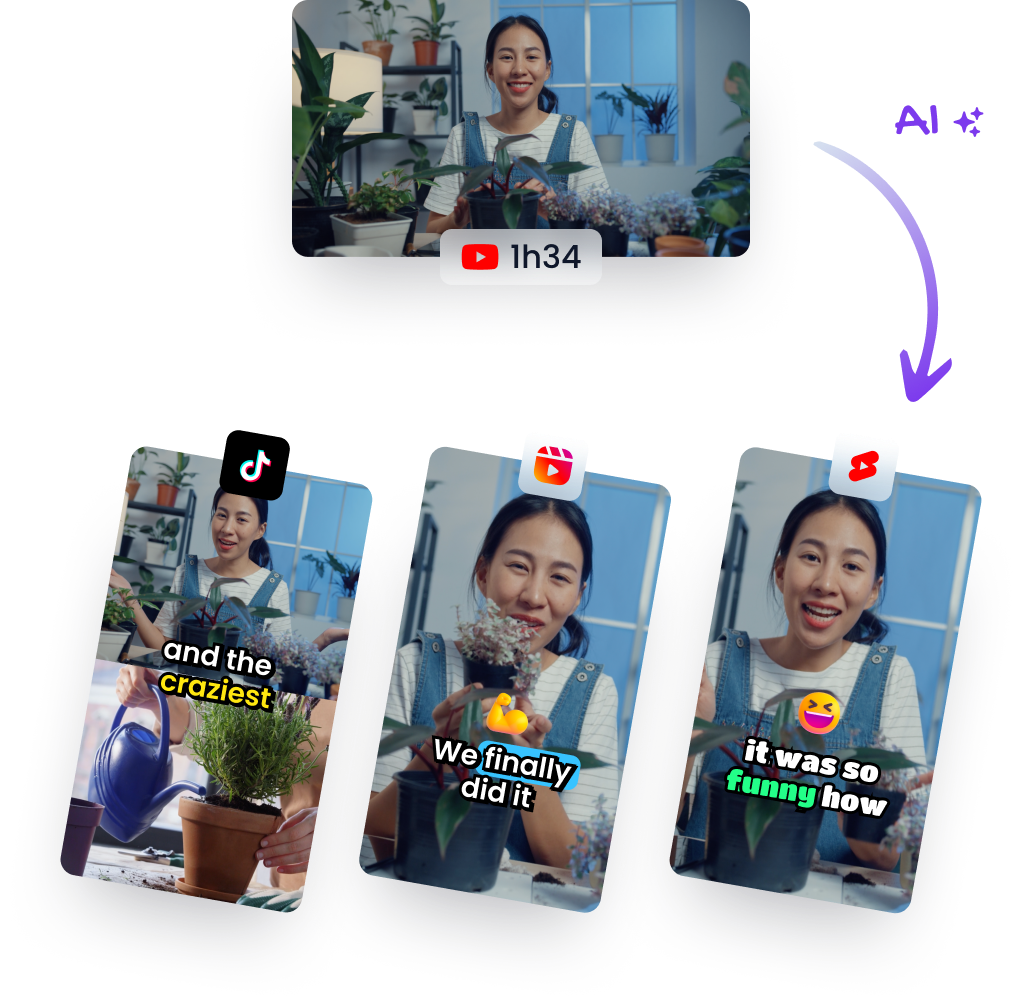
Turning one long video into a dozen shorts can be surprisingly simple with the right workflow. The best tools are designed to do the heavy lifting, analyzing your video to pinpoint the most engaging segments that have the potential to go viral.
Here’s a look at how this automated process typically works:
- Upload Your Source Video: You kick things off by uploading your long-form video file or just pasting a link from YouTube.
- Let the AI Do Its Thing: The tool scans the entire video, analyzing the transcript and visual cues to find the most interesting moments. It looks for questions, key phrases, and shifts in energy.
- Get Your Clips: Based on its analysis, the software automatically generates a batch of short clips, each focused on a single powerful idea.
- Add the Finishing Touches: The best part? These tools also handle the technical details. They reframe horizontal video into a vertical format, add dynamic captions to grab attention, and make sure the clips are ready for TikTok, Reels, and YouTube Shorts.
This is what it looks like inside Klap when you upload a video. The clean, simple interface shows you don’t need to be a professional video editor to start repurposing your content like one.
Your job shifts from tedious editor to strategic curator.
By automating the discovery and basic editing of these clips, you can slash your post-production time by over 90%. This efficiency is what allows you to maintain a consistent posting schedule—something the algorithms absolutely love.
You can quickly review the AI-generated suggestions, make a few tweaks to the captions or timing, and get them scheduled. To see the tech in action, you can explore a dedicated long to short video converter and see how it works firsthand.
This is how you scale your video marketing without scaling your workload.
Getting Your Videos Seen by the Right People

Creating a fantastic video is a huge accomplishment, but it's really just the starting line. The real magic of video marketing for small business happens when your content connects with the right audience.
This isn't about just hitting "publish" and hoping for the best. Getting your videos seen is a strategic game where understanding each platform’s algorithm is just as important as the content itself. Think of it as giving your video a roadmap and a megaphone so it can find its people.
How to Get Found on YouTube
YouTube is basically a search engine. People show up with a problem to solve or a question to answer, which is a massive opportunity for your business. To get found, you need to think like your customer and bake the words they're searching for right into your video's DNA.
Your video’s title is the most critical piece of this puzzle. It needs to be compelling enough for a human to click but clear enough for the algorithm to understand. A title like “Our New Product” is forgettable. But something like “How to Fix a Leaky Faucet in 5 Minutes (DIY Guide)” directly targets what someone is typing into that search bar and promises a quick solution.
Next up, your video description. Don't leave it blank! The first two or three sentences are gold because they show up in search results. Make sure they include your primary keywords and clearly summarize what the viewer will actually learn.
Cracking the Code on Social Media Feeds
Social media platforms like Instagram, TikTok, and Facebook are all about interruption. You’re fighting for eyeballs in a fast-moving, endless scroll. The rules here are completely different from YouTube.
First, always upload your video natively to each platform. That just means uploading the actual video file directly instead of pasting in a YouTube link. The algorithms heavily favor native content because it keeps users on their platform longer. Simple as that.
Second, formatting is non-negotiable. Vertical video is the language of Reels and TikTok. A horizontal video with big black bars looks lazy and will get scrolled past in a heartbeat. You have to frame your shots vertically from the start or use a tool to reframe them properly.
Thumbnails are your video's first impression and can make or break its performance. A well-designed thumbnail can increase click-through rates significantly because it grabs attention and communicates value before the user even reads the title.
Finally, write captions that spark conversation. Instead of just describing the video, end your caption with a question to get people talking in the comments. Engagement signals like comments and shares tell the algorithm that your content is valuable and worth showing to more people. Every platform has its own flavor, which is why digging into the differences is so important. For a deeper dive, check out this comparison of TikTok vs YouTube Shorts.
Don’t Sleep on Thumbnails and Hashtags
Let’s talk about two often-misused elements: thumbnails and hashtags.
Your thumbnail is your video's billboard. It needs to be high-contrast, feature a clear focal point (like a face showing emotion), and maybe a tiny bit of text to create curiosity. A great thumbnail stops the scroll and earns the click.
Hashtags are your video's categorization system. They help platforms understand what your video is about and show it to users who are interested in those topics.
- Be Specific: Instead of
#marketing, get granular with#smallbusinessmarketingtips. - Mix It Up: Use a combination of broad, niche, and location-specific hashtags. A local bakery, for example, could use
#cupcakes,#customcakeshouston, and#houstonbakery. - Check Relevance: Don't just copy and paste popular tags. Make sure every single hashtag is directly relevant to what's happening in your video.
By combining a searchable title, a compelling thumbnail, and the right hashtags, you give your video the best possible chance to cut through the noise and land right in front of the customers who need to see it.
Tracking What Matters: Your Video Marketing ROI
So, how do you know if your video marketing is actually working? Likes and views are nice for the ego, but they don't pay the bills. Measuring the real success of your video marketing for small business means digging a lot deeper than those surface-level vanity metrics.
The real goal here is to figure out which numbers truly impact your bottom line. Are people sticking around to watch? Are they clicking where you want them to click? Most importantly, are your videos turning into actual sales? Answering these questions is how you prove a positive return on investment and get smarter with every video you make.
Moving Beyond Vanity Metrics
It's so easy to get hung up on chasing views, but a view alone doesn't tell you much. The metrics that really matter are the ones that reveal what your viewers are thinking and doing. These are the numbers that tell you if your content is truly connecting with your audience.
Instead of views and likes, let's zero in on what drives results:
- Watch Time & Audience Retention: This tells you exactly how long people are watching. A high retention rate is a gold star—it means your content is genuinely engaging. If you see a massive drop-off at a specific point, that's a crystal-clear sign something in your video isn't working.
- Click-Through Rate (CTR): This is the percentage of people who clicked on your call-to-action (like a link in your description or a button on the video). A strong CTR is a fantastic sign that your video successfully motivated someone to take that next step.
- Conversion Rate: This is the big one. It tracks how many viewers actually completed the goal you set out for them, whether that was signing up for your newsletter, booking a demo, or buying your product.
Focusing on these performance indicators gives you a clear picture of the real-world impact your videos are having.
Finding the Data That Drives Decisions
You don't need a fancy, complicated analytics dashboard to get this information. The platforms you're already on have powerful, built-in tools that give you a peek behind the curtain.
Here are a couple of practical places to start looking:
- YouTube Analytics: Head to the "Engagement" tab for any video and you'll find the audience retention graph. This chart is a lifesaver for spotting the exact moment viewers start losing interest.
- Meta Business Suite: For your Facebook and Instagram videos, you can compare metrics like 3-second video plays vs. ThruPlays (which means they watched to the end or for at least 15 seconds). This helps you figure out if your hook is strong enough to stop the scroll.
Of course, accurate tracking relies on solid data analysis best practices to turn raw numbers into smart decisions. The key is not to get overwhelmed. Just focus on one or two metrics that tie directly back to the goal of that specific video.
If you made a video to drive traffic to your website, your CTR is your North Star. If the goal was brand awareness, watch time and audience retention are what you should obsess over. Always match your metrics to your mission.
Turning Insights into Action
All this data is completely useless if you don't do anything with it. Think of every video as a learning opportunity.
Noticed a huge drop-off in the first 10 seconds of your last few videos? Your intros need to be way more compelling. Did a video on a certain topic get consistently high watch time? Great, make more content just like that.
This feedback loop is what separates the pros from the amateurs. You analyze, you learn, and you get better. This iterative process is how you stop just "making content" and start creating videos that deliver measurable results and prove their worth.
And the proof is in the numbers. Wyzowl's research shows that 92% of marketers report a good ROI from video, and 89% of people say watching a brand’s video has convinced them to buy a product or service. There's a clear line connecting well-made video content and real business growth. For a deeper dive, you can learn about the latest video marketing findings.
Ready to maximize your video output without spending hours editing? With Klap, you can turn your long-form videos into a month's worth of viral shorts in just a few clicks. Stop the tedious work and start working smarter. Try Klap for free today.