A Winning Small Business Social media Strategy
Other

Let's be real: a winning social media strategy isn't about being everywhere at once or posting non-stop. For a small business, it's about making smart, targeted moves that actually grow your bottom line. When you're short on time and resources, the secret is to work smarter—focusing on high-impact plays like repurposing your video content with AI to meet customers right where they are online.
Why a Smart Social Media Strategy Matters
Feeling like you're drowning in social media tasks? You're not alone. For most small business owners, the idea of juggling multiple accounts, pumping out daily content, and chasing trends feels like a second full-time job.
But what if you could cut through the noise and build a presence that genuinely grows your business without burning you out? That's exactly what a smart strategy does.
This isn't about racking up vanity metrics or just "posting to post." A real small business social media strategy is your roadmap. It helps you find the right people, build trust, and ultimately, drive sales. It’s the difference between shouting into an empty room and having real conversations with people who want what you offer.
From Overwhelmed to Optimized
The good news? You don’t need a huge marketing budget or a dedicated team to win at social media. The right tools and a focused game plan can completely level the playing field.
Here’s why having a deliberate strategy is non-negotiable:
- Maximizes Limited Resources: It points your time and money toward the platforms and content that deliver the best ROI. No more wasted effort.
- Builds Authentic Connections: A good strategy forces you to really understand your audience's problems and passions. That’s how you create content that clicks and builds loyalty.
- Drives Measurable Growth: Instead of guessing what works, you can track what truly matters—like website clicks and leads—and make decisions based on real data.
The modern customer journey almost always involves a social media feed. In fact, a jaw-dropping 58% of consumers now discover new businesses through social platforms, blowing past traditional channels like search engines. For local services and e-commerce brands, this makes social media the number one discovery channel on the planet. You can dig into more insights from Sprinklr's 2025 report about social media marketing statistics.
The goal is simple: stop posting and start connecting. A well-crafted strategy transforms social media from a daily chore into a powerful engine for customer acquisition and brand building.
This guide will walk you through a practical, no-fluff framework to do just that. We'll show you how to get more mileage out of content you already have—like long-form videos—and use slick AI tools to amplify your reach, making every single post count.
Choose the Right Platforms for Your Business
Jumping on every trending social media platform is a surefire way to burn out. A much smarter approach is to go where your ideal customers already hang out and build a real presence there. An effective small business social media strategy isn’t about being everywhere; it’s about being in the right places.
Before you even think about what to post, get crystal clear on who you're talking to. What are their digital habits? Their pain points? Their interests? You wouldn’t set up a pop-up shop in a random neighborhood, so don’t do it online, either.
Know Your Audience Before You Post
Think beyond basic demographics. What does a typical day look like for your customer? Where do they scroll for advice, for a laugh, or for professional growth?
For example, a local bakery's ideal customer might be a 35-year-old parent who is super active in local Facebook Groups, always looking for weekend treats and birthday cake ideas. On the flip side, a B2B consultant’s target client is probably a 45-year-old executive who spends their limited social media time on LinkedIn, hunting for industry insights.
Don't chase algorithms or platforms. Chase your customer. Understanding their online behavior is the single most important step in choosing where to invest your time and energy.
Once you have that picture in your head, you can start matching their profile to the right platforms.
A Small Business Guide to the Top Platforms
Every social network has its own vibe, user base, and content style. Spreading yourself too thin is a classic mistake. The goal is to get really good at one or two platforms where you can genuinely connect with your audience.
Here’s an actionable breakdown of the major players from a small business perspective:
- Instagram: A visual powerhouse. It’s perfect for businesses with strong aesthetic appeal—think e-commerce brands, restaurants, and artists. Since 55% of consumers learn about new brands on social media, Instagram's mix of Reels, Stories, and carousels gives you multiple ways to tell your story visually.
- TikTok: The undisputed king of short-form video and authentic, trend-driven content. If your audience skews younger or your brand has a personality that leans into creativity, TikTok offers organic reach that’s hard to beat. It’s a goldmine for behind-the-scenes clips, educational "how-to" videos, and user-generated content campaigns. For a deeper look, our guide on TikTok vs YouTube Shorts can help you decide which is better for your goals.
- Facebook: With a staggering 3 billion monthly active users, Facebook is still a beast. Its real strength for small businesses is in community building through Groups, hyper-local ad targeting, and sharing a wider mix of content—from event announcements to customer reviews. It's especially powerful for businesses with a local focus or those targeting a broader age range.
- LinkedIn: This is the non-negotiable B2B platform. If your customers are other businesses or professionals, you have to be here. It’s the place for sharing industry expertise, case studies, and company news to build professional authority. A solid revenue-focused LinkedIn marketing strategy is key to turning those connections into actual clients.
Picking your platforms isn't a forever decision, but it is a strategic one. Start with the single platform that best aligns with your ideal customer's habits. Once you've built a consistent presence there, then you can think about adding a second. This focused approach is how you build real momentum instead of just spinning your wheels.
Building Your Content Engine with AI Repurposing
Let’s be honest: the daily grind of creating fresh social media content is exhausting. It's one of the biggest reasons small businesses get stuck, leading to burnout, random posting, and results that just don’t move the needle.
The answer isn't working harder. It’s about working smarter by building a content engine that practically runs itself.
Forget the idea that you need to cook up something brand new every day. The most successful approach is the "create once, publish everywhere" model. You take one solid piece of content—like a video—and slice it up into dozens of smaller, bite-sized assets perfect for different platforms.
The Power of One Long-Form Video
Video is the undisputed king of engagement, but producing it constantly feels overwhelming. What if you could make just one long-form video and let it fuel your social media for an entire month?
Think about the longer video content you might already have, or could easily create:
- A 45-minute webinar explaining your core service.
- A 30-minute product demo walking through key features.
- A 20-minute podcast-style chat with an industry expert.
- A 15-minute Q&A session answering common customer questions.
Each of these is a content goldmine. That single 45-minute webinar is packed with shareable moments, key takeaways, and powerful quotes. But manually scrubbing through footage to find and edit those clips? That's a time-sucking nightmare most small business owners can't afford.
Automating Your Workflow with AI
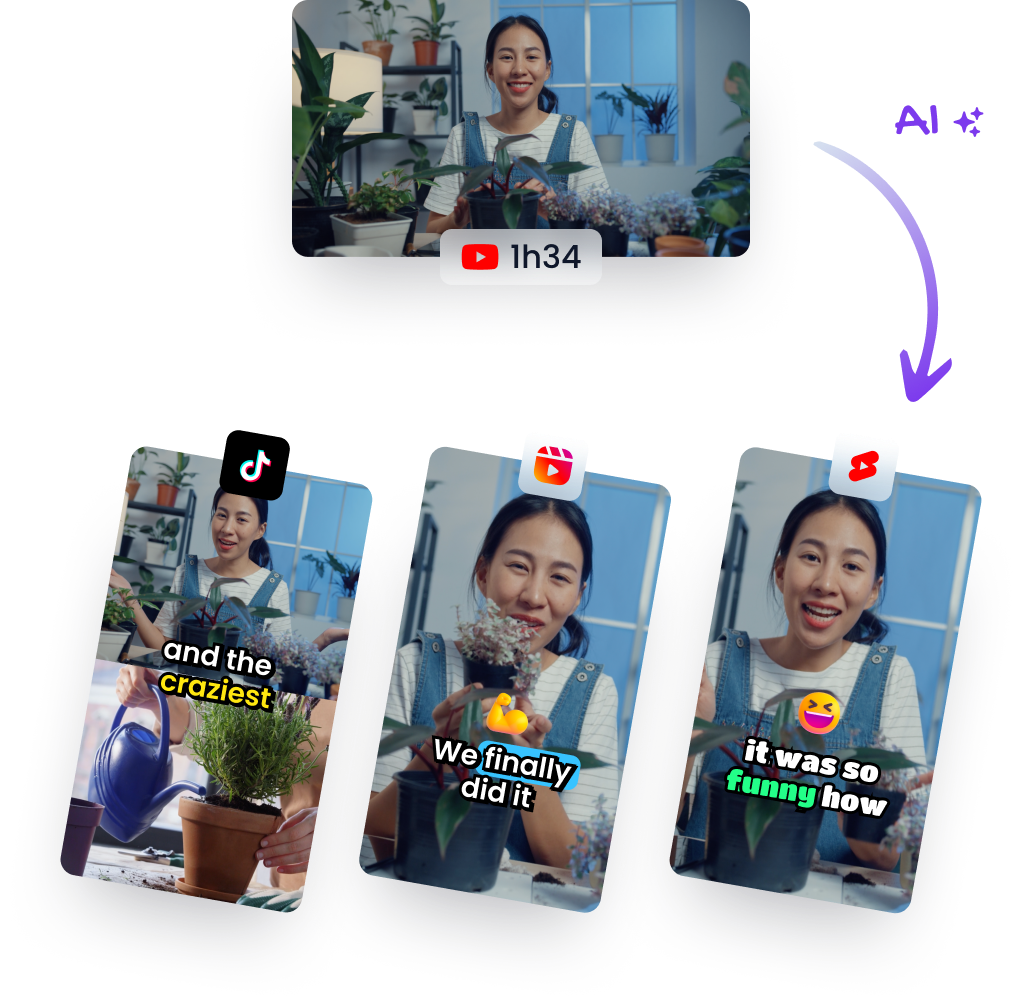
This is where AI-powered tools completely flip the script. Platforms like Klap are built specifically to automate this repurposing process. Instead of you spending hours chained to an editor, an AI can analyze your entire video in minutes.
Just upload your video or drop in a YouTube link, and the AI gets to work. It’s smart enough to identify the most compelling, "viral-worthy" moments by detecting topic changes and tracking who is speaking.
The AI then optimizes everything for social media. It automatically reframes your horizontal video into a vertical format—perfect for Instagram Reels, TikTok, and YouTube Shorts. It even generates slick, dynamic captions, which is crucial when you remember that 85% of Facebook videos are watched with the sound off.
For a business with limited time and budget, this isn't just a nice-to-have—it’s a lifeline. It turns content creation from a daily chore into a single, high-impact task. A full day of editing can now be done in under an hour.
This simple flowchart shows how to connect the dots between your audience, the platforms they use, and the content you create.
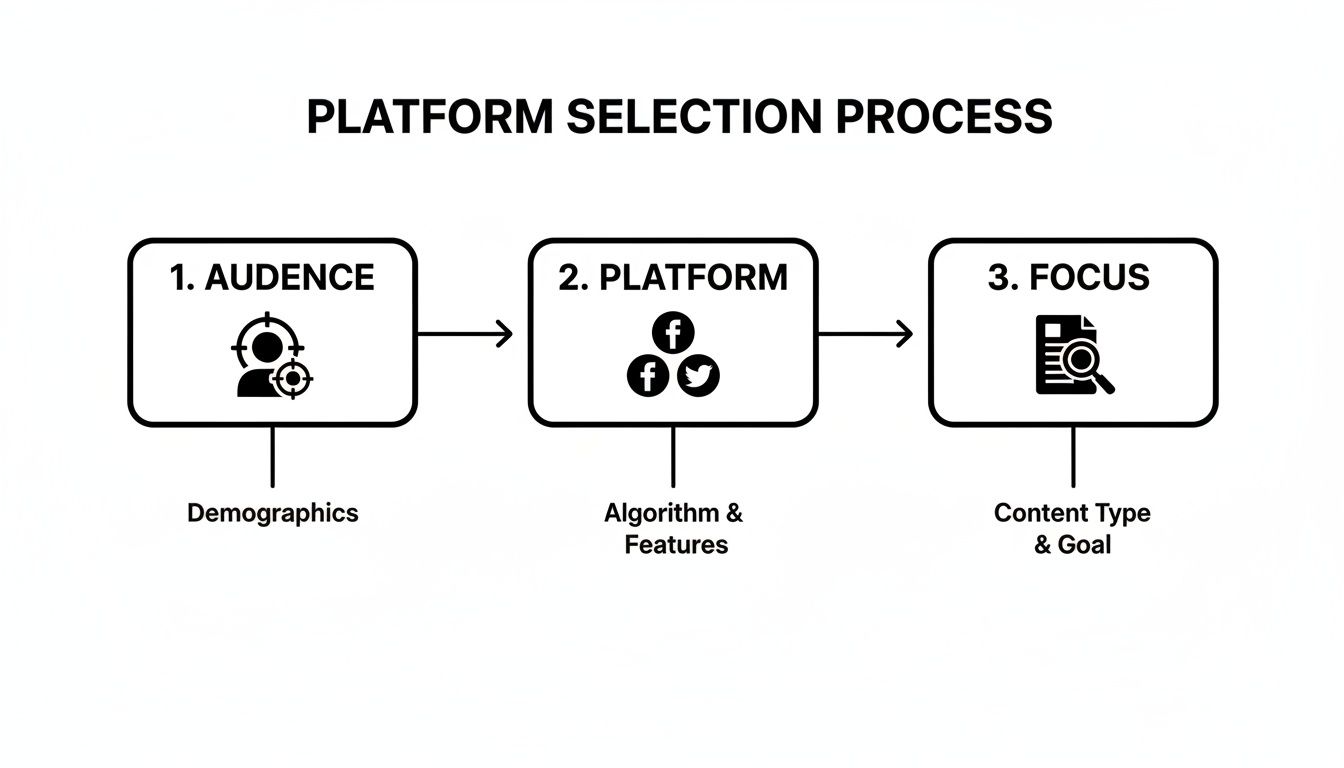
This framework is all about making sure your content lands where your ideal customers are, giving you the best shot at making an impact.
A Real-World Scenario
Picture a business coach who just hosted a 45-minute webinar on "Boosting Q4 Sales." In the past, that recording would probably just collect digital dust. Now, she uses an AI repurposing tool.
- She uploads the webinar recording.
- The AI scans the video and pulls out 15 distinct, high-value moments.
- It instantly generates 15 vertical clips, each 30-90 seconds long, with eye-catching animated captions already added.
- Just like that, she has enough unique video content to post every other day for a month on Instagram and LinkedIn.
The result? She saves hours of time, stays consistent, and puts out a steady stream of valuable content that cements her as an expert. This is how you build a powerful content engine that works for you. To keep everything organized, exploring different social media management tools can help you schedule and track all these new posts.
Getting the Most from Your Repurposed Clips
Once the AI has worked its magic, the final step is to schedule your clips and add some platform-specific flavor.
- Nail the Hook: Make sure the first three seconds of every clip are strong enough to make someone stop scrolling. You know your audience best.
- Write Captions that Connect: Use the caption to add more context, ask a question, or tell people what to do next (like "Click the link in bio!").
- Use Smart Hashtags: Mix broad and niche-specific hashtags to help new people discover your content.
This system—creating one pillar video and letting AI do the heavy lifting—is the secret to an efficient and effective small business social media strategy. To see this process in even more detail, check out our guide on how to create YouTube Shorts from an existing video. It allows you to maintain a consistent, high-quality presence that builds your brand without draining your most precious resource: your time.
Creating a Realistic Content Calendar That Works
Consistency is the engine of any successful small business social media strategy. But "being consistent" can quickly lead to burnout if you don't have a smart system. A content calendar isn't about cramming every time slot with a post. It's about building a sustainable rhythm that keeps you visible without taking over your life.
The secret to making this work is a simple but powerful technique: content batching.
Instead of waking up every morning scrambling for something to post, you set aside a single block of time—maybe a couple of hours on a Monday—to prep everything for the week. This is where those video clips you generated with an AI tool like Klap become your absolute best friend.
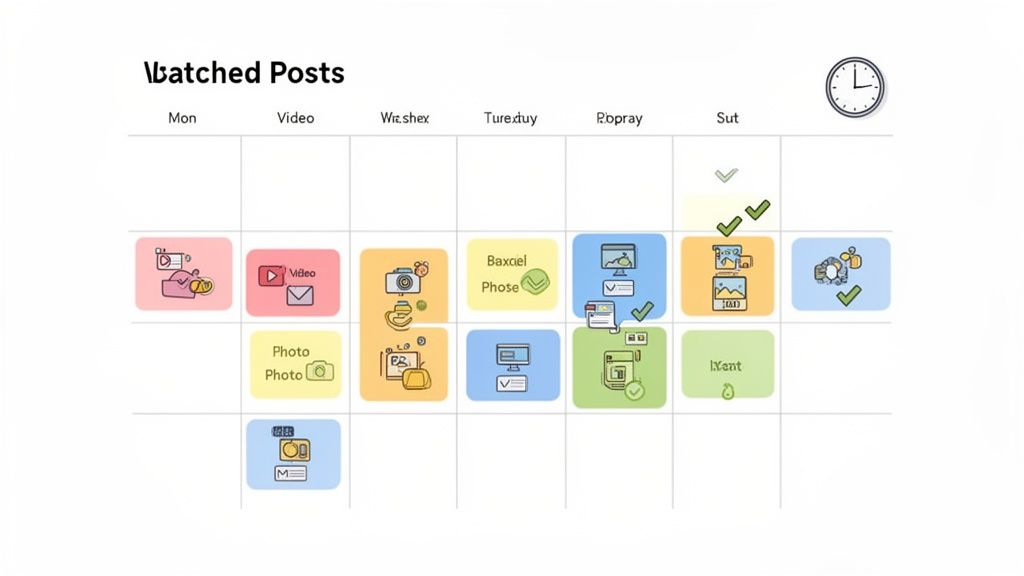
This one change transforms your workflow. You go from reactive and stressed to proactive and in control, freeing you up to handle the things that actually move the needle, like having real conversations in the comments and DMs.
The Building Blocks of Your Calendar
A great content calendar is all about balance. A good mix keeps things fresh and shows off different sides of your brand.
Think about rotating through these core content types:
- Educational Clips (Your Repurposed Videos): These are the golden nuggets—expert tips, quick tutorials, and industry insights you pulled from longer videos. They build your authority and give people a reason to follow you.
- Behind-the-Scenes (BTS) Content: People buy from people they know, like, and trust. Snap a quick photo of your workspace or show a glimpse of how your product is made. It instantly humanizes your brand.
- User-Generated Content (UGC) & Testimonials: Did a customer tag you in a great photo or leave a glowing review? Share it! This is social proof at its finest and builds credibility faster than you bragging about yourself.
- Promotional Posts: This is when you make a direct ask—sales announcements, new service launches, or driving traffic to a landing page. Use these sparingly for maximum effect.
I always tell my clients to stick to the 80/20 rule: 80% of your content should educate, entertain, or engage. Only 20% should be directly promotional. It’s a game-changer for building an audience that actually trusts you.
Sample Weekly Content Calendar for a Small Business
Here’s a simple, actionable template showing how you can map out your batched content for the week. This example focuses on Instagram and a more professional platform like Facebook or LinkedIn.
DayInstagram (Reel/Story)TikTokFacebook/LinkedIn
Monday
Repurposed Video Clip #1 (Tip)
Same Repurposed Video Clip #1
Share Clip #1 with a thoughtful question
Tuesday
"Ask Me Anything" Story Poll
BTS video of your workspace
Post a text-based industry question
Wednesday
Photo of your workspace
Answer a common customer question
Short post about a recent team win
Thursday
Repurposed Video Clip #2 (How-to)
Same Repurposed Video Clip #2
Link to a relevant blog post
Friday
Share a customer testimonial (Story)
Quick win/tip for the weekend
Reshare a positive customer review
Saturday
Reel promoting a weekend offer
Fun trend related to your niche
Post about the offer with a link
This structure gives you a clear roadmap. You're always providing value while strategically weaving in opportunities to promote your business. It's consistent without being repetitive.
Scheduling for Maximum Impact
Once you know what to post, you need to decide when. Forget generic "best times to post" articles. The only thing that matters is when your specific audience is most active online.
Luckily, you don't have to guess. Dive into your platform's built-in analytics—like Instagram Insights or Facebook Page Insights—to find your audience's peak hours.
To truly automate your system, use a scheduling tool. Plenty of simple and even free options let you upload all your batched content at once and set it to go live automatically. This is the final piece of the puzzle for reclaiming your time.
By combining content batching, a balanced content mix, and smart scheduling, you build a machine that works for you. You stay visible, you grow your audience, and you do it all without letting social media run your life.
If you’re hungry for more ideas, check out our other articles on effective content creation for more advanced tips.
Engaging Your Community and Measuring Growth
Getting a steady stream of content out the door is a huge win, but that’s only half the job. The real magic of a small business social media strategy happens after you hit publish. It’s in those moments of interaction where you turn passive scrollers into a real community.
Too many businesses treat social media like a billboard. But it’s not a monologue; it's a conversation. When someone comments on your video or shoots you a DM, they're knocking on your door. Your job is to answer it. A prompt, personal response shows there's a real person behind the logo, and that builds trust faster than anything else.
Fostering a Thriving Community
Think of your social media profiles as your digital storefront. If a customer walked in and asked a question, you wouldn't just stare at them. The same goes for online. Actively engaging with your community isn't just a nice-to-do; it's essential for growth.
Here are a few simple ways to get those conversations started:
- Ask Real Questions: Don't just post and ghost. End your captions with an open-ended question. Instead of a flat "Here's our new coffee blend," try "What's the one thing your morning coffee must do for you?"
- Reply with Meaning: A simple "thanks!" is fine, but you can do better. When someone leaves a thoughtful comment, acknowledge their point or ask a follow-up question. This shows you're listening and encourages others to join in.
- Shine a Spotlight on Your Followers: Did a customer tag you in a post showing off your product? That's gold! Reshare it to your Stories. This is called user-generated content (UGC), and it's one of the most powerful forms of social proof.
A brand that responds makes customers feel heard. In fact, nearly 80% of consumers say a positive social media interaction makes them more likely to buy. This isn't just about being friendly—it's a direct line to sales.
Measuring What Actually Matters
It’s easy to get obsessed with "vanity metrics" like follower counts and likes. They feel good, but they don't pay the bills. To know if your social media is actually growing your business, you need to track the numbers that signal real results.
You don't need a fancy analytics suite to get started. All the core data you need is already waiting for you inside the native tools like Instagram Insights or TikTok Analytics—for free.
Key Metrics That Drive Business Growth
Let's cut through the noise and focus on what has a direct link to your bottom line. Keep an eye on these three powerful metrics to see what’s truly working.
1. Engagement Rate
This is the single most important metric for judging your content quality. It tells you what percentage of your audience is actually interacting with your posts.
- What it is: The total likes, comments, shares, and saves on a post, divided by your total followers (or by the post's reach).
- Why it matters: It tells the platform's algorithm that your content is valuable, which means they'll show it to more people for free. A post with 100 likes and 50 comments from a 1,000-follower account is performing better than a post with 200 likes and 5 comments from a 10,000-follower account.
2. Website Clicks (or Link Clicks)
This metric is the bridge between your social media and your website. It shows how many people were interested enough by your content to take the next step.
- What it is: The number of times people click the link in your bio or a specific link in a Story.
- Why it matters: This is a clear signal of purchase intent. Whether they’re going to your site to book a service or check out products, these clicks represent qualified leads.
3. Direct Messages (DMs) and Inquiries
For many small businesses, especially service-based ones, a DM is a sales lead walking through the door. Tracking how many inquiries you get is a direct way to measure your social media ROI.
- What it is: The number of messages you get asking about your services, products, or pricing.
- Why it matters: These are hot leads. Someone who slides into your DMs is actively considering a purchase. A quick, helpful response can turn that inquiry into a paying customer.
By focusing on these core numbers, you get an honest picture of how your social media efforts are fueling real business growth. It allows you to confidently double down on what’s working and tweak what isn't.
Got Questions? Let's Talk Strategy.
Even the best social media plans run into real-world questions. Here are some of the most common ones I hear from small business owners, with straight-up advice to keep you moving forward.
How Much Time Should I Really Be Spending On Social Media Every Day?
Forget the stopwatch. The goal isn't to rack up hours—it's to be effective. With a smart content repurposing system, you can handle your most important social media tasks in just 20-30 minutes a day.
That time is best spent on the human stuff: replying to comments, answering DMs, and engaging with your community. The content creation part gets batched. Block out an hour or two once a week to prep and schedule everything. This simple shift turns social media from a daily grind into a predictable, manageable part of your business.
Do I Absolutely Have To Be On TikTok?
Nothing is mandatory. But right now, short-form video on platforms like TikTok and Instagram Reels is where you'll find the most organic reach and engagement. If your audience is there, ignoring it is like leaving money on the table.
The fear of making video is almost always a bigger hurdle than the actual work. The secret is to repurpose what you already have—a webinar, a client call, or a product demo. You can pull a whole month's worth of clips from a single long video without ever hitting "record" on something new.
This strategy lets you test a platform like TikTok without a huge commitment. You can see what resonates before going all-in.
What's The Biggest Mistake Small Businesses Make On Social Media?
Hands down, it's posting without a plan. Many businesses post whenever they have a free second, with no real goal in mind. This "scattergun" approach leads to weak results and burnout.
The second-biggest mistake is trying to be everywhere at once. A winning small business social media strategy is all about focus. It means you:
- Pick one or two platforms where your ideal customers actually spend their time.
- Get to know the audience on those platforms—what they like, what they share, and what problems they have.
- Show up for them with consistent, valuable content that helps or entertains them.
How Do I Measure ROI If I'm Not Selling Products Online?
ROI isn't just about online checkout carts. For a service business, social media generates leads and builds the brand trust that gets people to pick up the phone.
Instead of hunting for direct sales, track the metrics that matter to your business:
- Website Clicks: Are people leaving social media to check out your website? That's a huge win.
- Form Submissions: How many are filling out your "Contact Us" form or booking a consultation?
- Direct Inquiries: Are you getting more DMs or calls asking for quotes or information?
These are all direct lines to revenue. And when your follower count and engagement climb steadily over time, that's proof that you're building real brand awareness and becoming a trusted name in your space.
Ready to stop the content grind and start working smarter? Klap uses AI to turn your long-form videos into a month's worth of viral-ready social clips in minutes. Try Klap for free and build your content engine today.