A Smarter Way to Capture Videos from YouTube
Other
Capturing videos from YouTube isn't just about downloading. It's a strategic process: identify the best moments in your content, extract them cleanly, and repurpose them to fuel all your other social media platforms.
This is how you work smarter. You can turn one long-form video into a dozen short-form clips, each one perfectly tuned for TikTok, Instagram Reels, and YouTube Shorts.
Why You Need a Smart Way to Capture YouTube Videos
Let's be practical—your long-form videos are a goldmine just sitting on your YouTube channel. But in a world where attention is the most valuable currency, asking your audience to consistently watch a 20- or 30-minute video is a huge ask.
The real audience growth, the kind that actually moves the needle, is happening in short, digestible bursts.
This isn't a passing trend; it's a seismic shift in how people consume content. Viewers are flocking to platforms that deliver quick, high-impact videos. The answer isn't to simply pump out more long-form content. The key is to work smarter with the content you already have.
The Content Goldmine Hiding in Your Channel
Think about this: every single minute, creators upload over 500 hours of video to YouTube. If you're a YouTuber or podcaster, your hour-long tutorials and interviews are packed with moments just waiting to be clipped into viral shorts.
The whole process boils down to three simple stages: identify, extract, and repurpose.
This isn't just about downloading a file. It's a strategic workflow designed to squeeze every last drop of value from your hard work and maximize your content's reach.
When you adopt this mindset, you stop being just a content creator and become a content strategist. You break free from the endless cycle of creating from scratch and start building a library of powerful assets you can deploy across multiple channels. This drives growth and engagement without leading to burnout. Our other guides on content creation offer more tips to build a sustainable strategy.
The core idea is simple but incredibly powerful: one great long-form video can fuel your social media presence for weeks. Every key point, interesting anecdote, or powerful quote is a potential short clip waiting to be discovered.
By learning how to effectively capture videos from YouTube, you unlock a more efficient and scalable content engine. You save time, multiply your output, and meet your audience exactly where they are—on the short-form platforms they scroll through every single day.
Using AI for Instant Video Capture
Let's be honest, manual editing is a grind. It often feels like you're hunting for a needle in a haystack, scrubbing through hours of footage just to find one or two good moments. The smartest way to capture videos from YouTube today is to skip the manual labor entirely and use AI-powered tools that work directly from a URL.
This approach completely flips the script on content repurposing. Instead of you searching for golden nuggets, the AI does the heavy lifting. It analyzes your video's transcript, topics, and even visual cues to pinpoint the segments with the highest potential to go viral. It's like having a super-fast video editor who already knows what your short-form audience wants to see.
How AI Turns a Link Into Viral Clips
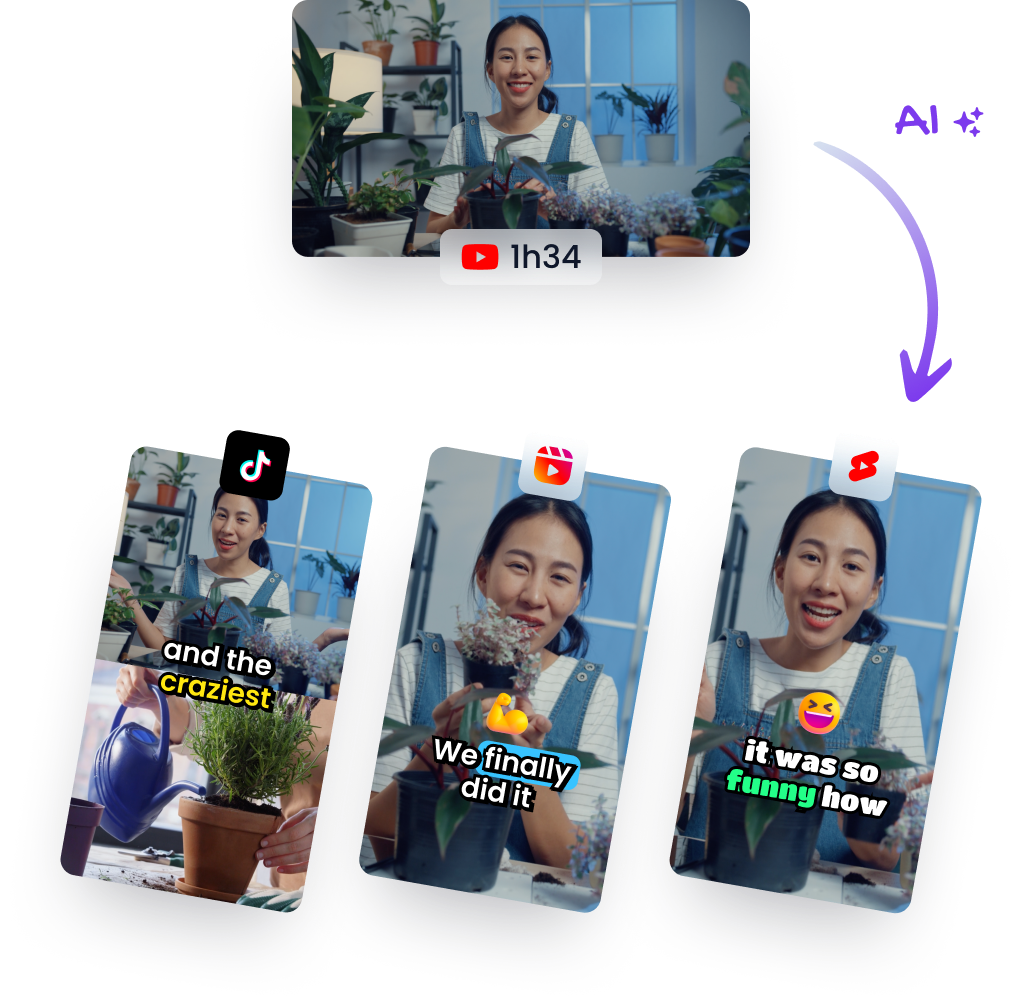
The whole process is refreshingly simple. You just give a tool like Klap a single YouTube link, and its AI gets to work. Within minutes, it’s not just slicing your video into random chunks; it's intelligently identifying distinct topics and potential hooks.
Imagine a podcaster who just released a 45-minute interview. They can paste that YouTube URL into an AI tool and, a few minutes later, get back a dozen ready-to-post short clips. The AI handles all the tedious parts automatically:
- Topic Detection: It actually understands the different subjects you discussed and groups the clips to match.
- Engagement Scoring: The system flags moments that are most likely to hold a viewer's attention, like a powerful quote or a big reaction.
- Auto-Reframing: It takes your horizontal video and reframes it into a vertical 9:16 format, making sure the main speaker is always perfectly in the shot.
- Dynamic Captions: It adds stylish, animated captions that grab attention, which is crucial since so many people watch with the sound off.
This is the real difference-maker: AI doesn't just capture video; it captures value. It finds your best moments and preps them for maximum impact on social media, saving you countless hours of editing headaches.
This screenshot shows just how clean the interface is—a simple YouTube link is all you need to kick things off.
The result is a curated gallery of clips, each with a generated title and topic, ready for you to review and share.
Feeding the Short-Form Video Frenzy
The demand for short-form content is absolutely insane right now. YouTube Shorts alone have skyrocketed to over 70 billion daily views, making it a powerhouse in the social media world. For any marketer or creator, this means the ability to capture videos from YouTube is more critical than ever to feed that massive appetite for content.
If you want to get in on this trend, Klap’s AI short video generator is built specifically for this workflow. And if you're curious to learn more about the explosion in short-form video, check out these eye-opening YouTube statistics.
By using AI, a single long-form video can be spun into a full week's worth of high-quality social media content. This lets you maintain a consistent posting schedule and grow your audience without burning yourself out.
Traditional Video Capture: Downloaders and Recorders
While AI is amazing for speed, sometimes you just need to get your hands dirty. For those moments when you're planning a detailed edit in something like Premiere Pro or Final Cut, the old-school ways to capture videos from YouTube are still your best friends. These boil down to two classic approaches: dedicated video downloaders and screen recording software.
A dedicated downloader is your go-to when you absolutely need the highest possible quality from the source video. These tools are designed to grab the original file straight from YouTube's servers, leaving you with a clean, high-resolution MP4 to work with. This is the perfect route for creators who need to do complex color grading, heavy edits, or mix clips into larger projects offline.
But let's be real—the internet is flooded with sketchy download tools. Picking a safe one is non-negotiable if you want to keep your computer free of malware. A big part of this is just understanding the basics of how to turn a video URL into a usable MP4 file. If you're new to this, there's a complete guide to downloading and converting videos that breaks down the whole process really well.
Selecting a Safe Download Tool
Not all downloaders are created equal. Far from it. Many are just Trojan horses for adware or other junk you don't want. Before you download anything, run through this quick safety checklist.
- Reputation and Reviews: What are other creators saying? Look for recent reviews on trusted tech sites. Old reviews don't count for much.
- No Bundled Software: Pay close attention during installation. Sketchy tools love to sneak in extra toolbars, browsers, or "optimizers" via pre-checked boxes. A legit tool won't force this stuff on you.
- Clear Privacy Policy: The service should be upfront about what data it collects, if any. Vague or missing privacy policies are a huge red flag.
- Secure Website (HTTPS): Check for the lock icon. The downloader’s website must use HTTPS. It's a basic sign of a professionally run service.
Best Practices for Screen Recording
Screen recording gives you a different kind of power. It's perfect for snagging just a specific section of a video, capturing a live stream, or for moments when downloading just isn't an option. With screen recording, what you see is literally what you get, so your setup is everything.
The most common rookie mistake? Recording with a low-resolution display. This always leads to a pixelated, unprofessional-looking clip. To sidestep this, crank the YouTube video quality to its highest setting—1080p or even 4K if it's available—before you hit record. Then, jump into your screen recording software and make sure it’s set to capture at that same high resolution.
The most crucial element of screen recording is preparation. Before you start, close all unnecessary tabs and turn off notifications. A stray pop-up or a cluttered desktop can ruin an otherwise perfect take and force you to start all over again.
Finally, don't forget the audio. If the sound is important, double-check that your software is set to record "system audio" or "desktop audio." Always do a quick test recording to make sure both the video and audio are coming through clearly. It's a tiny step that can save you the massive headache of ending up with a silent video.
These traditional methods give you granular control over your source material, making them a solid choice for any detailed editing project.
Optimizing Captured Clips for Social Media
Once you have the YouTube clip, the real work begins. The raw footage is just your starting point; the magic happens when you adapt it for the fast-paced, vertical-first world of social media. This isn't just a nice-to-have step—it's what turns a simple capture into a clip that actually gets views.
Getting this right is non-negotiable. With over 1 billion hours of YouTube video watched daily by 2.7 billion users, the competition for attention is insane. Mobile viewing completely dominates, making up 63% of all watch time. Even more telling, a staggering 69% of those viewers watch with the sound off. Your clips have to be visually compelling from the very first frame.
Reframing for Vertical Video
First things first: you have to reframe for vertical. A standard 16:9 horizontal video just looks awkward and out of place on platforms like TikTok, Reels, and Shorts. Your goal is to convert it to a 9:16 vertical format.
Let's say you captured a clip from a two-person interview. A lazy crop-and-center approach is a disaster—you'll likely cut one of the speakers completely out of the frame. Smart reframing means creating dynamic movements that follow the conversation, keeping whoever is speaking centered. It makes the clip feel like it was made for the platform, which is key to holding a viewer's attention.
The Power of Dynamic Captions
Since most people are watching on their phones without sound, captions are your most important tool for engagement. But static, boring captions won't cut it anymore. People now expect dynamic, animated text that’s easy to read and looks good.
Here are a few actionable tips for better captions:
- Use High Contrast: Your text needs to pop against the video background. A simple outline or a subtle background color behind the words makes a world of difference.
- Keep It Short: Break up longer sentences into smaller, bite-sized chunks that appear on screen as they’re spoken.
- Highlight Key Words: Animate or add a splash of color to important words. This guides the viewer’s focus and makes your content much more scannable.
This one detail can be the difference between someone watching for three seconds versus thirty.
The goal is to make your content accessible and engaging, even in total silence. Well-designed captions make sure your message lands, boosting completion rates and overall performance whether the audio is on or off.
Automating the Optimization Workflow
Doing all this manually—reframing, captioning, exporting—is a massive time sink. Thankfully, modern AI tools can automate the entire process.
With a platform like Klap, you can drop in a captured YouTube video and get dozens of perfectly optimized shorts back in minutes. The AI handles the face-tracking needed for smart reframing and generates stylish, dynamic captions automatically.
This is a huge efficiency boost for creators and marketers. Instead of burning hours in a video editor, you can focus on strategy and actually distributing the content. If you want to see just how fast you can prep your content, check out our specialized YouTube to Shorts tool.
Navigating Copyright and Fair Use
Let's get straight to the big question: when you capture videos from YouTube, are you even allowed to do it? The answer isn't a simple yes or no, but the guiding principle is clear. Your goal should always be to create something new, not just repost someone else's hard work.
The line is drawn right where your content ends and someone else's begins. If you're grabbing clips from a podcast, webinar, or tutorial that you made, you're completely in the clear. It's your intellectual property. Repurposing it is just a smart way to get more mileage out of your efforts. This is, by far, the safest and most common reason to capture YouTube content.
Understanding the Rules
Things get tricky when you start using content created by others. YouTube's Terms of Service are pretty explicit about prohibiting downloads without direct permission. Messing this up can lead to copyright strikes, which puts your entire channel at risk. And don't think you'll fly under the radar—over 99% of copyright takedowns on YouTube are handled by automated systems that are incredibly fast at flagging infringements.
This brings us to the concept of Fair Use. It’s a legal principle that allows for the limited use of copyrighted material without getting permission, but only for specific purposes like commentary, criticism, news reporting, or education.
But Fair Use isn't a magic wand you can wave over any content you want to use. It's a legal defense, not a checklist. If it ever came down to it, a court would weigh four main factors:
- Purpose and character: Are you transforming the original work? Does your video add a new message or perspective, or is it just a straight copy? An analysis of a movie scene is far more likely to be considered fair use than just re-uploading the scene itself.
- Nature of the work: Using factual content, like a news broadcast, is generally safer than using something highly creative, like a blockbuster film or a hit song.
- Amount used: Did you use a short, essential clip, or did you lift the entire thing? The less you take, the stronger your fair use claim.
- Effect on the market: Does your creation stop the original owner from making money off their work? If your video is a substitute for the original, you're on thin ice.
The most critical factor here is transformativeness. Your new video must add something substantial—fresh commentary, a deep analysis, or an educational spin. Simply clipping a video and throwing on some captions almost never cuts it.
A Framework for Smart Decisions
When you're thinking about using a clip from another creator, just ask yourself this: "Am I adding real, new value, or am I just reposting?"
A sustainable content strategy is built on respecting intellectual property. It’s worth your time to get familiar with the specifics of fair usage policies to stay on the right side of the law.
Ultimately, the best path forward is to focus on repurposing your own material. You get all the benefits of creating fresh content for different platforms without any of the legal headaches. By building from your own library, you stay safe while creating a powerful content engine for your brand.
Frequently Asked Questions About Capturing YouTube Videos
Jumping into content repurposing always brings up a few questions. Getting the right answers from the start helps you build a smarter, faster workflow for capturing YouTube videos. Let's tackle some of the most common ones we hear.
What Is the Safest Way to Capture a Video from YouTube?
When it comes to safety, nothing beats working with your own content. For repurposing your own videos, an AI tool that imports directly with a YouTube link is hands-down the safest and most efficient way to go. This method completely sidesteps the sketchy territory of downloading third-party software.
If you absolutely must have a local file of someone else's video, stick to well-known online services. Be extra careful during any installation process to avoid accidentally installing bundled malware or adware. And when using content that isn't yours, the only truly safe approach is to make sure your use case falls under Fair Use or, even better, to get explicit permission from the original creator.
Actionable Insight: Stick with link-based importing tools for your own content. It eliminates the security headaches that come with downloading unknown apps and keeps your process clean and quick.
Can I Capture a YouTube Video Without Losing Quality?
Yes, but how much quality you keep really depends on your method. Unsurprisingly, the absolute best way to preserve perfect quality is to start with your original, high-resolution video file—the one you had before you uploaded it to YouTube.
When that's not an option, here’s how your other choices stack up:
- AI Link Import: Tools that grab your video via a link are generally limited to YouTube's streaming quality, which usually maxes out at 1080p. This is more than enough for crisp, high-quality clips on social media.
- Downloaders: If you go this route, always dig into the download options and choose the highest resolution available. Don't settle for the default if a better one is offered.
- Screen Recording: To get the best results here, you need to max everything out. Set your monitor's resolution, the YouTube player's quality setting, and your recording software's capture settings to the highest possible options (1080p or 4K) and a high bitrate.
Is It Legal to Capture Any Video from YouTube?
This is where a crucial line is drawn. It is 100% legal to capture and repurpose your own content. Taking your long-form videos and slicing them into shorts is a smart, effective, and completely legitimate content strategy.
However, capturing videos made by other people is a different story, restricted by both copyright law and YouTube's Terms of Service. Generally speaking, you can't just download or reuse someone else's video without their permission. The main exception is "Fair Use," which can apply to things like commentary, news reporting, or criticism. But be warned: Fair Use is a complex legal concept, not a simple get-out-of-jail-free card.
How Can I Capture Just a Short Clip from a Long YouTube Video?
The old-school way is a real time-sink. You'd have to download the entire video, import it into a video editor, and then painstakingly scrub through the timeline to find and trim the perfect segment.
There's a much smarter way to do it now. AI-powered tools are built for this exact task. You just paste the YouTube link, and the AI gets to work, analyzing the entire video to pinpoint the most engaging and valuable moments. It then serves up several ready-to-go short clips, often with dynamic captions and smart reframing already applied. From there, you can make a few quick tweaks and export in minutes, not hours.
Ready to stop wasting time and start creating clips instantly? With Klap, you can turn any long-form YouTube video into a dozen viral-ready shorts with just one click. Paste your link and let our AI do the heavy lifting. Try it for free at https://klap.app.